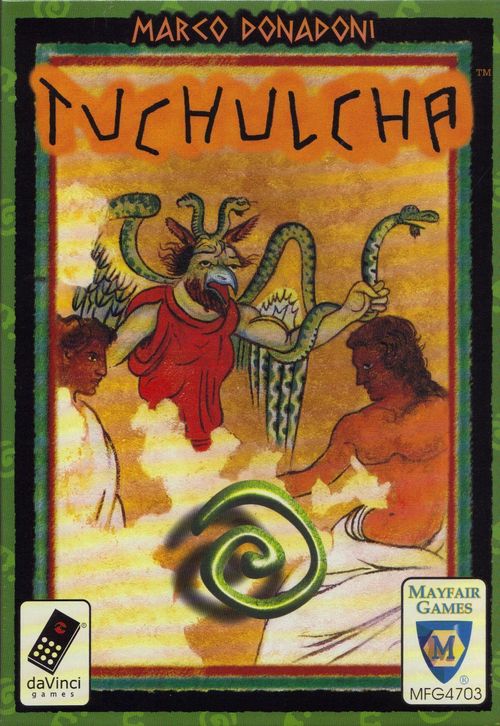
Tuchulcha
Tuchulcha Rulebook
Table of Contents
Table of Contents
Contents
- A double sided board
- 36 haruspexes in four colours (9 each of blue, red, yellow, black)
- 4 dice
- 4 seals
- These rules
The board is printed for 3 players on one side and for 2 or 4 players on the other. The board also shows the sanctuary of Tuchulcha, surrounded by the forest, one of the temples of the Etruscan divinities, the purification path of the haruspexes (the continuous path formed by spaces, the stones, on which the haruspexes walk), Velthumena (the goal of the haruspexes), and the sanctuary of Lasa Vecuvia (only used with 4 players).
Object of the Game
Each player is a high priest controlling a temple devoted to one of the four Etruscan divinities: Achvizr (represented by red), Leinth (black), Alpan (blue) and Thalna (yellow). The aim of each player is to bring the most haruspexes to the Velthumena altar. During the game, the players can also land on the other players' haruspexes forcing them off the path, and sending them to the forest of Tuchulcha. This is not an easy task! The haruspexes have a spiritual power, which measures their determination to remain on the path.
During the game, one of the players may decide to devote his temple to Tuchulcha, foe of the Etruscan Divinities. That player becomes really powerful and dangerous: he wins the game if he manages to force all the other players' haruspexes into the forest of Tuchulcha. However, a different player could devote his temple to Lasa Vecuvia, the eternal rival of Tuchulcha: that player wins if he manages to seal the passages to the forest of Tuchulcha, using his haruspexes.
The Spaces of the Board
- Temples: Each haruspex starts from the temple of his colour.
- Mystical stones (stones surrounded by a glowing aura): From their temples, the haruspexes enter the purification path on the adjoining Mystical Stone, and they leave the path to arrive in Velthumena from a Mystical Stone. E.g., the red haruspexes enter the path from this stone, and from this stone the yellow haruspexes exit (look at the cobblestones). A Mystical Stone provides protection to the haruspexes: it triples their spiritual power. However, this protection does not last long: at the beginning of his next turn, a player must move his haruspexes from these stones first.
- Ritual stones (stones with a green aura): A Ritual stone provides protection too: it doubles the spiritual power of the haruspexes. Unlike the Mystical Stones, though, haruspexes may stay on these stones as long as the player wishes.
- Passages (stones with a vortex): These stones are the passages to the forest of Tuchulcha. When a haruspex stops on one of these stones, he is dragged to the forest of Tuchulcha: he will not be able to move anymore until the end of the game!
- Velthumena: The haruspexes complete their purification path by arriving at the Velthumena altar. Note: only the haruspexes that are in their starting temple or on the path are considered to be in play. Haruspexes in Velthumena or elsewhere are not considered to be in play and may not be moved anymore.
Preparation
Each player chooses a temple, and puts eight of his haruspexes (nine if playing with less than four players) on his chosen temple. Keep the four dice handy. The Seals are only used in a game with four players: in this case, put them in the sanctuary of Lasa Vecuvia.
The Game
The rules that follow are for a four-player game. You will find variations for a different number of players at the end.
Choose a starting player. The game is played in turns in clockwise order. During his turn, the player rolls the dice, and moves his haruspexes on the stones, the spaces of the purification path. Once he has moved, his turn is over, and it's the next player's turn.
Players normally roll two dice, unless they roll doubles or they change their role (see below). A player rolling doubles may choose to roll immediately a third die.
The haruspexes enter the path on the stone connected to their temple by the cobblestones of their colour; they move clockwise on the path, and exit to Velthumena again from a stone connected with cobblestones of their colour.
Haruspexes may always pass through stones occupied by other haruspexes, either belonging to the moving player or to another player.
Spiritual power
The spiritual power of the haruspexes is their determination to remain on the path, their will not to surrender to the call of Tuchulcha.
The spiritual power is the number of haruspexes on any one stone, increased if this is a Mystical or a Ritual stone.
- The Ritual Stone doubles the spiritual power of the haruspexes.
- The Mystical Stone triples the spiritual power. However, players must begin their movement by moving all of their haruspexes off these stones.
Moving
The player must always use all the results of the dice rolled, even if it is to their disadvantage. If this is not possible, then the player must use the maximum possible number of dice (if necessary, ignoring the rule that forces their haruspexes to move away from Mystical Stones).
The player may move one or more of his haruspexes. If a player moves the same haruspex many times, using the result of more than one die, then the haruspex moves using one roll after the other, and never the sum of the rolls.
There is no limit on the number of haruspexes of the same colour that can stay on the same stone.
Hitting an opponent
Haruspexes of different players may never stay on the same stone. In order to end movement on an occupied stone, the player must move at least as many haruspexes onto the stone as the spiritual power of the opponents' haruspexes there. The haruspexes being 'hit' in this way are sent to the forest of Tuchulcha, from which they cannot return!
When a haruspex hits an opponent, it may not move again for the remainder of the turn.
Haruspexes stopping on a Passage are sent to the forest of Tuchulcha, just like haruspexes that have been hit!
Velthumena
The haruspexes do not need an exact roll to enter the Velthumena altar; any leftover points are simply lost. Haruspexes in the Velthumena altar may no longer move.
Examples
The board caption on the path reads (translated from the Italian): "This is the path the blue haruspexes must take."
- Opening moves. Blue starts and rolls 3-5: he moves two haruspexes out of his temple, one 3 stones and the other 5 stones.
- Mystical and Ritual stones. Now it's red's turn, who rolls 1-4: he moves two haruspexes onto the path, that land on two special stones, useful for defence. The haruspex moved 4 stones is on a Ritual Stone; the haruspex moved 1 is on a Mystical Stone. The red haruspex on the Ritual Stone has a spiritual power of two, the one on the Mystical Stone, three.
- Doubles and a third die. Yellow rolls 2-2. Since he rolled doubles, he chooses to roll a third die: he rolls 4, and uses it to bring haruspex A onto a Ritual Stone. Then he moves the haruspex B 2 stones, and then 2 again, bringing it to the same stone as A. This pair of haruspexes now has a spiritual power of four: two, for two haruspexes, doubled by the Ritual Stone.
- Hitting a single haruspex. 5-5-3: black rolls 5-5, then 3 with the third die. He moves only one haruspex that lands on the blue haruspex C; this one is sent to the forest of Tuchulcha! In this case the conditions to hit a haruspex were met: the number of black haruspexes (one) equals at least the spiritual power of the blue haruspex (one).
- Revenge and a Passage. Blue rolls 3-6. He uses the 3 to get revenge, hitting the black haruspex D and sending it to the forest; since it has hit an opponent, this blue haruspex may not move until next turn. So, with the 6, the blue player moves another haruspex E from the temple: it arrives on a Passage space, so it is sent to the forest of Tuchulcha! Blue, actually, had no other options for the 6: the haruspex F cannot move because it cannot hit the red haruspex G, who has a spiritual power of three!
- Leaving a Mystical stone. Red rolls 6-5. He must start by moving his haruspex G away from the Mystical Stone: he uses the 6 to avoid the Passage. With the 5 he moves another haruspex from the temple.
- A few turns later. 6-6-2. The haruspex A leaves the Mystical Stone. With a 2 and one 6 the blue haruspexes A and B land on the two black haruspexes (spiritual power = 2): they are hit and sent to the forest. For the remainder of the turn, these blue haruspexes cannot move. Thus, blue moves his haruspex C, 6 stones, and into Velthumena. Even a 3 would have been enough to make it. If he had rolled 2-2-6, the two haruspexes A and B could not have hit the black haruspexes. You must use all of your dice: after hitting the black pair, blue could not use the other 2 with any of his other haruspexes!
Changing Role: Tuchulcha and Lasa Vecuvia
Tuchulcha
Only one player at a time can devote his haruspexes to Tuchulcha.
To make this change, the player must devote three haruspexes to Tuchulcha by moving them to the Tuchulcha temple at the beginning of his turn: the first two must come from Velthumena and/or the forest, while the third may be in either of these two places, or in that player's starting temple. The three haruspexes are placed in the sanctuary of Tuchulcha. Any other haruspexes in Velthumena belonging to this player are placed in the forest.
Example: Red decides it is the right time to change his role. He devotes three haruspexes: he takes two of them from Velthumena and the forest, and the other one from his starting temple. He places the three haruspexes in the sanctuary of Tuchulcha.
The player who has chosen to support Tuchulcha has three benefits and now has a new goal in the game. This player now wins when there are no other players' haruspexes in play (i.e. on the path or in their starting temples). He is out of the game if another player manages to bring even one haruspex into the Velthumena altar (in this case, put all his haruspexes back in the box).
The three benefits for his haruspexes are:
- they are invulnerable: they cannot be hit anymore;
- they move rolling four dice, of which one is discarded as a tribute to Tuchulcha, and using the remaining three;
- they ignore the rule that forces them to stop after they have hit an opponent, and they also ignore all the advantages of the stones, except the Passages.
The haruspexes of Tuchulcha must use all the results of the dice, just like the other haruspexes.
Example: 2-1-5-3. Red rolls four dice and discards one: the 5. With 2 and 3 he hits the blue pair on stone D. Normally, this pair would double their spiritual power with the Ritual Stone. But the red player ignores the effect of the stone, so the blue pair only has a spiritual power of 2! With the 1, one of these two red haruspexes, who are not forced to stop after they hit an opponent, moves again. Since red ignores the Mystical Stones, with the 1 he could have hit the haruspex E; also, the haruspex on F was not forced to move away. The red player has changed his role so his haruspexes do not enter the Velthumena altar.
Example: 4-4. Yellow moves a haruspex to G, where he has another one. He chooses not to roll a third die: one of the haruspexes of Tuchulcha is too close to him and the risk of leaving a haruspex unprotected is too high.
The haruspexes belonging to a player who changes role (Tuchulcha and Lasa Vecuvia, see below) do not enter the Velthumena altar: they only continue to move clockwise along the path.
Lasa Vecuvia
If the haruspexes of Tuchulcha are in play, one - and only one - of the other players may devote his haruspexes to Lasa Vecuvia.
In order to change his role, the player must have at least four haruspexes still in play. At the beginning of his turn, he places all his haruspexes that are in Velthumena and the forest into the sanctuary of Lasa Vecuvia; if he has no haruspexes in either place, then he places any one of his haruspexes of his choice into the sanctuary. He also takes the 4 seals.
From now on, this player wins if he manages to seal all four Passages. If, at any time, he does not have enough haruspexes to seal all the passages, then he is out of the game (put his haruspexes back in the box).
Example: The black player decides to change his role too: he places all his haruspexes from Velthumena and the forest into the sanctuary of Lasa Vecuvia.
Attention: the haruspexes of Lasa Vecuvia stay in play even if a player who has devoted his temple to Tuchulcha is eliminated.
When a haruspex of Lasa Vecuvia lands on a Passage space, he seals it, turning it into a normal stone. That haruspex then retires to the sanctuary of Lasa Vecuvia, from which he may no longer move.
His haruspexes gain three benefits:
- they can be sent to the forest only by the haruspexes of Tuchulcha. If hit by any of the others, they go back to their starting temple;
- they roll two dice, but move only on the unoccupied stones, jumping over any other haruspex;
- they must use all the results, as usual. However, as soon as the player is left with only one haruspex, he may discard any single die that would force him to overtake the last passage (which would force him to do another complete circuit to get back to it!).
Example: 5-4. Black must leave the Mystical Stone. He does so with the 4 and seals the Passage H: he places one of the seals on the Passage, and the haruspex retires to the sanctuary of Lasa Vecuvia. With the 5 he moves on the ex-Passage I: it is now a normal stone.
Example: 2-3. Blue has only 2 haruspexes still in play: he cannot move either 2 stones, because he cannot hit the haruspex of Tuchulcha. Using the 3 forces him to move onto the Passage J! With 2-2-2 he would have not moved at all! Blue now has only one haruspex in play: on his next turn, he will be able to use less dice than he rolls, with a minimum of one.
Example: 5-6-3-1. Red discards the 3, moves haruspex K 6 and 5 to hit the last of the blue haruspexes, and then 1 more: the haruspexes of Tuchulcha do not have to stop after they have hit an opponent. Blue is now out of the game: all his haruspexes are put back in the box.
Example: 2-6. Yellow moves haruspex L 6 and then 2, hitting the Lasa Vecuvia (black) haruspex M, which returns to his temple. Note that yellow could not move 2 first and then 6, since there is a haruspex of Tuchulcha in the way.
Example: Black rolls 3-3-4: he seals the Passage N. After the red player takes his turn (and does not hit any haruspexes), yellow manages to move one of his haruspexes into the Velthumena altar: this eliminates the haruspexes devoted to Tuchulcha! Now only yellow and black are still in the game.
Example: Yellow decides to immediately devote his haruspexes to Tuchulcha. To do so he must devote 4 of his haruspexes: he moves one from Velthumena and the one in the forest, plus two more from his temple. If a yellow haruspex - now haruspex of Tuchulcha - hits a black one, of Lasa Vecuvia, he sends it to the forest. In this case black would be out of the game, since he does not have enough haruspexes to seal all the Passages; and yellow would win since he is the only one in play. Black wins if he manages to seal the two Passages that are still open.
Replacing Tuchulcha
A player eliminating the haruspexes of Tuchulcha may devote his temple to Tuchulcha, at the end of the same turn! If he does not do so, then any player (including himself) may later devote his haruspexes to Tuchulcha at the beginning of his turn.
Important: Each time a new player devotes his temple to Tuchulcha, a larger number is required. Each time, Tuchulcha demands one additional haruspex (from Velthumena, the forest or the starting temple). Also, you may not devote your temple to Tuchulcha unless the other players have at least two haruspexes still in play (except for a temple devoted to Lasa Vecuvia).
Unlike temples devoted to Tuchulcha, if a temple devoted to Lasa Vecuvia is eliminated from the game, no other player may devote his haruspexes to Lasa Vecuvia. If a temple devoted to Lasa Vecuvia is removed from the game, any Passage seals remain.
End of the Game and Victory
The game ends as soon as one of these conditions is met:
a) the haruspexes of Tuchulcha win if they are the only ones still in play;
b) the haruspexes of Lasa Vecuvia win by sealing all four Passages;
c) if the haruspexes of Tuchulcha are not in play, the game ends immediately as soon as the last haruspexes of any player reach the Velthumena altar or the forest. In this case, the winner is the player with the most haruspexes in the Velthumena altar. If there is a tie, the winner among the tied players is the one with the fewest haruspexes in the forest.
The Game for 2 or 3 Players
Differences from the 4 player version. Each player starts with 9 haruspexes. If there are two players, then their haruspexes start the game on two opposite temples; also 5 haruspexes of the other two neutral colours are placed in their temples. With three players, use the side of the board with three starting temples: haruspexes walk a complete circuit of the path, and exit to the Velthumena altar from the same Mystical Stone where they entered the path (in the rare case where a haruspex ending his path stops on that stone, identify it by placing it on the border of the stone). The first player to devote his haruspexes to Tuchulcha must devote four (three from Velthumena and/or the forest, another one from there or the temple), and rolls three dice (with a double, he may roll a fourth die) discarding one as usual. No player may devote his haruspexes to Lasa Vecuvia.
Special rules for 2 players. Each player, on his turn, may move his haruspexes and/or the neutral ones (also of both colours); if a player devotes his haruspexes to Tuchulcha however, he may only move his own haruspexes. Neutral haruspexes are not forced to leave Mystical Stones, and they cannot be devoted to Tuchulcha.
Apart from the usual winning conditions, if a player causes one of the neutral players to win the game, then his opponent is the winner instead.
Note: throughout these rules "he", "his", etc. are used to indicate both genders.
The Etruscan Haruspexes
Background text printed in the rulebook.
We know very little about Etruscan religion, and mainly through what has been indirectly handed on by Latin and Greek authors: written witnesses in the Etruscan language to this ancient culture have been almost completely lost.
One of the few myths we know is settled in Tarquinia, in the middle of Italy: a supernatural being popped out from the track of a plough; he was a child with the aspect and the wisdom of an old man. Tagete, the link between Gods and mankind, explained, maybe through song, the fundamentals of the Etruscan Discipline: an ensemble of knowledge and precepts, ordered by very strict criteria. The dogmas of Tagete did not explain reality, but taught how to read the will of the Gods in all of its forms.
Life, Cosmos, and the World were presented to the eyes of the Etruscans as never ending enigmas and riddles. The Haruspexes (Netvis in Etruscan) were the greatest experts in the solution of these 'games'. In order to understand clearly each event either fortuitous (an accident or the flight of the birds) or natural (thunders, lightning or comets), they spent their entire life studying what Tagete said, and what was added to that during the course of time.
Of the books forming this 'corpus', only the titles in Latin and very rare original fragments in Etruscan have reached us. The most important were the HARUSPICINI books, dealing with how to interpret the entrails; the FULGURALES books, dealing with the interpretation of lightning; the RITUALES books, dealing with liturgical form; and FATALES books dealing with the obscure rules of fate. The latter also contained prophecies made by the nymph Vegovia (or Lasa Vecuvia), that the emperor August used to keep in the temple of Apollo Palatino together with the Sibylline books.
The haruspexes wore a large mantel and a pointed hat, and carried a long staff with a rounded edge: all these were symbols of their sacred status.
The basis of the haruspex knowledge was a meticulous and careful observation of the cosmos. He stared at the Sky and the Earth, and used to see them subdivided into sixteen zones, reserved either to a good or an evil divinity. Any natural event was interpreted according to its position and, thus, considered a good or bad omen.
Etruscans used to face each key moment in their public and private life only after they first tried to understand, through the haruspexes, the will and plan of the Gods.
The Etruscan haruspexes developed also a doctrine based on Time, on the cycle of civilizations, of cities and of life itself. People and cities had a well defined time to spend: they, the Etruscans, would have disappeared after a certain amount of time, too.
The ending of their time revealed itself through signs (political, economical and military disorders). These signs were reflected in their artworks: paintings depicting banquets were no longer full of joy and happiness, and the famous 'Etruscan smile' was replaced by a bitter bending of the lips, like in the Etruscan Mona Lisa, Velia Velcha, depicted in the Tomb of the Bear, in Tarquinia.
From the Abyss, there come horrifying monsters: Vanth, the death angel representing inevitable Fate, Charun with its hair of snakes wielding a huge hammer; and Tuchulcha [/tu.'khul.kha/], who has a hooked bill, donkey ears, an evil look, and who wielded snakes as weapons.
The haruspexes could not allow that everything would be lost, that their civilization and culture was doomed to end. They used their Discipline to create something to preserve their civilization, something that could have a chance to reach fame, power and influence never seen before. Hence, they founded Rome.
The legend of the foundation of Rome provides us with the most accurate description of the Etruscan ritual of foundation. The haruspex marked the boundaries of a piece of terrain, which became the Templum (i.e., the symbolic projection of the celestial Templum, or house of the Gods). This space, properly oriented and marked by poles, was made free from any evil influences, and the haruspex were ready to contemplate the sky, waiting for divine signs. Once birds appeared (they brought omens as their flying is pure: it does not leave tracks in heavens) the haruspex evaluated their species, number and direction relating them to the divinity that expressed its will.
Romulus and Remus, fought through 'auspices' (from Latin AVIS = bird and SPICIO = to look at; Remus saw the eagles first, but Romulus saw many more) the right and honour to be the founder of Rome, and give the city his name.
Rome, living heart of the Latin culture, was founded with an Etruscan ritual and name: its Etruscan roots will always be vivid and recognizable throughout its great story.