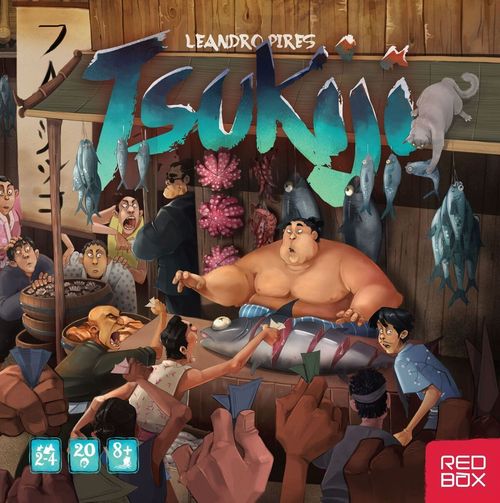
Tsukiji
Tsukiji Rulebook
Table of Contents
Table of Contents
- Goal
- Game Components
- Components and Number of Players
- Game Setup
- Gameplay
- End Game
- Variant Rules: Special Points
Goal
In Tsukiji, your goal is to end the game with the most valuable set of Product Cards for your restaurant. At the end of the game, the players who finishes with the most money after the conversion of their products wins the match.
Game Components
The Cards (105 total)
There are 3 types of Cards in the game: Product Cards, Joker (Takusan) Cards and Yakuza Cards.
Product Cards (15 for each product type)
The Product Cards are basic commodity cards which are divided into six colors, each representing a type of fish or seafood: Shrimp (Ebi, red), Scallops (Hotategai, gray), Salmon (Sake, orange), Octopus (Tako, pink), Pufferfish (Fugu, white) and Tuna (Maguro, purple).
Each product type (except for Tuna/Maguro, which we'll discuss later in this book) has a respective marker on the Quotation Board. The Marker, which will be moved during the game, represents the price variation of those products in the Tsukiji Market.
Joker/Takusan Cards (7 cards)
The Joker (Takusan) Card is a special card, illustrated with a drawing of all the products traded in Tsukiji Market. It can be used as a Product Card of any type when bought.
Yakuza Cards (8 cards)
The Yakuza Card is a negative effect card, illustrated with a mobster. It represents a protection fee that your restaurant needs to pay for the Yakuza. When purchasing one of these cards, the player has to discard one of their Product Cards.
Evaluation Tickets (36 tickets, 9 for each color)
The Evaluation Tickets are used to indicate the players' interest in each of the available batches of cards. There are two types of tickets: Normal and Bonus. Normal Tickets have a value between 0 and 4 and are redeemed after use. The Special Tickets have different effects and are explained under Special Tickets. Special Tickets are used only once and are discarded after use.
Price Tablets (12 tablets)
The Price Tablets are used to mark the sale value and the quotation modifier of each batch after the joint evaluation by the players. Price tablets have two pieces of information: a Cash Amount, which represents how much that batch will cost to be acquired in this round, and a Quotation Modifier, representing how much each product in that batch will rise or fall in the market quotation. One of the tablets in play will have a clock symbol, meaning that the player who purchased that lot will be the next turn's First Player.
Coins (14 of ¥1 | 9 of ¥5 | 9 of ¥10 | 4 of ¥20)
Coins are used to purchase batches and, at the end of the game, will be added to the player's final score.
Product Markers (5 Markers)
Product Markers are used to mark the current quotation of each product type on the Quotation Board, in other words, the market value of the product in Tsukiji Market. There are five colored markers with the characteristic shape of each fish/seafood type.
First Player Marker (1 Marker)
The First Player Marker is used to identify the player who will take action first. It is passed to the player who acquires the highest value batch in the turn and will be in their possession until another player buys the highest batch from the table.
Quotation Board (1 board)
The current market value of each product traded in the Tsukiji Market is represented at the Quotation Board. In this board, there is a table of values between 1 and 60 in which the Product Markers are placed and moved to represent their value each turn. At the bottom of this board there are five niches with values of yen that serve to account for the final price of each product at the endgame.
Rulebook (1 book)
If you are reading this, you already have the rulebook at hand.
Components and Number of Players
All cards have a symbol indicating the number of players required for them be used (2 players, 3 players or 4 players). For a two-player game, remove all cards with symbols 3 players and 4 players. In a match with 3 players, remove the cards with the symbol 4 players. In a 4-player game, all cards will be used.
The number of players who will use the Price Tablets is show on the back of each sign. For 2-player games, use the three 2-player Tablets. For 3 players, the four 3-player Tablets and for 4 players, use the five 4-player Tablets marked for 4-player games.
Game Setup
Before the game starts, it's necessary to separate the pieces and cards that will be used in that match per the number of players. The pieces that won't be used should be stored in the game box. After that, prepare the game following the guidelines below:
- Shuffle the cards that will be used, forming a buying stack;
- Place the Quotation Board on the table with the coins and Price Tablets that will be used;
- Randomly place the 5 Product Markers in positions 1 through 5 of the Quotation Board;
- Each player chooses a color and receives all remaining Evaluation Tickets of that color;
- The first player will be the one who has eaten fish or seafood most recently and will receive the First Player Marker. The player on their left will be the second player, and so on;
- The first player receives ¥48 from the Bank and each subsequent player in the tur will receive ¥3 more than the previous player: the second player will receive ¥51, the third player will receive ¥54, and so on.
The picture on the first page shows how the components can be arranged on a table for 4 players.
Gameplay
Tsukiji is played in 7 turns, each containing 4 phases: a) Offer, b) Evaluation, c) Quotation and d) Purchase.
a) Offer
At the beginning of each round, batches containing three cards each are revealed. To assemble these batches, place the cards from the top of the stack them in columns of 3 in the center of the table from left to right, face up.
The number of columns is different depending on the number of players, with the number of columns being one more than the number of players. With 2 players 3 columns are made. With 3 players, 4 columns are formed and in a 4-player game one forms 5 columns. At the end of this phase, a 2 player game should present three cards as shown below:
b) Evaluation
Having revealed the batches, players must then evaluate each of them in any order to quantify interest in each of these batches. To do so, players will simultaneously use their Evaluation Tickets secretly (face-down). Each player deposits one of their tickets in each lot, so that when they finish each lot will have an Evaluation Ticket from each player.
The Evaluation Tickets value represent the players' interest in a lot of cards. The Special Tickets have different effects, which are explained under Special Tickets.
HINT The Evaluation Tickets are the main tool for price manipulation in Tsukiji. A lot of strategy is required to use it well, so that your investments are valued and your opponents' lose value. For example, you can use a low-value ticket to reduce the cost of a batch that interests you so you can get it cheaper. Use your tickets wisely and your restaurant will have the most valuable products at the end of the game.
c) Quotation
All Evaluation Tickets are now revealed. First, it should be checked if there is any Special Annulment Ticket – if so, resolve its effects. Once this is done, it's enough to add the value of the tickets (and multiplier, in the case of tickets x2) to obtain the final value of each batch.
Once each batch's values have been counted, place the Highest Price Tablet (the highest tablet always has the clock symbol) in the lot that reaches the highest value. Place the second higher Price Tablet in the second most valuable lot, and so on until all batches have a tablet as shown below:
In case of a tie between the batch's values, the batch furthest left is considered to have the largest sum and receives the higher Price Tablet. As an example, in the figure below, the batch with nine points to the left got the 12-valued Table and the 9 point batch to the right gets the 9-valued Tablet.
After all the Price Tablets were placed, the Evaluation Tickets are returned to each player, the Special Tickets are discarded from the game and the product values are updated in the Quotation Board. The Tuna (Maguro) Cards, Joker (Takusan) Cards and Yakuza Cards are not listed on the market, so they should be ignored in this procedure.
Market Atualization
At the top of the Quotation Tray, there is a chart indicating the order for updating the products on the market. That order is always the same: Shrimp (Ebi), Scallop (Hotategai), Pufferfish (Fugu), Octopus (Tako) and Salmon (Sake).
At this time, all the Shrimp (Ebi) cards in the batches should be identified. Once this is done, verify the batch where each of these cards is and add (or subtract) the modifiers to the values of each of these batches. After obtaining the final modifier value, the Shrimp (Ebi) marker is moved forward (or backward, if the value is negative) that number of spaces.
The same procedure should be repeated for the products Scallop (Hotategai), Pufferfish (Fugu), Octopus (Tako) and Salmon (Sake), in that order. If there is more than one card of the same product in a row, the modifier is considered twice, one for each card.
See in the image below an example of moving the cards' values for the batches in the Quotation Board.
In the example, the Shrimp (Ebi) marker advances 4 spaces in the Quotation Board, since there is only one of such type in the batch with the +4 modifier. The Scallop (Hotategai) marker will remain in the same place as the two cards of this type are in the batch with the 0 modifier. The Pufferfish (Fugu) marker will recede a space, since the only card of this type is in the lot with -1. The Octopus (Tako) marker will advance 6 spaces as there is one card in the lot marked with the +4 and another in the lot with the +2. Finally, the Salmon (Sake) marker will advance 8 spaces, since it has one card in the lot marked +4 and two cards in the lot marked +2 (+4 + 2 + 2 = 8).
Please note that the Yakuza Card and the Tuna (Maguro) card in the second batch were not considered since they are not listed on the market.
Once this procedure is finished, the Evaluation phase is terminated and the Purchase phase begins.
Special Tickets
The Special Annulment Ticket voids the effect of a 4 valued ticket a batch. If there isn't such a ticket in that batch, the Annulment Ticket will be counted as a +2 ticket which will be added to the total value of that lot.
Special Tickets -1 and +6 are used as the Normal Tickets, that is, they effectively reduce the value of the batch by 1 (in the case of the -1 value ticket) or increase it by 6 (in case of the value ticket +6). The difference of these tickets to the normal ones is that they can only be used once in the game, being discarded soon after their use.
The Special Ticket "x2" multiplies the value of all other numeric tickets of that batch by 2. For example, if a batch receives the "0", "4" and "x2" tickets, the total value of that batch will be 8 since the ticket x2 multiplied the ticket 0 by two and the ticket 4 by two. Note: If there is more than one "x2" ticket in a batch, the multipliers will be cumulative; however, if there are only "x2" tickets in a batch, the value will be 0.
Special Cards
The Yakuza Cards and Joker (Takusan) Cards work slightly differently from the other cards:
- Yakuza Card – This card eliminates a Product Card from the player who bought it. After the player downloads the other cards purchased from the batch were the Yakuza Card was, the player must immediately discard one of their Product Cards along with the Yakuza card.
- Joker (Takusan) Card – This card must be downloaded into some product line of the player who purchased it, at his choice. At the end of the game, this card will be counted as one more Product Card in that row.
Note: Joker cards can't start a row. Therefore, in the rare case that a player can't allocate one or more Joker (Takusan) Cards, due to the absence of available product rows, the Joker (Takusan) Card(s) should be discarded.
d) Purchase
At this phase, players will buy the products for their restaurants. In game terms, players will buy the cards that, at the end of the match, will be converted into cash.
Starting with the first player of the turn and following clockwise each player may purchase a batch of cards by paying the Bank the amount indicated on the tablet for that batch. When making the payment, the player picks up all three cards from the batch for himself.
The purchased cards must be immediately downloaded in front of the player who acquired them, in any order. The effect of the Yakuza Card is activated as soon as the other cards in the batch are downloaded. No card can be saved for later download. Once downloaded, a card will never be removed neither switch places.
The cards have different rules for downloading:
Identical Product Cards should always be downloaded in the same row. For example, if the player already has a Octopus (Tako) card on the table, all future Octopus (Tako) cards that are purchased must be placed in the same row as the existing one. Tuna (Maguro) cards are considered Product Cards and follow these same rules.
Whenever a first card for a product is acquired, a new row for that product must be started.
See in the image below how the cards should be organized: In this example the row contains 3 Octopus (Tako) cards and a Joker (Takusan) Card, so it should be counted as if there were 4 Octopus (Tako) cards.
If he or she wishes, a player may forgo one of the lots and receive ¥3 from the Bank.
HINT Sometimes, not spending money may be the best strategy to accumulate resources and be able to pay for the best batches in the next turns.
The remaining cards' batches after all players have completed the purchase phase must be discarded.
The player who purchases the clock marked batch will be the first player on the next turn, receiving the respective marker.
If that batch isn't acquired by anyone, next turn's first player will be the same player who started the current turn.
HINT Remember that the player doesn't necessarily need to buy the most valuable batch. Within his or her strategy, other batches with lower value may be more interesting or contain products with better quotation on the market board.
End Game
When all seven turns are played, the game ends. At this point, all players should check their product sets and score the final points.
Each Product Marker should be placed in one of the five niches of the board according to its final position in the Quotation Board. The lowest ranked product's marker is put in the 5th place, followed by the next marker, which should be placed in the 4th niche, and so on. The procedure continues until the best quoted product marker, which should be placed in the 1st niche. If two or more markers have the same quotation, those that are above the others are considered more valued than the ones below.
See in the image below how to consolidate the values of each product.
In the previous page example, the Salmon (Sake) should be placed in the 5th niche, the Pufferfish (Fugu) in the 4th, the Octopus (Tako) in the 3rd, the Shrimp (Ebi) in the 2nd and the Scallop (Hotategai) in the 1st one. This consolidation will determine the value of each card in the final score. Using the image above, each Scallop (Hotategai) card that the players own will be worth ¥10, each Shrimp (Ebi) card ¥7, each Octopus (Tako) card ¥5, each Pufferfish (Fugu) card ¥3 and each Salmon (Sake) card ¥1.
The Tuna (Maguro) cards are accounted based on sets. This product will have a different value for each player according to the total amount of Tuna (Maguro) cards each player has. A table shows the value of this product: if the player finishes with 5 Tuna (Maguro) cards, this whole set (not each of the cards) is worth ¥25. If the set has 3 cards, the three cards together would be worth ¥12, and so on.
The Tuna (Maguro) cards try to represent the importance of the tuna to the real Tsukiji Market. The tuna value is based in its meat quality and in the amount of fat in the fish. So the more Tuna (Maguro) cards you have, the better quality it will be and more valuable it will become at the game end.
The full Tuna (Maguro) set-value table:
| Tuna (Maguro) cards in set | Set value |
|---|---|
| 1 | ¥3 |
| 2 | ¥7 |
| 3 | ¥12 |
| 4 | ¥18 |
| 5 | ¥25 |
| 6 | ¥33 |
| 7 | ¥42 |
| 8 | ¥52 |
| 9 | ¥63 |
Finally, each player counts the value of all their cards according to these criteria, adding the value of their remaining money. The final value of this sum is your final score in the game.
The player with the highest score wins.
In the example above, Player 1 beats Player 2 by only 3 points.
If a tie happens, the player with the highest number of unused Special Tickets is considered the winner. If the tie persists, the tied players share the win.
It's time to check the products purchased, put everything in the truck and go to the restaurant, after all lunch time is soon!
Variant Rules: Special Points
If you wish to add more replayability and strategy to the game, at end game you can add the following special score list:
- Diversified Restaurant +10 points (at least 3 cards of each type of product)
- Specialized Restaurant +10 points (at least 8 cards of the same type of product)
- Popular Restaurant +5 points (most Product Cards with the worse quotation)
- "Safe" Restaurant +3 points (highest number of Mafia Cards)