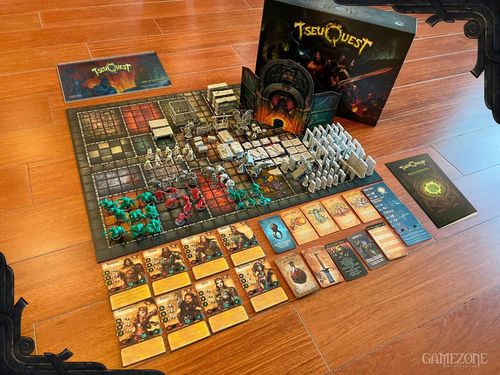
TseuQuesT
TseuQuesT Rulebook
Table of Contents
Table of Contents
- 1. Introduction
- 2. Components
- 3. How to Start an Adventure
- 4. Game Turn Rounds
- 5. Actions
- 6. Movement Action
- 7. Search Action
- 8. Attack Action
- 9. Projectile Attack Action
- 10. Line of Sight (LoS)
- 11. Magic Action
- 12. Special Actions
- 13. The Very Evil Warlock
- 14. Placing Game Props and Adversaries
- 15. Game Prop Characteristics
- 16. Traps
- 17. The Adventures
- 18. Between Adventures
- 19. The Irritant (but potentially hilarious), Rule of "Errors Play as Well"
- Heroic Rules
- H4. Game Turns
- H6. Movement Action
- H8. Attack Action
- H9. Projectile Attack
- H11. Magic Action
- H12. Special Actions
- H20. Exhaustion
- H21. Temporary Damage
- H22. Anxiety Check
- H23. Losses
- H24. Surrender
- H25. Addiction to Liquid Silver
- H26. Euphoria Effect (Vol. II required)
- H27. Primordial Chaos Spells (Vol. II required)
- H28. Blood Spells (Vol. II required)
- H29. Ill-Fated Cards (Vol. II required)
- Supernatural Training: First Cycle
- S30. Resistance Alpha (Level 0, the 4 Initial Adventures)
- S31. Supernatural Training Combat Section
- S32. Supernatural Training Mixed Section
- S33. Supernatural Training Magic Section
- Closing Note: Unresolved Situations
1. Introduction
The players who take on the role of adventurers will have to collaborate with each other. They will face the adventures presented to them by the player who takes on the role of narrator and opponent, the Evil Warlock.
Players must try to solve missions and challenges presented to them by the Evil Warlock, either through combat, magic, exploration ... resorting to their cunning or intuition, their courage or prudence and, why not, a bit of luck. In short, the content of this game will offer you adventure, mystery and fun.
It is advisable to use the Basic Rules exclusively if there are rookie players in your game. It is only advisable to add the Heroic Rules when all the players are familiar with the basic rules. In case there is a mix of rookie and veteran players in the game, the latter should pay attention to facilitating the gaming experience for less experienced players. If only veteran players sit around the game, then throw caution to the wind and add the Heroic Rules for a more complete gaming experience.
2. Components
Combat Dice (dCom). Four faces: crowned skull, skull, kite shield and oval shield (see sections 8 and 9). Combat dice also carry a fumble symbol face.
Movement Dice (dMov). Six-sided dice with numerical faces, plus the fumble symbol and the maximum-movement symbol (see section 6).
Adventurer sheets. Each adventurer sheet shows:
- Character: the name of the adventurer.
- Dices: the pool of dCom for the adventurer's Attack, Defense and Movement.
- Attack: the dCom rolled in an attack action (see 8.2).
- Defense: the dCom rolled in defense (see 8.4).
- Movement: the dMov used for a Tense Move (see 6.1).
- Life Points (LP): shown on the LP dial.
- Mind Points (MP): shown on the MP dial.
- Characteristics: the adventurer's special abilities.
- Weapon: the weapon the adventurer carries and the extra dCom it provides (see 8.3).
The LP and MP dials are the red and teal dials on the sheet.
(Sample sheet, Barbarian. Its printed abilities read: Onslaught: "Each crowned skull result in attack, allows him to move the target one square and occupy it if he wants." Firm: "He does not fall unconscious when he arrives at the result A on the MP wheel. However he will only have 1 action point per turn." Clan Rivalry: "He can not end his movement adjacent to another barbarian, nor can he move through their squares." Robust: "He can only equip helmets and tailored armor." Weapon, Smiling Devil Claymore: "Gives 2dCom to attack. While holding it he is immune to FEAR.")
Antagonist sheets. Sheets for the figures controlled by the EW (see section 13).
Reference cards. Cards titled Actions (see section 5), Attack Fumbles (see 8.12) and Movement Fumbles (see 6.14).
Chaos spells. Magic cards for the EW's figures (see 13.6).
Elemental spells. Four decks of magic cards, one for each element: Aer, Ignis, Terra and Aqua. Each card shows its TYPE (see 3.6·A).
Monsterpedia, Equipment, Treasure and Artifacts. Card decks named by their labels in the printed components picture. Their use is described in the adventures and in sections 12 and 17.
The Book of Adventures is the EW's main tool (see 3.1). The EW's game screen, the game board and the props are described in sections 3, 14 and 15.
3. How to Start an Adventure
3.1 Role Distribution: from the group of players someone must take on the role of Evil Warlock (EW) and the rest as the adventurers. The EW, using the Book of Adventures as their main tool, will act as narrator when requested by the chosen adventure, will have the information provided for the development of the adventure and will be the rest of players' adversary. During the game the EW manages all the figures that are not used by the adventurers. The EW figures can be two types: Henchmen and Antagonists.
3.2 Choosing the Adventure. The EW chooses the mission from the Book of Adventures, before choosing adventurers, or dealing out cards. Secretly jot down the name of the adventure and do not share it with the players until just before it begins.
3.3 The side of the game board indicated by the chosen adventure is placed face up, with the TQT symbol to the left of the EW and the GZ symbol to his right. The EW sets the TQT game screen in front of him, which is filled with different game tables to help the EW at a glance.
3.4 Players divide up the available adventurers as they see fit.
3.5 Players decide which position they will occupy around the game board.
3.6 At this point Magic cards are dealt out, they are only available to adventurers with Magic Ability (indicated on their adventurer sheet).
3.6·A The elemental magic cards of the Aer, Ignis, Terra and Aqua are grouped by type, making four independent decks. Each of the four decks is shuffled and placed face down.
3.6·B Magic cards are dealt out in three magic acquisition rounds, as follows:
- 1st round: Each player, with Magic Ability and sufficient level, chooses a single element and draws three cards.
- 2nd round: Each player, with Magic Ability and sufficient level, chooses a different element than that of the first round and draws two cards.
- 3rd round: Each player, with Magic Ability and sufficient level, chooses a different element from the previous two rounds and draws a card.
No player can repeat an element in the magic rounds.
3.6·C The entire process of magic card distribution is done randomly and secretly, without looking at what has been picked until the end of all three magic rounds.
3.6·D The first to choose is the first adventurer with Magic Ability to the left of the EW. The next adventurer with Magic Ability that is located to his left will do the same and so on until each player with Magic Ability has obtained the corresponding cards for that magic round.
3.6·E Once the process of choosing magic cards in the three magic rounds is over, players can proceed to look at their own magic cards. The remaining cards will remain hidden until the end of the game, from both the EW and the adventurers. The surplus magic cards can be used as a result of an event during the game.
3.6·F No player is obligated to show their cards to anyone, until they decide to use each one, at which time it must be made public.
3.7 The EW then proceeds to read the title and introduction of the adventure, and at which time the adventure will officially begin.
4. Game Turn Rounds
4.1 Turns in the game are POSITIONAL. Players are activated one by one, starting with the player sitting to the left of the EW and following in a clockwise direction around the table.
4.2 Each player has 2 action points during their turn. At the moment that the active player can no longer or does not want to do anything else with his action points, then the turn passes to the next player.
4.3 A player cannot re-activate their adventurer once they have passed the turn to the next player, even though they have not consumed all their action points. They must wait for their turn to come back around to them in a new round of turns.
4.4 Once all the players have activated and finished their turns it is up to the EW to perform the actions he is able to with the figures he controls.
4.5 The EW has 2 action points for each of his figures, which are activated one by one in any order he wants.
4.6 A game turn round is considered completed when the EW ends his activation and passes the turn to the player to its left.
5. Actions
5.1 A player can assign his 2 action points to his adventurer to develop actions on the game board. The action points can be used totally or partially, including not using them at all. The players have at their disposal several actions, listed in section 5.3 of this rule book. Each action you want to perform costs 1 action point.
5.2 Each player decides what actions they want to take each turn and in what order. To carry them out first they are declared aloud and then performed.
5.3 The actions available are as follows:
- 5.3·A MOVEMENT Action, limited to one per turn (see 6).
- 5.3·B SEARCH Action, can be used up to two times per turn (see 7).
- 5.3·C ATTACK Action, can be used up to two per turn (see 8).
- 5.3·D PROJECTILE ATTACK Action, can be used up to two per turn (see 9).
- 5.3·E MAGIC Action, can be used up to two per turn (see 11).
- 5.3·F SPECIAL Actions, several actions are included under this name (see 12). Up to two special action types can be used per turn, but without repeating the same action type in the same turn.
5.4 Unconsumed action points in an adventurer's turn cannot be saved for later use. Unused action points are lost at the end of the adventurer's turn.
6. Movement Action
6.1 To move your figure around the squares on the board you must use a movement action. On the adventurer's character sheet there is a movement value (movement symbol). This indicates the amount of movement dice (dMov) should be used to perform a Tense Move and whether or not it has any special characteristics.
6.2 The dMov have numerical values on their sides. The sum of the results obtained when rolling them is the number of squares that your adventurer can voluntarily move with a movement action when making a Tense Move.
(Illustration: two movement dice showing numbers, "+ ... = 7".)
6.3 The number of squares to be moved can be used partially or completely. Movement not used during a movement action is lost, it cannot be saved for later use.
6.4 Movement is from the square that the figure occupies to another orthogonally adjacent square, i.e. diagonal movement to adjacent squares is not allowed.
(Illustration: movement arrows on the board showing 4, 2 and 4 squares of movement.)
6.5 The movement action must be completed before any further actions can be made. You cannot split a movement action. I.e. partially moving a figure, performing another action and then finishing the unused movement is not permitted.
6.6 What is indicated in Sections 6.1 and 6.2 only applies to adventurers and some antagonists. Henchmen can only move a set number of squares, indicated on their corresponding cards.
6.7 Figures cannot occupy or cross squares containing impassable elements with a movement action. The squares are considered impassable if they are occupied by another figure or by miniature props that prevent movement (see 15.12 Props Chart). Neither can you move to another square crossing an intersection of the board described as a wall in the ongoing adventure.
(Illustration: movement arrows 1 to 6 around obstacles and walls on the board.)
6.8 You can pass through a square occupied by another figure if the player who controls it gives permission to pass, except if it is orthogonally adjacent to an enemy figure. A player is never allowed to finish the move in a square occupied by another figure.
6.9 Movement dice, in addition to the sides with numerical results, have hexagonal bases with symbols that affect movement in different ways.
6.10 If in a roll, the maximum-movement symbol is rolled, it automatically grants the maximum allowed movement possible for a figure according to its character sheet. From the same roll, the result of the other die is disregarded if it is numeric.
6.11 If the result of a movement dice roll is a double maximum-movement symbol, in addition to achieving the maximum possible movement result, you also get a temporary one-time-use advantage that is applied in that same move. The player chooses this one-time advantage before moving.
6.12 Temporary movement advantages when obtaining double maximum-movement symbol:
- Reflexes! Avoid the first vertical trap (not on the ground) that you encounter when moving, whether it is secret or not.
- Jump! You can successfully jump over any set elements obstacle that occupies one square, this square should be counted as a movement point.
- Leap! You can successfully jump to the other side of a square occupied by a floor trap, this square should be counted as a movement point.
- Charge! You can add 1dCom if with your movement ends in contact with an opponent and your next action is an attack action.
- Foresight! You can choose to be the first or last adventurer activated. Applied on the next turn.
- Luck! You can jump up to 2 squares across an abyss tile, but cannot move any further.
6.13 When a movement fumble symbol is rolled, an uncertain movement outcome or fumble results. Use the numerical result obtained on the other movement dice with the following table of MOVEMENT FUMBLES and apply the effect immediately.
6.14 Movement points. (Table of MOVEMENT FUMBLES. Each entry is a movement fumble symbol plus the numerical result of the other movement die. The printed table shows the die faces as dice images; the face values are transcribed as 1 to 6 in the printed order, Lost to Shhh, with the 6 face confirmed against the text of 6.16.)
| Roll | Name | Effect |
|---|---|---|
| Fumble + fumble | Stumble! | See 6.15. |
| Fumble + 1 | Lost! | The EW rolls 2dMov and moves your adventurer (only numerical results are counted). |
| Fumble + 2 | Wake up! | Move 2 squares, but this turn you cannot perform Magic, Projectile attacks or Attack Actions. |
| Fumble + 3 | Concentrate! | Move 3 squares, but this turn you cannot perform Search Actions. |
| Fumble + 4 | Come on! | Move 4 squares, but this turn you cannot perform Special Actions. |
| Fumble + 5 | Be more careful! |
6.15 Stumble! The figure loses its movement action because it has fallen, slipped or stumbled, and the action is considered used. In addition, if the figure still has an action point to use in this turn it is also considered lost. The figure is placed lying face up on the board, to represent the situation. However, if the figure is adjacent to a pit or an abyss, then it falls into that square instead of being laid down. While lying down, the figure can only defend itself with half its dCom. On its next turn it gets up and moves as normal.
(Illustrations: a figure lying on the board after a stumble, and a figure beside a pit.)
6.16 SHOVE. Means that if you move adjacent to a friendly figure, the EW can move it to an adjacent square. If you simultaneously pass by two or more adjacent friendly figures, the EW will decide which figure to apply the shove to. If you get a movement fumble symbol + 6 or a movement fumble symbol + maximum-movement symbol, you shove twice affecting different squares.
(Illustration: shove arrows on the board.)
6.17 When NOISE is generated, the EW must consult the adventure's instructions to see what consequences it may have. Adventurers can avoid making noise if they move stealthily, which is represented by rolling only 1dMov for a Tense Move. In stealth mode, rolling a fumble symbol means not moving. However, a maximum-movement symbol result allows the adventurer to move 7 squares.
7. Search Action
7.1 In addition to the visible set elements, some adventures may contain elements that are secret or hidden to the eyes of the players. These elements are only available to the EW in the description of the adventure that is being played.
7.2 If an adventurer wants to discover hidden elements, he must perform a search action on his turn. Once the adventurer has declared their chosen search, the EW will immediately tell them if they find anything from that position and in a radius of 4 squares within line of sight.
7.3 The search types are:
- 7.3·A Search for Traps: The EW indicates the type and location of a single trap, the one closest to the searcher. If there is more than one at the same distance, the EW chooses which one to reveal.
- 7.3·B Search for Hidden Treasures: The EW indicates the existence and location of any hidden treasure.
- 7.3·C Search for Secret Doors: The EW reveals the location of any secret door. The secret door is considered open once placed.
7.4 The EW must place the set elements on the board that the adventure calls for if a search reveals some kind of hidden element. In the case that the element is not physical, describe the situation to the players.
7.5 It is not possible to perform a search action if there is an adversary within the corresponding search area. (Illustration: a crossed-out example and a check-marked example.)
7.6 Other adventurers' figures do not prevent search actions.
7.7 You cannot use a single action to perform more than one simultaneous search.
8. Attack Action
8.1 To attack another figure in hand to hand combat, an attack action is required. The target is declared out loud before performing the action. It is necessary to be orthogonally adjacent to the target figure's square, not diagonally.
(Illustration: adjacent figures marked as valid targets, and a diagonal figure marked as invalid.)
8.2 All the figures in the game have "attack ability". This indicates how many combat dice (dCom) they have at their disposal in an attack action, reflecting their skill, strength and preparation.
8.3 Some figures may additionally add extra dice to an attack action, provided by the weapon that they wield (see adventurer sheet). Only one weapon is used per attack action, even though the adventurer may have other weapons.
8.4 The attack action consists of two parts: First the attacker rolls their dCom, representing their ATTACK (sword symbol). Second the defender (the figure that was attacked) rolls their dCom, representing their DEFENSE (shield symbol).
8.5 The attacker rolls as many dCom as indicated in sections 8.2 and 8.3. Each result of a skull or a crowned skull indicates an impact on the defender. The attacker ignores his shield results.
(Illustration: a sample attacker roll.)
8.6 After seeing the result of the attacker's dice roll, the defender may decide not to roll his dice in defense.
8.7 To protect themselves from an attack, the defender may roll as many dCom as are indicated by their defensive capability. Each result obtained with the appropriate shield image blocks and cancels 1 attacker's skull result (see 8.8). The defender ignores their skull results.
8.8 The adventurers block an impact with the result of a kite shield crowned by a knight's helm, while the henchmen and antagonists do so with the oval shield crowned by a Norman helmet.
(Illustrations: the kite shield and oval shield combat faces, with the blocking results marked.)
8.9 Each unblocked impact removes a life point (LP) from the defending figure. If the attack has a number of unblocked impacts greater than the target's LPs, the excess impacts are lost. Leftover impacts cannot be saved or reassigned.
8.10 A figure is eliminated if its LPs (heart symbol) reach 0.
8.11 Each crowned skull result on the attacker's dice indicates a direct unblockable impact on the defender. Whereas, each fumble symbol (?) result forces the attacker to make a roll (up to a maximum of two) with 1 dMov on the Attack Fumbles table below.
8.12 Attack fumbles:
| Name | Effect |
|---|---|
| Buahahahaha! (Evil Laughter) (rolled on the fumble symbol) | The defender chooses a result from this table. |
| Counterattack! | The defender turns his skull results into direct unblockable impacts on the attacker. |
| Disarmed! | The attacker loses the weapon that they are wielding. They recover it once they are no longer adjacent to an adversary. |
| Agh! | If you still have an unused action, it cannot be an attack action. |
| Oh no! | Your attack action is randomly directed towards an adjacent friend. |
| Hehehe! | Negates 2 skull results. |
| HA! | Negates 1 skull result. |
| Almost botched it up! |
(Each row's die face is shown as an icon on the printed table; the rows are listed here in printed order.)
8.13 Each of the defender's crowned skull results blocks two attacker's skull results. Every fumble symbol (?) result by the defender forces him to make a roll (maximum two) with 1dMov on the Defensive Fumbles table below.
8.14 Defensive fumbles:
| Name | Effect |
|---|---|
| Buahahahaha! (Malevolent Laughter) (rolled on the fumble symbol) | The attacker chooses a result from this table. |
| Get Wrecked! | The attacker converts his shields results into skulls. |
| Disarmed! | The defender loses the attack or defense item that they are wielding until they are no longer in contact with an enemy. |
| Oops! | The attacker can move the defender one square. |
| Be more careful! | Hinder an adjacent friendly figure, which loses an action point. |
| Hehehe! | Negates 2 Shield results from the roll results. |
| HA! | Negates 1 shield result from the roll results. |
| Almost botched it up! |
(Each row's die face is shown as an icon on the printed table; the rows are listed here in printed order.)
8.15 Combat automatically generates noise (see 6.17).
9. Projectile Attack Action
9.1 This action allows for an attack on a figure that is not adjacent. The target is declared out loud before performing the action. In addition, the target must be in line of sight. The attacker cannot use this action if they have an adversary adjacent to them.
(Illustrations: the attacker and target positions A to D on the board.)
9.2 In the case of projectile attacks, weapons must be used that allow for ranged attacks. These weapons have their own DAMAGE value, represented by a variable amount of dCom. This value is used by the attacker for this action, replacing the normal attack value (sword symbol) used in the attack action (see 8.2).
9.3 Although a character may have more than one weapon with range ability, only one weapon is allowed per projectile attack action.
9.4 The projectile attack action consists of two parts: First the attacker rolls their dCom, representing their SHOT. Second the defender (the figure that was shot) rolls their dCom, representing their DEFENSE.
9.5 The attacker rolls as many dCom as are provided by the ranged attack weapon he is using. Each skull or crowned skull result obtained indicates an impact on the target. The attacker ignores his shield results.
9.6 The target can protect itself from this projectile attack action by rolling dCom given by items they are carrying that expressly indicate their contribution in defense against projectiles, such as shields, armor and various other protections. The target also adds extra dice in defense added by partial obstacles in the trajectory (see 15) and the difficulty of the throw or shot (see 9.16).
9.7 Each result with the appropriate shield image blocks and nullifies a skull result obtained by the attacker. The target ignores their own skull results on the dice.
9.8 The adventurers block an impact with the result of a kite shield crowned by a knight's helm, while the henchmen and antagonists do so with the oval shield crowned by a Norman helmet.
9.9 Each unblocked impact removes a LP from the defending figure. If the attack has a number of unblocked impacts greater than the target's LPs, the excess impacts are lost. Leftover impacts cannot be saved or reassigned.
9.10 A figure is eliminated if its LPs reach 0.
9.11 Each crowned skull result on the attacker's dice indicates a direct unblockable impact on the defender. If there is more than 1 crowned skull, each successive crowned skull does double damage. Whereas, each fumble symbol (?) result forces the attacker to make a roll (up to a maximum of two) with 1 dMov on the Projectile Attack Fumbles table below.
9.12 Projectile attack fumbles:
| Name | Effect |
|---|---|
| Buahahahaha! (Evil Laughter) (rolled on the fumble symbol) | The target of the projectile attack chooses a result from this table. |
| I can not believe it! | You miss the shot and however improbable you hurt yourself, you lose 1 LP. |
| Naaa-na-na-na-naaa! | You miss the shot and your weapon is useless for the rest of the adventure. |
| Damn weaponsmith! | You will have to use 2 consecutive actions to make your weapon functional again. |
| Oh no! | Your projectile hits a random friendly figure in LoS. |
| Ho, ho! | Your shot does not cause any damage to the target. |
| Ha! | Negates 1 skull result from the roll results. |
| (crowned skull) |
(Each row's die face is shown as an icon on the printed table; the rows are listed here in printed order.)
9.13 Each crowned skull result on the target's defensive roll blocks two attacker skull results. Any fumble symbol (?) result, from the equipment carried by the figure, forces the defender to make a roll (maximum two) with 1dMov on the Projectile Defence Fumbles Table below.
9.14 Projectile defence fumbles:
| Name | Effect |
|---|---|
| Buahahahaha! (Evil Laughter) (rolled on the fumble symbol) | The attacker chooses a result from this table. |
| Impossible! | Consider all the attacker's shield results as skulls. |
| How! | The attacker is able to find a path free of obstacles. Discard the defensive dice that do not come from your protective items. |
| ...! | The shot catches you by surprise, discard the defensive dice added by own protective items. |
| Oh no! | The projectile is directed against a friendly figure up to 3 squares away from the target. |
| Grrr! | You lose your next 2 action points. |
| Aaah! | You lose your next action point. |
| (crowned skull) |
(Each row's die face is shown as an icon on the printed table; the rows are listed here in printed order.)
9.15 The target of a projectile attack must always make its defense roll.
10. Line of Sight (LoS)
10.1 A figure must be in LoS to be chosen as the target of a projectile attack.
10.2 In order to have a LoS, a straight line must be drawn between the center of the attacker's square and the center of the target square, without that line passing through another square that prevents it.
10.3 A LoS is interrupted in the following cases:
- 10.3·A If your line passes through a square containing a standing figure, be it friend or enemy.
- 10.3·B If your line crosses a wall or a closed door.
- 10.3·C If your line passes through a square containing a set element that constitutes an insurmountable obstacle (see 15.12).
- 10.3·D The corner of a wall also prevents you from drawing a LoS diagonally between two squares, even if it passes tangentially. The corner effect is also produced by a square occupied by a figure or by an insurmountable set element.
(Illustration: LoS lines from attackers A to D on the board.)
10.4 The same LoS rules apply if the projectile's target is an empty square.
10.5 Some game props represent a partial obstacle, so they do not prevent a LoS from being drawn and a target which is behind them can be chosen. Most partial obstacles give an extra 1dCom to the target's defensive roll. Each partial obstacle that crosses the LoS contributes extra dice in defense. The results of fumble symbols on these extra dice are considered simple failures and do not require the fumbles table.
11. Magic Action
11.1 A magic action allows you to use a magic card. This action is only available to characters with magic ability. In addition, only they can possess and use magic cards.
11.2 When using a magic action, the chosen card must be placed face up on top of the board, declaring out loud that it is going to be used. The card itself specifies the casting cost, the type of target that can be selected, its duration and the magic effect that is triggered immediately after its use.
11.3 Magic cards may have a casting cost, in the form of mind points (MPs), in order to be used. When using a card with a casting cost, the MP required for using the card must be reduced on the corresponding character sheet. If the casting cost cannot be met, the card has no effect.
11.4 A spell card is not discarded once played, but returns to the caster's hand immediately after use. Some magic cards must remain on the game board to represent that their effect is active, they will not be available again to the player until that effect ends.
11.5 If, for any reason, a magic card is discarded during the current game, it is returned to its corresponding deck.
11.6 If the target of the magic card (target symbol) specifies "on the caster", this means that it can only be used on the caster themself. In any other case where the target is said to be a figure in a particular area, in addition to the figures that meet the distance requirement, the caster can also be targeted.
11.7 A figure is eliminated if its MPs (mind symbol) reach 0.
11.8 When a figure with magical ability is eliminated or falls unconscious, any of their spells in play that are active are dissipated.
11.9 A magic action is not required to use a magic item, unless expressly indicated.
11.10 The magic cards are not kept at the end of the adventure, but are put back into their corresponding decks. In this way, all the magic cards will be available again at the beginning of the next adventure (see 3.6).
12. Special Actions
12.1 The use of each special action is limited to one time per turn. You can perform more than one special action per turn, but they must be different from each other. As with normal actions (see 5), you must declare your intention aloud before performing the special action.
12.2 Deactivate Trap: The figure must be adjacent to the trap you want to disable in order to use this action. Each trap has a level of complexity, expressed in a numerical value, specified in the adventure being played. Roll a 1dMov, if the result is equal to or greater than the level of complexity of the trap, then it is deactivated. This action cannot be used if an adversary is adjacent to the adventurer.
12.3 Detect Magical Traps: The EW indicates the existence and location of any magic trap, but not its nature. The adventurer perceives magic traps in a 4 square radius, even out of LoS. This special search action is only available to adventurers with magical ability. It is not effective if there are any adversaries in the search area.
(Illustration: an adventurer detecting a magic trap within a 4 square radius.)
12.4 Exchange Equipment: With this action you can take and give objects with a single adjacent partner. This action cannot be used if any of those involved in the exchange is adjacent to an adversary.
(Illustration: an equipment exchange between adjacent figures.)
12.5 Multi-purpose action: this action serves for various things related to using, taking or activating. For example, to take potions or essence, to activate a mechanism or interact with prop elements, playing cards that it expressly requires, etc.
12.6 Mental control: with this action a summoner controls an elemental.
- 12.6·A It costs 2 action points and allows you to immediately carry out 2 actions with an elemental. Elementals can only carry out movement and attack actions. The summoner controls the elemental as long as it uses this special action continuously. Voluntarily the summoner can use 1 action point to release the elemental.
- 12.6·B The summoner may lose its mental connection with the elemental involuntarily, if the summoner is fired upon, attacked, moved or has an adjacent adversary, or if the summoner loses LoS with the elemental. In this case there is still 1 more turn in play, but under the EW's control.
13. The Very Evil Warlock
13.1 The EW is the one who controls the events of the game, the game's props and assumes the role of adversary to the other players, following the indications of each adventure. The EW also acts as a narrator when the chosen adventure requires, provides the relevant information on traps, treasures and special situations that are activated during the development of the game.
13.2 The EW, in his role as an opponent of the adventurers during the games, is the one who manages the adversaries in each adventure, which are governed by the rules described in this rule book.
13.3 During his turn, the EW may use all corresponding antagonist and henchman figures, but only if they are already activated or visible on the board. The EW cannot activate figures that have not yet been discovered as a result of the adventurers' exploration, unless indicated in the adventure that is being played.
13.4 The EW can assign up to two action points to each figure under its control. Once you have performed the actions you want with a figure you cannot activate it again until the next turn. You cannot perform a partial activation of a figure, activate a different one and then return to the previous one.
13.5 The figures called henchmen are assigned a fixed movement, which is described on their player cards. The antagonists move what their character sheets indicates in the movement section (movement symbol).
13.6 The EW does not choose magic cards for himself at the beginning of the adventure. But if you activate a figure under the EW's control with magic ability then, at that moment, the EW randomly picks up the corresponding chaos magic cards, without being able to check the remaining cards.
14. Placing Game Props and Adversaries
14.1 The game props of the adventure remain unplaced on the board until required during gameplay and/or as indicated by the instructions for the adventure.
14.2 The EW places the game props and the adversaries that are encountered by the adventurers as a result of their movement actions. They appear when they are visible to the adventurers, without a distance limit. The EW pauses the movement of the adventurer to place them in their places on the board, the adventurer then continues with their remaining movement.
14.3 The adventurers' movement does not force the placement of elements on the board that the adventure indicates are hidden or are secret. These are only placed if a successful search is made to locate them or if they are activated during gameplay, such as traps.
14.4 A closed door can be opened during a move action, spending 1 movement point while the figure is in front of it. Once a door is opened it will remain so permanently, being replaced by the open door prop element.
14.5 Only the figures controlled by the players and antagonists can open doors.
14.6 When the door of a room is opened by an adventurer the EW must place all the game props that are inside, even if they are not in LoS.
(Illustration: a room with props placed after a door is opened.)
14.7 Game props should be placed in the square indicated on the adventure map. The placement of adversaries on board is not as strict, leaving the EW some choice.
15. Game Prop Characteristics
15.1 Prop elements have various characteristics, most of which are listed in the Game Prop table (see 15.12). Consult it to: know if they are passable, if they can be jumped to get to a square behind them, if they break the LoS and, finally, if they grant defensive coverage against shots.
15.2 Each prop is placed on the board in a specific way. Visit TSEUQUEST.COM for a visible explanation.
15.3 Game Props are classified as passable if they do not prevent movement from the place they occupy.
15.4 The game board has printed wall lines, which cannot be traversed.
15.5 In some adventures you can indicate certain wall lines that can be considered rubble and therefore can be traversed without affecting movement or impeding LoS. Half-ruined wall markers are placed on wall line corners. This way, they indicate that the two lines of the walls towards which they are oriented are considered semi-ruined walls.
15.6 A figure cannot be placed in a square whose area is occupied by a game prop, unless specifically permitted. The EW can apply exceptions to facilitate the development of the game.
15.7 If you want to jump or pass over a game prop, it must indicate that it is jumpable. In order to carry out this action look at section 16.8.
15.8 Doors activated by some mechanism, such as levers, can be opened and closed as many times as the mechanism is used.
15.9 Any action taken on a prop element by a figure must be performed facing and adjacent to it.
15.10 Game Props may provide coverage for a figure targeted by a projectile attack, provided it is in the LoS path (see section 9.6). Full coverage denies LoS. A partial coverage grants a variable number of dCom that the target can add to their defense roll. There are also props that DO NOT give any coverage.
15.11 There are props that allow movement in the square they occupy, but not through them (such as the fireplace or weapons rack), as they are placed in a square but attached to a wall, thereby allowing movement in the rest of the square that they leave free.
15.12 Tseuquest Prop Table.
| Prop | Passable | Jumpable | Blocks LoS | Coverage |
|---|---|---|---|---|
| Altar / Sarcophagus | No | Yes | No | Partial / 1dCom |
| Cage | No | No | No | None |
| Chair / Throne | No | Yes | No | None |
| Chimney | Yes* | No | No | None |
| Dimensional Portal | Yes | No | Yes | None |
* It allows movement in the square it occupies but not through element.
16. Traps
16.1 Each adventure indicates what type of traps it contains, what position they are in and what damage they do. That information is initially only available to the EW in the Adventure Book. The traps work as follows:
- 16.1·A If a figure enters a square containing a trap, it is triggered and does its damage according to type. The figure's movement is paused, the trap acts and then the figure continues its movement if possible. The same happens if a figure crosses an intersection between squares on which a trap is triggered.
- 16.1·B Figures controlled by the EW do not activate traps with their movement, unless otherwise indicated by the adventure's special rules.
- 16.1·C Once a trap is activated for the first time or its placement is unveiled by a search (see 7), it becomes visible and placed on the board. From then on it can affect all figures, including those that the EW controls.
- 16.1·D Traps do not stop working because they acted against a figure, but remain ready to re-act. Some traps can be deactivated using the special Disable Trap action (see section 12.2).
(Illustrations: a figure entering a trap square.)
16.2 Rock Trap. The square where the rocks fall from the roof becomes impassable. This trap can be one or two squares. The injured person receives damage without any possible defense. They must roll 1dMov to try to dodge the trap, with three possibilities: a maximum-movement symbol result nullifies the damage received and they can continue their movement, any numerical result allows them to move to an adjacent empty square only and, finally, if the result is a fumble symbol (?) they are buried and trapped until a friendly figure is placed adjacent to them. This trap can be disabled.
(Illustrations: the three outcomes of the Rock Trap dodge roll.)
16.3 Spear trap. It is a wall mechanism oriented towards an intersection between two squares and triggers against each figure that passes through that intersection. If the trap attack is a surprise the character cannot use its defense value to protect itself. This trap can be disabled.
16.4 Axe Trap. It has the same characteristics as the previous one (see 16.3), with the addition that if a figure receives damage it cannot continue with its movement and remains in the square in front of the trap trigger. This trap can be disabled.
16.5 Arrow Trap. This wall mechanism can be placed in two ways: oriented towards an intersection between two squares or towards a square. In the first option it acts when a figure crosses the gap between squares to which it is oriented and in the second option when a figure enters the square. Its mechanism is activated when it detects movement in its LoS, realizing a projectile attack. The affected figure can defend itself the same way as it would against a projectile attack. In no case does it cancel the affected figure's movement. This trap can be disabled.
16.6 Pit trap. When a figure steps on the square that contains a pit trap, it falls to the bottom and receives impact damage, without any possible defense. If it falls while performing a move action, that action is terminated. In its next turn the figure can leave and move using a movement action, but can only roll 1dMov. This trap cannot be disabled.
16.7 Deep pit trap. It behaves like the previous one (see 16.6), with the addition that the figure also loses its next turn. You can exit the trap and move using a move action, but can only roll 1dMov and only if there is a friendly figure adjacent to the trap and not in contact with an enemy. This trap cannot be disabled.
16.8 Figures can jump a pit trap square, to avoid it, which costs 3 movement points. They must also have at least 1 movement point to occupy the next square to which they want to jump. The same mechanic is applied for all those prop elements that according to the prop element table are jumpable (see 15.12).
(Illustrations: a figure jumping over a pit trap, and the figure falling into the pit.)
16.9 A figure inside a pit can be attacked by a projectile from an adjacent square.
17. The Adventures
17.1 In the Book of Adventures, the EW has at their disposal a series of independent adventures and also a sequence of related adventures. All of them are outlined in a campaign diagram that facilitates the progression of the plot. It indicates which adventure obligatorily comes next or if the adventurers can choose the path to take. Veterans will be reminded of the "choose your own adventure" type system.
17.2 All adventures have a similar structure that is repeated from one to the next. In the central part there is a map that shows the limits of the playing surface on the board to be used in the adventure and the prop elements and adversaries available. On the left is the title of the adventure, followed by a column of text that represents the setting, introduction or the advice and precautions that Mentor deems to give. The text on the right is the Adventure instructions, where all the detailed information that needs to be taken into account during the game is explained.
17.3 The Adventure Instructions section may contain additional rules or even rules differing from those of this rule book. The content of the Adventure Instructions must be applied while playing the adventure that contains them. Each adventure's special rules take preference over any section in this rule book.
17.4 If the adventures areas of the board appear likely to have hidden treasure, than a search for hidden treasure can be performed (see 7.3.b). The adventurer, who performs the search for the first time in an area, takes at least one card from the treasure deck. This card is written down by the adventurer, then returned to the treasure deck. Its specific content can be determined at the end of the adventure.
17.5 In addition to the previous section (see 17.4), in the course of an adventure a Chest prop may appear. The content of each one is variable, being described in the Adventure Instructions. Coffers should be opened using a multipurpose action (see 12.5).
17.6 An adventure ends when there is no adventurer on the board, regardless of whether the adventure's main mission has been accomplished or not. It is left to the discretion of the EW to finish the adventure if they consider that it is opportune and invigorates the gaming session.
17.7 The adventurers recover all of their LP and MP at the end of the adventure. The cards still in the possession of each player are returned to their corresponding decks, except for equipment.
17.8 It is possible that some adventures run one into another without this possible rest period, as if the previous adventure had not yet ended. This can affect the recovery of the lost LP and MP. It can also influence the distribution of magic cards.
18. Between Adventures
18.1 The objects and equipment obtained by an adventurer in the course of an adventure can be kept at the end of the adventure, as long as the EW allows it, becoming part of the adventurer's belongings.
18.2 The gold obtained by an adventurer during an adventure becomes part of their belongings. That gold can be used to buy equipment, as well as other things. The EW is the one who decides what the adventurers have at their disposal while buying.
18.3 Adventurers can get equipment during the time span between adventures. They can buy or barter with the EW, simulating that the transaction is done in some market or store. They can also exchange equipment between themselves.
18.4 For as many belongings that an adventurer has, he cannot carry them all during the adventure, not even for "just in case". The equipment with which an adventurer begins an adventure must be validated by the EW, who must use their common "geek" sense.
18.5 The EW must inform the players the adventure options they have next, without going into details.
18.6 The surviving adventurers can continue the storyline of the proposed game campaign in the Adventure Book. Even if an adventurer does not survive a mission, it is possible to continue as long as there are still available reserve adventurers. The adventurer reserve is formed by the unchosen adventurers, of the eight available initially, at the beginning of the game campaign. A surviving adventurer can be exchanged for another from the reserve and then becomes part of it. No eliminated adventurer can be part of the reserve.
18.7 Players may change from one adventurer to another between games, choosing one that is available from the adventure reserve. The change or replacement of adventurers takes place in the period between adventures, not during the course of one.
19. The Irritant (but potentially hilarious), Rule of "Errors Play as Well"
19.1 BROKEN GAME. "There is only one EW here and it's not you Hero." If the adventurers obtain favorable advantages that the EW may consider abusive or overpowered from the rules or the indications on any token or card, it is likely that the players are obtaining an advantageous situation by misinterpreting a text or violating its original idea. The EW must be attentive and act by reinterpreting any possible abusive situation in the EW's favor. Error also plays a role.
19.2 "Don't be so hasty!" Rolling dCom in any type of attack without declaring who it is against previously to the roll allows the EW to decide who that attack is directed at as long as there is more than one eligible adversary. Error also plays a role.
19.3 "Think before you speak hero!" If, after declaring an action, the player cannot or does not want to carry it out, the necessary action point should be considered used. Error also plays a role.
19.4 "Buy a Dice Tower already!" (Available from Tseuquest.com) If during a dice roll any dice fall off the table, they should not be counted in the result of the roll. Error also plays a role.
19.5 "Naughty, naughty! Go back to your square!" Players should not undo or rectify their move after moving to an allowed and passable square. Error also plays a role.
19.etc (closing line of the printed section, marked with a smiley)
Heroic Rules
These heroic rules (H.) are optional, and can be used completely or partially. The EW can even choose to use them in some adventures and in others no. They are designed to make TseuQuesT a richer and more diverse experience, but not necessarily more complex.
All these sections are exclusively for the adventurers use, unless otherwise indicated.
The first rules follow the same numbering of the basic rulebook, complementing each corresponding section. But new sections with consecutive numbering are also added to the basic rulebook.
In these TSEUQUEST Heroic Rules there are references to using materials that are not included in the core game, such as the Primal Chaos Spell Deck, Blood Spell Deck, Heroic Cards, and Bane Cards. Those components are part of Vol. II.
H4. Game Turns
Heroic Rules adds two types of game turns: the Initiative Turn and the Malicious Turn. Unlike the Positional Turn described in the basic rules (see 4.1), Initiative and Malicious turns are not organized by following the seating order that each adventurer occupies at the game table.
H4.7 Initiative Turn
Each player can request this type of turn only once per adventure, but must do so just before starting a new round of turns. Two consecutive initiative turns may not be taken.
H4.7·A Each adventurer rolls 1 dMov (ignoring the crowned skull and the fumble symbol) and adds the result to the MPs (mind points) he or she has at that moment. The total will be their initiative value.
H4.7·B The EW also rolls 1 dMov (ignoring the crowned skull and the fumble symbol) and adds the result to the MPs of any figure in the EW's service that is on the board. That initiative value must exceed the lowest score rolled by the adventurers in order to take a normal turn. If the EW doesn't pass, only one figure can be activated that turn.
H4.7·C The initiative values obtained from highest to lowest determine the order of player and EW activation. In case of a tie, whoever has the most MPs will act first. If there is still a tie, table position is applied.
H4.8 Malicious Turn
The EW can request it once per adventure at the start of a round of turns. The EW can even impose the Malicious Turn on an Initiative Turn before it starts. As a result, that Initiative Turn is lost.
H4.8·A The EW rolls 1 dMov and adds it to the result the MP of a creature on the board at the EW's service. The total will be the initiative value. The EW ignores the crowned skull result but a fumble symbol fumbles and the Malicious Turn is lost.
H4.8·B Each adventurer rolls 1 dMov (ignoring the crowned skull and the fumble symbol) and adds the MPs they have at that moment to the result. The adventurers who obtain an initiative value greater than the EW maintain their 2 action points, those who match only have 1 action point and those rolls under the EW's result lose their turn.
H4.8·C The initiative values obtained from highest to lowest determine the order of player and EW activation. In case of a tie, whoever has the most MPs will act first. If there is still a tie, table position is applied.
H6. Movement Action
In the Heroic Rules, Natural Movement is added as a compliment to Tense Movement that is made by rolling dMov as described in 6.1 and 6.2.
H6.1·A Natural Movement is performed without rolling dice and grants the adventurer the maximum possible result of their allowed Tense Movement according to their character sheet.
H6.1·B Adventures normally start with Natural Movement. This will be changed to Tense Movement for all the adventurers as soon as there is an enemy on the board or when indicated by the special rules of each adventure. Natural Movement returns as soon as there are no enemies on the board and the adventure does not indicate otherwise.
H6.1·C Natural Movement causes NOISE (see 6.17) if more than half of the available movement points are used.
H6.1·D Although all the adventurers are using Natural Movement, an adventurer must use Tense Movement if they want to surpass an already detected trap that can affect them. Even when jumping a trap they must use the mechanics described in 16.8.
H6.8·A Large Figure
Those Figures that occupy at least two adjacent squares to each other orthogonally, such as the active Gargoyle and the Mole Troll, are considered Large. In their normal movement they can move one square diagonally. They can also pivot on one of their spaces at the cost of 1 movement point.
No physical figure may pass through a space occupied by a Large Figure. LoS cannot be traced through the spaces they occupy. A Large Figure negates the Risky Shot chance (see H9.17).
H6.18 Running
This Movement Action costs 2 action points instead of 1, which allows 3 dMov to be rolled. The amount obtained from the sum of the three dice will be the movement points achieved. To run players always have to roll dice, even when the situation is Natural Movement. Running makes noise (see 6.17).
H6.18·A The highest numerical result obtained is applied when determining a fumble. In case of getting 2 fumbles, the figure falls (see 6.15) after moving the possible squares using the numerical result of the third dMov.
H6.18·B Triggering a trap while running doubles the damage taken.
H6.19 Diminished Movement
Movement is hindered -1 for each dCom provided by armor and shield for defense. This reduction is applied from Natural Movement of 8 or more.
H6.20 Melee Combat Area
The adjacent squares to a figure into which a melee attack can be made are considered its Melee Combat Area (MCA). A figure ends its movement upon entering an enemy's MCA.
H6.20·A It is possible to disengage from a MCA at the start of a movement action. It involves receiving an extra attack from each enemy that projects its MCA onto the space that is being abandoned. It is possible to defend normally against each extra attack.
H6.20·B A figure that disengages and enters a different figure's MCA is re-engaged.
H6.20·C A figure can avoid engaging in any MCA if it runs past (see H6.18), but receives any possible extra enemy attacks without the possibility of a defense.
H8. Attack Action
H8.16 Bare Handed
Attack actions carried out without weapons distribute their damage, removing MPs and LPs equally, in the case that the damage number is odd remove MP. At the start of its turn, a figure automatically recovers 1 MP and 1 HP lost from a bare-handed attack, since it is considered Temporary Damage (see H21). However, damage dealt by a crowned skull is not automatically recovered.
H8.17 The Whole Hog!
This attack action uses 2 action points and allows the adventurer to repeat all the dComs rolled that he or she deems appropriate, except for the fumbles. On their next defense, as many dComs as were repeated as a result of the whole hog attack action are subtracted from the dice pool.
H8.18 Charge!
Allows the adventurer to add +1 dCom to the attack action if it follows a move action during the same turn. At least half of the maximum movement of the charging figure must be used. During the movement, no square can be repeated. As a consequence, the adventurer has -1 dCom to defense on the next attack received during the same turn.
H8.19 Numerical Inferiority
Any figure on the board attacked by more than one enemy during the same turn loses -1 cumulative dCom to its defense against each different attacker after the first.
H8.20 Distribution of Attacks
A figure controlled by the EW must distribute its attack actions if it has more than one adventurer in MCA and at least one of them has not yet received any type of attack that turn. A figure is considered attacked if it has already been the target of any projectile, magic effect or combat.
H9. Projectile Attack
H9.16 Difficult Shot
The target of a projectile gains an extra +1 dCom to its defense for every 10 tiles distance from the shooter. These extra dComs, which the defender receives for difficulty, are exempt from fumble results (fumble symbol).
H9.17 Risky Shot
A target can be shot despite LOS being hindered by other figures (exception to 10.3·A). If the dice roll of a risky shot does not get any maximum-movement symbol then the projectile is directed against the first figure that hinders LOS.
H9.17·A This rule cannot be applied to Big Figures described in H6.8·A as they always prevent LOS.
H9.18 Disabling Shot
A target wounded by this missile attack suffers the additional loss of 1 action point. This temporary debuff applies only on its next activation turn.
H11. Magic Action
H11.11 Elementals
Elementals, like those summoned by magic cards, are immune to spells from their own element, but are especially sensitive to spells from their opposing element, which do double damage: Ignis vs Aqua and Terra vs Aer. (The printed text reads "Ignis vs Aqua y Terra vs Aer"; the word "y" is a Spanish conjunction left in the English text and is rendered here as "and".)
An Elemental dispersed by the effect of its opposing element cannot be re-summoned for the rest of the game, the spell is discarded.
H11.12 Incantamentum
This is a way of conjuring spells by chanting magic formulas that are written on objects or on parchment. It is not essential to have magical ability to use Incantamentum.
H11.12·A In addition to describing the magical effect, scrolls have two requirements in order to be used successfully:
- First, the MPs that the adventurer must have at the time of using it must be equal to or greater than those indicated on the scroll, which is taken as a reference number without consuming MPs.
- Second, he must roll as many dComs as he has MPs above the number of the first requirement and get as many hits (skulls and crowned skulls) as the scroll asks for.
H11.12·B Any fumble results rolled botch the attempt and the scroll explodes, blinding the caster for one turn for each fumble rolled. Adventurers with magical ability skip the first fumble.
H11.12·C A temporarily blinded player must immediately turn his chair around and play with his back to the board, and is unable to look at it.
H11.12·D The scroll turns to ash after use, whether it was successfully cast or not. Items with magical formulas that are activated by Incantamentum are used in the same way as scrolls, but are not destroyed after use.
H12. Special Actions
H12.7 Aim
When making a missile attack, there is the option of paying 1 additional action point, which allows the player to reroll 1 dCom whose result is not to the player's liking, except for a fumble.
H12.8 Transport
This special action allows adventurers to carry and move a teammate or a heavy object, even dragging it. It must be used while being adjacent, placing the carried figure into the carrier's space. The two figures move together in a Tense Movement using only 1 dMov. If a fumble symbol is rolled there is simply no movement and with a maximum-movement symbol movement is 7 squares. The one who is carrying the teammate fights and defends with half his dCom rounding down. Dropping the load is a free action.
H12.9 On Guard
If an adventurer is not adjacent to an enemy they may choose not to use any action points during their turn, declaring themselves on guard. This special action can be activated during the EW's turn while the adventurer has 1 action point available.
H12.9·A It can be activated by detecting enemy movement in line of sight, interrupting and momentarily pausing the movement sequence of the figure the adventurer reacts to. This supposes an exception to section 4.2. It can also be activated if the adventurer receives any projectile attacks.
H20. Exhaustion
An exhausted adventurer has only 1 action point per turn and in all corresponding dice rolls are halved.
Exhaustion is reached after running 3 turns in a row or in melee combat for 5 consecutive actions. Wearing heavy armor reduces the number of turns required to reach exhaustion by -1.
H20.1 Exhaustion recovery is achieved by resting for a full turn doing nothing. The second time an adventurer reaches exhaustion they will need two turns in a row without taking any action in order to recover. The third time it happens they will bottom out, and be unable to recover for the rest of the adventure.
H21. Temporary Damage
H21.1 This damage causes the loss of LPs or MPs but not permanently, since they begin to recover naturally and gradually from the next turn, without having to do anything special. At the start of each turn, both 1 LP and 1 MP lost from temporary damage are automatically recovered. It is even possible to recover double the points if no action is taken during the turn, neither fighting nor being shot at.
H21.2 This type of damage must be expressly indicated by the object or situation that causes it, otherwise the basic rules regarding loss of life points or mind will apply.
H21.3 A figure that falls unconscious (see S30.4, S30.5, S30.6) due to transient damage returns to consciousness naturally by recovering those lost mind points, at the rate of 1 point per turn.
H21.4 A model that falls dying (dying symbol) due to temporary damage does not recover naturally and the rule S30.3 applies.
H22. Anxiety Check
H22.1 This check can be requested in certain rushed situations or from oppressive fear. Each adventure specifies these situations in its special rules.
Elves have +1 dCom for Anxiety checks.
H22.2 The check is passed by rolling as many dComs as the adventurer has at the moment and scoring at least as many hits as required by the handicap of the given situation. Each skull adds 1 hit, each crowned skull 2 hits and each fumble symbol subtracts -1 from the total count. The consequences of not passing the check are described in the corresponding section of the adventure.
H23. Losses
The adventurers lose 1 action point for their immediate turn if one of them dies during the course of the mission. Elves are not affected by this rule.
H24. Surrender
Right at the start of their turn an adventurer may decide to surrender. They will not be able to carry out any action or any movement. After surrendering, they are captured by the closest enemy type and their figure is removed from the board. They can be rescued at some point after finishing the current quest, through the RESCUE quest. It is not possible to surrender to zombies, mummies, skeletons, trolls or any wild beasts/animals. It is also not possible to surrender to inanimate objects.
H25. Addiction to Liquid Silver
H25.1 1st Stage: Sporadic Use
A) Consuming liquid silver during an adventure forces an Addiction Test to be taken at the start of the next game.
B) The test consists of rolling 1 dMov and obtaining a result of 2 or more to avoid progressing through the stages of addiction.
C) Each vial of liquid silver consumed during an adventure adds a -1 penalty to the Addiction Test for the next adventure.
D) A fumble symbol result means failing the test, and a maximum-movement symbol result means successfully passing the test.
E) Failure to pass the Addiction Check for three consecutive adventures leads to stage two addiction.
H25.2 2nd Stage: Habitual Consumption
A) The adventurer must drink liquid silver before starting an adventure. If they do not take it, they must take an Addiction Test during their first turn and pass it so as not to lose their attack and defense abilities until the end of the adventure.
B) A fumble symbol result means failing the test, and a maximum-movement symbol result means successfully passing the test.
C) Each dose consumed during the adventure supposes a penalty of -1 to the dice roll in the following check.
D) On the other hand, not taking any doses during the adventure gives a +1 bonus to the next check.
E) Losing the ability to attack and defend three adventures in a row means moving to the 3rd stage of addiction.
F) Three adventures in a row overcoming the addiction check leads back to stage one addiction.
H25.3 3rd Stage: Permanent Consumption
A) LMPs no longer naturally recover from rest between quests. (Printed as "LMPs".)
B) In addition, sections A, B, C and D of the 2nd stage of addiction apply.
C) Three adventures in a row overcoming the addiction check leads back to stage two addiction.
H25.4 Rehabilitation
At the end of a quest an adventurer can request help from the order of Mentor to eliminate the need for liquid silver consumption. The process imprisons the adventurer for 5 consecutive adventures, with no exceptions. After that time, the adventurer is considered detoxified, with zero levels of addiction.
A detoxified adventurer who consumes any amount of liquid silver immediately reverts to stage two addiction.
H26. Euphoria Effect (Vol. II required)
H26.1 An adventurer who gains at least two maximum-movement symbols during an attack action can draw a Heroic Card (see S32.6) at random. That card must be used in the same turn it is obtained or in the following one. If it is not used it is discarded.
(Illustration: two maximum-movement symbols added together give a Heroica card.)
H27. Primordial Chaos Spells (Vol. II required)
H27.1 They are exclusively available to the EW through some antagonists that appear in the adventures. They are governed by the same rules as the adventurers' Primordial Spells (see S33.4).
H28. Blood Spells (Vol. II required)
They are a replica of the elemental spell deck, but differ in that they are printed with a mixed MP and LPs costs, even just LPs. The way they are used is very varied and is specified in those adventures where they are included.
(Illustration: the Typhoon Blood Spell card, marked "mixed casting cost".)
H29. Ill-Fated Cards (Vol. II required)
These cards are available to the EW from the start of Adventures Vol. II.
A) The EW may use one (1) ILL-Fated card at any time during their turn. One (1) more may also be used during any adventurer's turn.
B) ILL-Fated cards with dice result symbols are applied to boost EW dice rolls, even after a roll.
C) ILL-Fated cards are single use only, after which they are discarded and returned to the Bane deck. They are also not kept after the adventure ends.
D) The EW draws a random ILL-Fated card when an adventurer rolls a double fumble symbol.
E) The EW randomly draws one ILL-Fated card at the start of a game for each extra adventurer above four. During the course of the adventure, the EW cannot have more ILL-Fated cards than adventurers remaining on the game board, randomly discarding the surplus ones.
(Printed as "LILL-Fated" in item B; read as ILL-Fated.)
Supernatural Training: First Cycle
This whole section is optional but, unlike the Heroic Rules, if you decide to use Supernatural Training it must be in its entirety. Adventurers can gain certain abilities after doing Supernatural Training adventures that appear in the adventure tree timeline.
Each of the three Supernatural Training levels has two associated quests, which must be played in order to choose a maximum of two skills per level. These two skills are freely selected from the sections that apply to the adventurer.
All adventurers can access the options in the Combat and Mixed sections. Only adventurers with magical ability can access the Magic section.
Skill table (columns: Combat, Mixed, Magic)
| Level | Related adventures | Combat | Mixed | Magic |
|---|---|---|---|---|
| Initial trials | 0-a, 0-b, 0-c and 0-d | Resistance Alpha | Resistance Alpha | Resistance Alpha |
| Level I | 2-x and 3-x | Destabilize; Perfect Defense | Epic Move; Neutralize | The Mage Empties; Spells Primordial I |
| Level II | 5-x and 6-x | Incapacitate; Perfect Attack | Resistance to Magic; Recover Vital Energy | Equilibrium; Spells Primordial II |
| Level III | 1-x and 2-x (Vol. II) | Progressive Damage; Heroic Dice | Epic Dodge; Heroic Cards | Magic Springs Forth; Spells Primordial III |
Adventures 2-x and 3-x must be completed to access Supernatural Training level I.
Adventures 5-x and 6-x must be completed to access Supernatural Training level II. These adventures are in VOLUME I of TseuquesT.
Adventures 1-x and 2-x of VOLUME II of TseuQuesT must be completed to access Supernatural Training level III.
S30. Resistance Alpha (Level 0, the 4 Initial Adventures)
This ability is obtained after completing the four initial adventures of Vol.I that serve as a learning stage (0-a, 0-b, 0-c and 0-d). Alpha Resistance activates the two extra steps that exist on both dials on the adventurer card (red A, red skull, teal A and teal swirl). This is the only ability that is given to all adventurers without a choice.
S30.1 When any circumstance lowers the value on the Life and Mind dials below 1, the adventurer is no longer eliminated, as stated in 8.10, 9.10 and 11.7. Instead, in descending order, step red A or teal A is counted first, followed by the final step red skull or teal swirl, as appropriate.
S30.2 Red A: In this state the adventurer has only 1 action point and half the dice available to them for any roll.
S30.3 Red skull: The adventurer falls down dying and cannot perform any actions. They must roll 1 dMov to see how many turns they can last in that state before applying rule 8.10 or 9.10 and being eliminated. A fumble symbol is instant elimination and a maximum-movement symbol takes a step back on the LP dial and places it on red A.
- A) During the turns that the adventurer is dying they can receive help in order to be saved. Other than on the board, a still-dying adventurer removed from the board is considered stabilized and will not be eliminated. But they will not be able to return to the current game.
- B) An adventurer who has been dying and recovers must roll a 1 dMov at the end of the adventure to see how many adventures they will spend convalescing and thus will not be available.
S30.4 Teal A: The adventurer must roll a 1 dMov and obtain a numerical result equal to or less than the value of their Life Points at that moment.
- A) Succeeding on this test or obtaining a maximum-movement symbol means that the adventurer only has 1 action point and half the dice available to them for any roll while they remain at this value on the mind dial.
- B) Failing the check or getting a fumble symbol results in the adventurer falling unconscious (see S30.5 & S30.5). (Printed as "see S30.5 & S30.5" in the source.)
S30.5 Teal swirl: The adventurer falls unconscious and does not regain consciousness naturally or by their own means during the current adventure, but is NOT eliminated. An unconscious figure can be aided by a teammate to recover MP.
S30.6 An unconscious figure falls prone and is unable to take any actions. They also do not impede passage through their square or project any combat areas onto their adjacent squares. They defend themselves from attacks using only the dCom contributed by armor.
S31. Supernatural Training Combat Section
S31.1 Destabilize (Level I - Combat): An attack result with 2 crowned skulls destabilizes the opponent, causing them to lose 1 action point on their next turn.
S31.2 Perfect Defense (Level I - Combat): Occurs when more dice are rolled in defense than in attack in combat and all the defender's results are shield and at least one crowned skull. After resolving the combat, it allows the defender to choose between two options:
- Detach from combat by one square, or
- prevent the attacker's next action from being an attack.
S31.3 Incapacitate (Level II - Combat): A target wounded by a crowned skull in an attack action also suffers the loss of up to 1 action point. This temporary debuff applies only on its next turn of activation.
S31.4 Perfect Attack (Level II - Combat): If on an attack roll all results are skulls and at least one crowned skull, then it is considered a PERFECT ATTACK. The defending enemy has -1 dCom when defending against this attack. This rule does not apply if the defender has more dCom on defense than the attacker on attack.
S31.5 Progressive Damage (Level III - Combat): In an attack action, each crowned skull obtained after the first causes 1 extra point of damage, progressively. This way the second crowned skull does 2 damage, the third does 3 damage, etc.
S31.6 Heroic Dice (Level III - Combat):
- A) At the start of an adventure (Vol.II), whoever has this ability rolls 1 dMov to determine how many Heroic Dice they will have at their disposal, randomly drawing them from a container.
- B) During the adventure, the player can choose before making a roll how many heroic dice he wants to use, substituting the normal dice.
- C) These dice are single-use only, after which they are no longer available to the adventurer for the rest of the game. Unused heroic dice carry over from one adventure to another and are at the adventurer's disposal.
S32. Supernatural Training Mixed Section
S32.1 Epic Move (Level I - Mixed): The adventurer can ignore any Melee Combat Area limitations if they roll 2 maximum-movement symbols on their movement roll, in addition to gaining the temporary movement benefits described in 6.11 and 6.12.
S32.2 Neutralize (Level I - Mixed): On your dCom dice rolls you may decide to spend up to one (1) maximum-movement symbol result to remove a fumble symbol result.
S32.3 Resistance to Magic (Level II - Mixed): The instant an adventurer is targeted by a spell, they can resist it by rolling as many dComs as they have at that moment. MPs are not consumed, they simply serve as a reference to know how many dice are rolled. If the roll obtains as many shield results (printed as "comet shields") as the cost of the spell they want to defend against, then the magic resistance has been effective and the spell has no effect. Magic resistance cannot be used against magic missiles. It is also useless against zero MP cost spells.
S32.4 Recover Vital Energy (Level II - Mixed): Once per adventure, adventurers can simultaneously recover 1 LP and 1 MP, for which 1 dMov is rolled at the cost of 2 action points. Getting a fumble symbol means not recovering anything. Recovery cannot be performed if there are enemies within 4 tiles. For adventurers with magical ability the cost is only 1 action point.
S32.5 Epic Dodge (Level III - Mixed): The adventurer can choose to dodge an attack just before receiving it. The attacker then rolls their attack dice and, if there are any, only chooses a hit result that is applied against the adventurer, who does not make a defense roll. The adventurer must move one space and the attacker moves to the space unoccupied by the adventurer. Epic Dodge cannot be used if there is no available space to move to. The attacker's fumble symbols are applied.
S32.6 Heroic Cards (Level III - Mixed) (Vol. II necessary):
- A) An adventurer with this ability randomly gets 1 heroic card at the start of an adventure. This card can be kept throughout the adventure until it is used.
- B) 1 Heroic card is also drawn the first time its LP dial reaches 2. The same goes for the MP dial. Cards thus obtained must be used on the same turn as obtained or on one's next turn. If the player decides to keep it beyond this turn limit, the EW draws 1 Bane card (see H29).
- C) Up to two heroic cards may be used at any time during a player's turn. One more can also be used during the EW's turn.
- D) Heroic cards with dice result symbols are applied to boost one's own dice rolls, even after they are cast.
- E) They are single-use only, after which they are discarded and returned to the heroic deck. They are also not kept after the adventure ends.
S33. Supernatural Training Magic Section
S33.1 The Mage Empties (Level I - Magic): It allows the adventurer to use a spell card without paying its casting cost, the spell cannot be kept and is discarded once used, unlike what is indicated in 11.4.
S33.2 Primordial Spells (Level I - Magic) (Vol. II required): A Primordial Spell behaves like the elemental spells in the core rulebook but with two notable differences: it has no casting cost and is discarded immediately after use.
After seeing the cards that have been dealt to them in the magic rounds, an adventurer can decide to exchange any one or two of their elemental spells for the same number of primordial spells. Primordial spells are chosen randomly but must match the element of the discarded ones.
S33.3 Equilibrium (Level II - Magic) (Vol. II required): Equilibrium cards are added to the deck of their corresponding element during magic rounds for an adventurer who has access to them through his Supernatural Training.
S33.3·A The MPs an adventurer has at the time an Equilibrium card is used to determine what effects are available to them. They can choose one of those that equals or less than their MPs from the following list:
- With 1 MP - Dispel: cancels an active spell in LoS at the cost of 1 MP.
- With 2 MP - Dispel: cancels an active spell in LoS without MP cost.
- With 3 MPs - Counter-spell: interrupts the EW's turn, dispelling a spell at the moment it is cast and before it takes effect, at the cost of 1 MP.
- With 4 MPs - Counter-spell: interrupts the EW's turn, dispelling a spell at the moment it is cast and before it takes effect, without cost of MPs.
- With 5 MPs - Wildcard: it is used instead of paying the cost of one's own spell.
- With 6 MPs - Fade: removes any specter that is in LoS and up to 5 cells away.
- With 7+ MPs - Anti-magic: against an enemy figure in LoS, eliminating 1 random spell card from the EW's hand that are available to the target for the rest of the game. Intrinsic spells on an antagonist's sheet that are not represented by a spell card are also included.
S33.3·B Equilibrium cards are used on a player's turn unless otherwise specified. Only one card can be used during a player's turn and another during the EW's turn. In any case, they are discarded after use.
S33.4 Primordial Spells (Level II - Magic) (Vol. II required): At most 1 Primordial spell can be cast at any time out of turn.
S33.5 Magic Springs Forth (Level III - Magic): Each time the adventurer's LP dial reaches 1, they may randomly draw a card from the Primordial Spell deck (see S33.4). This card may remain unused for only two turns.
S33.6 Primordial Spells (Level III - Magic) (Vol. II required): The Primordial Spells can be reinforced by the adventurer after being cast, using their own MPs to increase their effect or their duration: each extra MP used extends its duration 2 more turns or each extra MP increases the strength of the effect by 1.
Closing Note: Unresolved Situations
If during the course of the game a strange situation occurs that could not be resolved with the game rules or the FAQ's, then appeal to your geek common sense and give it a simple, logical and as consensual a solution as possible. Remember: it is a game and above all it has been made to have fun. It doesn't pretend to be perfect, it aims to provide entertainment.