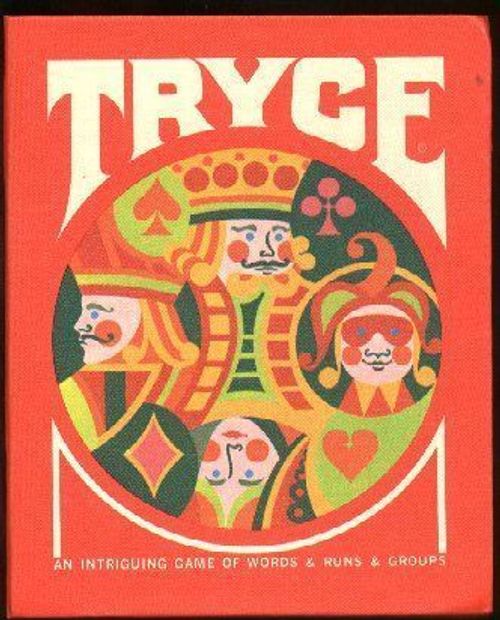
Tryce
Tryce Rulebook
Table of Contents
Table of Contents
The Cards
Tryce is played with two decks of 54 cards which have the markings of conventional playing cards plus letters of the alphabet. The cards are used to form Groups, Runs and Words of specific contracts which are melded, displayed face up on the table.
A Group consists of three-or-more-of-a-kind (three 7's, three 2's, four Kings, etc.); a Run consists of four-or-more-of-a-suit in sequence (A, K, Q, J of Hearts; 3, 4, 5, 6 of Clubs, etc.). A Word consists of four-or-more letters that spell any word found in a standard dictionary, except personal given names or surnames. (Foreign words may be used if so decided before the game.) In Pat Hands (4 and 7) only, one of a player's words may consist of just three letters.
Aces may be played high or low at either end of a Run. Jokers are wild. In a Group or Run, a joker can represent any number of any suit in the deck. In the formation of Words, jokers can represent any of the 5 vowels of the alphabet (A, E, I, O or U as marked on each card). Cards which have been melded may not be picked up or rearranged. However, when playing on his own or his opponents' melds, a player may replace a joker with a natural card but must immediately re-use that joker at either end of the same Group or Run, or at either end of the same Word but only as a vowel.
The Information Board
The Information Board is placed in slots of card tray and positioned so all players can see it. Red marker peg is inserted in the hole in front of Hand 1. After hand has been played, peg is moved to indicate next hand.
The 7 Hands are divided into 3 Banks. Under each Bank is the number of cards to be dealt for each Hand. Under each Hand is listed the contract — the plays to be made to win the contract points which are shown at the bottom of the Board.
TRYCE INFORMATION BOARD
| Bank | Cards dealt | Contract points | Hand 1 | Hand 2 | Hand 3 | Hand 4 | Hand 5 | Hand 6 | Hand 7 |
|---|---|---|---|---|---|---|---|---|---|
| Bank 1 | 10 cards each | 10 points | 1 Group, 1 Word | 1 Run, 1 Word | |||||
| Bank 2 | 11 cards each | 20 points | 1 Group, 1 Run, 1 Word | 3 Words (Pat Hand) | 1 Group, 2 Words |
The Seven Deals
At the start of the game, the two decks are combined and each player draws a card. In case of a tie, the tying players draw again. Highest card wins the deal of Hand 1. (When drawing for the deal, rank is as follows: Joker, A, K, Q, J, 10, etc.). Successive deals as well as the play move clockwise around the table.
At the start of a hand, dealer shuffles the cards and player to right of dealer cuts.* Dealer checks Information Board for the number of cards designated for the given hand. Cards are dealt face down, one at a time, to each player. Dealer also turns one card face up in center of table to form the discard pile. Remaining cards are stacked face down next to discard pile to form stock.
Players pick up cards and try to arrange them to form the hand contract. Player to left of dealer has first turn.
*Perfect Cut Bonus (optional): Player to right of dealer checks Information Board and tries for a perfect cut. If for Hand 1 he can cut the deck so dealer has precisely 10 cards per player plus one extra to start the discard pile, he has made a perfect cut. For superb guessword, he receives 25 points which are entered under his name on a score sheet. On each successive deal, player to right of dealer tries for these bonus points.
[Printed as "superb guessword" in the original.]
Hands 1, 2, 3, 5 and 6
These hands consist of drawing, selling and buying, melding, playing out extra cards and discarding. At the beginning of each turn, player either draws the top card from the discard pile or offers to "sell" it (see Selling and Buying) and draws the top card from the stock.
During his turn, a player may meld any part of the contract he has formed. To meld, he displays (places) the cards forming the Group, Run or Word face up on the table; then, if he holds other playable cards, he may add them to opponents' melds (these cards will add to the opponent's score).
After melding once, a player may, on subsequent turns, meld again and/or add other playable cards to his own or his opponents' melds. However, he may never meld more Groups, Runs and/or Words than specified for the contract.
To complete his turn, player discards one card.
Pat Hands 4 and 7
These hands are played the same as the others with these exceptions — player may not add playable cards to his own or his opponents' melds and must be able to "go down" without a final discard. In Hand 7 players must buy cards (see Selling and Buying) as a minimum of 15 cards is needed to complete the contract.
Selling and Buying
If a player, in his turn, does not want the top card on the discard pile, he announces that it is "for sale." Any other player who wants this card can say "I buy" and take it, providing he is also willing to draw an extra card from the top of the stock. (Should two people speak up for the card simultaneously, the highest at random draw from the stock wins it. Cards drawn at random are reshuffled into the stock.) After offering card for sale, player continues his turn in the usual manner — drawing top card from stock, playing and discarding.
Any card in the discard pile which is not drawn or bought is temporarily out of use. If stock is depleted during the play of a Hand, discard pile is reshuffled and turned over to form a new stock.
Going Down
When a player who has melded the entire contract disposes of all his cards, he declares that he is "going down." (Discard is optional except for Pat Hands, 4 and 7.) This ends the play of the hand.
The Scoring
The winner of each Hand (player who "goes down") is given the contract points designated on the Information Board:
- Bank 1, Hands 1 and 2 — 10 points each
- Bank 2, Hands 3, 4 and 5 — 20 points each
- Bank 3, Hands 6 and 7 — 30 points each
Each player is awarded points for the cards in his melds; points for any cards "caught" in his hand are subtracted from player's score. Cards have the following values:
- Jokers and Aces — 10 points each
- K, Q, J, 10 — 5 points each
- 9, 8, 7, 6 — 3 points each
- 5, 4, 3, 2 — 1 point each
End-of-Game Scoring. When Hand 7 has been played and scored, all points are totaled for each player. The player with the highest score is the winner.
Letter Frequency for Tryce
Each TRYCE deck has 52 cards plus two jokers. The two decks have the following number of letters:
| Letter | Count | Letter | Count | Letter | Count | Letter | Count | Letter | Count | Letter | Count | Letter | Count |
|---|---|---|---|---|---|---|---|---|---|---|---|---|---|
| A | 8 | B | 2 | C | 2 | D | 3 | E | 11 | F | 2 | G | 3 |
| H | 5 | I |
The four jokers are wild cards which may be used in groups or runs as any number of any suit or in words as any vowel (A, E, I, O, U).