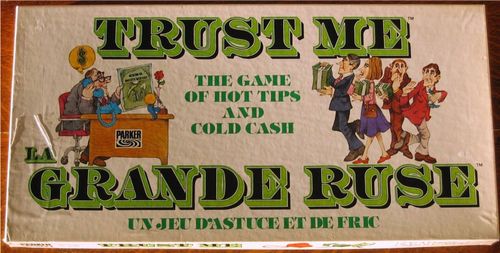
Trust Me (1981)
Trust Me (1981) Rulebook
Table of Contents
Table of Contents
Object
To be the player with the greatest total wealth at the end of the game.
Equipment
Playing board, die, 4 dollar-shaped playing pieces, 4 claim markers, 12 briefcases, 16 "Payoff" cards, 28 "Trust Me" cards, a pack of shares, and a stack of money.
Set Up
-
Each player chooses a playing piece and places it onto the Trust Me Investment Company in the middle of the board. Each player then takes the claim marker of the matching color and places it onto the table in front of him or her.
-
Shuffle the pack of "Trust Me" cards and place them, face down, by the side of the board. These cards form the draw pile. (Disregard the blank card.)
-
Spread out the 16 "Payoff" cards, face down, on the table. Move them around so no one knows which is which. Then, as shown below, insert one into each of the 12 briefcases.
Hold the briefcase notch side down with the "Payoff" card face down. Slide the card into the briefcase so it's held by all the notches. [Illustration of hands inserting card into briefcase.]
-
After inserting the "Payoff" cards, you'll have 4 left over. Without looking at them, place them aside—face down and out of play—for the rest of the game.
-
With the briefcases still face down, move them around again. Then, without turning them over, place one onto each of the properties pictured on the board.
-
Choose a player to be the Banker. The Banker: a) separates the shares by number and hands each player two [unclear: "5 ... shares"] shares; b) arranges the money by denomination and hands each player two $5 bills.
During the game, the Banker must take care not to mix his or her shares and money with those that belong to the Bank.
-
Each player rolls the die. Whoever rolls the highest number goes first; play then proceeds, in turn, to that player's left.
Optional Rule: Before anyone plays, each player secretly may look beneath one property's briefcase.
Playing
Before you try to play, please read through the following rules very carefully.
To start your turn, roll the die and move your playing piece the number of spaces that you roll. You may move either forward or backward, but not diagonally. What you do next depends on where you land:
Crimson Circle, Green Horn Avenue, Gold Dust Drive and Blueberry Boulevard spaces. In front of each property are three colored spaces. Whenever you land on a colored space by exact count, first look to see if that property is claimed. If there's a claim marker on that property's briefcase, your turn ends. If there's no claim marker, you have a choice:
a) If you wish, you may secretly look beneath that property's briefcase. In this way you can learn the property's true value. After looking, replace the briefcase, face down, and end your turn. On your next turn, you may, if you wish, claim that property. To do so, simply place your claim marker onto the briefcase. Then roll and move as usual.
b) If you prefer, you may claim the property without first learning its value. By doing so, you'll be able to continue your turn. Instead of first looking under the briefcase, immediately place your claim marker onto it. Then roll and move again.
White spaces and Wild Goose Chase spaces. Whenever you land on one of these spaces, immediately end your turn.
Hot Tip spaces. Whenever you land on a Hot Tip space, you may look under one of the unclaimed briefcases in the specified area. As soon as you do, your turn ends. Do not move your playing piece to that area.
Occupied spaces. Whenever you land on a space that's occupied by another player, immediately send that player on a "Wild Goose Chase." To do so, move his or her playing piece to any of the four Wild Goose Chase spaces—even one that's already occupied.
a) If your opponent has claimed a property and you have not, that property becomes yours. Simply remove your opponent's claim marker and replace it with your own. Do not look beneath the briefcase or move your playing piece.
b) If both you and your opponent have claimed properties, remove your opponent's claim marker and leave yours where it is.
In either case, your turn ends.
Trust Me Investment Company space. After claiming a property, return to this space. As soon as you do, you can immediately try to convince your opponents to invest in your claim.
a) When you have a claim, you don't have to land on this space by exact count; you may stop moving as soon as you reach it.
b) More than one player may occupy this space at one time.
Investing
The secret to this game lies in shrewd and careful investing. Investing takes place as soon as someone returns to the Trust Me Investment Company with a claim.
At this moment, all movement stops. Then, starting to the left of this player, everyone in turn decides whether or not to purchase shares in the claimed property. The player with the claim is the last to decide about investing.
a) To invest in an opponent's claim, give that player $1 for every share you want. Then take your shares from the Bank and add them to any you already have.
b) To invest in your own claim, give the Bank $1 for every share you want. Then take your shares from the Bank and add them to any you already have.
c) If you don't want to buy any shares, you don't have to. Simply keep the shares you already have.
d) If you prefer, you may "divest." In other words, you may cash in some or all of the shares you already have. You would "divest" only if you know or suspect that the claim is so poor that it would carry a penalty. To "divest," simply return your unwanted shares to the Bank in exchange for an equal amount of money.
Whenever you give an opponent money, place it onto the center of the board—in a "reserve account"—until the property's value is revealed. This is to prevent that player from using your money to buy shares in his or her own claim.
After everyone—including the claimant—has had a chance to invest, the holder of the claim turns over the briefcase, thus revealing the value of the property. As explained below, your investment's payoff—or penalty—depends entirely on the number of shares you have at this moment.
[INVESTMENT PAYOFFS AND PENALTIES table]
| Result | Effect |
|---|---|
| One Stack of Bills | From the Bank you receive money equal to the number of shares you own. Keep all your shares. |
| Two Stacks of Bills | From the Bank you receive, in money, twice the number of shares you own. Keep all your shares. |
| Empty Briefcase | You receive no money, but may keep all the money and shares you already have. |
| "You've Been Had!" | Return all your shares to the Bank, but keep all your money. |
Example: Someone returns to the Trust Me Investment Company with a claim. You haven't yet seen under that property's briefcase, so you have no idea of the property's value. The claimant naturally tries to convince you and the others that this property is an incredibly valuable investment. (After all, the more money you invest, the more money he or she stands to make!)
Although you don't really trust this "hot tip," you decide to invest anyway. Your claimant earlier in the game, a different opponent, saw under that briefcase. And he just invested heavily. So you do, too, hoping his memory is accurate.
From previous investments you have $60 and 25 shares. You decide to buy 50 more shares. You pay $50 to the "reserve account" and take your 50 shares from the Bank. You now have a total of $10 and 75 shares.
After everyone has had a chance to invest, the claimant turns over the briefcase.
a) If the briefcase contains two stacks of bills, you'll get $150 from the Bank.
b) If it contains one stack of bills, you'll get $75 from the Bank.
c) If the briefcase is empty, you'll get no money from the Bank.
d) If the briefcase announces "You've Been Had!", you'll have to return all 75 shares to the Bank.
As you can see, your payoff or penalty depends on the number of shares you own.
As soon as the payoffs and penalties are paid, the claimant takes the money from the "reserve account," then removes the claim marker, the "Payoff" card and the briefcase. The briefcase and "Payoff" card are placed aside—face down and out of play—for the rest of the game.
Special Notes About Investing
-
Notice that your payoff or penalty depends on the total number of shares you own. Not only on the shares you already had or the ones you just bought, but on the total.
-
As you can see, a "You've Been Had!" briefcase carries a serious penalty. So if you expect one to appear, then don't invest in that property.
Instead, "divest" by cashing in your shares to the Bank. You don't have to cash in all your shares. But if you have any shares when a "You've Been Had!" appears, you'll lose them all.
However, let's say you're not sure of what's going to appear, and decide to cash in only some of your shares. If the claim turns out to be a good investment, you'll receive a payoff according to the number of shares you have left.
-
Remember which "Payoff" cards have already turned up.
Example: There are only two "You've Been Had!" cards. If both of them have already turned up, there's no need for you to cash in your shares.
-
Remember who has seen what. If you claim a property sight-unseen, a player who knows its value may tip you off by his or her investment decision.
-
If you think an opponent has claimed a property with an empty briefcase, you probably shouldn't invest. You'd just be paying cash to that opponent with no chance of a return on your investment.
Trust Me Cards
Whenever you roll a "1," don't move your playing piece. Instead, draw the top card from the draw pile and follow its directions.
a) If a card tells you to move to a particular property, you may either look beneath its briefcase and end your turn; or claim the property sight-unseen and roll again.
b) If you draw a "Bamboozled" card and fail to roll one of the required numbers, go immediately to any Wild Goose Chase space. If at that moment you have a claim, you lose it and must remove your claim marker from the board.
c) If you draw a "Challenge Another Player" card, you may challenge any other player in an attempt to take his or her claim. You may do so only if you do not currently have a claim of your own.
The challenge is very brief. Each player rolls the die. If your roll is higher, you [unclear: "take"] the claim, remove your opponent's claim marker, substitute your own, and send that opponent to any Wild Goose Chase space. If, however, your opponent's roll is higher, he or she keeps the claim and sends you to any Wild Goose Chase space.
Remember: If you already have a claim when you draw this card, go straight to the Trust Me Investment Company and try to convince everyone to invest in your property.
Winning
The game ends when only two briefcases remain on the board. At this moment, everyone adds together his or her money and shares. Whoever has the highest combined total wins the game.
Investment Strategy
Sometimes you know exactly what a property is worth; sometimes you have no idea at all. The less you know about the briefcase in question, the greater the risk if you invest.
-
After claiming a property, you don't have to return to the Trust Me Investment Company right away. If you have a chance on subsequent turns to look under other unclaimed briefcases, you may do so. Sometimes the delay will pay off. After all, the more properties you're familiar with, the better an investor you'll be.
-
If you think a briefcase contains a "You've Been Had!", you had better cash in your shares. Otherwise you'll pay a penalty.
-
Remember which "Payoff" cards have already turned up.
Example: There are only two "You've Been Had!" cards. If both of them have already turned up, there's no need for you to cash in your shares.
-
Remember who has seen what. If you claim a property sight-unseen, a player who knows its value may tip you off by his or her investment decision.
-
If you think an opponent has claimed a property with an empty briefcase, you probably shouldn't invest. You'd just be paying cash to that opponent with no chance of a return on your investment.