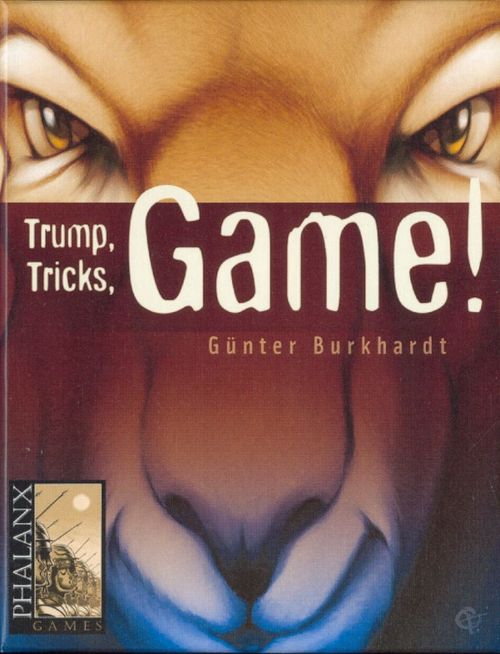
Trump, Tricks, Game!
Trump, Tricks, Game! Rulebook
Table of Contents
Table of Contents
Components
Each Trump, Tricks, Game! copy contains:
- 52 playing cards (48 animal cards, 4 trump cards)
- 1 rules manual
If any of these parts are missing or damaged, we apologize for the inconvenience and ask that you contact us to receive any replacement parts needed. Please send your correspondence to:
Phalanx Games b.v. Attn.: Customer Service P.O. Box 32 1380 AA Weesp The Netherlands E-Mail: [email protected]
Starting Play
First the animal and trick cards are separated. With 4 players all animal cards are used. With only 3 players the animal cards with a value of 1, 6, and 12 are placed back into the game box. Afterwards the animal cards are shuffled. Each player secretly receives 12 of them and takes them onto his hand.
Now the trick cards are shuffled as well and put on the table. Each one is placed slightly on top of the earlier placed one.
The colors of the trick cards (labeled Trump Cards) determine which color is trump in each game turn. The top card is trump in turn one.
Note: The players know the trump colors of the next game turns. Therefore they may try to collect trump cards for them.
The animal cards each carry a value and a footprint symbol. A piece of paper and a pen are handy for noting the victory points of the players.
General Course of Play
Trump, Tricks, Game! consists of 4 game turns. The player with the mouflon card of value 10 is the starting player. The player with the most victory points begins in the other game turns. A game turn consists of 12 rounds of card play.
At the end of the first, second, and third game turns the players add their points (= the number of animal footprints on their cards). The players either write them down or keep them in mind.
In the first three game turns the players may only take 3 tricks (with 4 players) or 4 tricks (with 3 players).
Cards won are the hand cards of the players for the next game turn – the cards are not reshuffled and newly distributed.
In the fourth game turn each player tries to take as many tricks as possible. Now it is important to catch the animals (= cards), not finding their footprints.
Playing a Card
The game is played in clockwise order. Each player always plays one card per round. One player takes the trick and continues playing the next card.
Cards with higher numbers are more valuable than cards with lower numbers.
Tricks that have been won are placed, facedown, next to each player.
Follow Suit Rule
In all game turns the players have to follow suit according to these rules:
The color of the card played first determines the "color of the trick". The other players have to play cards of the same color. The player playing the card with the highest number takes the trick.
If a player does not have a card in this color, he must play a card of a different one. If he plays a card in the current trump color (take a look at the trump cards), he trumps any cards played earlier. Trump color cards: The highest number played takes the trick.
Example: Blue is trump color. Michael plays a red 5. Karen follows suit and plays a red 7. Daniel trumps with a blue 8. Peter does not have a red card, too, however, he does not want to take the trick. He plays a green 1. Daniel takes the card and will play the next card.
Predetermined Number of Tricks
When a player has already won the predetermined number of tricks (see General Course of Play, above), he cannot take more tricks in a game turn.
Cards played by such a player are not "counting" anymore. However, the player still has to play one card and follow suit.
A player does not have to follow suit a card played by a player who already has won the predetermined number of tricks. The first player who still needs tricks determines the "color of the trick" with his card.
Victory Points and Footprints
After the first, second, and third game turn each player counts the number of footprints on his cards. This sum is multiplied with the number of different footprints. Example: 5 bear, 4 wolf, and 3 wild boar footprints are 12 x 3 = 36 victory points.
Catching Animals
In the fourth and last game turn the number of tricks is not predetermined. The footprints have no meaning anymore.
Now it is only important to get as many tricks as possible.
The players receive the following victory points. For each:
- Wolf card: 1 point
- Mouflon card: 2 points
- Wild boar card: 3 points
- Bear card: 4 points
These points are added up; they are not multiplied.
Winning
The game ends after the fourth game turn. Now all victory points (from all 4 turns) are added. The player who scored the most points is the winner.
Optional Rules
Some players may find the basic game to be too luck dominated. Therefore we have included the following two optional rules. They may be incorporated separately or together.
Refusing a Card
If a player has only one card left in his hand in the "color of the trick", he may refuse it. He places it openly in front of him on the table when he has to play a card and may now play any other card (including a trump).
Important: Each player may only have one refused card in front of himself. This card still counts as one of his hand cards and must be played at a later time according to the rules. When it has been played, another card may be refused.
Donating a Trick
A player that took a trick may keep it and put it in front of himself (as in the basic game).
Alternatively, he may donate the trick to one of the other players who has not won the predetermined number of tricks yet.
- He moves the trick openly to the other player.
- This player may take it or he may try to refuse it.
- To refuse it, he must have a hand card that has a lower value than all the cards of the trick (i.e., a trick with a "1" card may not be refused. However, a trick may not be donated to a player who played the "1" card!).
Important: The card selected to refuse the trick must be in one of the colors of the cards in the trick. Example: If a player wants to refuse a donated trick consisting of a red 12, a red 3, a blue 5, and a yellow 6, he has to play a red, blue or yellow 1 or 2. If a donated trick is refused, the card used to refuse it is put into the trick and the refusing player may take any card of the trick to his hand cards.
Note: If a refusing player chooses a card in the color of the card that lies in front of him (see Refusing a Card, above), he has to put that card back onto his hand.
- If a donated trick is refused, the donator has to take it – he may not try to donate it again.
- The player who got the trick plays the next card.