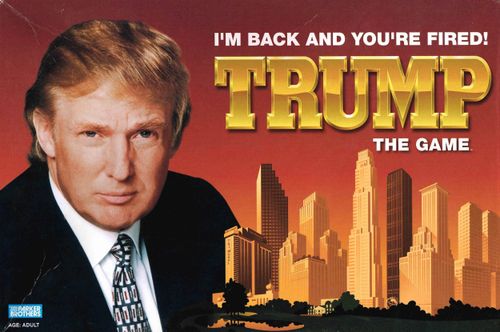
Trump: The Game
Trump: The Game Rulebook
Table of Contents
Table of Contents
Overview
For 3 or 4 Players.
Your goal: Have the most money at the end of the game.
Game contents:
- Gameboard
- 72 Trump cards
- 2 plastic trays
- 4 T pawns
- 1 die
- 8 property boxes
- Trump money
- Property label sheet
- Money tray label
TRUMP THE GAME is played in two phases:
- Part 1 is the Buying Phase. During this phase, you draw and play Trump cards, and buy properties while moving your pawn around the board. The BUYING PHASE is over after all eight properties have been purchased.
- Part 2 is the Dealing Phase. During this phase, you do not draw cards or move your pawn around the board. Instead, you either play a card from your hand or offer a deal to another player. When all cards have been played, or when all players have CONSECUTIVELY passed, the game is over. Whoever has the most money wins!
Game Setup
-
Remove the eight property labels from the sheet. Insert one label onto the top of each property box as shown in Figure 1. Property boxes are then placed on their matching gameboard spaces.
Figure 1 shows a property label being inserted onto the top of a property box.
-
Apply the game label to the front of the 3-section money tray. Separate the money by denomination and place each pile into the tray (the bank).
-
Slide one $50 million bill (from the bank) into the "secret" slot in each of the eight property boxes as shown in Figure 2.
Figure 2 shows the bill being slid into the secret slot of a property box.
-
Give each player $400 million in cash from the bank (two $100 million bills, three $50 million bills and five $10 million bills).
-
Shuffle the card deck and deal five Trump cards facedown to each player. You can look at your cards but keep them secret from the other players. Place the card tray in the center of the gameboard. (Card tray is located under cardboard insert in game box.) Place the rest of the Trump cards facedown in one side of the tray to create a draw pile. The other side will be for the discard pile.
-
Each player selects a different color T pawn and places it on the START space of the gameboard.
-
Each player rolls the die. Highest roller goes first. Rolling a "T" is higher than rolling a "5." Play continues in a clockwise direction.
Part 1: The Buying Phase
On your turn, do the following two actions:
-
Draw a Trump card from the top of the deck and add it to your hand. (If you forget to draw a card before taking the next part of your turn, you are penalized and do not get to draw one.)
-
Roll the die and move your pawn, OR play one card out of your hand onto the discard pile.
-
If you decide to roll the die and a number comes up, move your Trump pawn clockwise around the board the number of spaces shown on the die. Then do what the space directs. (See GAMEBOARD SPACES below for details.) You can pass over and land on spaces occupied by other pawns.
-
Rolling a T: If you roll the die and T comes up, draw a card at random from another player's hand and then roll the die again to move your pawn. As long as you keep rolling T, you can continue to collect a card from any opponent.
-
If you decide to play a card, you do not roll the die or move your pawn. Instead, do what the card says. Then place the card faceup in the discard pile. (See THE TRUMP CARDS below for an explanation of each card.)
The Gameboard Spaces
Each space on the gameboard asks you to do something special. Here is what to do when you land on one of these spaces:
-
START: This is where all tokens are placed at the start of the game. If you land on this space during the game, draw one Trump card from each opponent's hand. Your turn is then over.
-
Property spaces: Shown on the gameboard are the eight property boxes. They sit on their matching property spaces. These properties are referred to as unowned until they are purchased by a player. Once a property has been purchased, the property box is removed from the board and placed in front of the buyer.
If you land on an unowned property box or the space of an owned property, put $10 million from the bank into the property box. Your turn is then over.
-
Money space (its icon is not legible in the scan): Put the indicated amount of money from the bank into the slot of the unowned property box of your choice. Then draw a Trump card from the deck. Your turn is then over.
-
FOR SALE (remaining unowned property): Choose one of the remaining unowned properties to go up for sale. (See SELLING A PROPERTY section for details.)
-
FOR SALE (any property): Choose any owned or unowned property to go up for sale. (See SELLING A PROPERTY section for details.)
-
ACQUIRE $20 MILLION TIMES A DIE ROLL: Roll the die again. Multiply the number rolled times $20 million and collect that amount from the bank. If you roll a T, pick a card at random from an opponent and roll again to see how much money you get from the bank. Your turn is then over.
-
TRADE ONE PROPERTY: You can exchange one of the properties you own for an opponent's or for an unowned property on the board. Or you can keep the property you have. It's your choice. If you have no property, then you can't trade. If you trade for an unowned property, take the unowned property and return your chosen property to its original space on the board. Your turn is then over.
The Trump Cards
In most instances, you'll play a Trump card by placing it faceup in the discard pile on the board. You cannot look through the discard pile to see which cards have already been played.
On your turn, here's what to do when playing one of the following Trump cards:
Profit Cards
There are five different kinds of profit cards.
-
The profits listed on these cards vary from $30 million to $60 million. If you own one of these cards and its corresponding property, you may play the card to collect the amount shown from the bank. Add the money to your cash in hand.
There is one of these cards for each of the eight properties.
-
If you own one of these cards and its corresponding property, you may play the card, roll the die and collect $20 million times a die roll from the bank. If you roll a T, take a card from an opponent and roll again to see how much money you collect from the bank. Add the money to your cash in hand.
There is one of these cards for each of the eight properties.
-
The profits listed on these cards vary from $60 million to $120 million. If you own both properties and hold the matching card, you may play the card to collect the indicated amount from the bank. Add the money to your cash in hand.
Properties located near each other on the board are paired together on 2-property profit cards. Keep this in mind when bidding for properties. The right combination of properties and cards can lead to bigger profits!
There are eight of these cards with different property combinations.
-
The profits listed on these cards vary from $40 million to $50 million. If you own at least one property, you can play this card to collect the amount shown from the bank. Add the money to your cash in hand.
There are eight of these cards.
-
These multi-property cards can deliver the biggest payoffs in the game. If you own the number of properties indicated on the card, you may play it to collect the indicated amount from the bank. Add the money to your cash in hand.
There are two 3-property cards and one 4-property card in the deck.
Tax Cards
If you play one of these cards on an opponent, the opponent must pay you $20 million for each property he or she owns. If the opponent does not have enough cash to pay the tax, he or she must surrender all cash holdings, plus one property (opponent's choice) to you. Add the money to your cash in hand.
If you think an opponent might be low on cash, consider playing a tax card on him or her. If your hunch is correct, you'll get some cash and a property worth at least $50 million!
There are five of these cards.
Force Sale Cards
You may play one of these cards to force the sale of any property, owned or unowned, yours or an opponent's. See SELLING AND BUYING PROPERTY section on next page for details.
There are four of these cards.
Die Roll Cards
You may play this card to boost your holding of Trump cards. (The card text reads "Roll the die 5 times. For every T you roll, draw a card from any player.")
There are two of these cards.
NOTE: If an opponent asks you how many Trump cards you have, you must reveal the amount.
There are three other types of cards in the deck. They are special Bidding cards. See SELLING AND BUYING A PROPERTY for explanations of these cards.
Selling and Buying Property
Selling a Property
A property is put up for sale by one player and is bid on by all players.
When to sell. A property must be put up for sale when either of the following occurs:
- Whenever you land on a FOR SALE space, select a property to go up for sale as indicated by the directions on that space.
- Whenever you play a FORCE SALE card (instead of moving your pawn), you must choose a property, either owned or unowned, yours or an opponent's, to go up for sale.
How to sell. Whenever you sell a property, you are called the Broker. As the Broker, remove the property box to be sold from the path (or from the owner) and place it in the center of the board. Any pawns on top of the property box are returned to the board on the matching space. Players then bid on the property.
How to bid. To purchase a property, you must be the highest bidder. Bidding is a 3-step process:
- An Opening Bid is made.
- The Bidding continues.
- The Bidding is concluded.
Buying a Property
An Opening Bid is made. From their cash in hand, players secretly take the amount of cash they want to offer for an opening bid. If you are short on cash or don't want to bid, you don't have to. However, it is usually to your advantage to bid at least $10 million. If you don't make an opening bid, you cannot join the bidding later and you cannot play any cards during the bidding.
The Broker then asks all players to simultaneously place their cash bids in front of them on the table. Starting with the Broker, players announce their bids in a clockwise direction, so the highest opening bid can be determined. In case of a tie, the first player in clockwise order to make the tied bid is considered to have the highest opening bid.
The Bidding continues. After all players have announced their opening bid, they continue taking turns in clockwise order, starting with the Broker, trying to be the highest bidder.
IMPORTANT: To increase your bid you must top the last high bid by at least $10 million.
On each turn, a player can do one of the following five things:
-
Play a Bidding Card to increase your bid. OUTSIDE INVESTOR cards range in value from $20 million to $60 million. Try to play one or more of these cards on your turn to raise your bid to at least $10 million over the highest bid. When you play this card(s), take the amount of cash listed on the card(s) from the bank and add all of it directly to your bid.
There are eight OUTSIDE INVESTOR cards.
-
Use your cash holdings to increase your bid. You can increase your bid to $10 million (or more) over the highest bid by drawing money from your cash in hand.
IMPORTANT: You can only increase your bid after an OUTSIDE INVESTOR card has been played by anyone in the game! Once an OUTSIDE INVESTOR card has been played, players can increase their bid each time it's their turn.
You can also combine cash from OUTSIDE INVESTOR cards together with your own cash holdings when increasing a bid.
You may want to bid higher than you think a property is worth, especially if you are holding matching Trump cards that can bring you big profits.
-
Play a Bidding Card to knock an opponent out of the bidding. There are 13 YOU'RE OUT OF THE BIDDING cards. Play one of these cards faceup in front of the opponent you want out of the bidding. Once knocked out, a player can get back in the bid only by playing an I'M BACK IN THE BIDDING card on his or her own turn. You cannot play a YOU'RE OUT OF THE BIDDING card on an opponent if you are already knocked out of the bidding.
-
Play a Bidding Card to get back in the bidding, if you've been knocked out. There are five I'M BACK IN THE BIDDING cards. Once knocked out, you can return to the bidding on your turn by playing one of these cards on top of the YOU'RE OUT OF THE BIDDING card in front of you.
-
Just say "Pass." You are still in the bidding (as long as you made an opening bid and haven't been knocked out of the bidding).
The Bidding is concluded. Bidding, playing of cards, or passing continues in a clockwise direction with players knocking opponents out, getting back in, and increasing their bids using cash and cards. This can continue on and on, until all players still in the bidding have consecutively passed.
Once these players have consecutively passed, the highest bidder still in the bidding gets the property. All previously played bidding cards are then placed in the discard pile.
- If the property was unowned, the high bidder's money is paid to the bank. All unsuccessful bidders get their entire cash bid back.
- If the property was owned, the high bidder pays the former owner. All unsuccessful bidders get their entire cash bid back.
If you are the new property owner, place the property box in front of you. Open the box and reveal the cash amount inside. Then put the money back in the box and close it up. You can look inside anytime you want, but the dollar amount never has to be revealed again (except if the property is sold).
Bidding on your own property. If you own a property, there are two ways you could be forced to sell it:
- If a FORCE SALE card is played on you by an opponent.
- If someone lands on a Force Sale space and forces you to sell your property.
You can bid on your property along with everyone else. If you are the highest bidder, you retain the property, but you must put all of your bid money into the property box. If you lose your property to a higher bidder, surrender the property box to the new owner. You get your cash bid back, along with payment from the highest bidder.
If the draw pile runs out. Occasionally the draw pile will run out before all 8 properties are sold. Here's what to do when this happens:
- The player who drew the last Trump card completes his or her turn.
- That same player then becomes the Broker and puts the remaining properties up for sale one at a time, until all properties are sold.
See Bidding Examples below.
Bidding Examples
Example one: the Hotel goes up for sale.
- The players: Sitting clockwise around the table are you, Donna, Mike and Jeff.
- The sale: You land on a FOR SALE space and choose the unowned Hotel to go up for sale. You are now the Broker.
- The bidding action: All players secretly decide their opening bids. You direct everyone to place their bids on the table.
- Players announce their bids in a clockwise direction. You bid $100 million, Donna bids $70 million, Mike bids $120 million and Jeff bids $10 million. Mike is the highest opening bidder.
- Now the bidding process continues. Since you are the Broker, you go first. You play a YOU'RE OUT OF THE BIDDING card on Mike to knock him out of the bidding. Now you are the highest bidder.
- Donna passes. (She doesn't have an OUTSIDE INVESTOR card to play, so she can't increase her bid.) Her bid remains at $70 million.
- Mike doesn't have an I'M BACK IN THE BIDDING card, so he is out of the bidding.
- Jeff passes. His bid remains at $10 million.
- Since all players able to bid have passed, the bidding is over.
- You get the Hotel for $100 million, which you pay to the bank.
- You reveal that there is $50 million inside the property box. You paid more than the property is worth, but you have some valuable Trump cards that will make your purchase very profitable.
- The unsuccessful bidders take back their bidding money and return it to their cash in hand.
Example two: the Convention Center goes up for sale.
- The players: Same as at left.
- The sale: Donna lands on a FOR SALE space and puts the unowned Convention Center up for sale. She is now the Broker.
- The bidding action: All players secretly decide their opening bids. Donna directs everyone to place their bids on the table.
- Donna bids $60 million, Mike bids $50 million, Jeff bids $60 million and you bid $10 million. There is a tie for highest bid, so the first $60 million bidder (Donna) is declared highest opening bidder.
- Now the bidding process continues. Since Donna is the Broker, she goes first. Because she already has the highest opening bid, she passes.
- Mike plays an OUTSIDE INVESTOR card worth $50 million to raise his bid to $100 million.
- Jeff raises his bid to $110 million by adding $50 million from his cash in hand. He can do this now because Mike played an OUTSIDE INVESTOR card.
- You pass. Your bid is still at $10 million.
- Donna uses her cash in hand to raise her bid to $120 million.
- Mike passes. His bid is still at $100 million.
- Jeff plays a YOU'RE OUT OF THE BIDDING card to knock Donna out of the bidding. (Jeff is now highest bidder.)
- You pass. Your bid is still at $10 million.
- Donna doesn't have an I'M BACK IN THE BIDDING card, so she is out of the bidding.
- Mike plays a YOU'RE OUT OF THE BIDDING card on Jeff. (Now Mike is the highest bidder.)
- Jeff doesn't have an I'M BACK IN THE BIDDING card, so he is out of the bidding.
- You pass again. (You didn't want the property.)
- Donna and Jeff are out of the bidding, so Mike gets the property for $100 million, which he pays to the bank. He reveals that there is $130 million inside.
Part 2: The Dealing Phase
As soon as the last property has been purchased from the board, the BUYING PHASE is over. Now the DEALING PHASE begins. Players no longer use the gameboard and no longer draw cards from the draw pile.
On your turn, you can do one of the following. Your turn is then over.
- Play a card from your hand.
- Make a deal.
- Pass.
Play a Card From Your Hand
Most of the cards that you played in the Buying phase can still be played in the Dealing phase.
-
You could play a COLLECT PROFITS card if you own the matching property(s).
-
Or, you could play a TAX card on an opponent.
-
Or, you could play a FORCE SALE card and put up the property of your choice for sale. (You would be the Broker.)
NOTE: Of course, Bidding cards could be played if a property is put up for sale.
-
Or, you could play a ROLL DIE 5 TIMES card with the hope of rolling T and collecting cards from other players.
Make a Deal
If you choose not to play a card or have no card to play, you can offer a deal to any other player. Deals may involve the sale, trade, loan, or gift of cards and/or property. You can haggle on price, but it must be quick! The other player can accept a deal or reject it. As soon as a deal is rejected, your turn is over.
You can make practically any type of deal imaginable and it can be as simple or as complicated as you want. However, if you make a deal, you must try to honor it. You cannot lie to another player or intentionally break a promise. Of course, some situations may be open to interpretation. Players should work together to resolve any differences.
IMPORTANT: You may make a deal and play a card on the same turn, but only if the card is related to the deal. Your turn is then over. For example: If you own the Hotel property and make a deal to purchase the HOTEL PROFITS card, you could then buy that card, play it and collect your profits all on the same turn.
Pass
Instead of making a deal or playing a card, you can pass to the next player.
Deal Examples
Buy! Sell! Trade! Loan! All kinds of deals are possible. Here are just a few examples.
Deal #1
- The situation: You have the HOTEL PROFITS card worth $60 million, but Donna owns the Hotel property. You'd like to sell your card to Donna since she owns the property.
- The offer: On your turn, you offer to sell the card to Donna for $40 million.
Donna agrees and pays you $40 million. Your turn is over. (Instead of selling the card, you could have also tried to buy the Hotel property from Donna and then played your Hotel card.)
Deal #2
- The situation: You own the HOTEL AND CASINO PROFITS card worth $120 million. You also own the Hotel property, but Jeff owns the Casino property. You want to buy the Casino so you can play your card.
- The offer: On your turn, you ask Jeff to sell you the Casino property for $30 million more than the property is worth. (Jeff can look inside his Casino property box to determine the Casino's value.)
Jeff says "no thanks." Your deal is denied. Your turn is over.
On Jeff's turn, he asks if you'd like to buy the Casino on a temporary basis. He offers you the Casino for a mere $10 million now, if you'll pay him $50 million after you play your HOTEL AND CASINO PROFITS card on your next turn. You must further agree to sell the Casino back to him for the same $10 million at the end of your turn.
You agree. Then on your turn, you play the HOTEL AND CASINO PROFITS card and collect $120 million from the bank. You pay Jeff the $50 million you owe him and then sell the Casino property back to him.
You made a profit of $70 million. Jeff made $50 million and retained his property for future deals.
Deal #3
- The situation: You own the Convention Center property. Jeff has the CONVENTION CENTER PROFITS card worth $40 million.
- The offer: Jeff asks you if you'd like to buy the CONVENTION CENTER PROFITS card for $30 million.
You say "no thanks." Jeff's deal was denied. His turn is over.
On Jeff's next turn, he asks if you'd like to make a risky deal. You're intrigued, and ask him to continue.
Jeff tells you that he has some very desirable cards in his hand. He says that if you pay him $40 million, you can pick two cards at random from his hand.
- The counteroffer: You tell Jeff that $40 million is too much for such a risk. You offer $30 million.
Jeff accepts. You pay him $30 million and pick two cards at random from his hand. Jeff's turn is over.
- The surprise: You look at the cards and discover you've picked his CONVENTION CENTER PROFITS card worth $40 million, plus a TAX card.
On your next turn, you play the TAX card on Mike, who has three properties. Mike must pay you $60 million. Plus, you still have your CONVENTION CENTER PROFITS card, which you can play on a future turn.
Deal #4
- The situation: You own the Tropical Island property, as well as the TROPICAL ISLAND AND CRUISE LINE PROFITS card worth $100 million. Jeff owns the Cruise Line. You want to buy the Cruise Line from Jeff, but only temporarily.
- The offer: You tell Jeff that if he sells you the Cruise Line for $10 million now, you'll pay him $60 million when you play the TROPICAL ISLAND/CRUISE LINE card. You further promise to sell the Cruise Line back to him for $10 million.
Jeff agrees to make the deal as long as you agree to return the property at the end of your next turn.
NOTE: Jeff played it very smart here. He realized you never said exactly WHEN you would play the TROPICAL ISLAND/CRUISE LINE card. He wants to make sure he gets the property back at the end of your next turn.
Deal #5
- The situation: You own two properties, a 3 PROPERTY PROFITS card worth $160 million and a SPORTS COMPLEX PROFITS card worth $30 million. Donna owns the Sports Complex. You would like to temporarily own the Sports Complex, so you can play your cards.
- The offer: You tell Donna that if she gives you the Sports Complex now, you'll play the SPORTS COMPLEX PROFITS card and give her $20 million. Then you will play the 3 PROPERTY PROFITS card on your next turn and give her $70 million of the earnings. You will, of course, give her back the SPORTS COMPLEX as soon as you play the card. She agrees.
You play the SPORTS COMPLEX PROFITS card, collect the $30 million and pay her $20 million.
- The surprise: As the game continues, Mike plays a FORCE THE SALE OF ANY PROPERTY card on you. He then forces you to sell the SPORTS COMPLEX before you can give it back to Donna!
Remember: every deal has an element of risk. In this case, Donna might lose the Sports Complex, through no fault of yours! Sometimes business is tough.
Winning the Game
The DEALING PHASE is played until there are consecutive passes by all players in the game. Players either run out of cards or give up on making deals with the cards they have. When the dealing phase is over, all players count their cash in hand and the money inside any property boxes they own. The player with the most money is the winner.
Most Often Asked Questions
Outside Investor Card Questions
Does an OUTSIDE INVESTOR card have to be played before bids can be increased?
Yes. At least one OUTSIDE INVESTOR card must be played by any one player before bidding can increase. Once an OUTSIDE INVESTOR card has been played, all bidders are free to increase their bid (with cash, OUTSIDE INVESTOR cards or both) each time it's their turn.
If I play an OUTSIDE INVESTOR card and don't get the property, do I have to give the Outside Investor money back to the bank?
No. All unsuccessful bidders get their entire cash bid back, including any money gained from playing OUTSIDE INVESTOR cards. OUTSIDE INVESTOR cards that have been played are placed in the discard pile.
Can I play more than one OUTSIDE INVESTOR card on my turn?
Yes, you have that option. This is the only part of the bidding where you can play more than one card on your turn.
Bidding Questions
What happens when several players are tied for the highest bid and no one has any OUTSIDE INVESTOR or YOU'RE OUT OF THE BIDDING cards to play?
Each player passes in turn. After all bidders have passed, the first player in clockwise order who made the tied bid is considered to have the highest bid and gets the property.
If I have been thrown out of the bidding, do I have to play my BACK IN THE BIDDING card on my next turn or can I wait?
You can wait if you want to. However, if you pass and then all the other players pass, the bidding is over and you're out of luck. (If you play a BACK IN THE BIDDING card, you cannot increase your bid until your next turn.)
Money and Property Questions
Can I take money out of a property box I own and use the cash for bidding or to make a deal?
No. Money must remain in the property boxes until the end of the game. (As the property owner, you can count the money whenever you'd like, but the money must be put back into the box.)
If I land on the space of an owned property, do I give the owner of the property $10 million of my money?
No. Take $10 million from the bank and place it into the owner's property box.
If I own properties but only a small amount of cash, what do I do if an opponent plays a tax card on me?
If you don't have enough cash to pay the tax, you must surrender all cash in hand, plus one of your properties (your choice) to your opponent.
If I land on the TRADE ONE PROPERTY space, does my opponent have any say in which of his properties I trade for?
No.
In Part 2 of the game, if someone loans me a property and someone else plays a Force Sale card on that property, could the original owner lose his property?
It's possible. The highest bidder would get the property.
Can I continue to play if I run out of cash?
Yes. In Part 1 of the game, you can continue to draw a card and roll the die or play a card when it's your turn. In Part 2 of the game, you can play cards, or make deals with your property and cards.