Troyes: Bonus Cards
Troyes: Bonus Cards Rulebook
Table of Contents
Table of Contents
Bonus Cards
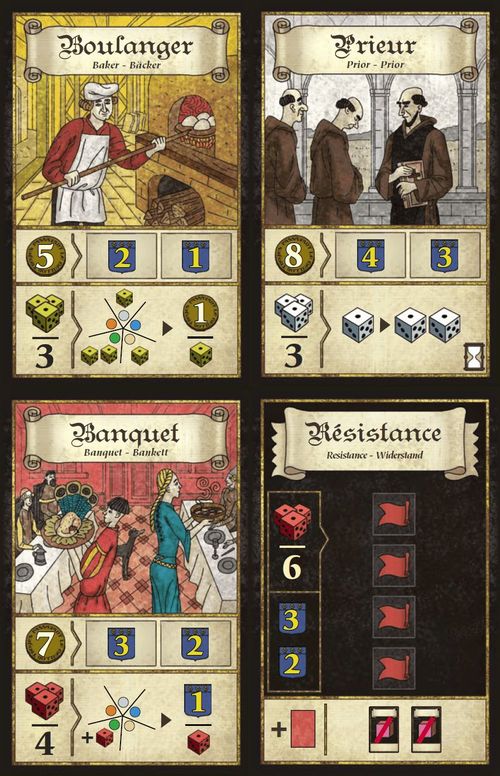
Baker
Gain 1 denier for each yellow die in the city square.
Banquet
Gain 1 VP for each red die in the district of the city containing the most red dice (the district may belong to another player, including the neutral player).
Prior
Use 1 white die as though it were 2 white dice of the same value. You cannot use more than 1 white die for this action.
Resistance
When this card comes into play, it calls for a second red event; take the card from those returned to the game box during setup. The second red card will call a yellow or white card as normal. When Resistance resolves, remove the most recently placed cube from each Event card.
The cost and reward icons, card numbers and card artwork are pictorial on the printed cards and are not transcribed here.
The King's Challenge
Solo variant rules
Initial Placement
-
Le Roy uses the meeples of 2 colors. The gray meeples are not used.
-
Roll 6 dice (2 red, 2 yellow, 2 white); the 3 highest results indicate where le Roy places three meeples, then proceed to place 2 of your own meeples. Repeat this placement order until all spots are filled (the buildings should contain 12 of le Roy's meeples, and 6 of the player's).
NOTE: Equal numbers are resolved as follows: red > yellow > white. The value of the dice is irrelevant; le Roy will place his meeples on the best places in each building, as shown here (the best place is 1, the worst is 6):
The source shows three building diagrams, one each for the Palace (red), City Hall (yellow) and Bishopric (white), with the places numbered 1 to 6 from best to worst. The diagrams are pictorial; the NOTE above gives the rule.
-
Shuffle the 6 character cards, and place them on the table, one on top of the other, in such a way that the bottom part of each card remains visible. The card on top will be the first to be resolved (see below for rules on resolving character cards).
Gameplay
-
Le Roy and the player will take turns being the Start Player, alternating each round.
-
Negative events do not affect le Roy.
-
Any event that refers to the neutral player now refers to le Roy (his meeples and cubes).
-
Le Roy ranks his dice by value, then by color (red > yellow > white), as shown below.
Example: The strongest die is in the upper left, the weakest in the bottom right. (The example is a pictorial arrangement of six dice in the source.)
-
When combating black dice, le Roy uses his strongest available die to eliminate only the highest remaining black die. Any remaining black dice are passed back to the player.
-
For the player's turn, the game proceeds just like the standard game. If the player chooses to purchase le Roy's dice, he pays the appropriate deniers to the bank.
-
For le Roy's turn, roll 2 black dice and combine their value to determine his action for the turn (see the table on page 2). The price indicated is the number of dice le Roy spends for the action. IMPORTANT: Le Roy always spends his best dice, and continues taking turns until all of his dice have been used. If the price exceeds his number of remaining dice, le Roy still completes the action using all of his remaining dice.
| Result | Action | Price |
|---|---|---|
| 2 | Le Roy gains 2 VP | 3 dice (1 is purchased from the player) [1] |
| 3 | Le Roy gains 2 VP | 2 dice (1 is purchased from the player) [2] |
| 4 | Le Roy places 1 worker meeple [3] | 1 die |
| 5 | Le Roy resolves the right-most event | X die/dice [4] |
| 6 | Le Roy places 1 tradesman meeple [5] | 1 die |
| 7 | Le Roy places 2 cubes on the cathedral [6] | 2 dice |
| 8 | Le Roy reveals a character card [7] | 0 die |
| 9 | Le Roy resolves the right-most event |
Notes:
- Le Roy purchases your best available die for 6 deniers.
- Le Roy purchases your best available die for 4 deniers. If you have no dice, he uses his own without paying you.
- Le Roy's highest die will indicate where (red = Palace, yellow = City Hall, white = Bishopric). Le Roy always expels one of your meeples if possible.
- Le Roy spends one die for each free banner on the event card.
- Le Roy places a meeple on the spot worth the most VP. In case of a tie, use the least expensive location. If still tied, the preference order is red > yellow > white.
- Le Roy places his cubes on the best available spaces of the lowest available row. If there are no spaces left, le Roy instead gains 2 VP.
- Le Roy and the player immediately receive the points of the character on top of the pile. This character card is then removed from the game. If there are no characters left, le Roy instead gains 1 VP. Le Roy does not score for gold and influence.
End of the Game
Le Roy and the player receive the appropriate number of points for each of the remaining character cards, if applicable.
The player's final score is calculated by subtracting le Roy's VP from his own.
- -100 to 0: Your defeat merits no additional comments. You're beheaded.
- 0 to 5: Wipe that smile from your face. It's not terrible, but le Roy will still have your head.
- 6 to 10: An average performance, at best.
- 11 to 15: Not bad, you're starting to make something of yourself.
- 16 to 20: You're making le Roy start to worry. You're beheaded.
- 20+: Congratulations! Masterful work!
Card Modifications
- Tax Collector - Gain 2 deniers for each of le Roy's citizens on City Hall instead of 1.
- Tithe - Take up to 3 yellow dice from le Roy instead of 1. You can still use a maximum of only 3 dice per action.
- Traveling Builders - If there is an empty space on the Cathedral, le Roy gains 1 VP.
- Banquet - Do not count le Roy's dice when determining the district with the most red dice. You gain VP even if le Roy has more red dice in a district than you.