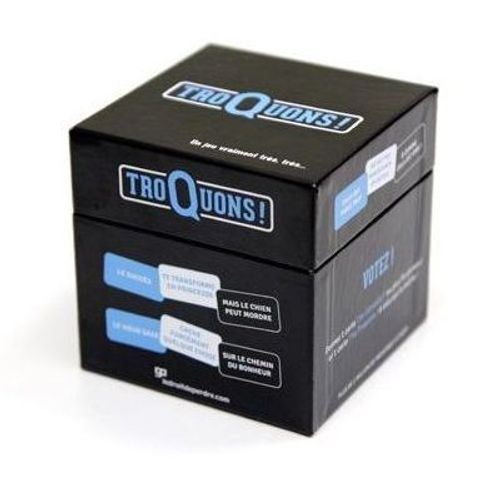
Troquons !
Troquons ! Rulebook
Table of Contents
Table of Contents
Components
- Sujet (Subject) cards: 55 × 2
- Verbe (Verb) cards: 55 × 2
- Morale (Moral) cards: 55 × 2
- 20 blue cubes (each worth 1 point)
- 10 black cubes (each worth 3 points)
- 8 "T'es Troquons !" (You're a Troquon!) cards
- 8 "T'es Génial(e) !" (You're a genius!) cards
Each card has text printed on two circuits, a white circuit and a blue circuit. The card illustration in the rules shows the white circuit text at the top and the blue circuit text at the bottom.
Setup
- Place the Sujet, Verbe and Morale cards in three piles between the players.
- Each player receives 3 cards (one S, one V, one M) plus 1 "T'es Génial(e) !" card and 1 "T'es Troquons !" card.
- Choose to play with the white circuit or the blue circuit. This choice applies to the whole game.
Goal of the Game
Be the first player to reach 7 points of "génialitude" (genius-ness).
Forming Your Maxim
Each player looks secretly at their S-V-M cards. Together they form a maxim. Example:
- L'excès (Excess)
- peut envahir tes sens (can invade your senses)
- comme la moutarde (like mustard)
You cannot combine the text of the white and blue circuits, but you can sometimes reverse the suggested order (S-V-M).
Trading Phase
Open the trading phase by declaring: "Troquons !"
The aim is to make an effective maxim that will please the other players. Trading is optional, but it lets you improve your maxim.
- Only cards of the same type may be traded (S with S, V with V, M with M).
- You may trade as many times as you like between players.
- You may draw from the draw pile only once: place one of your cards face up in the discard (remise), next to the corresponding pile, then take the top card of the draw pile.
- After that, everyone may trade freely with the card or cards in the discard (la remise).
Revealing Maxims
When the trading phase ends, each player reveals their maxim aloud. The youngest player begins. They place their 3 cards face up in front of them.
- If the maxim is clear to everyone, they pass the turn to their left-hand neighbour.
- If someone asks them "Qu'as-tu voulu dire par là ?" ("What did you mean by that?"), they must explain their maxim.
Voting
After all maxims have been read, every player votes at the same time, with their cards placed face down:
- One "T'es Génial(e) !" card goes beside the maxim they preferred.
- The other "T'es Troquons !" card goes beside the maxim they appreciated least.
Note: a player may not vote for their own maxim, nor give both of their votes to the same player.
Scoring
Reveal the votes and tally the results:
- Each "T'es Génial(e) !" card received scores 1 point.
- "T'es Troquons !" cards do not cost points; they invite you to keep progressing.
Record points with cubes: a blue cube is worth 1 point and a black cube is worth 3 points.
Next Round
- Discard the S-V-M cards that have been used, and redistribute the vote cards.
- Each player takes back 1 "T'es Génial(e) !" card and 1 "T'es Troquons !" card for the next round.
End of the Game
The first player to have 7 points or more wins the game. In case of a tie, there are several winners, but a new round is never refused!
Variants
(The French rules sheet refers to further variants on the publisher's website and social media; those pointers are not reproduced here.)
1) Combining circuits for a cost. By paying 1 point, a player may freely combine the text of the white and blue circuits. Their options increase, but the move is risky.
2) Announcing circuit combinations. Before each turn, announce a new combination of circuits. For example, with "Blue-White-Blue", each player must make their maxim using a Subject from the blue circuit, a Verb from the white circuit and a Moral from the blue circuit. You may also announce "White-White-Blue", "Blue-Blue-Blue", and so on. This rule lets you create more than 1 million proverbs!