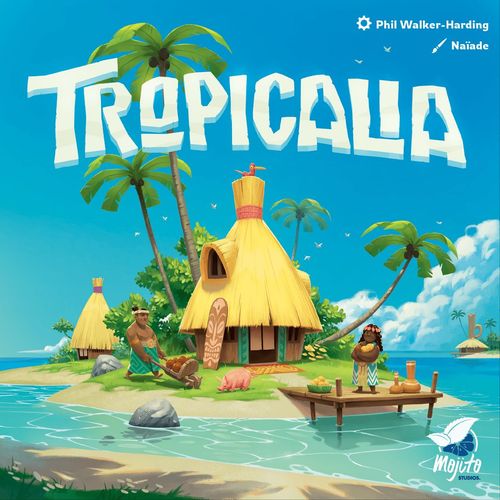
Tropicalia
Tropicalia Rulebook
Table of Contents
Table of Contents
Game Summary
Content
- 16 Island tiles: 6 fields, 6 markets, 4 plazas
- 8 Frame pieces to hold the Island tiles in place
- 16 Workers: 4 each in the 4 player colors
- 4 Player boards: 1 per player
- 4 Shell counters: 1 per player
- 1 Construction board to hold the available Village tiles
- 56 Fruits: 21 sugar apples (yellow), 21 coconuts (brown), 14 mangoes (red)
- 40 Village tiles: 10 buildings, 10 events, 10 orchards, 10 treasures
- 40 Item tiles: 10 carts, 15 baskets, 15 surfboards
- 5 First player tiles, marked rounds 1-5
- 1 Cloth bag to hold the Fruits
- 6 Advanced markets, double-sided. Used in the advanced variant
Setup
- Set up the Island board in the center of the table. First, connect the 8 Frame pieces together. Then shuffle the 16 Island tiles and place them face-up in random order in a 4 x 4 grid inside the frame.
- In a 2 player game, flip over the 2 tiles marked with the "X" player-count icons, and the tile marked with the "X" player-count icon.
- In a 3 player game, flip over the 2 tiles marked with the "X" player-count icons.
- Place the Construction board near the Island board. Shuffle all the Village tiles into a face-down draw pile nearby. Draw 5 tiles and place them face-up on the spaces of the Construction board.
- Place all Fruits in the cloth bag and place it in reach of all players.
- Shuffle the Item tiles and place them in a face-down draw pile beside the board.
- Each player takes a Player board, chooses a player color and takes the corresponding 4 Workers and Shell counter, placing the Shell counter on space 0 of their Shell track.
- Stack the First player tiles in ascending order from 1-5 beside the board. A starting player is randomly chosen and they take the top First player tile, marked with the number 1.
- The player to the left of the starting player begins with 1 Shell, and moves their Shell counter accordingly. In a 3 or 4 player game, the next player to the left begins with 2 Shells. In a 4 player game, the final player begins with 3 Shells.
- Finally, starting from the top leftmost Island tile and moving to the right and down, place 3 random Fruits on each field tile, taking them from the bag, and 2 face-up Item tiles on each plaza tile, drawing them from their pile.
You are now ready to play!
2 Players setup example: (illustration)
The Player Board
The player board is used to store the player's Fruits, and is where they build their village. At the start of the game, you may store up to 5 Fruits on the printed basket spaces. Collecting basket tiles will provide extra spaces for storage.
The order of Fruits on the player board does not matter and can be changed at any time.
Important: You may discard Fruits from your board at any time to make room for new ones, but may never go over your storage limit. Discarded Fruits are returned to the bag.
When you build a Village tile, place it on one of the 9 square spaces of your player board. Village tiles can not be moved once placed!
Start of a Round
The game is played over 5 rounds. At the start of each round, set up the Island board as follows:
- Each field tile has 3 Fruits placed on it, drawn randomly from the bag. When placing the Fruits from the bag, you should start at the top and leftmost field tile on the Island board and then move to the right and down, filling each field in order. This is done only to ensure the Fruits are placed out randomly.
- Each plaza tile has 2 Item tiles placed on it face-up, drawn from the Item tile draw pile.
On the first round of a game, this is step 8 of the setup.
Playing the Game
Each round of the game has 2 phases: the Morning phase followed by the Day phase. The workers arrive on the island in the morning to plan their actions and then execute them during the day.
1. The Morning Phase
The players take turns placing one of their Workers around the coast of the Island, starting with the player who has the First player tile for the current round, and moving clockwise around the table.
On your turn, take one of your unplaced Workers and place it on any vacant space on the Island board frame. You may have Workers at both ends of a row.
Once everyone has placed all their Workers, play moves on to the Day phase.
Morning phase example: The Magenta player goes first, placing their Worker on A, Blue chooses to place their first Worker on B. Now it's Magenta's turn again, who can place their next Worker on any of the vacant spaces of the frames. They place it on C, in front of their other Worker. Blue goes next, choosing a vacant space (D), and the two players continue like so until no more Workers to place remain.
2. The Day Phase
The players now take turns moving their Workers on to Island tiles to take their actions. Again, play begins with the person having the First player tile and moves clockwise around the table.
On your turn, you must choose one of your Workers on the board Frame and move it onto any vacant Island tile in the row this Worker is in. Vacant means any Island tile that does not already have a Worker of any color on it. You may "jump over" any other Workers in the row to place yours on a vacant tile.
After placing, you then take the action of the Island tile your Worker is on (see Island tile actions, p. 6). If there are no vacant Island tiles in its row, the Worker disc may not be moved (unless you have a surfboard or a cart tile - see below).
However, you may always choose to return home. This means you return your Worker to beside your Player board and then draw 1 Fruit randomly from the bag. On the very rare occasion that there are no Fruits in the bag, you miss out.
Note: In a 2 or 3 player game, you may not place your Worker on the flipped Island tiles.
Day phase example: Magenta player goes first, moving their Worker to A, to collect the Fruits from a field. Blue then moves their Worker to B, a plaza, and collects the two basket tiles. Magenta then moves their second Worker to C, a market where they can sell mangoes, and finally Blue moves to D, a market where to sell sugar apples. At this point, Magenta could move the Worker in E to the coconut market on the bottom right corner, but by doing so, they would cover the only vacant space available for their last Worker (F). The third Blue Worker (G), however has no other choice but to return home, given the only Island tiles on that row are already occupied by another Worker.
Using a Surfboard Tile
If you have a face-up surfboard tile, you may use it to instead place your chosen Worker on any vacant Island tile (it does not have to be in the same row as the Worker). Flip the surfboard tile face-down and move your Worker to any vacant Island tile on the board. Then, take the action of that Island tile.
Surfboard example: The Magenta player doesn't have any sugar apple to sell at the market, the only vacant Island tile in that row. However, they have a surfboard tile. They decide to use it and flip it face-down to move their Worker on to the field tile to collect Fruit.
Using a Cart Tile
If you have a face-up cart tile, you may use it to place your chosen Worker on an occupied market tile in that Worker's row. Then take the action of this tile. You may use a surfboard and a cart at the same time to place your Worker on any occupied market tile.
Any number of Workers may end up on the same market tile due to the playing of cart tiles.
Cart example: Magenta player has still some mangoes to sell, so they decide to use the cart tile, by flipping it face-down, to move yet another Worker to the market tile they used on a previous turn of this current Day phase.
Island Tile Actions
Field: Take all the Fruits on the field tile and place them on empty basket spaces and/or basket tiles on your Player board. Remember that you can always discard any unwanted Fruits to make room for new ones you are collecting!
Plaza: Take the two Item tiles on the plaza tile, then:
- Place any cart and surfboard tiles face-up beside your Player board, to be used on a future turn.
- Place any basket tile face-up on the left-most empty space below the baskets on your Player board. If all these spaces are taken, remove the tile from the game.
Market: You may sell any number of Fruits of the depicted type for the listed price - 2, 3 or 4 shells per Fruit.
Take the Fruits you sold from your board and return them to the bag. Then earn shells equal to the amount you received for the sale, by moving your Shell tracker accordingly on its track.
Building a Village Tile
At the end of your turn in the Day phase, you may build 1 Village tile from the Construction board. First, you must pay the cost in shells. The cost is the number listed in the shell depicted on the tile plus the number listed on the Construction board above the tile. After paying the cost in shells (moving your Shells tracker), place the chosen village tile on any of the nine square spaces on your player board. The tile may not be rotated and must be placed with the artwork in the correct orientation. If you have already built 9 village tiles, you may not build any more.
Building a Village tile example: Magenta player just sold fruit, and they now have enough money to buy the tile A from the Construction board, which costs 8 + 3 = 11. They move their Shell tracker backwards on its track, take the tile, and place it on their board. It shows 1 mango, so they immediately take 1 mango from the bag. They also completed 2 fountains (B), therefore they get to draw 2 random Fruits from the bag, one at a time. Finally, Magenta slides the tile on the tile under the "+4" on the Construction board to the left, and draws a new Village tile to fill the leftmost space that is now empty (C).
Field tiles: After placing a field tile, take the depicted Fruit(s) from the bag. If a Fruit type is not present in the bag, you may choose another type instead. On the very rare occasion that there aren't enough Fruits in the bag, you miss out.
Completing fountains: If the placement of the village tile results in the completion of any fountains along the edges of the tile, then you draw a random Fruit from the bag for each fountain formed, one at a time. On the very rare occasion that there aren't enough Fruits in the bag, you miss out.
After building, slide the tiles on the Construction board to the left to fill in the now empty space. Then draw a new tile from the draw pile and place it face-up below the "+4" space.
End of a Round
The round ends when all players' Workers have been placed on the Island board or returned home. Take now the following steps:
- In a 2-player game only: Remove from the game the left-most Village tile on the Construction board. Slide the tiles on the Construction board to the left to fill in the now empty space. Draw a new tile from the draw pile and place it face-up below the "+4" space.
- Any Item tiles remaining on the Island board are removed from the game.
- Any Fruits remaining on the board are put back in the bag.
- After the first 4 rounds, the player who owns the Worker on the plaza tile with the brown board takes the top First player tile from the stack. If no Worker was placed on this plaza tile, the current first player takes the top First player tile. The brown board has no effect at the end of round 5.
- Players retrieve all their Workers from the Island board and place them beside their player board, ready for the next round.
End of the Game
After the fifth round, the game is over. Each player calculates their final score as follows. (Victory points are shown with the star icon.)
Scoring by tile:
- Building tiles: Score the points listed on the tile.
- Event tiles: Score 7/15/24/34/45 points for 1/2/3/4/5 unique events on your player board.
- Orchard tiles: Score the points listed on the tile.
- Treasure tile (surfboard): Score 2 points per surfboard tile beside your Player board, used or unused.
- Treasure tile (event): Score 2 points per event tile on your player board.
- Treasure tile (orchard): Score 2 points per orchard tile on your player board.
- Treasure tile (basket): Score 2 points per basket tile on your player board.
- Treasure tile (building): Score 2 points per building tile on your player board.
- Treasure tile (completed fountain): Score 2 points per completed fountain on your player board.
Other scoring:
- Lose 4 points for each type of Village tile you have 0 of - building, event, orchard, treasure.
- 1 point per Fruit remaining on your player board.
- 1 point per 2 Shells remaining.
- 1 point per unused cart and surfboard tile. Used carts and surfboards are worth nothing.
The player with the most points wins!
If there is a tie, the player with the most remaining shells wins. If there is still a tie, the player with the most remaining Fruits wins.
You can use your Shell tracker to keep track of your points. Just don't forget to count how many shells you have at the end of the game, because they are worth points!
Advanced Variant
Experienced players can use the Advanced markets for an extra challenge. After setup, shuffle the double-sided Advanced market tiles and place 3 of them randomly on top of the following market tiles: sell coconut for 3, sell sugar apple for 3, sell mango for 4. The Advanced markets marked with a green star provide an extra level of challenge.
Each advanced market tile allows Fruits to be sold in a new way:
Front side:
- Sell a set of 1 coconut and 1 sugar apple for 5 shells. You may sell multiple sets.
- Sell a set of 1 sugar apple and 1 mango for 6 shells. You may sell multiple sets.
- Sell any Fruit for 2 shells. You may sell multiple Fruits.
- Sell a set of 4 Fruits of the same type for 13 shells. You may sell multiple sets.
- Sell any number of Fruits of the same type for 2 shells each. If before selling, you have more Fruits on your player board than every opponent, the Fruits sell for 4 shells each instead. (green star)
- Sell any number of Fruits of the same type. Earn an amount of shells per Fruit equal to the number of Workers currently on market tiles (not including the disc just placed). (green star)
Back side:
- Sell a set of 1 coconut and 1 mango for 6 shells. You may sell multiple sets.
- Sell a set of 1 coconut, 1 sugar apple, and 1 mango for 9 shells. You may sell multiple sets.
- Sell any Fruits for 5 shells. You may sell only 1 Fruit.
- Sell a set of any 5 Fruits for 13 shells. You may sell multiple sets.
- Sell any number of Fruits of the same type for 2 shells each. If before selling, you have fewer Fruits on your player board than every opponent, the Fruits sell for 5 shells each instead. (green star)
- Sell any number of Fruits of the same type. Earn an amount of shells per Fruit equal to the number of Workers currently on Island tiles in the same row and column of this market (not including the disc just placed). (green star)