Troke
Troke Rulebook
Table of Contents
Table of Contents
Pieces
Object: Win chips by capturing opponent's pieces and by assembling Castles on one's own Goal Line.
Troke is a game for two, three or four players. There are twelve playing pieces of each color.
[Diagram 1 omitted.]
-
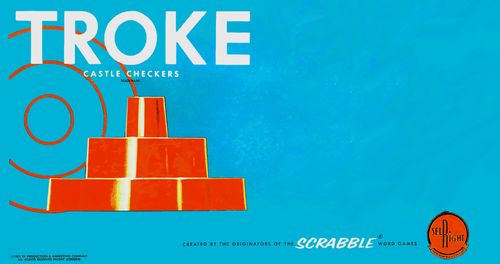
The pieces fit together so that two or three of them may be assembled on one point. A complete assembly of three pieces, all of one color, is called a Castle.
-
Each player receives all twelve pieces of one color. When there are two players, one plays the Red and the other the Green pieces.
When there are three players, one plays Red, one Green, and the third either Yellow or Blue, and they should change positions after each game so as to take turns being opposite the unoccupied side of the board. Four players may play as individuals, each for himself, or they may play as partners, Green and Red against Blue and Yellow.
- Scoring is done with chips. At the start, each player receives an equal number of chips of the same color as his playing pieces.
Starting Position and Objects of Play
- Each player sets up all twelve of his playing pieces in the form of four Castles on the row of starting points in front of him (his Starting Line); these are marked with outer rings of his color.
His object in play is to move all his pieces across the board and reassemble them on his four goal points in the row opposite him (his Goal Line); these are marked by center spots of his color.
- The object in scoring is to win chips. Chips may be won by capturing pieces of opposing colors and by assembling complete Castles on one's own Goal Line. The player who has won the most chips is the victor.
The Moves
-
Red always moves first, then the turn passes to the left.
-
A move is made by taking any one piece, either a Tower, a Wall, or a Moat, and moving it along a line to the next point (marked by a circle). A player may move his pieces straight or diagonally forward or sideways, but never backward.
(See moves indicated by black arrows on Figures I, II and V seen on pg. ) [Source as printed: the page reference is blank and the figure numbers are Roman numerals; the illustrations are numbered 1 to 8 below.]
-
A piece cannot be moved to a point already occupied by a piece of the same type (Wall, Tower or Moat), but it may be moved to a point occupied by one or two pieces of different kinds, regardless of color.
-
When a piece is moved to a vacant point, the move is complete and the player's turn ends. When a piece is moved to a point occupied by another piece or pieces, it captures those pieces (regardless of their color).
-
For each piece captured, whether his own or his opponent's, the player, in the same turn, moves one additional point, straight or diagonally forward or sideways.
The additional move or moves must be made by the entire assembly: the piece or pieces that did the capturing plus the piece or pieces captured.
Thus, while a player may never move his own piece backward, it may be carried backward when captured by an opponent, but the opponent may never carry a player back into a player's own Starting Line.
The opponent, therefore, must work out his move so that it will terminate before reaching a player's Starting Line, or he cannot make this particular capture.
-
A captured piece of a different color remains under the control of the capturing player only during the capturing move. In subsequent turns, it may be moved by its own player or captured again by an opponent.
-
When a capturing move is made, the player must continue and complete the moves called for by rule 10. Therefore, a player cannot legally capture his own or opposing pieces if the position of other pieces blocks completion of the move in accordance with rules 7 to 10.
The only exception to this requirement occurs when the capturing piece reaches one of its own goal points (see rule 16).
Moves That May Not Be Made
-
Castles may be partially assembled on a player's Goal Line, but may not be completed unless all of that player's pieces have left the player's Starting Line. Thus, it is good strategy for players to move their pieces out of their Starting Lines early in the game to avoid being blocked or delayed in assembling completed Castles.
-
After moving from its Starting Line, a piece may not move or be carried back to its Starting Line or into any Goal Line except that Goal Line of its own color.
That is, Red and Green may not move into the Blue or Yellow Goal Lines. Blue and Yellow may not move into the Red or Green Goal Lines.
-
No player may shuttle sideways between the same two points in the same or successive turns.
-
When any piece reaches one of its own goal points before completing a capturing move, the player may elect to continue the move sideways to another goal point or to terminate the move at the first goal point touched.
-
On his own Starting Line, a player may move sideways or take the additional moves for capturing his own man or men.
-
On his own Goal Line, a player may move sideways and has the option of taking additional moves for capturing his own or opponent's men, as explained in Rule 16.
-
A player may not be moved or captured by any opponent on the player's own Goal Line. This does not prevent the opponent from moving pieces of different size to the same point if he has not yet moved out (since it is the opponent's Starting Line). However, such a move does not constitute a capture and does not earn additional moves or chips for the opponent.
[Source as printed: "pieces of different size" in rule 19 may be a typo for a different word; kept as printed.]
Ending the Game
-
Play ceases and the game ends when a player has reassembled all twelve of his pieces to form complete Castles on his own Goal Line.
-
If a player is unable to move legally, he loses his turn. If no player is able to move legally, the game is ended. A player may not waive his turn if he is able to make any legal move.
-
Whenever a player captures an opposing piece, he receives one chip from the owner of the piece captured.
-
The first player to assemble one Castle on his own Goal Line receives one chip from each of the other players.
-
The first player to assemble two Castles on his own Goal Line receives two chips from each of the other players.
-
The first player to assemble three Castles on his own Goal Line receives three chips from each of the other players.
-
The first player to assemble four Castles on his own Goal Line receives four chips from each of the other players.
Alternate Scoring System
For those who prefer more strategy and higher stakes, the above scoring is still used at the conclusion of the game, but the players can earn additional chips during play each time an opponent's piece (or pieces) is captured.
Scoring would be as follows:
Each opponent's piece has the following value:
- Tower: 1 chip
- Wall: 2 chips
- Moat: 3 chips
Player's Tower capturing opponent's:
- Wall: 2 chips
- Moat: 3 chips
- Wall and Moat: 5 chips
Player's Wall capturing opponent's:
- Tower: 1 chip
- Moat: 3 chips
- Tower and Moat: 4 chips
Player's Moat capturing opponent's:
- Tower: 1 chip
- Wall: 2 chips
- Tower and Wall: 3 chips
[Source as printed: the third heading reads "Player's Wall capturing opponent's", a repeat of the second. Its values (Tower 1, Wall 2, Tower and Wall 3) match a Moat capturing, so the heading is corrected to Moat here.]
Move Diagrams
The source's eight figures are illustrations. Their captions are kept below.
Figure 1: Opening Moves. Each player moves one piece straight or diagonally forward to a point marked by a round spot. (Moves illustrated are diagonally forward.)
Figure 2: Opening Moves and Captures. The blue Wall captures the blue Tower and both move one point further. The yellow Wall moves to an unoccupied point, ending yellow's turn.
Figure 3: Compound Captives. The blue Moat captures two pieces and gains two moves forward. The yellow Tower captures a Moat and together they move one point to capture a Wall and gain a second extra move forward.
Figure 4: Compound Captures. Blue moves a Moat and yellow a Wall. Each captures two pieces and is entitled to move two additional points forward.
Figure 5: Opening an Attack. Both players have moved their Castles to the center of the board. Blue begins an attack by moving a Tower to create an opening for a capturing move.
Figure 6: Capturing Opposing Pieces. Yellow's Tower captures two blue pieces at the center of the board and moves them two points toward yellow's goal.
Figure 7: Counter Attack. Blue's Tower captures the Wall and Moat left in a vulnerable position by yellow, and moves two points onward. Note that blue cannot carry the yellow Wall and Moat back into their Starting Line.
Figure 8: Moving Away from Capture. Yellow moves a Wall forward from the point to which it was carried in the previous move. Note that blue, in his turn, now will have an opportunity to complete a Castle on either of two Goal points.