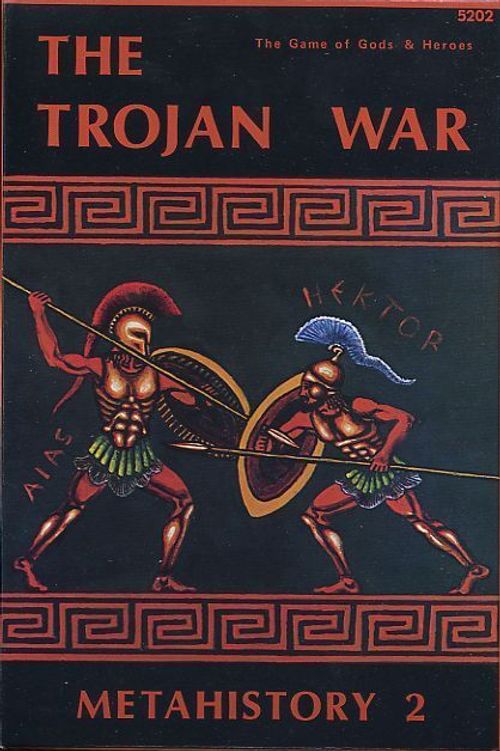
The Trojan War: The Game of Gods & Heroes
The Trojan War: The Game of Gods & Heroes Rulebook
Table of Contents
Table of Contents
- Introduction
- Counters
- Preparation for Play
- Sequence of Play
- Movement Phase
- Combat Phase
- Combat Results
- Rallying
- Replacements
- Rendering Aid
- Walls
- Intervention of the Gods
- Victory Points
- Scenarios
- Scenario 1: The Deeds of Diomedes, from The Iliad, Book V
- Scenario 2: The Short Battle, from The Iliad, Book VIII
- Scenario 3: The Battle at the Ships, from The Iliad, Book XI+
- Scenario 4: The Vengeance of Achilles, from The Iliad, Book XX+
- Scenario 5: Then Came the Amazons, from Quintus Smyrnaeus, Book I
- Scenario 6: The Death of Achilles, from Quintus Smyrnaeus, Book I
- Scenario 7: Hercules' Grandson, from Quintus Smyrnaeus, Book VI
- Scenario 8: The Second Battle at the Ships, from Quintus Smyrnaeus, Book VII
- Scenario 9: The Triumph of Neoptolemus, from Quintus Smyrnaeus, Book VIII
- Campaign Game
- Combat Results Table
Introduction
The Trojan War is a 2-player game about the legendary conflict between the ancient Greeks and the city of Troy, immortalized in Homer's epic poem The Iliad, in 1185 B.C.
The game is played over a Hex-grid Map depicting the Scamander Plain, with each playing piece representing a specific Hero of the armies, together with the common foot soldiers led by them.
There are 11 Scenarios that can be played, each of them as a stand-alone battle. They can also be played chronologically as a Campaign covering the entire siege of Troy.
Counters
Blue-Green Unit counters are Greek, while Orange-Red Unit counters are Trojans. The top-left number on the Unit counters is the Attack Factor, top-right number is the Defense Factor, bottom-left number is the Movement Allowance.
A few Hero Units are armed with bows and have a Bow Attack Factor highlighted in a colored box.
Some Unit counters have an "R" next to their Class and this indicates that the Hero is a Replacement, which can only come out once casualties begin to happen during the course of the battle. Some Unit counters also have an "*" underneath their Class, and these Heroes are only available in specific Scenarios.
In addition to Unit counters, there are also Combat Results Markers used to indicate modifiers applied on Hero counters during Combat.
Acts of Intervention by the Gods of Greek Mythology are represented by Counters that help the players in a variety of ways. From giving bonuses in Combat, shielding Heroes from harm, to even rescuing fallen Heroes from capture, God Intervention Counters are essential to either players' victory.
Finally, there are Markers used to keep track of Victory Points each player accumulates during the battle and the current game turn.
Preparation for Play
a) Both players decide which Scenario they wish to play and which side they will play as.
b) Each player takes all Hero Unit counters for their side without "R" or "*" on them.
c) Using the Scenario outline, players remove Heroes indicated and add the indicated "R" and "*" Heroes needed.
d) Both players draw the number of God Intervention Counters needed without looking at them.
e) Both players take 15 Chariots each.
f) Set up as indicated in the Scenario outline. The player who takes the first turn sets up their Hero Unit and Chariot counters first.
g) Start the first turn, skipping the first player's Rally Phase.
Sequence of Play
Each Game-Turn consists of several phases, which must be performed in order. The Scenario rules indicate which side moves first.
a) First Player's Turn
- Rally Phase ("Stun" & "Panic" Combat Results can be removed)
- Movement Phase
- Combat Phase
- Joint Replacement Phase (Both players take Replacements, if any)
b) Second Player's Turn
- Rally Phase
- Movement Phase
- Combat Phase
- Joint Replacement Phase
Movement Phase
During each Movement Phase, the current player may move some, none, or all of his Hero and Chariot Unit counters. Each Unit may be moved in any direction or combination of directions up to their maximum Movement Allowance Value per turn. A Unit may move less than its Movement Allowance and does not have to move at all if the player wishes. Unused movement may not be saved for the next turn. Units may not leave the map, except by Evacuation.
Example: Achilles, who has a Movement Allowance of 9, may move nine Hexes each turn.
a) Friendly Units- A Unit may freely move through any Hex occupied by other Units on their side. Any number of friendly Units may end their movement in the same Hex; however, this may affect them negatively during Combat.
b) Enemy Units- A Unit may NEVER move into or through a Hex occupied by a non-killed enemy Hero. An enemy Hero also exerts a Zone of Control (ZoC) into nearby Hexes, which slows down movement of Hero's within them. Leaving a Hex in an enemy PZoC or SZoC costs two points of a Hero's Movement Allowance, in addition to the cost of entering the next Hex (for a total of three points).
- ZoC's extend into, but not through, non-killed enemy Heroes and Walls.
- Wounded and Killed Heroes do not exert any ZoC.
- Empty Chariots do not exert any ZoC.
- Stunned and Panicked Heroes only exert a PZoC.
c) Chariots- Each Chariot can carry up to 2 friendly non-killed Heroes at a time. They can also be used to transport 1 killed friendly or enemy Hero alongside 1 friendly non-killed Hero.
- A Chariot may only pick up Heroes that begin the turn in its Hex.
- A Chariot moves at its normal Movement Allowance, loaded or empty. It may enter an enemy PZoC only if it is carrying a Normal or Stunned Hero.
- A Chariot may drop off a Hero in any Hex that it moves through. The Chariot may continue moving, but the Hero may not move any further by itself that turn.
- Capturing Chariots- A Hero may move into or through Hexes occupied by empty enemy Chariots without penalty. If a Hero ends the Combat Phase in the same Hex as an enemy Chariot, the Chariot becomes friendly.
Combat Phase
Each Normal Greek or Trojan Hero which is next to an enemy Hero during its own Combat Phase may attack that enemy Hero. No more than one attacker may attack a single defender at a time. Attack Factors may NOT be combined. If there is more than one Hero occupying a Hex, then none of them may attack. They may still counterattack.
Only one attacking Hero is allowed to put Combat Results on a single defender in a turn. A defender may be attacked by another Hero ONLY if the first Hero's attack(s) were ineffective ("Miss" or "Chariot Hit"). A single attacker may attack a defender more than once per Combat Phase, possibly accumulating Combat Results on the defending Hero.
If ONE Stunned, Panicked, or Wounded Hero is in the same Hex as ONE Normal Hero, the owning player decides which one will defend against an attack. In any other type of defending stack, the attacking player decides which Hero will defend.
Combat Procedure
a) Attack- Subtracting the Defense Factor of the defending Hero from the Attack Factor of the attacking Hero gives the Combat Differential. This can be positive, negative, or zero. Finding the corresponding column on the Combat Results Table (CRT), the attacking player rolls the d6 and cross-references the column and the line on the CRT to determine which Combat Result (if any) is applied to the defending Hero.
Example: Menelaus attacking Pirus is a 6 minus 4 attack, which gives a Combat Differential of +2. If a 3 is rolled, then Pirus would be Stunned.
b) Counterattack- After every attack, whether the attack was successful or not, the defending Hero may counterattack even if it has already counterattacked during that turn. Combat Results just suffered by the defender are not considered. However, PREVIOUS Combat Results are considered; these may prevent the counterattack from occurring. Counterattacking is conducted just like a normal attack. Any Hero may counterattack any number of times, provided they retain a Normal state.
Example: Pirus' counterattack is 5 minus 7, which is a Combat Differential of -2. If a 2 is rolled, the Combat Result is a "Miss". Pirus' Stun is not considered for the counterattack due to it being sustained during this specific attack.
c) Retreating- If the defending Hero suffers a "Miss", "Chariot Hit", or "Stun" Combat Result they have the option to Retreat. An attacking Hero that suffers a "Chariot Hit" or "Stun" Combat Result from a counterattack also has the option to Retreat. All Heroes that suffer a "Panic" or "Wound" Combat Result MUST Retreat.
- A Hero on foot Retreats one Hex.
- A Hero on a Chariot Retreats up to two Hexes.
- While Retreating, the Hero may not enter any enemy PZoC's, and if they are surrounded by PZoC's then Retreat is not possible.
- A Hero may never Retreat into a Hex occupied by an enemy non-killed Hero, an enemy Wall, or off the Map.
- Only the attacked or counterattacked Heroes may Retreat, not any other Heroes stacked in the same Hex with them.
Example: Pirus, having suffered a "Stun" Combat Result during this attack, may Retreat one Hex away from Menelaus. Menelaus may not Retreat since Pirus' counterattack was a "Miss".
d) Advancing- The attacker may Advance if:
- The defender Retreats or is killed.
- The attacker does not suffer a "Stun" or worse Combat Result from the defender's counterattack.
The defender may never Advance, regardless of the counterattacks results.
- Advancing is along the defender's Retreat path or into killed Hero's Hex; one Hex if the attacker is on foot and up to two Hexes if on a Chariot.
- Advancing is always voluntary, but it must be done immediately, before any other attack commences.
Example: Menelaus may Advance into the Hex that Pirus just Retreated out of.
Multiple Attacks (Hero Classes)
The type of Class the Hero Unit has on their counters determines how many times that Hero may attack per turn. Remember that only Heroes who retain a Normal state may attack.
- Class III Heroes may attack three times per Combat Phase.
- Class II Heroes may attack two times per Combat Phase.
- Class I Heroes may attack once per Combat Phase.
The defender of the second or third attack may be the same Hero, or it may be a different Hero.
Example: Menelaus may attack Pirus again, this time benefiting from Pirus' Stun. Pirus may not counterattack since he is Stunned.
Bow Attacks
Bow attacks may be done by Heroes with Bow Attack Factors. These attacks are done against enemy Heroes that are two to three Hexes away. Intervening Hexes may not be a Wall, or occupied by a non-killed Hero, unless the bowman is firing from atop a Wall. The attack can fire along the edge of a Hex which has a Wall or friendly Hero.
The Combat Procedure for Bow attacks are the same as any other attacks, with the following exceptions:
- No counterattack may occur.
- The defender must Retreat away from the attacker.
- The bowman does not Advance.
Example: Paris can fire at Ajax, but not at Sinon or Achilles.
Combat Results
a) Miss- The attack is unsuccessful.
b) Chariot Hit- One enemy Chariot is removed from the affected Hero's Hex. If no Chariot is present, then this result is considered a "Miss".
c) Stun- The Hero's Defense Factor is reduced by 1.
d) Panic- The Hero's Defense Factor is reduced by 2. The Hero may not enter an enemy Hero's PZoC without an escort.
e) Wounded- The Hero's Defense Factor is halved (round fractions down). The Hero may not enter an enemy Hero's PZoC without an escort.
f) Killed- The Hero is slain and is flipped over and left on the Map.
If a Hero that already bears a Combat Result receives that Result again, it changes to the next most severe Result:
- Stun + Stun = Panic
- Panic + Panic = Wounded
- Wounded + Wounded = Killed
If the Hero receives a worse Combat Result than one already acquired prior, then it replaces the previous Result. However, if the Hero receives a less severe Result, then it is ignored.
Rallying
During the Rallying Phase, the player whose turn it is rolls the d6 for each of their Heroes that are either Stunned or Panicked. Wounded Heroes cannot be Rallied.
- Panicked Heroes cannot Rally if they are in an enemy Hero's PZoC.
- Stunned Heroes Rally on a roll of a 4 or higher.
- Panicked Heroes Rally on a roll of 5 or higher.
Rally Assistance- If a friendly Class II or III Hero is in the same or adjacent Hex as the Hero attempting to Rally, then a positive modifier is applied to their die roll.
- A Hero may not give Rally Assistance if he's also Stunned, Panicked, Wounded, or Killed.
- Class II Heroes add a +1 modifier.
- Class III Heroes add a +2 modifier.
The Hero may give Rally Assistance the same turn he Rallies. No more than one Hero can assist on a die roll. However, a single Hero may assist more than one die roll.
Example: A Stunned Odysseus becomes Normal if a 2 or higher is rolled due to Achilles's +2 modifier as a Class III Hero.
Replacements
Whenever a Hero is Killed, the owning player takes one new Hero that is marked with an "R". A Replacement is also taken for each Wounded Hero that is successfully Evacuated. No more than 12 Replacement Heroes for each side may be on the board.
Replacement Heroes are placed on the last Hex-row of the Map, behind the Wall of Troy for the Trojans and on Ship Hexes that are not Destroyed for the Greeks. They may not be placed in enemy PZoC's. A Replacement Hero may be placed on the Map in any Joint Replacement Phase of the following turn the original Hero was Killed (even during the opponent's turn). When a Replacement Hero is Killed, they are immediately removed from the board.
During the Campaign, Killed Replacements may be recycled back into the Replacement Pool to be used again in other Scenarios.
Rendering Aid
Although Panicked and Wounded Heroes still possess the ability to move by themselves, they are unable to move into/through enemy PZoC's. however, they may be Escorted by another friendly Normal Hero. The Normal Hero moves into the Hex and then continues its movement accompanied by the Panicked or Wounded Hero. A single Normal Hero may only Escort one other Hero in a turn.
Chariot movement may be used if both the transported and transporting Heroes begin in the same Hex with the Chariot, or if both Heroes begin in different Hexes but both have Chariots.
The Normal Hero may "drop off" the other Hero at any point during the movement. The Panicked or Wounded Hero may not move by itself in that turn.
- Killed Heroes- May be transported by friendly or enemy Chariots, or even friendly or enemy Heroes. The transporting Hero may not bear any Combat Results. Movement is not hindered, but a Hero carrying a Killed Hero while on foot cannot attack during the Combat Phase (counterattacks are still possible). If a Hero transporting a Killed Hero suffers a "Stun" or worse Combat Result, then they immediately drop the Killed Hero.
- Evacuations- If a Killed or Wounded Hero reaches the last Hex-row on its side of the Map, behind its own Wall, then they are removed off the Map and are safe from further harm.
- Wounded Heroes may not return to the Map unless Healed by God Intervention.
- Killed Heroes are considered Captured if they are taken to the enemies last Hex-row. Captured Heroes are more valuable when allocating Victory Points.
Walls
The Walls of Troy and the Greek Sea Wall are considered friendly to their respective forces. Heroes on Walls exert normal ZoC's in all directions.
a) Movement- Friendly Heroes move normally through Wall Hexes. Enemy Heroes must end their movement when moving onto the Wall from the ground. They may not enter enemy PZoC's, unless the enemy Heroes are exerting that ZoC from the ground. Enemy Chariots may not move onto a Wall. All Units move normally from Wall Hex to Wall Hex or from Wall Hex to ground.
b) Defense- When a Hero on a friendly Wall is attacked or counterattacked by a Hero on the ground, its Defense Factor is increased.
- Trojan Wall gives a +3 modifier to Trojan Heroes.
- Greek Sea Wall gives a +2 modifier to Greek Heroes.
c) Greek Sea Wall- If four or more non-Killed Trojan Heroes are on or behind the Greek Sea Wall at any time, the wall is Destroyed for the rest of the battle. All Hexes are considered normal for all purposes.
Intervention of the Gods
Before play begins, all God Intervention Counters are flipped face-down and thoroughly mixed up. Each player then draws the number indicated in the Scenario that is being played, without the other player seeing them. Some Scenarios may specify additional, non-random counters players can use.
Each God Intervention Counter may only be played once per game, and after it is played, they are removed from the players' pile. A player may not use more than one per turn. The player places his Gods Intervention This Turn counter on the Game Turn Track as a reminder. However, this does NOT include God Intervention Counters and other events outlined in the Scenario's special rules.
NOTE: An (*) in the title of the counters listed below may not be played DURING a die roll, to change an already announced attack or counterattack.
a) *A God Fights- Placing this counter on a Hero will grant them a +2 modifier to their Defense Factors and to the die rolls for each attack or counterattack by that Hero.
- At the start of their Rally Phase, the player rolls the d6 for each Hero with this counter. The counter is removed on a roll of 1 or 2.
b) * Strength & Courage- Placing this counter on a Hero will grant them a +1 modifier to both their Attack and Defense Factors.
- This counter is removed off the Hero if it ever suffers a "Panic" or "Wounded" Combat Result.
- At the start of their Rally Phase, the player rolls the d6 for each Hero with this counter. The counter is removed on a roll of a 1.
c) Render an Enemy Helpless- A player can use this counter at the end of their Combat Phase, which allows them to place a "Panic" marker on any enemy Hero. If the Hero chosen is already Panicked, then it is "Wounded" instead.
d) Deflect Weapon- A player may play this immediately after any attack or counterattack. A single Combat Result which has just been applied to a friendly Hero can be reduced.
- Chariot Hit is a Miss.
- Stun is a Miss.
- Panic becomes a Stun.
- Wound becomes a Panic.
- Killed becomes Wound.
e) *Stop Weapon- Playing this on a friendly Hero, it may not be attacked during the enemy Combat Phase of the current turn. He MAY be counterattacked. This counter is automatically removed from the Hero at the end of the enemy Combat Phase.
f) *Mist- Placing this counter on a friendly Hero, that Hero may not attack, or be attacked. The Hero also does not exert a ZoC. Other Heroes in the Hex are unaffected. The Mist is removed whenever the affected Hero leaves the Hex, or when the owning player wishes.
g) *Rescue a Hero- A non-killed friendly Hero is removed from the Map. Chariots remain behind. On the next Joint Replacement Phase, the Rescued Hero can re-enter the Map as if he were a Replacement.
h) *Rescue a Slain Hero- A Killed friendly Hero is removed from the Map to prevent Capture. Chariots remain behind. The Hero may have been transported by the enemy, but it may not have already been removed from the Map by the enemy.
i) Heal- During the friendly Rally Phase, a "Stun", "Panic", or "Wound" Combat Result is removed from a friendly Hero.
Victory Points
In most Scenarios, Victory is determined by Victory Points. Each player has a "1x", "10x", and "100x" counter. When a player receives Victory Points, he moves his counters on the Game-Turn Record Track on the Map. Victory points are awarded as follows:
- Killing a Hero: Class Number times Attack Factor.
- Wounding a Hero: ½ Class Number times Attack Factor.
- Killing a Wounded Hero: ½ Class Number times Attack Factor.
- Capturing a Killed Hero: Class Number times Attack Factor.
Aggressiveness- If a player has fewer than ten non-Killed Heroes outside of his own Wall at the end of his own Movement Phase, the other player receives 4 Victory Points each turn that this happens.
- This rule is ignored if the Greek Sea Wall is torn down.
In some Scenarios, victory depends on the destruction of Ship Hexes. If a Normal Trojan Hero begins the Trojan Movement Phase on a Ship Hex, that Ship is permanently Destroyed.
Scenarios
There are 11 Scenarios. Each is a stand-alone battle; the Campaign Game (below) plays them in chronological order.
Scenario 1: The Deeds of Diomedes, from The Iliad, Book V
Shortly after Agamemnon's famous quarrel with Achilles, both armies get ready to fight. The Greek Hero Diomedes is especially favored by the goddess Athena that day.
Trojan Army: All Regular Heroes plus Pandarus; 15 Chariots
Greek Army: All Regular Heroes; 15 Chariots
Gods Intervention Counters: Trojans-6, Greeks-5
Set-up: Trojans on or behind line of Hexes between T and T' and the Greeks on or behind line of Hexes between G and G'
First Move: Greeks
Game Length: Eight Game-Turns
Victory: The player with the most Victory Points wins
Special Rule: Diomedes (Greek) receives two free "Strength & Courage" counters during the game. They may not both be in effect at the same time. Lost in the usual ways.
Scenario 2: The Short Battle, from The Iliad, Book VIII
The God Zeus is resolved to bring ill on the Greek army. Accordingly, he sends a crash of lightning into the Greek ranks at an unexpected moment, temporarily demoralizing them. While Zeus does his will, no other God is to intervene.
Trojan Army: All Regular Heroes; 15 Chariots
Greek Army: All Regular Heroes; 15 Chariots
Gods Intervention Counters: none
Set-up: Trojans on or behind Trojan Wall and the Greeks on or behind the Greek Sea Wall
First Move: Trojans
Game Length: Eight Game-Turns
Victory: The player with the most Victory Points wins
Special Rule: Zeus' Intervention: During any two consecutive Greek Rally Phases, the Trojan player may declare that no Panicked Greek Heroes may Rally.
Scenario 3: The Battle at the Ships, from The Iliad, Book XI+
Agamemnon initiates the battle with great zeal, but is eventually wounded, causing the Greeks to become disheartened. Zeus is still determined to see the Trojans triumph. Only the god Poseidon defies him and lends surreptitious aid to the two Ajax's. The Greek misfortune at last forces Achilles to allow his friend Patroclus to impersonate him in order to help the Greeks.
Trojan Army: All Regular Heroes; 15 Chariots
Greek Army: All Regular Heroes plus Patroclus; 15 Chariots
Gods Intervention Counters: Trojans-10, Greeks-none
- Ajax & Ajax the Lesser each receive one free "Strength & Courage" counter.
Set-up: Trojans on or behind line of Hexes from T to T' and the Greeks on or behind the Greek Sea Wall
First Move: Trojans
Game Length: Twelve Game-Turns
Victory: The Trojans win if the Destroy three Greek Ships AND have 50 more Victory Points than the Greeks at the end of the battle. The Greeks win by preventing a Trojan victory.
Special Rules:
a) Agamemnon's Recklessness: Agamemnon (Greek) must make an attack every Turn, beginning with Turn 3. If he is Stunned or Panicked or otherwise unable to attack, he becomes Wounded. (Victory Points awarded)
b) Loss of Agamemnon: When Agamemnon is Killed or Wounded, no Panicked Greek Heroes may be Rallied for the next two Turns.
c) Patroclus' Entry: Patroclus enters the Map after either 1) a Normal Trojan moves adjacent to a Ship Hex, or 2) the Trojans have 40 Victory Points more than the Greeks.
- He enters the same way as a Replacement Hero. No Panicked Trojans may be Rallied for the next two Turns.
- Once Patroclus has entered, the Greeks lose 5 Victory Points every Turn a Normal Patroclus does not make an attack.
- The Trojans receive 50 Victory Points if a Killed Patroclus is Captured, rather than the usual 21.
Scenario 4: The Vengeance of Achilles, from The Iliad, Book XX+
Because Hector has slain Achilles' friend Patroclus, Achilles is determined to slay Hector himself. Meanwhile, remorseful that his errors of judgement have brought the Trojans to an ill pass, Hector resolves to face Achilles in a duel to the death.
Trojan Army: All Regular Heroes except Sarpedon, plus 1 "R" Hero; 15 Chariots
Greek Army: All Regular Heroes except Agamemnon, Diomedes, Odysseus, & Eurypylus, plus Achilles & 4 "R" Heroes; 15 Chariots
Gods Intervention Counters: six for each player
Set-up: Trojans on or behind line of Hexes from T to T' and the Greeks on or behind the Greek Sea Wall
First Move: Greeks
Game Length: Eight Game-Turns
Victory: The Greeks win if Hector is Killed by Achilles, and if Hector was not already Stunned, Panicked, or Wounded because of another Greek Hero's attack or counterattack or an "REH" Counter. The Trojans win if Achilles is Killed, or if the Trojans earn more Victory Points than the Greeks. If neither or both players achieve their conditions, the game is a Draw.
Special Rules:
a) Achilles' Demoralization Effect: After Achilles has killed any Trojan Hero, Panicked Class I & II Trojans may not be Rallied until Achilles is Wounded or Killed.
b) Hector's Stubbornness: Hector may not go on or behind the Trojan Wall. He must attempt to Rally if Stunned or Panicked.
c) God's Fate: No God Intervention Counters except "Rescue Hero" or "Rescue Slain Hero" may be used on Hector.
Scenario 5: Then Came the Amazons, from Quintus Smyrnaeus, Book I
Following the death of Hector, the Amazon Queen Penthesilea arrives to help the Trojans. Still in mourning for the dead Patroclus, Ajax and Achilles remain at his grave until they realize what a danger Penthesilea poses for the Greek army.
Trojan Army: All Regular Heroes except Hector, Sarpedon, Asteropaeus (Asterops.), & Glaucus, plus Penthesilea & 3 "R" Heroes; 15 Chariots
Greek Army: All Regular Heroes plus Achilles; 15 Chariots (Achilles & Ajax are not on the Map)
Gods Intervention Counters: six for each player
Set-up: Trojans on or behind Trojan Wall and the Greeks on or behind the Greek Sea Wall
First Move: Trojans
Game Length: Ten Game-Turns
Victory: The player with the most Victory Points wins
Special Rules:
a) Aid for Penthesilea: Penthesilea receives two free "Strength & Courage" counters. They may not both be in effect at the same time.
b) Lateness of Ajax & Achilles: The Greek player rolls the d6 at the beginning of each Game-Turn. If a 6 is rolled, Ajax & Achilles may enter that turn.
Scenario 6: The Death of Achilles, from Quintus Smyrnaeus, Book I
Memnon, the prince of Ethiopia, appears to succor beleaguered Troy. He is no match for Achilles, but Achilles' time's run short as well. Angrily, Apollo assists the Trojan Paris in slaying the mighty Hero.
Trojan Army: All Regular Heroes except Hector, Sarpedon, & Asteropaeus, plus Memnon & 3 "R" Heroes; 15 Chariots
Greek Army: All Regular Heroes except Podarces, plus Achilles & 1 "R" Hero; 15 Chariots
Gods Intervention Counters: six for each player
Set-up: Trojans on or behind Trojan Wall and the Greeks on or behind the Greek Sea Wall
First Move: Trojans
Game Length: Eight Game-Turns
Victory: The player with the most Victory Points wins
Special Rules:
a) Achilles' Aggressiveness: The Trojans receive 10 Victory Points each Turn (beginning on Turn 2) that Achilles is Normal but does not make an attack.
b) Apollo's Aid to Paris: On or after Game Turn 5, Paris may make one special bow attack on Achilles using the +7 column on the Combat Results Table.
c) God's Fate: No God Intervention Counters except "Rescue Slain Hero" may be used on Achilles.
Scenario 7: Hercules' Grandson, from Quintus Smyrnaeus, Book VI
Eurypylus of Mysia, a grandson of Hercules, comes to Troy with reinforcements. Meanwhile, Odysseus and Diomedes have left Troy in order to fetch Achilles' son Neoptolemus. The Greeks defend in a demoralized state, since they have lost not only Achilles, but Ajax too- by suicide.
Trojan Army: All Regular Heroes except Hector, Sarpedon, Asteropaeus, & Glaucus, plus Eurypylus & 4 "R" Heroes; 15 Chariots
Greek Army: All Regular Heroes except Ajax, Antilochus, Podarces, Odysseus, & Diomedes, plus 6 "R" Heroes; 15 Chariots
God Intervention Counters: six for each player
Set-up: Trojans on or behind Trojan Wall and the Greeks on or behind the Greek Sea Wall
First Move: Trojans
Game Length: Eight Game-Turns
Victory: The Trojans win if they earn 100 Victory Points more than the Greeks if not, then the Greeks win.
Special Rule: Greek Demoralization: One is subtracted from each Greek attack or counterattack die roll.
Scenario 8: The Second Battle at the Ships, from Quintus Smyrnaeus, Book VII
Led by Eurypylus, the Trojans seek the final defeat of the demoralized Greeks. The Greeks struggle to hold on, expecting the Diomedes and Odysseus will soon return with Neoptolemus, Achilles' mighty son.
Trojan Army: All Regular Heroes except Hector, Sarpedon, Asteropaeus, & Glaucus, plus Eurypylus & 4 "R" Heroes; 15 Chariots
Greek Army: All regular Heroes except Ajax, Antilochus, Podarces, Nireus, & Penelos, plus 6 "R" Heroes; 15 Chariots (Odysseus, Diomedes, & Neoptolemus are off the board)
God Intervention Counters: eight for each player
Set-up: Trojans on or behind line of Hexes from T to T' and the Greeks on or behind the Greek Sea Wall
First Move: Trojans
Game Length: Eleven Game-Turns
Victory: The Trojans win if they destroy 3 Greek Ships OR if they have 100 Victory Points more than the Greeks at the end of the game. The Greeks win by preventing a Trojan victory.
Special Rules:
a) Greek Demoralization: One is subtracted from each Greek attack or counterattack die roll.
b) Recovery of Morale: At the beginning of each Game-Turn, the Greek player rolls a die. If a 6 is rolled, Greek Demoralization no longer applies. Also, Odysseus, Diomedes, & Neoptolemus may enter the Map that turn.
c) Value of Ships: The Trojan player receives 20 Victory Points for Destroying one Ship and 40 Victory Points for Destroying two Ships.
Scenario 9: The Triumph of Neoptolemus, from Quintus Smyrnaeus, Book VIII
Achilles' son Neoptolemus drives the Trojan army from the field. The Greeks come so close to capturing Troy by storm, that Zeus sends his lightning flashing to warn the Greeks that he would not be pleased if the city fell that day. Obediently, the Greeks withdraw.
Trojan Army: All Regular Heroes except Hector, Sarpedon, Asteropaeus, & Glaucus, plus Eurypylus & 4 "R" Heroes; 15 Chariots
Greek Army: All Regular Heroes except Ajax, Antilochus, Podarces, Nireus, and Penelos, plus Neoptolemus & 6 "R" Heroes; 15 Chariots
God Intervention Counters: six for each player
Set-up: Trojans on or behind the line of Hexes from T to T' and the Greeks on or behind the Greek Sea Wall
First Move: Greeks
Game Length: Ten Game-Turns
Victory: Each side receives 10 Victory Points for each Normal Hero that passes behind the enemy's Wall at any part of the Game-Turn, or that begins and ends the Turn behind the enemy's Wall (Victory Points are also received in the normal ways). The player with the most Victory Points wins.
Special Rule: Zeus' Intervention: At the end of each Game-Turn in which a Normal Greek Hero is on or behind the Trojan Wall, the Trojan player may roll a die. On a 5 or 6, the Scenario ends.
Scenario 10: The Bow of Philoctetes, from Quintus Smyrnaeus, Book X
The Greeks receive a prophecy that Troy will not fall until the Greek bowman Philoctetes joins the war. He is forthwith recruited and wreaks grave damage to the Trojan army. Meanwhile, the Trojan prince Deiphobus has become a seasoned warrior, defending his city with great skill.
Trojan Army: All Regular Heroes except Hector, Sarpedon, Asteropaeus, & Glaucus, plus 4 "R" Heroes; 15 Chariots
Greek Army: All Regular Heroes except Ajax, Antilochus, Podarces, Nireus, & Penelos, plus Neoptolemus, Philoctetes, & 6 "R" Heroes; 15 Chariots
God Intervention Counters: nine for each player
Set-up: Trojans on or behind the Trojan Wall and the Greeks on or behind the Greek Sea Wall
First Move: Greeks
Game Length: Eight Game-Turns
Victory: The Trojan player wins if he earns more Victory Points than the Greek player. The Greek player wins if he earns 1 ½ times as many Victory Points as the Trojan player. Otherwise, the game is a draw.
Special Rule: Maturity of Deiphobus: Deiphobus is considered a Class III Hero.
Scenario 11: The Topless Towers, from Quintus Smyrnaeus, Book XI
After Odysseus has stolen Troy's magical safeguard, the Palladium, the Greek's make a determined attempt to take the city by storm.
Trojan Army: All Regular Heroes except Hector, Sarpedon, Asteropaeus, Glaucus, Paris, Acamas, & Helenus, plus 7 "R" Heroes, 15 Chariots
Greek Army: All Regular Heroes except Ajax, Antilochus, Podarces, Nireus, & Penelos, plus Neoptolemus, Philoctetes, & 6 "R" Heroes; 15 Chariots
Gods Intervention Counters: ten for each player
Set-up: Trojans on or behind Trojan Wall and the Greeks on or behind the Greek Sea Wall
First Move: Greeks
Game Length: Twelve Game-Turns
Victory: The Greek player wins by having 6 Normal Heroes behind the Trojan Wall at the end of any Trojan Combat Phase. The Trojans win by preventing a Greek victory.
Special Rules:
a) Maturity of Deiphobus: Deiphobus is considered a Class III Hero.
b) Theft of the Palladium: The Trojan Wall only gives a +2 modifier to Trojan Heroes Defense Factor's. (A magic idol which had rendered Troy unconquerable had been stolen)
Campaign Game
The Campaign Game is a series of Battles in which the Scenarios are played in chronological order. All Regular Heroes are present from the first Battle until they are Killed, or until the Campaign is concluded. The Scenario outlines still apply, with the following exceptions:
a) Game Length: The length of the Campaign is up to 12 Battles, with each Battle being Ten Game-Turns each.
b) Victory:
- A Trojan Victory occurs if they successfully Destroy six Greek Ships. These Ships need not be Destroyed all in the same Battle. Destruction of the Greek Ships is a permanent change that lasts throughout the Campaign.
- A Greek Victory occurs if they manage to have six Normal Heroes behind the Trojan Wall at the end of any Trojan turn.
c) Combat Results Recovery: At the conclusion of each Battle, all "Stun", "Panic", and "Wound" Combat Results are removed.
- Exception: Wounded Heroes dot not recover between Battles 3 & 4.
d) Starting Positions for Next Battle: At the end of a Battle,
- If ½ or more of non-killed Greek Heroes are in front of the line of Hexes between G and G', then they start the next Battle on or behind that line of Hexes. Otherwise, they start the next Battle on or behind the Greek Sea Wall.
- If ½ or more non-killed Trojans are in front of the line of Hexes between T and T', then they start the next Battle on or behind that line of Hexes. Otherwise, they start the next Battle on or behind the Trojan Wall.
e) First Move: The side with the most living, non-Replacement Heroes on the Map at the beginning of the Battle moves first. In case of a tie, the Trojans move first.
f) Gods Intervention Counters
- Battle 1: Trojans-6, Greeks-5
- Battle 2: none
- Battle 3: Trojans-6, Greeks-none
- Battle 4+: 6 for both sides
g) "*" Heroes:
- Trojans:
- Pandarus is in Battle 1 onwards
- Penthesilea is in Battle 5 onwards
- Memnon is in Battle 6 onwards
- Eurypylus is in Battle 7 onwards
- Greeks:
- Patroclus is in Battle 3, but NOT in later battles (present during Set-up, ignore c) Patroclus' Entry in Scenario outline)
- Philoctetes is in Battle 10 onwards
- Neoptolemus enters after Recovery of Greek Morale
h) Replacement Heroes: "R" Heroes enter as stated in their Rules. They may also be taken for Heroes who are absent, and removed when those Heroes return.
i) Absences:
- All Wounded Heroes are Absent from Battle 4.
- Ajax, Odysseus, & Diomedes are all Absent during Greek Demoralization.
j) Greek Leadership Quarrels: At the end of the Battle in which Achilles is Killed, the Greek player rolls the d6, if both Ajax & Odysseus are still alive.
- Die Roll:
- 1 or 2: Ajax is Killed
- 3: Odysseus is Killed
- 4 or 5: both Heroes are Killed
- 6: neither Hero is Killed
k) Greek Demoralization & Recovery of Morale: During the Battle AFTER the one in which Achilles is Killed, 1 is subtracted from all Greek attack and counterattack die rolls. During the second Battle after Achilles' death, the die roll modification applies until Recovery of Morale.
- Recovery of Morale is rolled at the beginning of each Game-Turn during this Battle and occurs if a 6 is rolled. Recovery of Morale occurs automatically at the end of this Battle is a 6 has not been rolled yet.
- Ajax, Odysseus, & Diomedes may enter the Map (if not already Killed previously) after Recovery of Morale occurs, together with Neoptolemus.
l) Greek Sea Wall: The Wall is automatically repaired at the start of each Battle if was torn down in the previous Battle.
m) Zeus' Aid to the Trojans:
- Rallying: During any two consecutive Greek Rally Phases, the Trojan player may declare that no Panicked Greek Heroes may Rally. This may be done on any Game-Turn of a Battle. (Limit once per Campaign)
- Zeus' Decree: at the end of each Game-Turn in which a Normal Greek Hero is on or behind he Trojan Wall, the Trojan player MAY roll the die. On a 5 or 6, the Battle immediately ends. (Limit once per Campaign)
n) Apollo' Aid to Paris: Paris may make one special bow attack on Achilles using the +7 column on the Combat Results Table. This may be done on or after Game-Turn 5 of Battle 6, or anytime during a later Battle.
o) Theft of the Palladium: Before each Battle after the death of Achilles, the Greek player MAY designate one Greek Class III Hero and roll the die:
- 1: the Hero is Killed
- 2-5: No Effect
- 6: The Palladium is stolen
If Odysseus is the designated Hero, the Palladium is stolen on a 5 or 6. Once the Palladium is stolen, the Trojan Wall only gives a +2 modifier to the Trojan Heroes Defense Factor's for the duration of the Campaign.
p) The Trojan Horse: If neither side has achieved their Victory Condition by the end of Battle 11 AND if Odysseus is still alive, the Greek player may decide to fight a final Battle. This Battle is preceded by a die roll:
- 1-3: Up to six Greek Heroes may set up inside Troy
- 4-6: Greek Demoralization modifier applies for this Battle
No Gods Intervention Counters are used for this Battle. The normal Starting Positions outlined in section d) are used, with the exception of the six Greek Heroes set up inside Troy. The Greeks automatically set up and move first.
q) Marginal Victory: The Game is a Trojan Marginal Victory if:
- Odysseus has been Killed previously
- The Greek player decides not to fight a 12th Battle
- Neither side wins the final Battle by Game-Turn 10
Combat Results Table
The Combat Results Table (CRT) is printed on the last page of the rulebook. Find the column for the Combat Differential (attack factor minus defense factor, with a range of -5 to +7) and cross-reference the die roll of the attacking player.
Combat Differentials greater than +7 are treated as +7. Differentials less than -5 are treated as -5.
| Die Roll | -5 | -4 | -3 | -2 | -1 | 0 | +1 | +2 | +3 | +4 | +5 | +6 | +7 |
|---|---|---|---|---|---|---|---|---|---|---|---|---|---|
| 1 | Miss | Miss | Miss | Miss | Miss | Miss | Miss | Miss | Miss | Chariot | Stun | Panic | Panic |
| 2 | Miss | Miss |