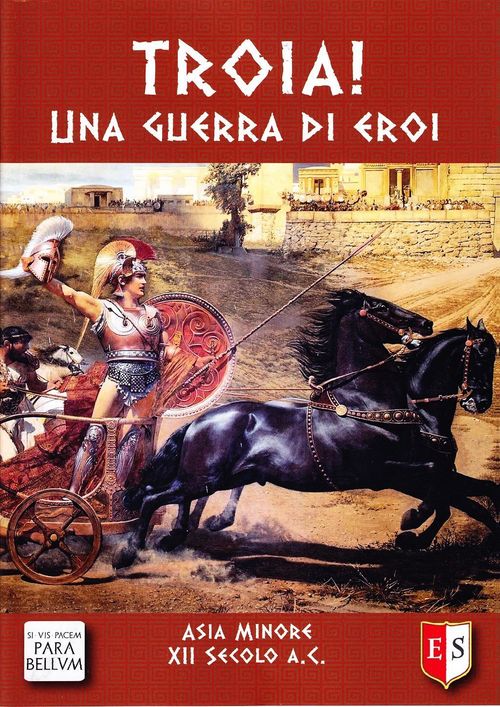
Troia! Una Guerra di Eroi
Troia! Una Guerra di Eroi Rulebook
Table of Contents
Table of Contents
- 2. The Components
- 3. The Map
- 4. The Game Units
- 5. Purpose of the Game
- 6. Duration of the Game
- 7. Sequence of Play
- 8. Activation Points
- 9. Strategic Movement
- 10. Challenges and Combat
- 11. Incursion on War Chariots
- 12. Supply and Attrition
- 13. Unit Recovery
- 14. Looting of Cities
- 15. Troy
- 16. Stratagems and Events
- 17. Heroes
- 18. Initial Setup
- 19. Reinforcements
- 20. Italian/English Index Names
- 21. Bibliography
2. The Components
- The map, which represents the part of the Aegean Sea and the coasts of Asia Minor where the war was fought.
- The game units (counters): Heroes and combat units.
- Stratagem markers, used for special operations.
- Generic markers to indicate the game situations, explained in the rules.
You also need a 6-sided die, d6, and a 10-sided die (0 is ten), d10, to play (not included).
3. The Map
The map is divided into areas represented by a circle or by a square, some of which have names. The areas are used to contain the counters and allow their movement. Two areas are adjacent if they are connected by a line, solid or dashed.
3.1. Sea routes
A dashed line represents a sea route, and each of them can be associated with a numerical track (printed on the map): each time a Force must go through a sea route with a numerical track, a d6 is rolled and the indications, printed on the map, corresponding to the value obtained are followed. If the numerical track is not present on the dashed line, the crossing is free (no die-roll is required).
3.2. Special areas
There are also some special areas:
- Troy, to which also a box in the lower-left side of the map is associated (the Troy box), containing a sub-area called the Fortress of Troy (including Pergamum, the citadel, not used in the game) and the peripheral sub-areas. The rules subsequently explain how to move within the Troy box. During play, the Troy box may be used to simply contain all the Trojan units which are in the Troy area.
- Aulide, which is the starting area of the Achaean fleet.
- Troade, Misia and Larissa, areas with a purple circle, are the possible landing areas of the Achaean fleet.
- Entrance areas, marked with a letter (A, B, C) which are used for the entrance of the Trojan Reinforcements. No unit can enter these areas, except Reinforcements.
3.3. Tables
The map also displays some helping game charts and tables and an Achaean Army box which will contain the units of the Achaean Army (which has a corresponding marker, which will occupy an area on the map).
4. The Game Units
There are two types of game units: Heroes and Combat Units.
4.1. Combat Units
Combat units represent the mixed forces of heavy infantry, light infantry and war chariots that participated in the war.
They have 3 values:
- Attack value (AV), top left
- Defense value (DV), bottom left
- War Chariots value, red, bottom right (CV)
If any value is not present, it is 0.
[Diagram: a combat unit's front (Fronte) shows the attack value 2 at top left (VA), defense value 2 at bottom left (VD), and war chariots value 1 in red at bottom right (VC). Its back (Retro) shows 1, 1 and 1.]
Combat units with their back side printed are two steps units: the front represents the unit at full strength, the rear at reduced strength. A combat unit that suffers the loss of one step for each cause is flipped to its back. If it was already on its back side or only had one step, it is eliminated.
Historical note: Many Trojan allied units have a single step: they would not have suffered large losses and would have returned home. The Achaeans transported many thousands of men, vehicles and tools of all kinds to Troy. But they also didn't have the ability to carry many battle chariots and thousands of horses to feed. That's why they have few chariots. The core of the armies was the infantry, heavy and light. Heavy infantry was the backbone of the combat units, while most of soldiers were lightly armed.and is represented by the attack value of the pieces. The light infantry, represented by the defense value of thecounters, was vital above all for defensive purposes and was a widely used weapon in battle.
4.2. Heroes
Historical note: The Heroes represent the leaders of the various armed contingents participating in the war. They were the best and most valiant soldiers, coming to battle with the most appropriate equipment for close combat. Personal challenges between them were not uncommon, because a victory could guarantee an important advantage over the morale of the opposing army.
Heroes have two values:
- Strength value (SV)
- Armor value (AR)
Each Hero is associated with one or more combat units of which he is the leader. Heroes and their troops are distinguishable by the color of the band on their counter, which identifies the region of origin.
[Diagram: example Hero counter, front (Fronte) with SV 4 and AR 7 marked, back (Retro) side also shown.]
A Force consists of any number of combat units and / or Heroes within an Area. There is no limit to the number of units that can reside or pass through an Area.
Exception: the sub-areas in the Troy box.
4.3. Stratagem markers
Each player has a personal mix of Stratagem markers to use as special operations (see 16.).
Both players can freely inspect the opposing units on the map, but not the opponent's Stratagems mix.
5. Purpose of the Game
5.1. Achaeans
The purpose of the game for the Achaeans is the destruction of the Fortress of Troy by the end of the game. This can be achieved by entering the city and defeating the defenders there or by eliminating all garrison combat units be means of a siege (see 16.2 and 16.9). The purpose of the Trojans is obviously to prevent this from happening.
5.2. Trojans
At the end of the game, if the Achaean player does not win, the Trojan player wins a Minor Victory if the Achaean player occupies with at least a friendly unit more "named" areas than the Trojan player, disregard Looted cities (see 14). Otherwise, it is a Decisive Trojan victory.
5.3. Defeated player
During the game, a single player with no combat units on the map is defeated. The game ends immediately and his opponent wins a Decisive Victory. Should (rare case) happen to both players at the same time, both players are defeated.
6. Duration of the Game
The game lasts 10 turns, each representing one or two campaign months.
Historical note: the duration of the war is unclear. It was probably long, but it lasted much less than the 10 years declared by Homer.
7. Sequence of Play
7.1. Initial Setup
First, players do the Initial Setup (see 18.).
7.2. Landing
Then the Achaean player rolls a d6 to see if his Army in Aulide moves towards one of the landing areas or stands still.
- If it stands still, the Achaean player has finished his activities for this turn and can try to move the Fleet again on the next turn. Now it's up to the Trojan player who carries out his part of the sequence of play (Phase (c) of the normal sequence of play).
- If instead the Achaean Army takes one of the three routes (Troade, Misia or Larissa), it is moved to the "Route to ..." area and immediately rolls another d6 for the sea route: only if the roll is successful, the Achaean Army can be placed on the determined landing area in Asia Minor; in any case (die roll successful or unsuccessful), the Achaean can choose to stay in the "Route to..." area or return to Aulide. If he does not land, the Achaean player will be able to retry to land in Asia Minor only in the next turn and the now it's up to the Trojan player.
On Turn 5, however, the Achaean player lands in Troade anyway and loses two units at his own choice (lost in the storm).
7.3. Normal sequence
Once the Achaen player has managed to land, the normal sequence of the game turn begins, which consists of the following phases:
- a) Activation Points
- b) Achaean Player Phase
- b.1) Strategic Movement
- b.2) Challenges
- b.3) Combat
- b.4) Supply and Attrition
- c) Trojan Player Phase
- c.1) Strategic Movement
- c.2) Challenges
- c.3) Combat
- c.4) Supply and Attrition
- d) Unit Recovery
- e) Loot of Cities
In the Achaean player phase, the active player is the Achaean player, while the inactive player is the Trojan player. Vice versa in the Trojan player phase.
8. Activation Points
All game activities are carried out by spending Activation Points (AP).
8.1. Receiving AP
At the beginning of each round (Phase a) each player receives his AP allotment.
- At each turn of the game before the Achaean player lands in Asia Minor, the Achaean player receives 0 AP, while the Trojan player receives 2 AP.
- Beginning with the game turn when the Achaeans land in Asia Minor, the Achaean player receives 10 AP, while the Trojan player 7 AP (not 2 AP anymore).
AP will be spent by each player in his own phase.
Exception: see 16.
When a player runs out of his AP, he can no longer take actions for that turn. The AP not spent by each player at the end of the turn are lost.
8.2. Activity Cost
The AP costs for each game activity are as follows:
- Movement of a Force: half, rounded up, of the number of combat units from the same region (colored band on top). Heroes don't count if accompanied by any of their own combat units, otherwise 1 AP for any number of Heroes from the same region (color).
Example 1: movement of a Force composed of: Achilles, Patroclus, 2 Miyrmidoni units (1 AP), 3 TirintiTyrin units (2 AP). Total: 3 AP.
Example 2: movement of a Force composed of: Achilles, (1AP), 2 MiceneMycenae units (1 AP), 3 TirintiTyrin units (2 AP). Total: 4 AP.
- Heroes' Challenge: 1 AP
- Combat: as Movement, above
- Playing a Stratagem: 1 AP
- Moving one or more Heroes from the same region: 1 AP
Only the active player pays the costs.
Exception: see 16.
8.3. Perform an activity
The player announces his intention to perform a certain activity, subtracts the AP from his total on the map and carries out the activity.
Example: A Force composed of Achilles, 3 Myrmidons (2 AP), a Koo unit (1 AP) and a Rhodes unit (1 AP) pays a total of 4 AP for movement. If the Force were to attack, for example with 2 Myrmidons (1 AP) and 1 Koo (1 AP), it would pay another 2 AP.
9. Strategic Movement
By spending the necessary AP, a Force can move across the map through adjacent areas. The movement allowance of a moving Force is 3 areas maximum, 4 due to Forced March (see 9.1).
Forces may move along sea routes (dotted lines). If the Force moves by Sea, it must normally roll a d6 and check if it moves and the effects of this movement, using the associated numerical track on the map. If transit by sea is not allowed, the Movement Point is lost; the player can use any remaining Movement Point(s) to retry the crossing.
During movement, a Force can leave one or more combat units or Heroes behind in an area it passes through and continue the movement. No units can be collected. When a Force enters an area with an enemy Force, it must stop and cannot continue its movement for that turn, unless it leaves one or more combat units in the area. He can also drop off any Hero(es) with the dropped troops. If a Force begins its movement in an area with an enemy Force, there is no such limitation.
Each unit or Hero can only move once per turn.
If a Force enters an area or is in Area (ex.: after a Combat) with one or more enemy Heroes alone, that is without accompanying friendly combat units, the Heroes must be automatically displaced on one or more closest areas on the map with friendly combat units (if more than one area is available, the owning player chooses which ones).
Heroes moving alone move a maximum of three areas, they can do a Forced March, but they do not suffer the effects of Forced March or of crossing a sea route (though they must roll the d6 to see if they can force march or cross the sea route; a d6 result of 5 or 6 forfeits the movement point).
"Aulide" is only the starting area of the Achaeans, it is not accessible by the players during the game.
9.1. Forced March
A Force with at least one Hero can extend its movement allowance to 4 areas, if the fourth area entered is connected by land (solid line). To do this he rolls a d6 after moving through 3 areas and follows the instructions as if it went from Rhodes to Koo.
10. Challenges and Combat
Historical note: In the Mycenaean era, the field battles of the classical era were not adopted. The fighting in closed order of the hoplitic phalanx is many centuries later. The Iliad and the other sources show us a series of engagements based mainly on the challenges of heroes, fought with a spear weapon, bows and, to a limited extent, swords. Scholars believe that the rest of the army also fought against each other in small groups. The combat was in no particular order, fluid, with continuous replacement of the ranks of soldiers from the front line to alternate moments of confrontation with moments of rest (Hector, the Hero, is praised by Homer because he is always on the front line). At certain times the scattered order was closed for moments of confrontation in closed order. The challenge between the Heroes could be decisive for the outcome of the soldiers' fights, due to the effect on morale that this induced.
By spending the necessary AP, the active player can carry out any number of Challenges and Combats, in any area where his units are with enemy units, subject only to the availability of AP and in the order he prefers. Challenges and Combats are not mandatory. Opposing units can coexist in the same area. There is no limit to the number of times the same combat unit, can attack or be attacked in a single turn.
A Hero cannot throw or accept more than one Challenge in a single area per Player's phase.
10.1. Challenges
A Challenge is a fight between two opposing Heroes who are in the same area (or sub-area if in the Troy box).
Note: the Fortress of Troy is a sub-area in itself, so a Hero in the Fortress cannot be challenged by a Hero who is outside the walls of Troy.
The active player (eg: the Achaean in the Achaean Phase) chooses the Hero who throws down the Challenge. To throw down a Challenge is not mandatory, but if a Challenge is thrown, the opponent cannot refuse it. The inactive player (eg: the Trojan in the Achaean Phase) then determines the Hero who rises to the Challenge, necessarily choosing a Hero with SV equal to or greater than that of the challenger, if possible. If that's not possible, he must choose still the one with the maximum SV. To resolve the Challenge, each player rolls a d10 and compares it to their Hero's SV. The Hero hits the opponent with a result of the d10 less than or equal to his own SV. If a Hero is hit, he is flipped over ("Wounded!") and he must check if he dies by rolling another d10. If this is less than or equal than his own AR, he is safe, otherwise he goes to Olympus and is eliminated from the game. The Hero killed at the request of the opponent is returned to the owning player who will celebrate the funeral. On the other hand, a Hero who is only hit remains in the game without consequences for him (but gives an advantage to the opponent in the next fight). Each Hero recovers from his wounds at the end of the following Combat step.
10.2. Challenge Effects
One or more hit on an enemy Hero provides a one-column modifier advantage in a single subsequent combat in the same Area.
One or more killed enemy Hero(s) provides a three columns modifier advantage in a single subsequent combat in the same Area.
The reciprocal effects of column modifiers can cancel each other out between opposing sides, though a single side cannot accumulate both the positive modifiers (always take the maximum effect).
Example 1: one (or more) friendly Hero and one (or more) enemy Hero killed do not give any modification columns.
Example 2: one (or more) friendly Hero hit and one enemy Hero killed give a 2 column advantage.
Example 3: one (or more) friendly hero hit, one friendly hero and one enemy hero killed, no column modifications.
The effects, positive or negative, of the Challenges apply only to the first Combat that occurs in the same area in the same turn.
10.3. Combat
Combat simulates the clashes between troops that took place during the Trojan War.
A combat is a confrontation between combat units (and not Heroes, even if their former Challenges may affect the Combat) who are in the same area (or sub-area if inside the Troy box). Combat is never mandatory. The active player selects the combat area, and the units that will attack, on basis on the AP spent. So does the inactive player, who is the defender, and he normally defends with all units in the area (or sub-area), including Heroes.
A combat cannot consist of more than ten combat units on each side.
Exception: see 15. Troy.
Historical note: The lack of a strategic view of the battle prevented the coordination of large armies on the battlefield.
The attacker declares the attacking combat units based on the Activation Points spent. The defender selects all the combat units present in the area for defense, but up to the allowed maximum, without spending AP.
10.4. Combat Resolution
To resolve the combat, the attacker adds up the AV of all attacking units, the defender the DV of all defending units. The ratio between the strength of the attacker and the defender is calculated and this ratio is rounded (in favor of the defender) to one of those on the first row of the Combat Table (on the map), determining the base column. The base column is moved, to the right or left, due to the result of any previous Challenges in the area or other modifications, for Stratagems, for terrain effects. All these column modifiers are added together to determine a net shift of the base column. If combat takes place in an area where, at the end of the strategic movement, only one player has one or more Heroes, the base column is shifted by one in favor of that player.
A d6 is rolled and the result of the d6 is crossed with the determined column.
| d6 | 1:3- | 1:2 | 1:1 | 2:1 | 3:1 | 4:1+ |
|---|---|---|---|---|---|---|
| 1 | 3/0 | 2/0 | 2/0 | 1/0 | 1/1 | 2/2 |
| 2 | 2/0 | 2/0 | 1/0 | 1/1 | 2/2 | 1/1 |
| 3 | 2/0 | 2/1 | 1/1 | 2/2 | 1/1 | 1/2 |
| 4 | 2/1 | 1/1 | 2/2 |
Combat Table, as printed on the map (rows: d6 result; columns: the determined column).
10.5. Combat table Modifiers Modifications
(normally cumulative, unless noted otherwise):
The Challenge modifier (see Rule 10.2):
-
1 Column Shift Left / 1 Column Shift Right: One or more Friendly / Enemy Heroes hit in a previous Challenge in the same area
-
3 L / 3 R: One or more Friendly / Enemy Hero killed in a previous Challenge in the same area.
-
1 R / 1 L: One or more Friendly / Enemy Hero(es) present in the area without enemy / friendly Heroes (not cumulative with Challenge modifier)
-
1 L: attack on the Batiea hill or across a River feature (within Troy box)
-
1 L: attack by sea (i.e. just preceded by a movement by sea over a sea route)
Stratagems and Heroes: see 16.
The advantage for an Enemy Hero(es) hit or killed is assigned to the victorious Hero (who can be of the active of the inactive player). Only if this Hero takes part to a subsequent Combat in the area, this bonus/malus is awarded to all friendly attacking combat units attacking with him. All Heroes present in area are considered to defend in a Combat.
Example: Achilles kills Pentesilea. Then he takes part to a subsequent Combat in the same area with units from another region. The Achaean attack receives a 3R bonus modifier.
10.6. Combat results
The results to the left of the "/" are for the attacker, those to the right are for the defender.
- Red background: the defender is the winner of the fight.
- Green background: the attacker is the winner.
The numerical result represents the total number of Steps that must be eliminated by the Attacking Force or the Defending Force. Each player applies the results to their Forces, absorbing results as they prefer. A good-order combat unit that takes a step loss is flipped over. An already flipped unit that suffers a further step loss, or a single step unit that suffers a loss, is permanently eliminated from the game. Heroes cannot take losses in combat, only in Challenges.
If one of the two sides suffers less step losses than the other, that side is considered the winner. Otherwise there is no winner.
If a winner had a total Chariot Value (CV), before absorbing losses, at least double that of the loser, the losses for the loser are doubled. This rule is not valid inside "Troy" area.
11. Incursion on War Chariots
Historical note: During the Trojan War there was no way to use chariots in field battles. The Achaeans did not have enough horses, the Trojans enough resources and the terrain was not favorable. The use of the chariots was limited to even dangerous disturbing actions.
This type of attack takes place during the Strategic Movement phase with a Force moving exclusively by land, adjacent to an enemy occupied area, and composed of no more than three combat units all with Chariot Values greater than 0 and/or Heroes. Such a Force entering an area occupied by enemy units from an adjacent area (exclusively) ends its movement there and immediately performs a Combat, applying any combat modifier for the presence / absence of Heroes and Stratagems, but the defender cannot choose more than the attacker's number of combat units (plus any Heroes). At the end of the Combat, the Force that made the Incursion, if it has a total residual CV greater than the opponent, regardless of the Combat result or of its remaining movement points, can retreat into the area from which it came. Otherwise it remains in the occupied area. Incursion inside the Troy area is not allowed.
12. Supply and Attrition
A player's combat units (not Heroes) must be supplied at the end of that player's game phase. A combat unit not supplied at the end of its phase loses one step. If it had only one, it is eliminated.
12.1. Achaeans
An Achaean Combat unit is supplied:
- in "Aulide"
- in any "coastal" area, that is to say any area touched by a sea route (dotted line), regardless of the presence of Trojan units in the area
Historical Note: The Achaean with their mighty fleet were absolute masters of the sea. Troy did not have an adequate war fleet.
- possibly in any non-coastal area adjacent to a coastal area, provided this coastal area is not solely occupied by Trojan combat units, and the unit succeeds in obtaining supply. To check if a unit obtains supply, each unit must roll a d6. On a result of 1, 2 or 3, the unit is supplied, otherwise it is not. The result of the d6 suffers +1 if there are Trojan units in either area (the coastal area or the non-coastal area)
- in Troy, if the Achaean player occupies alone (no Trojan unit) any of the following areas: Troade, Colone or Tebe (area names underlined on the map)
12.2. Trojans
All combat units of the Trojan player are supplied in Troy. All combat units named "Troiani" are supplied in Troy and in any area adjacent to Troy.
A Trojan combat unit is supplied:
- In their area of origin (see colored band on top of the counters)
- In an area adjacent to it (provided that the area of origin is not solely occupied by Achaean units and has not been looted, see 14.)
- Possibly in an area "with name" different from its area of origin. In this case the unit must roll a d6. On a result of 1, 2, 3 or 4, the unit is supplied, otherwise it is not. The result of the d6 suffers a +1 if there are Achaean units in the area
- Reinforcement units, as long as they remain in their entry areas (A, B, C).
13. Unit Recovery
In the Unit Recovery phase, both players, starting with the Achaean, can recover up to two combat units still on any area of the map spending one AP for each recovered unit.
Exception: see 14.
Each unit thus recovered is re-flipped to its good order state. Eliminated units can no longer be recovered.
14. Looting of Cities
The first time a combat unit (not a Hero alone) is in an enemy named area not occupied by enemy units during the Looting Phase, the city present there is considered to have been sacked by the occupying player, who randomly selects one of the Loot marker chits and gains the AP written on the back, to be used within the next game turn (mark them as "Extra AP" on the general track on the map). Besides normal activities, one Extra AP may be used to recover an additional third combat unit on the map.
Mark the plundered area with the Loot marker, to indicate that the area can no longer be plundered for the rest of the game. The number of Loot markers in the game is a design limit, no city can be sacked after all markers are deployed.
Koo and Rhodes are Achaean cities, all others are considered Trojan.
15. Troy
Troy is a special area, which has a special detail box on the map ("the Troy box").
The box contains sub-areas and links between the sub-areas, in gray (normal) or blue (across one of the two rivers). Special sub-areas: the Fortress of Troy, the Batiea hill.
When both players have units in the Troy area, they must reposition them in the sub-areas of the cross-section, first the Trojan player and then the Achaean. The Trojan player may initially deploy his units in the sub-areas where he wishes, the Achaean player must enter the Troy box through one of the five roads marked on the map and corresponding to the five drawn in the box. In any sub-area, there may never be more than 10 combat units per player at the end of the movement. At most 5 Trojan combat units may be defend in Combat "inside" the Fortress of Troy.
Units entering or exiting the box later must do so through one of the five roads marked on the map and corresponding to the five drawn in the box. Within the box, units move freely without spending movement points (but activated units must still spend Activation Points). Achaean units cannot enter the Fortress of Troy, except through the play of a certain Stratagem (see 16.). Once entered, they can throw down Challenges and instigate Combat(s) against enemy units present there and, if they manage to emerge victorious from a Combat, the game ends and the Achaean player has won. Otherwise they must retreat to any adjacent sub-area, even occupied by enemy units.
Units entering sub-areas with enemy units are forced to stop. A Force that is in a sub-area where enemy combat units are present may not leave it, unless it leaves one or more combat units in the sub-area, possibly accompanied by Heroes, belonging to the same moving Force.
Units of both sides in the sane [sic] sub-area can carry out Challenges or Combats, spending the required AP. The Batiea Hill provides a left column advantage in combat for a Trojan Force defending in it. A Force moving across a river feature into a sub-area with enemy units receives one column to the left in the first single subsequent combat in the same area of the same game turn.
16. Stratagems and Events
At the beginning of the game, the Achaean player selects two Stratagems / Events from those available to him, at his discretion, then the Trojan does the same. After that the players randomly select three (3) other Stratagem / Event chits from those available. The obtained chits are kept secret from the opponent. The remaining chits are set aside, not seen by the opponent. Each player can play any number of chits in his Phase, paying the necessary Activation Points, and at the time he thinks most appropriate, but their number is still limited. A chit played, successful or not, is in any case spent and eliminated from the game. In general, a Stratagem succeeds if, on rolling a d6, the result is less than or equal to the number printed on the counter. Otherwise the Stratagem fails, normally with no further consequence.
16.1. Assassination
Playable by the owning player during his player's phase after the Strategic Movement step, in an area where one of his own Heroes, who did not move during Strategic Movement, and one or more enemy Heroes are present. The player playing the Stratagem chooses the one enemy Commander to be subject to the assassination attempt, if more than one are present in the area. If the assassination is successful, the enemy Hero is eliminated from the game.
16.2. Trojan Horse
Playable at any time during a player's phase, in an area with one of his own Heroes, if there are no enemy units in the same area (or sub-area in the Troy box). The Hero Ulysses subtracts two (2) from the d6. If and when the Stratagem succeeds in the Troy box, in a sub-area outside the Fortress, for that game turn only Achaean units may enter the Fortress of Troy, from the sub-area where the Stratagem was positioned, regardless of the presence of Trojan units in the sub-area. During the turn when the Stratagem is played and succeeds, all the Trojan units inside the Fortress of Troy, when attacking or defending, have a maximum value of "1" in attack or defense, regardless the values printed on their counters. Furthermore, also the Heroes inside the Fortress have both their Strength and Armor values halved (rounded up) for that turn.
If the Stratagem succeeds in another area outside the Troy box, all the units in the area and in all adjacent areas can move a second time without spending AP. The Trojan Horse cannot be played in the same sub-area where the Siege Tower was played.
16.3. Melteni
Playable during your own movement phase. If the Stratagem is successful, a Force may move freely (without expending movement points) through one (only) sea route or into a fourth area by sea, without rolling the d6. If the Stratagem is not successful, the Force may employ its unused movement points to move.
16.4. Sundial
Playable during your own movement phase. If the Stratagem is successful, a Force may move freely into a fourth area by land, without rolling the d6 for Forced March (9.1).
16.5. Ambush
It is playable in two different moments:
- During your own combat phase, before a Combat, if the Stratagem succeeds, the opponent can choose at most one of his units for defense.
- During the opposing movement phase, when an enemy Force is about to leave an area with a friendly Force present. If the Stratagem is successful, a unit of the enemy Force loses a step and stops in the area.
This Stratagem cannot be played inside the Fortress of Troy.
16.6. Skirmish
Playable before a friendly or enemy Combat (after APs are spent and the combat declaration). If the Stratagem succeeds, only at most three combat units on each side can participate in the Combat.
16.7. Surprise Attack
Playable before a Combat. If the Stratagem succeeds, the attacker receives a +4 modifier to the Combat die roll.
16.8. Pestilence
It is not a Stratagem but a mandatory Event. The marker indicates when it should be played. Example: "3" indicates that it must be played as a third Stratagem by any player who owns it. Following the example, after two Stratagems have been played, whoever has played them, the player owning this Stratagem immediately and obligatorily must play it. Effect: Pestilence always breaks out in the area with the highest overall number of friendly and enemy combat units present (roll a die if there is more than one). One third (1/3) rounded down of each player's combat units loses a Step. Heroes do not count and suffer no effects. This event costs no Activation Points.
16.9. Siege Tower
Playable in the Combat phase of the Achaean player, in a sub-area of the Troy box in front of the Fortress, where there are Achaean combat units. If the Stratagem succeeds, Achaean units may execute Combat(s), but not any Challenge(s), against units in the Fortress of Troy from then on in the game, without having to enter it, with a modifier of one column to the left, in addition to any other standard column modifiers. If the Stratagem does not succeed, it can be retried once for each following turn (without expending AP). If all Trojan combat units are eliminated in this way, the game ends and the Achaean player is the winner. If all Achaean units are eliminated or leave the sub-area, the Siege Tower is permanently removed from play. Play before the Combat. The Siege Tower cannot be played in the same sub-area where the Trojan Horse was played.
17. Heroes
Some Heroes have special characteristics:
- Ulysses: -2 to d6 for the Trojan Horse
- Paris: -1 to d6 for the Assassination
- Hector: Shift One Column Left (-1L) in Combat, if he defends inside the Trojan Fortress
- Achilles:
- Challenge: he always hits first: with 8 or 9 he immediately kills the opponent, without the possibility of a reply. On a 7 or less, he injures the opponent normally. AR = 9. Achilles may be wounded or killed.
- Combat: +1R in Combat, if he attacks in open field, that is in any area other than Troy; Shift One Column Right (+1R) if he attacks inside the Troy box, but not if he attacks the Fortress. Always +2R after Patroclus's death. These modifiers are in addition to the other standard modifiers.
- Activation: Every game turn an Achaean Force is activated where Achilles is present, the Achaean player must roll a die. With a die result of 0, for that turn Achilles cannot move, nor he can throw or accept Challenges. This rule is not in effect any more, after the death of Patroclo.
- The back side of Achilles is his son Neoptolemus. If and when Achilles dies, flip the counter immediately.
- Priam: he is the king of the Trojans. He has no attack or defense values, cannot launch Challenges or participate in Combat, and always remains inside the Trojan Fortress. An Achaean Hero inside the Fortress can launch a Challenge against Priam to attempt to kill him, only after all the other Trojan Heroes have been challenged. Priam cannot react. If Priam is hit, all "Trojan" combat units have a maximum value of 1 in attack and defense, for the rest of the game.
18. Initial Setup
- Place the Game Turn marker on space 1 on the numerical map track.
- Place the Achaean Activation Point markers: 0 for the Achaean player (he can use this to possibly play a Stratagem marker), 2 for the Trojan player.
- First place all the Achaean units in the "Achaean Army" box on the map except the "Rhodes" and "Koo" units (identified by a colored circle) which are placed on the respective islands and the "Achaean Army" marker in the "Aulide" area.
- Then place the Trojan units in their areas of origin, identified by the name written on the markers, except the Reinforcements (see 19.). Trojan units named "Troiani" (black band on the top) can be placed in the areas of Troia, Troade, Colone and/or Tebe, at the discretion of the Trojan player.
- Place all Reinforcement units out of the map, close to their Entrance Area (A, B or C).
Note: The Thracians, allies of the Trojans, have a * on the counter: they cannot move from their home region until the Achaeans land in Asia Minor.
- Both players take their Stratagem markers.
Then follow the sequence of play (see 7.3).
19. Reinforcements
Only the Trojan player receive Reinforcements. Reinforcements are additional units that have a yellow letter and number (Letter: entrance area; number: turn of entry). They come into play the Game Turn indicated on their counters, in the Trojan Movement Phase, positioned on their Entrance Area. They can only move if the Trojan player spends AP.
20. Italian/English Index Names
| Italian | English | Italian | English |
|---|---|---|---|
| Troia | Troy | Misia | Mysia |
| Troade | Troad | Larissa | Larisa |
| Colone | Kolonai | Aulide | Aulis |
| Tebe | Thebe | Tirinti | Tyrins |
| Rodi | Rhodes | Micene | Mycenae |
21. Bibliography
Main sources:
- Homer, Iliad
- Dictys Cretensis, Chronicle of the Trojan War
- Dares Phrygius, History of Troy's Destruction
Other works:
- Barry Strauss, The Trojan war. A new history, Simon&Schuster, 2006
- Eric H. Cline, 1177 BC. The Year Civilization Collapsed, Princeton University Press, New Jersey, 2014.