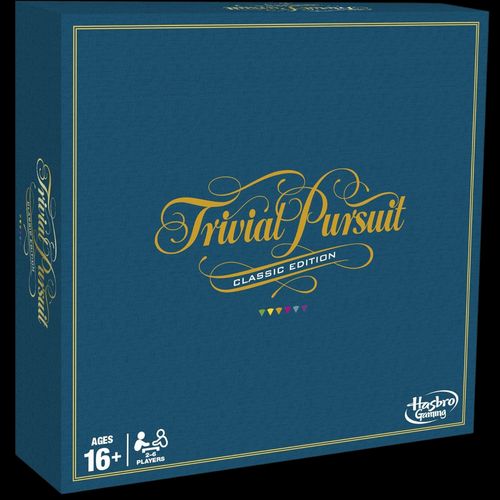
Trivial Pursuit
Trivial Pursuit Rulebook
Table of Contents
Table of Contents
Equipment
Trivial Pursuit contains one playing board, one die, question-and-answer cards, two card boxes, six player tokens, and 36 scoring wedges.
Object of the Game
Players must correctly answer questions in each of the six categories by having landed in each of the category headquarters, which are located at the ends of each of the six spokes. Play then proceeds to the hexagonal hub at the center of the board for the game-winning question.
Start of Play
Each player selects a token and receives six scoring wedges, one in each of the six category colors. Players roll the die; the player rolling the highest number moves first (ties re-roll).
The first player rolls the die again and, starting from the hub at the center of the board, moves the token the indicated number of spaces in any direction. The first move for each player will end either in a category headquarters (at the end of a spoke, if the die roll is 6) or in a category space (if the die roll is 1 through 5). When a token lands in a category space or headquarters, the player is asked a question in that category.
The category spaces and headquarters are color-coded:
- Blue — Geography
- Pink — Entertainment
- Yellow — History
- Brown — Art & Literature
- Green — Science & Nature
- Orange — Sports & Leisure
The question, next to the appropriate colored dot, is taken from the first card in either box and read by another player (answers are on the opposite side of each card). The next question comes from the first card in the other box. If the player answers correctly, their turn continues with another roll of the die. If they answer incorrectly, the turn passes to the left.
Movement
With each die roll, a move can be made in either direction around the circular playing path or on any of the spoke paths. A combination move along the circular path and up a spoke path is permitted. Backtracking—a combination of forward and backward moves on one die roll—is not permitted. A player must always move the exact number of spaces shown on the die.
Continuation of Play
Play continues, with cards placed in the rear of the box from which they are drawn after each question.
When a category requirement is met—a player correctly answers a question in a category headquarters—the appropriate scoring wedge is placed in the player's token (match the wedge contours to the token contours so they don't lodge). If the player answers incorrectly, the token must leave the headquarters on the next turn and re-enter it later to attempt another question for credit.
A player landing in one of the 12 "Roll again" spaces continues the turn by rolling the die again. When a token lands in the hub before the player has met the six headquarters requirements, the hub is treated as a wild-card space and the player chooses the category for the subsequent question. Any number of tokens may occupy the same space.
Winning the Game
After a player has correctly answered a question in all six category headquarters, the player's token must make its way to the hub to attempt to win.
The token must land in the hub by an exact roll of the die. If a player overshoots the hub, they must successfully answer a question in the category on which they land and try again to enter the hub on an exact roll, or wait for the next turn if the question is not answered correctly.
When the token lands in the hub, opposing players select the category for a final question (by agreement or vote), and the next card is drawn. If the question is answered correctly, the game is won. If answered incorrectly, the player must leave the hub on the next turn and re-enter it for another question. Because a correct answer always means another roll of the die, a player may meet the game-winning requirements on the first turn; if this happens, any player who has not yet had a turn is permitted a chance to duplicate the feat and create a tie.
Notes on Play
- All six categories are represented on the spokes at each die-roll out from the hub—so a player who does not roll a 6 on the first turn may still dictate the category for the first question (e.g. roll a 4 and travel the spoke with a yellow History space as the fourth space out). A player who overshoots while attempting to enter the hub has five categories from which to choose the next question.
- The rules contain no provisions about how long a player may take to answer or how precise an answer must be—players decide what constitutes a reasonable time and how exact an answer must be (e.g. whether a last name alone is enough).
- Players should decide before the game whether the correct answer is read aloud after an incorrect answer.
- Trivial Pursuit lends itself well to team play for as many as 24 players, with strong players in various categories dispersed among teams. Decide beforehand whether consultation among team members is allowed.
- When fewer than four play, one card box may be more practical than two. It's not necessary to shuffle the cards, but if you do, keep them properly aligned.