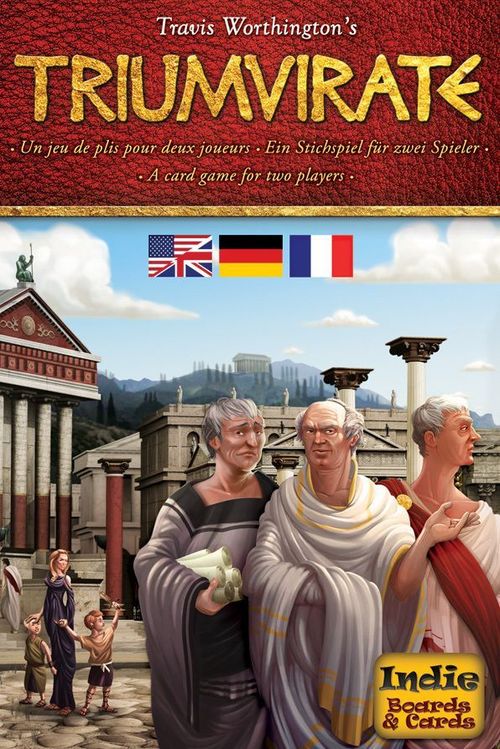
Triumvirate
Triumvirate Rulebook
Table of Contents
Table of Contents
Contents
- 27 Cards in 3 Colors (9 each red, yellow and black)
- 9 Consul Markers (3 each red, yellow and black discs)
- Scoring Tableau
- 3 Game Scoring Markers (purple discs)
- Dealer Marker (green disc)
The Cards
There are three suits of cards, each corresponding to one of the three Triumvirate members: Red for Caesar, Yellow for Pompey and Black for Crassus. Each suit contains 9 cards: one each of 0 through 8.
Each suit has 3 types of cards: Legions (7, 5, 3), Senators (8, 6, 4, 2, 1) and the Mob (0). Legions and Senators are both for trick play; but only Legions are point cards for end game scoring. The Mob has a special function during trick play.
The three card types are the Senator Card, the Legion Card and the Mob Card.
Objective
Players represent the leaders of Roman noble houses, who through the course of the game will be maneuvering the political struggles that determine which of the triumvirs will be crowned as Emperor.
The player that has the highest total value of pledged Legion cards which match the elected Emperor (the suit that won the game) is the winner of that game. Before beginning play, the players should agree to the number of games (recommended to play to the best 2 out of 3). A game typically takes 10 minutes to play.
Set Up
Place the Scoring Tableau in the center of the table as shown above. Place the Consuls, and Game Scoring Markers adjacent to the Scoring Tableau. Shuffle the cards and give them to the dealer, who also receives the Dealer Marker.
The Deal
At the start of the game each player will be dealt eleven cards, the remaining 5 cards will be set aside. Deal alternates on each hand.
Game Play
The non-dealer leads each hand and must play any one card as a lead. Players alternate, each playing one card with each trick consisting of two cards. Played cards remain face up and on the center of the table for the entire hand.
A player must follow suit where possible. If a player cannot follow suit then they may play any other card.
The highest card wins the trick (except in the case of a trumped trick), even if it is a different color from what is lead. In case of a tie the first card played wins the trick.
The Mob represents a civil disturbance; a trump card. It is the lowest rank card of its suit, but will beat any card of another suit. Leading the Mob card guarantees a win for the suit, because either the Mob loses to a ranked card of the same suit or trumps any card of another suit.
Place the winning card on top of the trick to serve as a reminder of the number of tricks won by that suit during the current hand.
The winner of each trick leads the following trick.
The hand is played until one suit has won three tricks. Winning a hand represents a Triumvirate member being elected as Consul. The winning triumvirs' Consul Marker is placed on the Scoring Tableau to indicate the victory.
A hand will comprise of 3-7 tricks.
Pledge
After the hand has been completed, each Player may select one card from his remaining in-hand cards to Pledge. This card is placed face down, adjacent to the Scoring Tableau and remains out of play for the remainder of the game. Pledging Legions (3, 5, 7) is a direct means of achieving victory. Pledging a Senator or the Mob can deprive your opponent from its use or as a means to short suit yourself.
Only one card may be Pledged on a hand, a maximum of three cards may be Pledged per player in a game.
Pledges can be made after the final hand, before the game ends.
Continuing Play
Deal alternates on each hand. Move the Dealer Marker before shuffling the cards that were played and the cards that were set aside on the last deal together. Cards still in-hand remain in-hand. Three cards are set aside and the rest are dealt evenly between the players.
Note: As players take the option to Pledge cards at different times the number of cards in hand may differ, but each will receive the same number of cards in each deal.
The game continues until one of the triumvirs wins three Consuls (hands). A game will consist of between 3-7 hands.
Game End
The game ends when one of the triumvirs becomes the Emperor by winning three Consuls. Players now reveal their Pledged cards. Players total the rank of the Legions Pledged matching the elected Emperor. The player with the highest total is the winner.
The winner of the game receives a game scoring marker, all the cards are collected, shuffled and the next game begins with the deal. Play continues until a player has won the number of games agreed to at the beginning of the play.
Example 1st Hand
5 tricks have already been played, Pompey and Crassus have both won 2, and Caesar has won 1.
Player A is dealer, Player B leads the first card of the hand.
6th Trick: Player B plays a black 6, Player A has no black cards and plays the red Mob.
Caesar (red) wins the trick (the red Mob trumps the black 6).
7th trick: Player A leads a red 2, Player B plays a red 4 and Caesar (red) wins the trick.
Caesar has won his 3rd trick and wins the hand. A red Consul is added to the Scoring Tableau.
Player A Pledges the red 3 and Player B Pledges the black 5. Neither of the two Pledged cards will reenter play in this game.
Player B now shuffles the 14 cards that were played (2 each from the 7 tricks) and the 5 cards that were set aside... 8 cards are dealt to each player, and 3 are set aside. Player A leads first card of next hand.
Example Game End
In the fifth hand Caesar (red) wins his 3rd Consul title, and thus ends the game. Player A Pledges no cards on this hand, Player B Pledges the red 7 from hand.
Player A reveals Pledges to Caesar of the 5th and 3rd Legions (red 5 and red 3), Player B has Pledged to Caesar the 7th Legion (red 7).
In this case Player A wins the game and receives a Game Scoring Marker. The sum of the Player A's Pledged cards is 8 (5+3) while Player B has only 7 Pledged. Player A receives a Game Scoring marker.
Acknowledgement
Design / Illustration: Luis Francisco and Pedro Vergani
I'd like to thank many people that made this game possible, notably BoB McClure whom shaped the game into what you see here. Guy Riessen and Joe Kisenwether for the enthusiasm after playing the game in its initial format. Many playtesters including Matt Dodor, Patrick McInally, Geof Gambill, Hank Panethiere, Carol Lagrow, Barry Frank and many others.
I would also like to acknowledge and thank the many people that helped make this 2nd Edition of the game possible. Without the financial support of Richard Pardoe, C Matt Pappathan, Mike Nowak, Kenny VenOsdel, John Bowditch, Herb Petro, David Inacio and especially Steve Hancock, this edition would not have been possible.