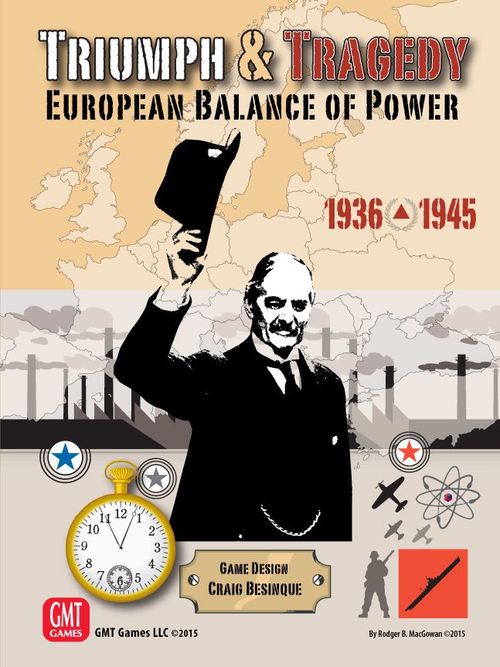
Triumph & Tragedy: European Balance of Power 1936-1945
Triumph & Tragedy: European Balance of Power 1936-1945 Rulebook
Table of Contents
Table of Contents
- Rulebook Organization
- Game Components
- Sequence of Play (Summary)
- Introduction
- 1.0 The Map
- 2.0 The Nations
- 3.0 The Units
- 4.0 Cards & Markers
- 5.0 Setup
- 6.0 Sequence of Play
- 7.0 New Year
- 8.0 Diplomacy
- 9.0 Technology
- 10.0 Seasons
- 11.0 Movement
- 12.0 Combat
- 13.0 ReBasing
- 14.0 Supply
- 15.0 War and Peace
- 16.0 Victory
- 17.0 Short Game (1939)
- 18.0 Two-Player Rules
- 19.0 Optional Rules
- Index
Rulebook Organization
In these rules, words used in a defined, game-specific sense are Capitalized (see Glossary on the Playbook back cover).
Game Components
- 1 22"x34" Map (cardstock)
- 208 16mm Wooden Blocks
- 2 Label Sheets (sticky labels)
- 1 Counter Sheet (diecut ½" counters)
- 55 Action cards
- 55 Investment cards
- 20 pp Rulebook
- 24 pp Playbook
- 3 Player Aid cards (2-sided cardstock)
- 1 Game Record sheet (permission to photocopy)
Sequence of Play (Summary)
New Year
- Year Start (advance Year)
- Victory Check/Reshuffle decks
- Peace Dividends/Turn Order
- New Year Resolution [1941-44]
- Production Phase
- 1st Player Production
- Production Blockade check
- Determine Production Level
- Spend Production
- 2nd Player Production (same)
- 3rd Player Production (same)
- 1st Player Production
- Government Phase (card play)
- Players play 1 Diplo, 1 Intel, or 2 matching Tech cards; or Factory cards ≥ Factory Cost; or
- Pass [3 in a row ends cardplay]
- Resolve Diplo. (adjust POP/RES)
- HandSize Compliance (discard)
Seasons (Spring/Summer/Fall)
- Command Phase (card play)
- 1st Player Turn
- Movement Phase
- Combat Phase
- 2nd Player Turn (same)
- 3rd Player Turn (same)
- Supply Phase (Summer: Blockade)
Winter Season (USSR only)
- Command Phase
- USSR Player Turn
- Supply Phase
Introduction
A full game lasts for 10 Game-Years. A Game-Year consists of New Year followed by four Seasons of play.
New Year (7.0). New Year consists of a Year Start procedure, followed by Production and Government Phases.
During Production, players receive their annual Production and allocate it between military, diplomatic, technological and economic efforts.
During Government, players play cards to execute Diplomatic, Industrial and Technological initiatives.
Seasons (10.0). Each Season (Spring, Summer, Fall, or Winter) begins with a Command Phase (10.1) when players can commit to military movement by playing a command card (or not).
Players with valid Command Cards in effect then take Player Turns in an order dependent on the Command Card played.
Player Turns consist of Movement (11.0) and Combat (12.0) Phases. Battles occur when Enemy units occupy the same area.
In wartime, each Season ends with a Supply Phase (14.0), during which Ground units (Tanks and Infantry) without a Supply Line (14.11) suffer penalties and (in Summer only) Blockades (14.22) are declared, which can impair Enemy Production. Supply is ignored during peacetime.
1.0 The Map
1.1 Land Areas
Land Areas are color-coded according to national ownership. National Territory consists of all Land Areas within a Nation. Coastal Land Areas border Seas or Oceans (also see 1.3 Straits).
Canada, the USA, Latin America and all named islands are playable. Violet areas are out of play for all purposes.
1.11 Land Borders
Land borders limit movement of units into and out of Battles (11.52) or making Sea Invasions (11.221).
1.12 City Types
Cities (circled dots and stars) provide Population (POP), one component of Production. Each circle indicates 1 POP value. Towns (dots) have no Population value. When Violated (15.4), Neutral Cities and Towns generate defensive forces (see 15.42 and Map Key).
1.121 Capitals
The largest City/Town in a Nation or Colony is its Capital (see 2.11/2.21/2.31/2.41). A Capital is Captured if it is occupied by Enemy units at the end of a Combat Phase. Not all Nations/Colonies have capitals.
1.13 Resources
Resources (RES), shown as black and red triangles, are another component of Production. Only TransAfrica Resources (red) are transportable around Africa (see 14.24).
1.14 Land Area Control
Area control is evaluated at the start of a phase (see 6.0) and does not change during that phase. Passing through an area does not alter its control.
Land Areas are always controlled by a Faction (Neutral Nations are considered separate independent Factions).
The sum of all Friendly-controlled Land Areas is termed Friendly Territory. Likewise for Rival/Enemy/Neutral Territory, etc.
Occupied Land Areas are controlled as follows:
- [Occupation] Land Areas occupied by a single Faction are controlled by that Faction.
- [Ownership] Land Areas occupied by more than one Faction are Disputed and are controlled by the Faction which has been there longest, termed the Owner (11.54).
Unoccupied Land Areas are controlled as follows:
- A Faction always controls the unoccupied Territory of its Great Powers (USSR, Germany, Britain).
- All other unoccupied Land Areas are controlled by the Faction controlling the Capital of that Nation or Colony.
Capitals are controlled as follows:
- Factions have default control of their own Powers' National/Colonial Capitals unless marked with a Control marker.
- Control markers are placed on Capitals when they become controlled by Occupation, Ownership or Diplomacy (8.2), unless default control applies.
- Control markers exert control until removed when a different Faction gains control of the Capital.
1.2 Sea Areas
Sea Areas are pale blue and divided by thin blue lines (Sea Borders).
Oceans (darker-blue Sea Areas with thicker Ocean Borders) are very large Sea Areas: it takes two area-moves to enter an Ocean.
1.21 Sea Area Control
Sea Area control is also evaluated at the start of a Phase and lasts unchanged throughout that Phase.
Seas occupied by Enemy units are termed Enemy Seas. All other Seas (including Rival-occupied Seas) are Open Seas and are considered Friendly.
1.3 Straits
Shaded dashed-blue circles containing both Land and Sea are Straits. Straits are treated the same as Coastal Land Areas except that:
- Units can move through a Neutral or Rival Straits by Sea (11.2) or Air Movement (11.3) without effect. Stopping there, however, would constitute Aggression (11.54). Sea Movement entering an Enemy-controlled Straits must stop.
- Supply Lines (14.11) and Trade Routes (14.21) can be traced through Rival and Neutral Straits (but not through Enemy-controlled Straits).
1.4 Production Tracks
Each Faction has a Production track, where it records its current levels of Population (POP), Industry (IND) and Resources (RES).
Base Levels of POP, IND and RES for each Faction are shown, along with other Faction-specific information.
Capital Control Example. The Axis automatically controls Berlin, Rome, and Tripoli. No Axis Control markers need be placed there. If a different Faction gains control of Rome, place a Control marker there which then exerts control over unoccupied Italian National Territory until removed.
Ownership. Ownership of Disputed Areas is shown by Owner units being placed upright, with opposing units lying flat, face-up.
Sea Area Control. Sea Areas are never Disputed (units of two Enemy Factions present) except during the Combat Phase, as Sea Battles are always fought to a conclusion.
2.0 The Nations
2.1 Great Powers
Germany (Axis), Britain (West) and the USSR are the Great Powers. They have their own National units (see 3.0).
2.11 Great Power Capitals
The Great Power National Capitals (Berlin, London and Moscow) are their Faction's MainCapitals (triple-circled stars). MainCapitals serve as their Faction's sole Production center (no Production is possible if it is lost) and have POP value of three.
Great Power SubCapitals (double-circled stars) have POP value of two.
Both MainCapitals and SubCapitals can serve as unit Supply Sources (14.11).
MainCapitals (POP 3)
| Power | Capital |
|---|---|
| Germany | Berlin |
| Britain | London |
| USSR | Moscow |
SubCapitals (POP 2)
| Power | SubCapital |
|---|---|
| Germany | Ruhr |
| Britain | Delhi |
| USSR | Leningrad / Baku |
| Italy | Rome* |
| France | Paris* |
| USA | Washington* |
* Major Power Capitals
Capital Cities (POP 1 / Muster 3): Poland — Warsaw; Spain — Madrid; Turkey — Ankara.
Cities (POP 1 / Muster 2). Towns (POP 0 / Muster 1).
Main/SubCapitals & Victory. Controlling an Enemy Main/SubCapital is worth 2 VPs. Controlling two of them wins immediately (see 16.0).
2.2 Major Powers
Italy (Axis), France (West) and the USA are Major Powers. The USA begins as a Neutral but can become a West Major Power (only) via Diplomacy (see 8.4). Major Powers also have National units.
2.21 Major Power Capitals
Major Powers Capitals (Rome, Paris, Washington) are SubCapitals (double-circled stars), with a POP value of two and also able to serve as Supply Sources (14.11) for Friendly units.
Defeat: If a Major Power's Capital is Captured (solely Enemy-occupied at the end of a Combat Phase, see 1.121) it is Defeated: place a Control marker of the conquering Faction in its Capital and permanently remove all national units from play.
A Defeated Major Power no longer belongs to a Faction.
See 2.31 for treatment of its Colonies.
2.3 Home Territory
Land Areas within the national boundaries of a Great or Major Power (color coded) are termed its Home Territory. Except for Fortresses (3.241) all new units (Cadres) must be built within Home Territory.
2.31 Colonies
Britain, France and Italy have Colonies (sidebar), shown in a lighter shade of their national color. They have default control of Colonial Capitals (and through that of unoccupied Colonial Territory).
Colonies are not Home Territory (i.e., new Cadres cannot be built there).
Unless its Capital is controlled or occupied by another Power, a Colony becomes an Armed Minor (15.42) when its owning Major Power is Defeated.
Colonies
| Power | Colony | Capital |
|---|---|---|
| Britain | Canada | Ottawa |
| Britain | Gibraltar | Gibraltar |
| Britain | Malta | Malta |
| Britain | Middle East | Suez |
| Britain | India | Delhi |
| France | French N. Africa | Algiers |
| France | Syria | Damascus |
| Italy | Libya | Tripoli |
2.4 Minor Nations
Minor Nations ("Minors") are color-coded yellow, orange, tan or brown. They begin uncontrolled, as Unaligned Neutrals (8.11), but can become influenced or controlled by a Faction via Diplomacy or conquest. While uncontrolled, each Minor is treated as an independent Faction.
If Violated, a Neutral Minor becomes an Armed Minor, deploying defensive units (see 15.4, Violation of Neutrality).
When a Minor becomes controlled by a Faction, a Control marker of that Faction is placed on its Capital.
If it becomes a controlled Satellite (8.2) via Diplomacy, it also deploys units of that Faction's Great Power.
2.41 Minor Nation Capitals
Most Minors contain just one City or Town, which acts as its Capital. Large Minors (buff-colored) have two Cities, one of which (starred) is its Capital (Population value of one).
3.0 The Units
Wooden blocks represent military units. A label is attached to each unit block, according to the table below. See also 4.6 Marker Blocks.
Note: Spare labels for each Faction are provided on label sheet 2. Do not attach them to blocks unless needed.
Units normally stand upright, their identities hidden from opponents (tip them backwards, face-down if necessary for secrecy, e.g., India).
When Engaged (11.5) with Enemy forces, units are turned flat, face-up, revealing their type and strength.
| Faction | Nation | Blocks | Labels |
|---|---|---|---|
| Axis | Germany | Med Gray | Gray |
| Axis | Italy | Tan | Olive |
| West | Britain | Dk Blue | Dk Blue |
| West | France | Lt Blue | Lt Blue |
| West | USA | Green | Green |
| USSR | USSR | Red | Red |
| — | Neutral | Orange | Tan |
Unit Labels. Nationality (block/label color; e.g. gray = German); Combat Value (maximum 4); Unit Type (e.g. Infantry). Step Reduction is shown by rotating the block: 3 CV, 2 CV, 1 CV.
UNIT TABLE
| Unit | Move | Firepower |
|---|---|---|
| Fortress [Ground] | 0 | A2/N3/G4/S3 |
| Air Force [Air] | 2R | A3/N1/G1/S1 |
| Carrier [Naval†] | (3R) | A2/N2*/G1/S2 |
| Sub [Sub] | (2R) | A0/N1/G0/S1 |
| Fleet [Naval] | (3R) | A1/N3/G1/S2 |
| Tank [Ground] | 3 | A0/N0/G2/S0 |
| Infantry [Ground] | 2 | A1/N1/G3/S0 |
| Convoy [Naval†] | (2) | none |
- ( ) Must stop on entering Land Areas.
- R Can ReBase (at times must, see 13.0).
- † Take Double-Hits: –2CV per Hit taken.
- * Carriers can Fire N1 and immediately Retreat (12.5) or ReBase (13.0).
3.1 Unit Attributes
3.11 Nationality
The color of a block and label shows a unit's Nationality (see 3.0).
3.12 Combat Value (CV)
A unit's strength or Combat Value (CV) is indicated by the number of pips on its top edge. This is the number of dice it rolls in Battle Resolution.
It is also the number of steps of damage the unit can take. As a unit is damaged, it is rotated to a new edge to show its reduced current CV. A 1 CV unit is termed a Cadre.
Note that USSR, French, Italian and Neutral units have a maximum CV of 3, while German, USA, and British units have maximum CV of 4.
3.13 Movement Speed
A unit's range of movement per turn, or Movement Speed, is automatically determined by its unit type (see UNIT TABLE, sidebar), and hence is not shown on the unit label. A unit can have a different Movement Speed on Land and at Sea.
3.14 Combat Priority
During Battle Resolution, units act in order as per the UNIT TABLE (sidebar), from the top down: i.e., Fortresses first, Convoys last. Among units of the same type, defending units normally Fire before units of the Active Player (exception: see FirstFire 9.0).
3.15 Firepower
The relative ability of a unit to damage Enemy units during Battle Resolution is its Firepower. Units have a specific Firepower for each Target Class, described by a letter and number ("A1"). The letter is the Target Class (A/N/S/G, see below); the number is the Firepower versus that Class:
"1" means a die roll of 1 scores a Hit; "2" scores a Hit on die rolls of 1-2; "3" scores a Hit on die rolls of 1-3, etc.
See 12.42 for Firepower details.
3.2 Unit Types
Unit-type automatically determines Movement Speed and Firepower.
Air, Naval and Submarine units are collectively termed 'ANS' units.
3.21 Air Units (Class A)
Air units use Air Movement (11.3). They can ReBase (13.0) and must do so at times. They cannot capture Land Territory (see 12.52).
3.211 Air Forces
- Movement: Air (over Land or Sea) 2.
- Firepower: A3/N1/G1/S1.
- Special: Can move freely through Areas containing Enemy units.
3.22 Naval Units (Class N)
Naval units use Sea Movement (11.2). They can ReBase (13.0) and must do so at times. They cannot capture Land Territory (see 12.52).
3.221 Carriers
- Movement: Land 1 [stop]; Sea 3.
- Firepower: A2/N2/G1/S2.
- Special: Lose 2 CV per Hit taken. (Carrier Strikes) Can Fire N1 and immediately Retreat/ReBase.
3.222 Fleets
- Movement: Land 1 [stop]; Sea 3.
- Firepower: A1/N3/G1/S2.
3.23 Submarine Units (Class S)
Submarine units use Sea Movement (11.2). They can ReBase (13.0), and must do so at times. They cannot capture Land Territory (see 12.52).
3.231 Subs
- Movement: Land 1 [stop]; Sea 2.
- Firepower: A0/N1/G0/S1.
- Special: Can move freely through Sea Areas containing Enemy units. Can Escape Sea Battles (12.73).
3.24 Ground Units (Class G)
Ground units can use Land (11.1) or Sea Movement (11.2). A Ground unit using Sea Movement immediately becomes a Convoy (3.244). Ground units at War require Supply (14.1), except Fortresses which are exempt.
3.241 Fortresses
- Movement: Immobile once placed.
- Firepower: A2/N3/G4/S3.
- Special: Can be built in Friendly Land Areas outside Home Territory (not in Battles). Limited to one per area. Ignore Supply rules (14.0).
3.242 Tanks (Corps)
- Movement: Land 3; Sea 2 (see 11.22).
- Firepower: A0/N0/G2/S0.
- Special: are Convoys (3.244) at Sea.
3.243 Infantry (Army)
- Movement: Land 2; Sea 2 (see 11.22).
- Firepower: A1/N1/G3/S0.
- Special: are Convoys (3.244) at Sea.
3.244 Convoys
Ground units at Sea are Convoys.
- Movement: Land [n.a.]; Sea 2.
- Firepower: none.
- Special: Can Sea Invade (11.221). Cannot Engage at sea. In Sea Battles: no Combat Action; separately targetable at "N" Firepower; lose 2 CV per Hit taken.
3.3 Unit Disbanding
Units can be removed from play by the owning player at any time (but can be rebuilt).
The Factions
- West: Focused on economic progress and largely disarmed, Britain and France seek a balance of power and access to resources.
- Axis: Chafing under the ignominy of defeat and seeking to regain former status, Germany and Italy have begun rearming, triggering an arms race.
- USSR: After defeat, revolution, and ruthless industrialization, the USSR seeks Great Power status.
4.0 Cards & Markers
The game uses two 55-card decks: an Action deck and an Investment deck.
4.1 Action Cards
Action cards have a Neutral Nation at each end of the card, usable to gain Influence over either of those Neutrals (see 8.0 Diplomacy).
In the center, shown sideways, is a Command Value, consisting of a Season and a letter-number combination, usable for moving units during that Season.
An Action card can be expended for any one of its possible uses.
4.2 Investment Cards
Investment cards have a Technology at each end of the card. Technologies enhance the ability of a specific type of friendly unit.
In the center, shown sideways, is a Factory Value usable to advance one's Industry level when cards with a total Factory Value at least equal to one's Factory Cost (7.32) are played.
An Investment card can be expended for any one of its possible uses.
4.3 HandSize Limits
Each Faction has a fixed HandSize Limit, which is the maximum number of cards it can retain in its hand at the end of the Government Phase. HandSize Limits are noted on each Faction's Production track. The number of cards in a player's hand is public information (a marker is provided to clarify this).
4.4 Peace Dividend Chits
Each Year Start, peaceful Factions receive a Peace Dividend chit (7.13).
These have a Victory Point (16.1) value of 0-2 which is kept secret by the owner. Chit values are:
- (4) x Peace Dividend 2
- (12) x Peace Dividend 1
- (16) x Peace Dividend 0
4.5 Marker Counters
Influence markers are placed on Neutral Capitals to indicate a Faction has gained Influence over them through Diplomacy (see 8.0).
Control markers (the back side of Influence markers) are placed on the Capitals of Nations and Colonies that have become controlled via Diplomacy or conquest. Control markers register control of a Capital while it is unoccupied.
Blockade markers are placed on POP/RES areas without valid Trade Routes (see 14.2).
4.6 Marker Blocks
For greater ease of play POP, RES, and IND markers are labeled blocks (instead of cardboard counters). Note that RES blocks have a label on both faces.
The Current Turn marker block (orange) is passed around to the Active Player (7.14) currently taking his turn. It also has a label on each face.
RES Marker Blocks — At Peace Side / At War Side. Put both types of RES labels on opposite sides of a single block. Have the colored-triangle side upward while at Peace (when RES are ignored) and the solid black triangle side up when at War (when RES do count towards Production).
5.0 Setup
Each Faction deploys 1 CV units (Cadres) of any desired type in its National/Colonial Cities, one Cadre per POP value (the number of circles; e.g., three in London). The Axis deploys double this amount (e.g., six in Berlin).
Britain and France receive additional starting units as specified below (see icons on map). Keep unused blocks hidden off-map.
Place the POP, RES, and IND marker blocks at their initial levels on the Production tracks and "at Peace with" markers in the DoW boxes.
Players then each draw a HandSize of Action cards, the Axis taking a double HandSize (14 cards).
Then begin play with 1936 New Year (7.0), including Peace Dividends, etc.
1936 Starting Forces: Germany's renunciation of the Versailles Treaty initiated a rearmament race in Europe, so most units start as 1 CV Cadres. Britain and France also start with additional units as indicated by icons on the map.
5.1 Axis Setup
Germany: Place 6 Cadres in Berlin, 4 in the Ruhr, and 2 each in Munich and Konigsberg (14 units).
Italy: Place 4 Cadres in Rome, 2 in Milan and 2 in Tripoli (8 units).
Total: 22 units / 22 CV. Draw 14 Action cards.
- INDustry: 12 [Factory Cost: 5]
- POPulation: 11
- RESources: 6
5.2 West Setup
Britain: Place 3 Cadres in London, 2 in Delhi and 1 each in Glasgow, Bombay & Suez. Add a 4 CV fleet in London, a Fort Cadre in Gibraltar and an Infantry Cadre in Karachi (see icons on map).
France: Place 2 Cadres in Paris, 1 in Marseilles and 1 in Algiers. Add a 3 CV fortress in Lorraine (icon).
Total: 16 units / 21 CV. Draw 8 Action cards.
- INDustry: 7 [Factory Cost: 6]
- POPulation: 12
- RESources: 11
5.3 USSR Setup
USSR: Place 3 Cadres in Moscow, 2 each in Leningrad & Baku, and 1 in other USSR Cities.
Total: 12 units / 12 CV. Draw 6 Action cards.
- INDustry: 9 [Factory Cost: 7]
- POPulation: 12
- RESources: 11
6.0 Sequence of Play
Each Game Year starts with a New Year procedure, see below (7.0).
Seasons of play (Spring/Summer/Fall/Winter) follow, during which players can move units and resolve Battles (have Combat, see 12.1) if they have played a valid Command card (10.1).
7.0 New Year
7.1 Year Start Phase
7.11 Advance Year
Advance the Year marker on the Time track.
7.12 Victory Check / Reshuffle
Check for Economic Victory (16.2). Reshuffle the Action and Investment decks, incorporating all discards.
7.13 Peace Dividends
Deal one Peace Dividend chit (4.4) face-down to each Faction that is at Peace (15.1), unless it Violated a Neutral (15.4) or was involved in a Battle during the previous Year.
7.14 Turn Order
Roll a die to determine that Year's Turn Order. Numbers in triangles at the ends of the Production tracks show the first player and direction of rotation (i.e., a die roll of "2" yields the Turn Order: Axis-West-USSR).
The player taking his turn is termed the Active Player. The Current Turn marker block is passed around to the Active Player with its upward face showing the direction of rotation.
7.15 New Year Resolution
In Year Start of 1941, 1942, 1943 and 1944 (see Year track), the West may receive automatic USA Influence (see 8.44) and/or units (see 8.45) at no cost.
7.2 Production Phase
In Turn Order, players do their Production until all have done so.
7.21 Production Level
Consulting his Production track, the Active Player determines his Production Level for that Year. This equals the least of his IND, POP and RES, except that:
- Factions at Peace ignore RES.
- Factions at War must count RES and can be Blockaded (see 14.2).
7.211 Blockade Resolution
For Factions at War, POP/RES are unusable if they were Blockaded (14.2) during the previous year's Summer Supply Phase and continue to be Blockaded during this Year's Production Phase.
During Production, remove Blockade markers from friendly POP/RES that can currently trace a Trade Route: POP/RES that remain Blockaded are not counted for friendly Production.
After Production, remove all Blockade markers.
7.22 Spending Production
The Active Player spends his Production to build units or buy cards. Each card or unit step costs one Production point. Players can use the Production Available markers to record Production being spent (see sidebar). Do not reveal the nature of units built or cards drawn.
Tracking Production Expenditure: The Production Available marker can be used to track Production expenditure by starting it on the current Production Level and moving it down the track as each Production 'point' is spent.
7.23 Building Unit Steps
Units cannot be built if they are:
- at Sea,
- Engaged in a Battle, or
- Unsupplied (14.1), but see 7.231.
Existing Units. Add 1 CV to an existing unit by rotating the block to its next stronger edge (no more than one CV per unit each Production).
New Cadres. Place a new 1 CV unit of any type in its Home Territory (2.3). New Cadres cannot build up any further in that same Production.
7.231 Building Fortresses
Fortress Cadres/steps can be built anywhere in undisputed Friendly Territory, even where Unsupplied. Major Power Fortresses must be built in Major Power National/Colonial Territory. Great Power Fortresses must be built in all other areas. Only one Fortress is allowed per Land Area.
7.24 Buying Cards
Draw an Action or Investment card from the top of that deck and place it face-down in front of you. Do not inspect purchased cards until your Production is completely finished.
7.3 Government Phase
In Turn Order, players take turns playing cards to improve their positions in various ways.
Some cardplay options involve a single card, some involve card pairs, and some involve multiple cards.
Cards have multiple possible uses, so cards must be played with the intended purpose shown upright from that player's point of view.
Government Cardplay: Players should realize that the onus to play cards is on the player with the most cards over HandSize (largest "Overhand"). Players with smaller Overhands can "Pass," forcing the largest Overhand either to play first or lose all his Overhand cards when cardplay is ended by 3 consecutive Passes, forcing all players to discard to their HandSize Limit.
7.31 Diplomacy (1 card)
The Active Player can play one Action card with the target Neutral shown upright from his point of view to gain Influence over that Neutral.
If a Rival has a Diplomacy card in play for that same Neutral, discard both. See Diplomacy 8.0 for details.
7.32 Industry (several cards)
The Active Player can play Investment cards with Factory values totalling at least his current Factory Cost (sidebar) to raise his IND level by one (immediately adjust marker on Production track).
Important: IND cannot be raised more than twice per Year.
Factory Cost is the number of Factories needed to raise Industry Level by 1. Initial Factory Costs (as per Production tracks) are: Axis 5 Factories; West 6 Factories; USSR 7 Factories. Factory Cost drops by 1 level when Declared War upon. West Factory Cost also drops by 1 level when the USA becomes a Satellite (8.43).
7.33 Technology (2 cards)
The Active Player can play two Investment cards with the same desired Technology to Achieve that Technology (played with the desired Tech upright from his point of view).
He can play them face-up to Achieve that Tech immediately, discarding one card of the pair (his choice) and keeping the other in front of him.
Alternately, the Tech card-pair can be played face down in one's Secret Vault (see 9.3). Secret Techs can be revealed at any time, with immediate effect.
Generally, Achieved Technologies upgrade one type of friendly units.
See Technology 9.0 for details.
7.34 Intelligence (1 Card)
Some Investment cards have an Intelligence function. When one of these is played, immediately execute its instructions (see 9.5).
7.35 Pass (no Cards)
Players can also Pass rather than play any cards, but when 3 players Pass in succession, Government cardplay ends: resolve Diplomacy (7.4).
Tracking Production Levels: It is strongly recommended that players immediately adjust POP and RES levels when Territory change occurs during Diplomacy Resolution (7.4) or Seasonal military maneuvers. These levels can be confirmed by adding all controlled/Influenced areas (as per Influence/Control markers) to that Faction's base levels (shown on the Production tracks).
7.4 Diplomacy Resolution
Resolve Diplomacy in Turn Order. For each Diplomacy card remaining in play, place or remove an Influence marker as per 8.0 (opposing cards and markers cancel each other).
Immediately adjust POPulation and RESource levels accordingly.
7.5 HandSize Compliance
All players must now comply with their HandSize Limit (as per Production tracks), discarding if necessary.
Axis 7 / West 8 / USSR 6
Remember that each Tech pair in a player's Secret Vault counts as one against his allowed HandSize Limit (9.3).
8.0 Diplomacy
Factions can gain Influence over Neutrals or reduce Rival Influence through Diplomacy.
During Government cardplay, players can play single Diplomacy cards, with the target Neutral seen upright from their own point of view.
If a Rival has a Diplomacy card for that Neutral in play, they cancel: discard both to the Action Discards pile.
Diplomacy WildCards (8.3) can Influence any one of several Neutrals depending on who plays it. These immediately add Friendly Influence markers (or remove Rival ones, if present) and are then discarded.
Diplomacy Resolution. After Government cardplay ends, for each Diplomacy card remaining in play, add one Friendly Influence marker to the relevant Neutral (place in the Capital), and then discard the card. If a Rival Influence marker is present, remove it instead of adding a friendly marker.
As Influence changes, immediately adjust POP/RES markers accordingly.
Repudiation. Owners can voluntarily remove Influence markers at any time.
Influence markers remaining in play after Diplomacy Resolution (7.4) determine the status of a Neutral as follows.
Repudiation Example: The Axis threatens to Violate (15.4) Czechoslovakia, which is a Protectorate of the West (2 Influence). The West opts to remove 1 Influence from Czechoslovakia, so the Violation would not trigger a Declaration of War.
8.1 Neutrals
Neutrals are Nations that are not part of any Faction and are treated as independent Factions. Entry of military units into Neutral Territory requires a prior declaration of Violation of Neutrality (see 15.4).
8.11 Unaligned (no Influence)
A Neutral with no Influence markers is an Unaligned Neutral: no Faction has use of the Neutral's POPulation or RESources.
8.12 Associates (1 Influence)
One Influence marker defines a Neutral as an Associate of that Faction:
- That Faction has exclusive use of its POPulation and RESources.
- An Associate remains Neutral: the Influencing Faction has no control over the Neutral's Territory and its units cannot enter or be built there.
- A military incursion by any Faction into Associate Territory requires a Violation of Neutrality or "VoN" (15.4).
Associates represent Neutrals with an exclusive trade agreement with a Faction while remaining neutral militarily.
8.13 Protectorates (2 Influence)
Two Influence markers defines a Neutral as a Protectorate of that Faction:
- That Faction retains exclusive use of its POPulation and RESources.
- A Protectorate remains Neutral: the Influencing Faction has no control over the Neutral's Territory and its units cannot enter or be built there.
- Military incursion by any Faction (including the Protector) into Protectorate Territory requires a VoN (15.4).
- In addition, a Rival attack on a Protectorate requires a Declaration of War (15.2) on the Protector and immediately converts the Protectorate into a Satellite of the Protector (place a Control marker and Satellite forces as per 8.2).
In addition to economic ties, Protectorates have a public defensive pact with that Faction, such that Violation (15.4) of a Neutral requires a Declaration of War upon its Protector.
8.14 Armed Minors
When Violated (15.4), all Influence is canceled and the Neutral becomes an Armed Minor (15.42).
8.2 Satellites (3+ Influence)
3+ Influence converts a Neutral into a controlled military Satellite of that Faction, with these effects:
- The Satellite is controlled by that Faction (place a Control marker in its Capital). Diplomacy can no longer affect this Nation.
- Place units of that Faction's Great Power (any type) in the Minor's Cities and Towns according to their Muster Values as follows:
- a 3 CV unit in a CapitalCity
- a 2 CV unit in other Cities
- a 1 CV unit in Towns
- That Faction has exclusive use of a Satellite's POP/RES.
- Satellite Territory is now Friendly Territory for that Faction (e.g., it can build fortresses and/or move there).
- Rival attack on a Satellite naturally constitutes a Declaration of War (15.2) on that Faction.
Satellites are Neutrals that have become militarily allied with a Faction, effectively becoming part of its military forces.
8.3 Diplomacy WildCards
Diplomacy Wildcards allow one to add Friendly Influence to (or remove Rival Influence from) one Neutral chosen out of several options (usually different options for each Faction).
When playing a Diplomatic WildCard, immediately place a friendly Influence marker in the selected Neutral (or remove a Rival one) and then discard it.
Immediately place or remove an Influence marker when playing a Diplomacy WildCard. This makes it clear which Neutral has been targeted. Then discard the card.
A few clarifications:
- Guarantee: Influence any Neutral Minor (not USA) adjacent to Rival controlled (not Influenced) Territory.
- Intimidation: Influence any Neutral Minor (not USA) adjacent to Friendly-controlled Territory.
- Foreign Aid: Influence any Neutral, but reduce your IND by one.
Table Talk: Players are allowed to openly negotiate with other players at all times, but agreements are not enforceable. [Secret negotiations are allowable if all players agree but greatly lengthen the game.] Note that both units (3.3) and Influence markers (8.0) can be voluntarily removed at any time.
8.4 USA Diplomacy
The USA is a Neutral Major Power that can be Influenced by Diplomacy. It begins as a Neutral (no Influence).
8.41 Axis/USSR Influence
The Axis and USSR can gain USA Influence but it cannot gain the USA as an Associate, Protectorate or Satellite. Axis/USSR Influence (maximum 3) merely makes it more difficult for the West to do so (Axis/USSR Influence must first be negated).
8.42 West Influence
One or two West Influence on the USA has the usual effects (use of POP/RES).
8.43 West Satellite
With three or more West Influence, the USA becomes a West Satellite, with the following effects:
- West Factory Cost drops one level.
- A 4 CV USA Fortress unit is placed in Washington, and a 2 CV USA Fortress in New York.
- If 1942 or later, USA Forces are now eligible to arrive (see 8.45).
- USA units can henceforth be built with West Production.
Important: USA units cannot leave the USA unless the West is at War.
8.44 USA Public Opinion
At Year Start/New Year Resolution of 1941, 1942, 1943 and 1944 (see flags on Year track), the West automatically gains one Influence on the USA (unless already a Satellite) which may immediately become a West Satellite as a result.
8.45 USA Forces
USA unit arrival is independent of West Production (most USA POP/RES is not available to other Powers).
Provided the USA is currently a West Satellite, in the West's Production of 1942, 1943 and 1944 (note small squares on Year Track) a USA unit of each primary type [Air Force/Fleet/Infantry/Tank] arrives in the USA at no cost (even when disputed) and may be built up further during that Production (not if England).
- 1942 USA units arrive at 1 CV.
- 1943 USA units arrive at 2 CV.
- 1944 USA units arrive at 3 CV.
If the USA is not a West Satellite at that point, that year's USA units are forgone.
8.46 Violation of the USA/Canada
If USA Neutrality is Violated by the Axis (the WEST or USSR cannot do so) or Enemy units enter Canada, the USA immediately becomes a West Satellite as per 8.43, except that:
- This pre-requires a DoW on the WEST, if War is not already in effect.
- Immediately place 1942 USA Forces.
- 1943 USA Forces arrive in the next West Production and 1944 units arrive one Production later.
USA Production: The 3 POP/4 RES shown for the USA are those in excess of its own military needs, and hence potentially available to the West.
USA Status — # of Influence
| Faction | 1-Associate | 2-Protectorate | 3-Satellite |
|---|---|---|---|
| West | 3 Pop / 4 Res | 3 Pop / 4 Res | 1942+ Units |
| Axis | • | • | • |
| USSR | • | • | • |
• = No effect (no POP/RES use). [Note: Axis/USSR Influence represents Isolationist forces in the USA.]
9.0 Technology
Technology increases the ability of friendly units of a specified type.
Most Investment cards have two Technologies (one at each end) in gray text boxes. Effects are described there, but a few clarifications follow.
- AirDefense Radar: Air Forces in Friendly Territory (1.14) Fire double dice (two dice/CV) at Enemy Air (notated as "2A3"). Example: A 3 CV Air Force Fires 6 dice.
- FirstFire: Units with these Technologies Fire before Enemy units of the same type that do not have it, even when attacking.
Tech WildCards have one blue-green textbox, and are of two types:
- Industrial Espionage: Pair this card with a Tech card in your hand that matches a Revealed Tech (9.2) to Achieve that Tech.
- Science: Beginning in the cited year, pair this card with a Tech card for the desired Technology to Achieve any listed Tech.
Technologies
| Technology | Effect |
|---|---|
| AirDefense Radar | Air Forces 2A3 in Friendly Territory |
| Heavy Bombers | Air Forces Move 3 |
| Precision Bombsight | Air Forces can bomb IND |
| Jets | Air Forces FirstFire |
| Naval Radar | Fleets FirstFire |
| Sonar | Fleets S3 |
| Heavy Tanks | Tanks FirstFire |
| Rocket Artillery | Infantry FirstFire |
| Motorized Infantry | Infantry Moves 3 |
| LSTs | 2 Invaders/Border |
| Industrial Espionage | WildCard: revealed Tech |
| Science [Year+] | WildCard: listed Tech |
| Atomic Research | Atomic Pile (1), Breeder Reactor (2), Plutonium (3), Implosion Trigger (4) |
Industrial Espionage: Already-revealed Techs are more easily duplicated by other Factions because the Industrial Espionage Technology can be used as a WildCard for any revealed Tech.
Atomic Research Progress: Atomic Research Techs must be Achieved in order, whether secret or Revealed. For this reason, all Technologies in the Secret Vault should be arranged in order of Achievement, left to right. If a player fails to observe this provision, all his Atomic Research is lost (discard).
9.1 Achieving Techs
A Tech-pair is 2 cards with the same Technology, or one such card along with an applicable Tech WildCard or a Mole Intel card (see 9.5).
During Government cardplay, a player can play a Tech-pair to Achieve that Technology, either:
- Revealed (9.2) to immediately gain the benefits of that Technology, or
- placed in that Faction's Secret Vault (9.3) to be Revealed later at a crucial moment.
9.2 Revealed Techs
To Reveal a Tech and immediately gain its benefit, a player places one card of the Tech-pair face-up in front of him; the other (owner's choice) is sent to the Investment Discard Pile (Tech WildCards must always be the card chosen to be discarded).
9.3 Secret Vaults
When Achieving a Technology during Government cardplay, a player can delay Revealing that Tech and instead assign it to his Secret Vault by placing the Tech-pair face-down in front of him, oriented so that the desired Technology is furthest from him. Secret Techs must be arranged from left to right in the order in which they were Achieved.
Each Tech-pair in your Secret Vault reduces your HandSize Limit by one.
A Secret Technology can be Revealed at any time, taking immediate effect.
9.4 The Atomic Bomb
Securing the Atomic Bomb Technology is one way to win the game (19.4). This Tech is accomplished in 4 stages, each of which must be Achieved in sequence (1st stage before the 2nd stage, etc.), and only one stage can be Achieved per Year.
Players receive one VP for each stage of Atomic Technology Achieved.
9.5 Intelligence Cards
Some Investment cards (blue text box) have an Intelligence ("Intel"), rather than Technology function. This is executed immediately upon its being played during Government cardplay. Some clarifications follow.
- Agent: inspect Rival units in one area.
- Code Break: inspect a Rival's hand.
- Spy Ring: blindly choose one card from a Rival's hand and keep it.
- Coup: remove all Rival Influence markers from a Neutral Minor (not USA).
- Sabotage: reduce a Rival's IND by one.
- Mole: inspect a Rival's Secret Vault. You can duplicate any Tech found there by pairing a matching gray-box (i.e., non-WildCard) Tech card from your hand with the Mole card. Show your resulting "stolen" Tech-pair to the victim.
- Double Agent: play immediately to reverse the effect of an Intelligence card just played against you back onto the player who played it.
10.0 Seasons
Following New Year are four Seasons during which units can move and resolve Battles provided a valid Command card is played.
10.1 Command Phase
Rotating in Turn Order, players either commit a Command card face-down or Pass. Players must Pass if they have already committed a card.
If all three players Pass in succession, all committed cards are revealed to determine which players will take Player Turns, and in what order. If no cards are committed, advance to the next Season.
Action cards are played sideways for Command purposes. Each is valid for a specified Season (Spring/Summer/Fall), containing a Command Priority (letter) and a Command Value (number).
The player with the earliest Command Priority (letter) takes the first Player Turn of that Season, followed by the next letter, etc., in what is termed "Command Order" (as opposed to Turn Order).
Action cards for the wrong Season still have Emergency Command value (10.11).
A Player not playing any Action card will have no Player Turn that Season—he cannot move units or resolve Battles (see 12.1). Investment cards have no Command Value (except to bluff Command ability)—discard them when revealed.
10.11 Emergency Command
An Action card for the wrong Season has Emergency Command value of two (four for the Axis). The Command Priority [letter] on the card still applies (if tied, the opponent chooses Command Order).
Under Emergency Command, no movement involving Aggression (11.54) is allowed and no Combat Phase occurs.
Emergency Command: Players without a valid (current Season) Command card can commit any one Action card for Emergency Command. This allows minimal unit movement (including into Disputed areas) but no new Battles can be started and there is no Combat Phase that Player Turn.
10.2 Player Turns
In Command Order, the players take Player Turns consisting of Movement (11.0) and Combat (12.0) Phases, in that order. The player taking his Turn is the Active Player.
Tracking Command Expenditure: The Active Player can use his Commands Available marker on his Production track, moving it down the track as each unit is moved.
10.3 Supply Phase
Following the completion of Player Turns, Factions at War (only) must:
- check all Ground units for Supply.
- [Summer Season only] mark as Blockaded POP/RES that currently have no valid Trade Route (14.22).
See 14.0 for details.
10.4 Winter Season (USSR)
In Winter Season, the USSR (only) can play one Command card (for any Season) in order to move units and fight Battles within the USSR only.
A Winter Supply Phase follows, which applies to units within the USSR only.
11.0 Movement
The Active Player can move a number of units equal to the Command Value of the Command card he played that Season.
Units can move freely through friendly units, but all units except Air Forces and Submarines must stop upon entering an Enemy-occupied area (Air Forces and Subs can move through Enemy-occupied areas).
Units can move by Land Movement, Sea Movement, or Air Movement, but these cannot be combined in a single move.
- Units cannot enter Neutral Territory (1.14) prior to declaring a Violation of Neutrality (15.4), allowing Neutral forces to be deployed first.
- Units cannot enter Rival Owned or occupied Territory without having previously Declared War (15.2). Declarations of War must be made before moving any units that Turn.
Movement Self-Regulation: Players are responsible for moving their units correctly: the unit's type is not revealed in any way. If you have questions about an opponent's honesty, you are playing the wrong game with the wrong person.
Area Control: Moving units into an area during a Movement Phase does not alter its control during that Phase. However, it will alter area control for the following Combat Phase which can affect Retreat and ReBasing options.
11.1 Land Movement
Units utilizing Land Movement must start the Movement Phase in a Land Area (which includes Straits, see 1.3) and move through a number of contiguous Land Areas up to the unit's Movement Speed. The unit must stop upon entering an area containing Enemy units.
Terrain borders have no effect on Land Movement, except for Ground units that are Engaging or Disengaging (see 11.5).
Naval and Submarine units can use Land Movement to enter an adjacent Coastal Land Area along the same coastline and then must stop.
11.2 Sea Movement
Units using Sea Movement must begin the Movement Phase in a Sea, Ocean, Coastal Land, or Straits area.
They may move through a number of contiguous Sea, Ocean, Straits or Coastal Land areas not exceeding their Movement Speed, but must stop upon entering a Coastal Land Area that is not a Friendly or Neutral Straits (see 1.3).
They may move into or through Sea Areas occupied by Rival units without conflict (or affecting Supply Lines or Trade Routes, see 14.0), but (except Subs) must stop on entering an area containing Enemy units.
11.21 Ocean Movement
Oceans are large Sea Areas: it costs two movement 'points' to enter them.
11.22 Convoys
A Ground unit using Sea Movement immediately becomes a Convoy.
Convoys move two Sea Areas (four Strategically) but can neither Engage (11.5) nor Disengage (11.51) Enemy forces at Sea. They can Sea Invade (11.221) into Enemy Land Areas.
Convoys Engaged by an Enemy at Sea are helpless in Sea Battles, see 12.72.
Convoys (Ground forces at Sea) are considered to include transports and escorts. No naval units are needed.
11.221 Sea Invasions
Convoys moving into Enemy Territory are Invading. Only one Ground unit per Turn (two with LST Tech) can Invade across a Coastal or Straits border even if it is undefended (as opposed to Border Limits, which apply only when Engaging/Disengaging). ANS units are exempt from Invasion Limits.
Invasion Disruption. Invading Ground units can take no Combat Action (i.e., Fire or Retreat, see 12.3) in the Combat Phase of that Player Turn. Place them face-down to indicate this. Accompanying Air/Naval/Submarine units can Fire normally.
Sea Invasions occur when Convoys move from the Sea onto Enemy-controlled Land Areas (crossing a Coastal border). Only one Ground unit per phase can Invade across a Coastal border, whether the invaded area is occupied or not. [Note: LST Technology allows two Ground units per Coastal border to Invade in a single Movement Phase.] This limit applies to Ground units only. ANS units ignore Invasion Limits (as for Border Limits), see 11.221.
11.3 Air Movement
Air Movement can move through both Land and Sea Areas. Air Movement need not stop when entering Enemy-occupied areas.
Air Forces beginning movement in a Sea/Ocean Area must end their move in an undisputed Friendly Land Area and may not use Strategic Movement (below).
11.4 Strategic Movement
Units can move double their normal Movement Speed when they move strictly within Friendly Territory (1.14), including Open Seas (1.21), and do not Engage or Disengage (11.5).
Strategic Movement cannot combine Land and Sea Movement. Strategic Sea Movement must still STOP upon entering a Land Area (except Straits).
Strategic Air Movement must start and end in Friendly Territory and may not pass through Neutral or Rival/Enemy Territory (i.e., Air Forces at Sea or in non-Friendly Territory cannot use Strategic Movement).
Strategic Movement Example: A Fleet (movement speed 3) can move up to double range (6 areas) if it remains completely within Friendly areas (including Open Seas) during movement, and neither Disengages nor Engages. A Fleet in the USA, for example, could move through the North Atlantic, Mid Atlantic and into the South Atlantic Ocean, provided that none of them are Enemy-occupied.
11.5 Engaging
Entering an area containing Enemy or Armed Minor units is Engaging.
11.51 Disengaging
Removing a unit from a Battle by movement or Retreat is Disengaging.
Units can only Disengage into adjacent Friendly areas (including Open Seas) that are not Battles. They cannot Disengage into Enemy, Disputed, and/or Neutral areas.
Unless Retreating (12.5) they can continue to move normally, except they cannot re-Engage that Turn.
Exception: Subs and Air Forces can Disengage into adjacent areas that are Disputed or Enemy-controlled, provided they move through the area and do not remain there (which would constitute re-Engaging).
Units unable to Disengage must remain in the Battle.
11.52 Border Limits (Land)
Terrain Border Limits restrict the number of Ground units that can Engage and/or Disengage across a Land border in a single phase. They do not apply at Sea, or to Air/Naval/Submarine (ANS) units on Land.
- Three Ground units can Engage/Disengage across a Plains border.
- Two Ground units can Engage/Disengage over a River or Forest border.
- Only one Ground unit can Engage/Disengage across a Mountain, Coastal or Straits border (two allowed across Coastal/Straits borders with LST Tech).
Border Limits apply for the Movement Phase, and then re-apply for Retreats during the Combat Phase.
Border Limit Example: Only 2 Ground units per Turn can Engage across the River from Munich to Lorraine. However, if the Axis controls the Low Countries, two more Ground units could Engage across its Forest border with Lorraine.
11.53 BattleGroups (Sea)
A BattleGroup consists of ANS units that begin movement in the same location and move along the same route and into the same Sea Battle. When several BattleGroups Engage simultaneously, only one BattleGroup can join that Sea Battle per Combat Round (see 12.21). For this reason different BattleGroups should be separated from each other when placed in the Sea Battle area.
11.54 Aggression
Entering into unoccupied Enemy Territory or any area containing solely Enemy units is termed Aggression (note: Armed Minors are the Enemy of their Violators, see 15.42). If a Battle occurs, that player is the Aggressor in that Battle for as long as it lasts. The original occupant is termed the Owner.
Note the difference between Aggressing and Attacking (12.1).
Disputed Land Areas: The Owner of a Disputed Land Area controls the area until only Aggressor units remain, upon which that Faction becomes the Owner (adjust POP/RES).
Area Control Table
| Area | Control | Trade Route | Supply Line |
|---|---|---|---|
| Land | Friendly | OK | OK |
| Land | Neutral | OK | No* |
| Land | Rival | No* | No* |
| Land | Enemy | No | No |
| Sea | Open | OK † | OK |
| Sea | Enemy | No | No |
* OK through Straits. † Not if Escaped Enemy Subs present.
Attackers vs Aggressors: The Attacker is the Faction provoking Combat in that Player Turn (the Active player). This is not the same as the Aggressor (the Faction trying to wrest control of a Land Area from the Owner). If the original Owner of a Land Area counterattacks the Aggressor, he is the Attacker for that Combat Phase.
Fortress Counterattacks: Fortress units can Fire when Attacking (e.g., to counter-attack an Aggressor).
11.55 Raids
Aggression by ANS units on Land without Ground Support (below) is termed a "Raid" and such ANS units are termed "Raiders." Raids cannot conquer Territory or block Retreat from Battles.
ANS units are prohibited from Raiding unoccupied Enemy Territory, except to do Strategic Bombing (see 12.62).
ANS units may enter occupied Enemy Territory without restriction (to start a new Battle or reinforce an existing one).
11.551 Ground Support
The presence of friendly Ground units in a Land Battle is termed Ground Support.
12.0 Combat
When Enemy units occupy the same area, it is termed a Battle. Battles in Land areas are Land Battles; those in Sea areas are Sea Battles.
12.1 Active Battles
At the start of a Combat Phase the Active Player must first designate the Battles to be resolved that Combat Phase by turning all units there face-up. These are the Active Battles for this Combat Phase. (Battle A-D markers may also be placed.)
He may resolve any or all current Battles at his option, but must resolve Battles where he has Aggressed (11.54) that Player Turn.
The Active Player is the Attacker in all Active Battles; his opponent is the Defender. (Attackers and Defenders are not the same as Aggressors and Owners in a Land Battle, see 11.54).
12.2 Resolving Battles
Active Battles are then resolved in an order chosen by the Active Player.
Active Land Battles are only resolved one Combat Round per Turn, so they are not necessarily settled immediately, often continuing from one Player Turn to another.
Sea Battles are always resolved to a conclusion: Combat Rounds are repeated until the Sea Battle ends.
Once an Active Battle has been resolved, continue with the next Active Battle (as chosen by the Active Player) until all Active Battles have been resolved.
When all Active Battles have been resolved, the Combat Phase ends.
12.21 Combat Rounds
Active Battles are resolved in Combat Rounds in which each unit in order takes one Combat Action.
12.22 Resolving Land Battles
When all units in a Land Battle have taken a Combat Action (12.3), the Combat Round ends: that Battle is fully resolved for that Turn.
At the end of a Land Combat Round:
- All ANS units without Ground Support (11.551) must Retreat (12.52).
- Active ANS units may always ReBase (13.12) if desired.
- The Owner's units are returned upright (tip back to preserve CV) to show they control the area; Aggressor units remain face up (except face-down Escaped Subs).
12.23 Resolving Sea Battles
At the end of a Sea Combat Round:
- All Air units must ReBase (13.2).
- Subs may Escape (12.73).
- Unless the Battle has ended, start another Combat Round.
12.24 Ending Battles
Battles end immediately when units of only one side remain (ignoring Escaped Subs, see 12.73).
All victorious units are immediately returned upright and forego any untaken Combat Actions. Active ANS units victorious in a Battle may ReBase if desired (see 13.12).
12.3 Combat Actions
In a Combat Round, each unit takes a Combat Action in order by unit type, proceeding from the top down on the Unit Table (sidebar). Fortresses go first, then Air Forces, etc., with Infantry coming last (Convoys get no Combat Action, see 12.72).
Within a given unit type, Defenders go before Attackers, unless Attacking units have FirstFire (9.0) capability and Defenders do not (see sidebar).
For its Combat Action, an individual unit can Fire (12.4) or Retreat (12.5).
When all units in that Battle have had a Combat Action, that Combat Round ends.
If it is a Land Battle, that concludes Battle resolution for that Turn.
If it is a Sea Battle, Combat Rounds continue until all units of one side Retreat (12.5), Escape (12.73) or are eliminated. That resolves a Sea Battle.
Order of Fire Example: Both sides in a Battle have Tanks and Infantry. The order of Fire is: Defending Tanks; Attacking Tanks; Defending Infantry; Attacking Infantry. Note: Attacking units with FirstFire Technology Fire before Defending units of the same type (unless the defender also has that Technology).
Tanks vs. Infantry: While Tanks Fire only G2 as against Infantry's G3, it must be remembered that Tanks Fire first, so some Infantry CV will usually be eliminated before it even gets a chance to shoot! Since all units in the game cost the same, and Tanks are expensive, Tank units in the game should be seen as smaller units than Infantry (Tank Corps versus Infantry Armies).
12.4 Unit Fire
A Firing unit rolls Combat dice attempting to damage Enemy units.
12.41 Targeting
Before Firing, the Firing unit must specifically Target one Target Class:
- Air (A) — Air Forces
- Naval (N) — Carriers/Fleets
- Ground (G) — Fortress/Tanks/Infantry
- Submarine (S) — Subs
- Convoys (N*) — Ground units at Sea
* Important: Convoys are separately targetable at "N" Firepower.
Units have a different Firepower (below) versus each Target Class.
Firing units can target any Class of Enemy unit in the Battle but are more effective Firing at some than others.
12.42 Firepower
Unit Firepower versus a given Target Class is shown by the number following the Class abbreviation (see Unit Table, sidebar).
Example: "A1" means Firepower of "1" when firing at Air units; "G3" means Firepower of "3" versus Ground units.
A unit scores a Hit, damaging the target, when it rolls a number equal to or less than its Firepower.
12.43 Firing a Unit
To Fire a unit, announce the Target Class and roll a number of dice equal to the Firing unit's CV.
Example: A 4 CV unit Firing G3 rolls 4 dice and scores one Hit on Enemy Ground targets for each roll of 1-3.
12.44 Applying Hits
For each Hit scored, reduce the currently strongest (largest CV) Enemy unit of the Targeted Class by 1 CV (exception: Carriers and Convoys lose two CV per Hit). The owner can choose which of equal-CV units takes a Hit. Units reduced to 0 CV are eliminated and removed from play (but may be rebuilt as Cadres).
If a unit's Fire eliminates all Enemy units of the Target Class, any excess Hits are lost (no changing targets).
Land Battle Resolution Example: An Axis Tank3 and Infantry4 attack a USSR Infantry3 and Infantry2 on Land. All units are Ground units.
- The Axis Tank Fires three dice at G2 ("3G2") for 1 Hit. The larger USSR Infantry loses a step to 2 CV.
- One defending USSR Infantry2 Fires 2G3 for 1 Hit. The larger Axis Ground unit (Infantry4) loses a step to 3 CV. The other defending Infantry2 Fires 2G3: 1 Hit. The Axis applies the Hit to the Tank3 (his choice between equal-CV units).
- The attacking Axis Infantry3 Fires 3G3: 2 Hits. Both USSR Infantry lose a step to 1 CV.
That ends the Combat Round, fully resolving this Land Battle for this Combat Phase. The USSR units (Owners of that area) return upright, the Aggressor Axis units remain face up.
Targeting in 3-Way Battles: When all three Factions have units in the same area, at the start of Battle Resolution the Attacking Faction must specify which Enemy Faction(s) are being targeted. Targeted Defenders can fire at Attacking units only (Attacker specifies which Faction's units of equal priority fire first). Attacking units must specify both Target Type and Faction when both Enemies are being targeted.
12.5 Retreats
Instead of Firing for its Combat Action, units can Retreat into an adjacent Friendly area (including Open Seas) and return upright (tip back to preserve CV).
Retreats must observe all Disengaging rules (11.51), including Border Limits.
Units cannot Retreat into:
(a) Enemy, Rival, or Neutral areas (Open Seas OK), (b) Areas that contained Battles (other than Raids) that Player Turn [Raids do not block Retreats], (c) [Defenders only] Areas from which the Enemy Engaged them that Player Turn, (d) [Attackers only] Any area other than the one from which they Engaged into the Battle, if they Engaged that Turn, (e) [Ground units only] Sea Areas, unless they are Friendly-occupied.
12.51 Retreat by ReBasing
ANS units can optionally Retreat by ReBasing (13.0) to an undisputed Friendly Land Area within movement range.
Air units must Retreat by ReBasing, and are eliminated if unable to do so.
12.52 ANS Forced Retreats
ANS units sometimes must Retreat.
- At the end of a Land Combat Round, Combat Phase, or Supply Phase, ANS units must Retreat from Enemy Territory if without Ground Support (11.551), and from Battles where Enemy Ground Support is present and Friendly Ground Support is not.
- At the end of a Sea Combat Round, all "Participating" Air units (i.e., that have taken a Combat Action) of both sides must Retreat (by ReBasing only; see 12.51).
- Units forced to Retreat that have no valid Retreat path are eliminated.
12.6 Special Land Combat
12.61 Invasion Battles
Ground units that Sea Invaded (11.221) that Turn have been placed face-down to indicate they have no Combat Action that Turn. When units are revealed, they are momentarily revealed and then placed upright.
Although they cannot Fire (or Retreat), they absorb hits normally in that Combat Round (reveal the unit, reduce its CV and return it upright). At the end of the Combat Round the unit is turned face-up (as normal for Aggressors) and treated normally in future Turns.
ANS units in Invasion Battles are not affected and Fire normally.
12.62 Strategic Bombing
Factions with Precision Bombsight Technology can directly attack Enemy IND with Air Forces located in (over) the Enemy MainCapital (only).
Air Force Firepower versus IND is I1 (hits on '1'). Each Hit permanently reduces Enemy IND by 1.
12.63 Raid Battles
When ANS units Aggress into Enemy Territory with no Ground Support, it is termed a Raid Battle.
Raids are treated as normal Battles except that they do not block Enemy Retreats. (Raiders must Retreat at the end of the Combat Round, see 12.52).
12.7 Special Sea Combat
12.71 BattleGroups
Individual BattleGroups (11.53) engaging into a Sea Area should be arranged separately in the area.
This is because one (and only one) BattleGroup can join a Sea Battle per Combat Round (at the beginning of which the Owner reveals the next BattleGroup to join).
As well, one newly-Engaged BattleGroup must join the Sea Battle at the beginning of each Combat Round, even if all previously committed BattleGroups have been eliminated from the Battle.
If no Enemy units remain, the Active Player need not reveal uncommitted BattleGroups in the Sea Area.
BattleGroups: All BattleGroups in the Sea Area are committed to the fight, but they do not all show up at the same time!
12.72 Convoys
Ground units at Sea become Convoys (11.22). Convoys get no Combat Action (i.e., they cannot Fire or Retreat) but are separately targeted as Naval ('N') units, losing 2 CV per Hit.
Carrier & Convoy Damage: Unarmored and gasoline-laden, Carriers are easily damaged. Convoys, juicy targets with little inherent self-defense, suffer equally heavily.
12.73 Submarine Escape
At the end of any Sea Combat Round, Subs can Escape from a Sea Battle by Disengaging downwards from the Battle: the owning player simply turns the Sub face-down in that Sea Area (tip back to preserve CV).
Escaped (face-down) Subs:
- have no effect on Control of that Sea Area.
- prevent Enemy Strategic Movement into the Sea Area but have no effect on normal Enemy Sea Movement.
- are not considered Engaged with Enemy units in the Sea Area (and both sides move accordingly).
- block Enemy Trade Routes (but not Supply Lines) through the Sea Area.
In future Movement Phases, Enemy units in the Sea Area may move normally (not Engaged). Escaped Subs may also move normally but revert to normal upright status after moving.
In future Combat Phases, Enemy units in the area may optionally re-Engage an Escaped Sub, in which case it reverts to normal upright status and Battle Resolution proceeds normally. In a friendly Combat Phase, Escaped Subs that have not moved may likewise optionally re-Engage Enemy units in the area, reverting to normal upright status for Battle Resolution. In either case the Sub remains capable of Escaping again after one Combat Round.
In future Supply Phases, Escaped Subs block Trade Routes (but not Supply Lines).
Escaped Subs & Future Combat: During friendly Turns, Escaped Subs co-occupying a Sea Area with Enemy units can optionally re-Engage (turn them face-up). No Command expenditure is required. Likewise, Enemy forces in the Sea Area can optionally re-Engage Escaped Subs during their friendly Turn (one BattleGroup can join each Combat Round, including the first).
12.74 Carrier Strikes
For its Combat Action, a Carrier unit can optionally Fire N1 at Enemy Naval units and immediately Retreat/ReBase, instead of just Firing normally at a selected target.
Carrier Strikes ("Shoot & Scoot"): Carriers can optionally target Naval units at N1 and then Retreat as a single Combat Action.
12.75 Air Units
At the end of a Sea Combat Round all Air units that have joined the Battle must ReBase (13.2).
13.0 ReBasing
ANS units can ReBase.
ReBasing is making a free move (no Command needed) during the Combat Phase out of a Disputed area into an undisputed Friendly-controlled Land Area.
A ReBasing move follows normal movement rules (e.g., Air Forces and Subs can pass through Enemy units, etc.).
ReBasing: Double Movement Range. ANS units can effectively double their movement range in 2 ways: (1) Strategic Movement — they can double their normal movement range within Friendly areas (provided they do not Engage or Disengage); (2) By ReBasing — they can move normally into a Battle and then move out of it again to ReBase (effectively doubling their movement range). Note that both these cannot occur on the same move: ReBasing is movement out of a Battle, but Strategic Movement is not allowed into a Battle.
13.1 Optional ReBasing
13.11 ANS Retreat by ReBasing
ANS units can always Retreat by ReBasing (12.5 Retreat rules apply). Air Force units must always Retreat by ReBasing (12.51).
13.12 Active ANS ReBasing
Upon Battle resolution (i.e., after a Land Combat Round or a fully resolved Sea Battle), Active ANS units in that area may ReBase (exception: Escaped Subs may not ReBase).
13.2 Mandatory Air Force ReBasing
At the end of a Sea Combat Round, all Air units (of both sides) that have joined the Battle must ReBase (eliminated if unable to do so).
14.0 Supply
At the end of each Season is a Supply Phase, when Factions at War must check Ground units for Supply.
During Summer Supply Phase, Factions at War also declare and mark Blockades (14.22) of Enemy POP/RES sources.
Neither applies to Factions at Peace.
14.1 Supply Checks
During the Supply Phase, Factions at War must check all Ground units for a valid Supply Line (below). Ground units without a Supply Line are Unsupplied and immediately lose 1 CV each (except Fortresses, which ignore all Supply rules).
ANS units are unaffected (except that forced Retreat applies to ANS units when all friendly Ground units are removed from a Disputed Area by Supply losses, see 12.52).
14.11 Supply Lines
A Supply Line is a continuous chain of Friendly (Land/Sea) areas between a Ground unit and a Supply Source for that Faction (i.e., a controlled Factional MainCapital or SubCapital).
Supply Lines can only pass through Friendly Territory (including Disputed Areas that are Friendly-controlled) and Open Seas. They cannot pass through Enemy-controlled areas or Rival/Neutral Territory (except Straits, 1.3).
14.12 Production Supply Check
During Production, Unsupplied Ground units cannot build steps nor can Ground unit Cadres be built in Unsupplied locations (except for Fortresses, which are exempt from Supply considerations).
14.2 Blockade
Blocking Trade Routes (below), can deny an Enemy use of some of his controlled POP/RES for Production.
Blockades: The Blockade rules allow Factions at War to negate Enemy POP/RES by blocking Trade Routes at both the end of Summer (Blockade Check) and the end of Fall (for Production).
14.21 Trade Routes
A Trade Route is a continuous chain of Land and/or Sea Areas traced from a Faction's controlled POPulation and RESources to its MainCapital (only!).
Trade Routes can pass through Friendly and Neutral areas, including Open Seas. They cannot pass through Rival areas except for Straits. They cannot pass through any Enemy-controlled area or a Sea Area that contains Escaped Enemy Subs.
A Trade Route cannot have more than one Sea Segment and one Land Segment. The Sea Segment can only cross Coastal, Straits, Sea and Ocean borders. The Land Segment can only cross Land and Straits borders.
Trade Route Segments: If Gibraltar is blocked, a Trade Route from Delhi cannot trace one Sea Segment through the Med to France, a Land Segment across France, and a second Sea Segment across the English Channel to London.
14.22 Blockades
During Summer Supply Phase, Factions at War can identify Enemy POP/RES sources currently unable to trace a valid Trade Route, and mark them (or if applicable their controlling Capitals) with Blockade markers (if control of a Blockaded area changes, remove relevant Blockade markers).
14.23 Confirming Blockades
During Production, recheck all POP/RES with Blockade markers for a valid Trade Route. Remove the marker if a Trade Route can currently be traced.
POP/RES still marked as Blockaded do not count towards Production. Leaving controlled POP/RES marker blocks where they are, mark the currently effective POP/RES (taking into account Blockade effects) with the cardboard "Unblocked POP/RES" markers.
Remove all Blockade markers after Production.
14.24 Med Blockade
A Blockade of Trade Routes through the Med greatly reduces the value of RES that must ship around Africa (POP is not affected by Med Blockade).
TransAfrica RES shown as red triangles can trace Trade Routes around Africa without problem.
However, other RES shown as black triangles cannot be counted for Production if their Trade Route must pass around Africa (note crossed-out RES icons in South Atlantic and West Indian Oceans).
When Declaring Blockades, mark with a Med Blockade marker (reverse of Blockade marker) any regular (black) RES whose Trade Routes must pass around Africa. If Med Blockade still applies during Production, those RES cannot be counted (mark the unblockaded RES total with the cardboard "Unblocked RES" marker).
Med Blockade: Trade Routes around Africa are 3500 miles longer than those via the Mediterranean. The additional fuel, shipping and escorts needed greatly reduce the value of RES that must ship around Africa in wartime.
Combination Blockades: If an area is subject to Med Blockade in Summer and a full Blockade at Production (or vice versa), only the lesser Med Blockade applies (as it was in effect during both Supply checks but full Blockade was not).
15.0 War and Peace
15.1 State of At Peace
All Factions begin at Peace. Factions at Peace:
- Draw a Peace Dividend chit (4.4) each New Year (unless they were in a Battle during the previous Year).
- Can ignore RES for Production.
- Use their initial Factory Cost (except see 8.43).
- Do not need to trace Supply Lines (14.11) or Trade Routes (14.21).
- Can occupy and pass through Sea Areas containing Rival units without conflict of any kind. This does not provoke a Battle (or War) or affect Trade Routes or Supply Lines (14.0).
- Must declare a Violation of Neutrality (15.4) before entering Neutral Territory.
- Must Declare War (15.2) before entering Rival Territory or the Territory of Rival Protectorates.
Passing through a Rival or Neutral Straits without remaining there is neither a Violation of Neutrality nor a Declaration of War.
15.2 Declarations of War
15.21 Declaring War
A Declaration of War (DoW) must be made before moving units that Turn (and Aggression against the victim must occur).
Except for passing through a Straits, Players may not enter the Territory of a Rival or its Protectorates (8.13) or enter Land areas containing Rival units without previously Declaring War.
15.22 DoW Effects
- The Declarer flips his relevant "Peace with" marker to its "DoW on" side. These Factions are now Enemies as well as Rivals (not reversible) and "at War."
- The victim removes the relevant "Peace with" marker from his track, revealing "–1 Factory Cost," as this drops one level for the victim.
- Surprise: all Declarer units have temporary FirstFire (9.0) for that Player Turn (but this can be negated by Enemy FirstFire Techs not also possessed by the Declarer).
DoW Effects: The Declarer has Surprise for that Player-Turn, but loses 1 VP towards Economic Victory at the game's end. The Victim gets reduced Factory Costs and is now at War with the Declarer with no penalty. Neither receives any further Peace Dividends. Both must begin counting RES and checking for Supply and Blockades.
Units at Sea Upon a DoW: Upon a DoW, the declaring Faction must vacate all Seas co-occupied with [now] Enemy units (DisEngagement rules apply), or resolve a Battle, with the declarer as the Aggressor.
15.3 State of At War
Factions at War:
- Get no further Peace Dividends.
- May enter Enemy Territory and Engage Enemy units without further penalty.
- Must check friendly Ground units for valid Supply Lines (14.11) during every Supply Phase.
- Must check for Blockades (14.2) during Summer Supply Phase.
- During Production, must count RES and check for Blockades.
15.4 Violation of Neutrality
Except for passing through a Straits, players cannot enter Neutral Territory (including Associates and Protectorates), without previously declaring a Violation of Neutrality (VoN), which converts the Neutral into an Armed Minor. When Declaring a VoN, Aggression against the victim must occur.
15.41 World Reaction
When a VoN occurs, both Rivals of the Violator immediately draw 1-3 Action cards according to the Muster Value of that Neutral's Capital. For example, each Rival gets 1 Reaction card for a VoN on Norway; 2 for Austria; or 3 for Poland.
These cards are added to the hand and can be used normally thereafter.
15.42 Armed Minors
An Armed Minor is considered a separate independent Faction and an Enemy of its Violator. Upon a VoN, remove all Influence markers (Diplomacy no longer affects that Nation) and deploy Neutral Fortresses in its Cities/Towns according to their Muster Values [see Map Key].
Example: For Poland, place a 3 CV Fortress in Warsaw, a 2 CV in Lvov and a 1 CV in Vilna.
Either Rival of the Violator can roll dice for an Armed Minor in Battle Resolution, but Neutral Fortresses must always target Ground units first.
Violating an Armed Minor Colony: An Armed Minor that was formerly a Colony of a defeated Major Power (see 2.21 & 2.31) can still be Violated. If so, it follows the same VoN process, except that its Fortresses are already in place.
Clarifying the Violator: To clarify a Violation of Neutrality, a Control marker of the Violating Faction may be placed under the Fortress defending the Armed Minor's Capital.
15.421 Armed Minor Defeat
When Enemy units have Captured (1.121) an Armed Minor's Capital, it is Defeated: remove its units, place the conqueror's Control marker on its Capital, and adjust POP/RES accordingly.
If a different Faction later conquers the Capital, change the Control marker.
15.422 Partition
While an Armed Minor remains undefeated, a Rival of the Violator can enter its Territory and attack its units without committing a VoN (no World Reaction, but it does become an Enemy of the Armed Minor). (Entry into Rival-occupied Land Areas, however, will still require a DoW.)
As always, participation in Battle cancels any Peace Dividend in the next New Year.
Partition: Either Rival of the Violator can attack a still-undefeated Armed Minor (under the pretext of "maintaining order") to gain some of its Territory for itself before the original Violator does, and without committing a VoN (no penalties)!
15.423 Intervention
An Enemy of the Violator can convert an Armed Minor into a friendly Satellite (8.2) by declaring an Intervention and occupying Armed Minor Territory with a Ground unit. At the end of the Movement Phase, it then exchanges all surviving Armed Minor Fortresses for equal-CV Intervenor units of any type.
Intervention: When an Enemy of the Violator sends military support (Ground units) into its Territory, a still-undefeated Armed Minor understandably joins that Faction as a military ally ['Satellite'].
16.0 Victory
16.1 Victory Points
A Faction's total Victory Points (VPs) equals:
- its current Production Level (including Blockade effects),
- +1 VP per Atomic Research level Achieved [reveal],
- +2 VPs per Enemy MainCapital or SubCapital controlled,
-
- Peace Dividend values [reveal],
- minus 1 VP per DoW issued.
Peace Dividends are not only an incentive to peaceful development but also add doubt as to each player's current Victory Point total.
16.2 Economic Victory
A Faction that can demonstrate a total of 25 VPs at the start of a New Year (Victory Check) wins immediately.
16.3 Military Victory
A Faction that controls two Rival MainCapitals/SubCapitals at the same time wins the game immediately.
16.4 Atomic Victory
A Faction that reveals Achievement of the A-Bomb Technology (4th level) and the ability to deliver it to a Rival MainCapital (i.e., an Air Force within movement range during a friendly Movement Phase) wins immediately.
16.5 Economic Hegemony
If no other form of victory is scored, at the end of 1945 the player with the most VPs wins the game. Calculate Production Level as for 1946 (excluding Blockade effects).
17.0 Short Game (1939)
- Place Starting Forces (Units/CV) and POP/RES as for 1936 setup (5.0).
- After a special Setup Player Order die-roll, each Faction, referencing the Short Game Setup Table:
- Adds additional (+) Cadres/CV within Home Territory.
- Draws Action and Investment cards.
- Places their IND marker.
- The Axis controls Austria: place a Control marker and a 2 CV Infantry there and adjust POP +1.
- The Axis plays 7 Diplomacy cards unopposed, marks the Influence/Control gained and adjusts POP/RES on its track, then discards the cards.
- Each Faction secretly draws three Peace Dividend chits.
- Begin 1939 with New Year.
Short Game Setup (1939)
| West | Axis | USSR | |
|---|---|---|---|
| +Cadres / CV | +8 | +20 | +14 |
| Action Cards | 12 | 18 | 10 |
| Investment Cards | 4 | 4 | 4 |
| 1939 IND | 10 | 15 | 12 |
| Peace Dividends | 3 | 3 | 3 |
18.0 Two-Player Rules
One player plays both the USSR and the West (the Allies), the other plays the Axis.
- One Allied (West/USSR) Cadre starting in Baku and India must be a Fortress.
- Initial Setup cards are dealt face down. The Passive Ally (18.2) cannot inspect or play half these cards in the first Year (see 18.22).
- USSR and West Diplomacy cards do cancel each other (not additive).
- If either Ally commits a Violation of Neutrality, the other Ally gets no World Reaction cards (15.41).
- If the Axis commits a Violation of Neutrality, each Ally receives one-half of World Reaction cards (odd cards going to the West).
- Declarations of War by (or upon) one Ally do not affect the Peace/War status of the other Ally.
- USSR and West units can never occupy the same area nor Declare War upon each other.
18.1 The Active Ally
In the Two-Player game, each Year one Ally is Active and one is Passive.
Immediately after the New Year Turn Order die roll, the Allied player must declare which Ally will be Active for that Game-Year (mark).
The Active Ally plays normally except it cannot Declare War at will (see 18.3).
Two-Player Rules Summary
The Allies:
- Get no Reaction Cards for a VoN by the other Ally.
- Must split Reaction Cards for Axis VoNs between them (the West getting the odd card if any).
- Must play an additional valid Command card when issuing a DoW.
The Passive Ally:
- Is declared immediately after Turn Order is decided.
- Must divide Production as evenly as possible between unit builds (steps plus Cadres), Action cards and Investment cards.
- Must place its purchased (and half its initial) cards into a face-down Passive Stack, which cannot be inspected or used until the next Game-Year (but doesn't count against HandSize).
- Can play one valid Command card to move units without being able to Aggress, Resolve Battles or Declare War.
- Can play two valid Command cards (the earlier of which is operative) to Aggress and/or Resolve Battles (as noted above, it must play an additional third valid Command card to Declare War).
- Can play any one Action card for Emergency Command (2 unit-moves, no Aggression, no resolving of Battles, no DoWs).
18.2 The Passive Ally
The Passive Ally has constrained Production choices, and limited Government / Command cardplay ability for that Game Year, as below.
18.21 Passive Production
Passive Production must be allocated as evenly as possible between:
- Unit builds (steps and Cadres),
- Action cards, and
- Investment cards.
Example: The West is Passive with Production of 8. It must buy two unit CVs, two Action cards and two Investment cards. The last two Production points must be spent on two different options of the three.
All cards purchased must be placed face-down in the Passive Stack. These cards cannot be inspected or played until the next NewYear, but do not count against HandSize. Of its initial Setup cards, half (round down) go in its hand, the rest in the Passive Stack.
To begin the next NewYear the Passive Stack joins that Ally's hand, and is playable whether it is Active or Passive that Year.
18.22 Passive Cardplay
The Passive Ally can only play cards from its hand for Government or Command purposes, not from the Passive Stack.
Note: World Reaction cards (15.41) go directly into the Passive Ally's hand and can be played thereafter.
18.23 Passive Turns
18.231 Defensive Turn
The Passive Ally can commit one valid Command card for a Defensive Turn. It can move units normally according to that card's Command Value, but cannot Declare War, Aggress, or Resolve Battles. It can reinforce existing Battles already containing friendly units.
18.232 Offensive Turn
The Passive Ally can commit two valid Command cards for an Offensive Turn, which equals a normal Player Turn, including a Combat Phase and the ability to Aggress/Declare War (but see 18.3).
Stack the two cards in alphabetical Order (A, B, C, etc.). The Top card is the operative card for that Turn (ignore the bottom card).
18.233 Emergency Turn
The Passive Ally can also play any single Action card for Emergency Command (two unit-moves). As usual, units can move into existing Battles that already contain friendly units but cannot Aggress, Resolve Battles or Declare War.
18.3 Declarations of War
To Declare War, either Ally must play and discard one additional Command card valid for the current Season, before moving any units that Turn.
A Passive Ally can only Declare War during an Offensive Turn (i.e., it must play three valid Command cards for that Season).
18.4 Economic Hegemony
To assess Economic Hegemony (16.5) in two-way games, compare Axis VPs to the greater of the Allied VP totals.
19.0 Optional Rules
19.1 Territorial Straits
Suez and Istanbul are Territorial Straits. Normal Straits rules (1.3) apply except that only friendly movement and Supply can pass through them.
19.2 Britannia Rules the Waves
The West can add to its initial Setup:
- A 1 CV British Fleet in Glasgow, and
- A 1 CV British Cadre in the North Sea.
Index
| Topic | Rule |
|---|---|
| Allies (2-way game) | 18.0 |
| Associates (1 Influence) | 8.12 |
| Atomic Bomb (Tech) | 9.4 |
| BattleGroups | 11.53, 12.71 |
| Battles (Land/Sea) | 12.1 / 12.2 |
| Blockade | 14.2 |
| Borders (Land) | 1.11 |
| Border Limits | 11.52 |
| Capitals | 1.121, 2.11, 2.21, 2.41 |
| Cities (& Towns) | 1.12 |
| Colonies | 2.31 |
| Combat | 12.0 |
| Command [cards] | 10.1 |
| Control (Land/Sea Areas) | 1.14 / 1.21 |
| Convoys | 3.244, 11.22, 12.72 |
| Declarations of War | 15.2 |
| Disbanding (unit) | 3.3 |
| Emergency Command | 10.11 |
| Engaging | 11.5 |
| Escape (Sub) | 12.73 |
| Factory Cost | 7.32 |
| Firepower | 12.42 |
| Government Phase (cardplay) | 7.3 |
| HandSize Limit | 4.3, 7.5 |
| Hits | 12.44 |
| Home Territory | 2.3 |
| Influence [markers] | 4.5 |
| Intelligence cards | 9.5 |
| Intervention | 15.423 |
| Movement | 11.0 |
| Nationality (of units) | 3.11 |
| NewYear | 7.0 |
| Oceans | 1.2 |
| Open Seas | 1.21 |
| Peace (state of) | 15.1 |
| Peace Dividends | 4.4 |
| Player Turn | 10.2 |
| Production Phase | 7.2 |
| Protectorates (2 Influence) | 8.13 |