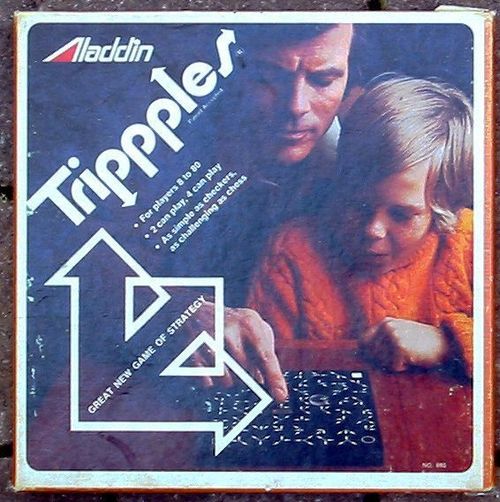
Trippples
Trippples Rulebook
Table of Contents
Table of Contents
Components
The Trippples game consists of a board which holds a total of 64 removable game tiles: 56 directional arrow tiles, two start tiles (square and circle), two finish tiles (outline square and outline circle), and four neutral zone (blank) tiles. These tiles, arranged in a virtually infinite* number of ways, make up the game surface.
Four transparent markers (two squares and two circles for a maximum of four players) are the playing pieces.
* 8.320987106 x 10^81 different combinations, to be exact!
Setting Up the Board
To set up the board for play, place the solid start tiles in opposite corners of the board, but on the same side of the board, and place the outline finish tiles diagonally across the board, on the opposite side, as in the diagram.
(Diagram: the solid square start tile is in the bottom-left corner and the solid circle start tile in the bottom-right corner; the outline circle finish tile is in the top-left corner and the outline square finish tile in the top-right corner; the four neutral zone tiles fill the centre of the board.)
For the first game, the four neutral zone tiles should be placed in the center of the board. All arrow tiles should be off the board, "arrows-down."
Draw for the square or round transparent markers. Square is first to select an arrow tile, which he positions anywhere on the board, arrows-up. The opponent then chooses an arrow tile, and places it in the game board — and so on, until the board is filled. The arrow tiles can be placed at random — or, as experience is developed, according to the special strategies of the players.
Important: The Dot on each arrow tile must always face the same edge of the board; this assures that all possible arrow combinations will appear in every game.
To begin the game, place the square transparent marker on the square start tile, and the circle on the circle start tile.
The Primary Rule
You must move your transparent marker in the same direction as one of the three arrows under your opponent's marker, while the arrows under your marker show your opponent which directions he can move.
The object of the game is to move your plastic marker one tile at a time horizontally, vertically or diagonally, either forward or backward, from your start tile to your finish tile. Whoever reaches his finish tile first wins. Keep in mind that to get to any particular tile, you must maneuver your opponent onto a tile with an arrow that allows you to reach that tile.
Play It Once
To begin your first game of Trippples, set up the board as described, and move your game piece to any adjacent tile. Your opponent then moves his game piece according to the arrows under your tile, and the game is under way.
Game Rules
-
Playing pieces can be moved to any unoccupied arrow tile, forward, backward, or diagonally. They cannot be moved to an occupied tile or a neutral-zone tile*, and, of course, they cannot be moved off the game surface.
-
If a player moves his playing piece to a tile that leaves his opponent without a legal move, the opponent simply misses his turn, and the player can then make a second move to any unoccupied arrow tile indicated by the opponent's playing piece.
-
A player who can make a legal move must do so. He cannot "pass" when a legal move — no matter what the direction or result — exists.
-
The game is won by the player who reaches his finish tile first. However, there are other ways to win, and "draw" games are possible. (See "other ways to win.")
* Trippples may also be played with the neutral-zone tile as a "wild card," which can be occupied, and which allows an immediate second move to any tile, regardless of what choices are indicated by the opponent's playing piece. Either rule is acceptable, as long as the players agree on it in advance.
Other Ways to Win
Trippples can be won without a player ever reaching his finish tile. Here's how:
The indirect win — when a player can force his opponent into an endless cycle of repeated moves to avoid a tile that will give the player a move to his finish tile. The player forcing this repetition must have a non-losing move for himself.
The "called freeze" — A player may win by announcing a move that will freeze both his and his opponent's playing pieces, so that neither player has a legal move open. The player calling the "freeze," however, must have a non-losing move at the time of the announcement.
A Game Is a Draw When
-
both playing pieces are frozen (without legal moves possible) and no "called freeze" announcement is made.
-
both playing pieces cycle repeatedly through the same series of moves, each to avoid losing.
-
both players agree to a draw because the layout of the tiles is such that neither player can win.
Variations
Easy win. Alter the game board by moving the start and finish tiles diagonally toward each other by one square. This opens the space around the finish tiles, creating more possible ways to win. And it makes starting easier, too.
Hidden arrows. To start the game, position the start and finish tiles in the four corners of the board, but turn all other tiles face down on the game board, including the neutral zone tiles. Either player begins with a free move, and the tile on which that player's game piece rests is then turned up to reveal the move options open to the other player. The game is then played to its conclusion. When a player reaches a neutral zone tile, he is entitled to a free move in any direction. It requires more luck than skill — but it's fun.
Inside-out. Place finish tiles in the center of the game surface, with start tiles in the corners, and neutral zone tiles anywhere. By strategically positioning the neutral zone tiles, a win can become incredibly elusive.
Doubles. This version requires two teams of two players each, and all four game pieces. Teams start on opposite sides of the board, and try to get either their own or their teammate's pieces to the finish line diagonally across the board. (Only one player must reach the finish tile for the team to win.) Any player's move options can be chosen from the arrows under either opponent's game piece (a maximum total of six move options).
Note to serious Trippples players: It is obvious that Trippples offers many varied versions of play — so many, in fact, that even its inventors haven't discovered them all! We welcome game players' comments, and invite you to write us with new variations of your own.