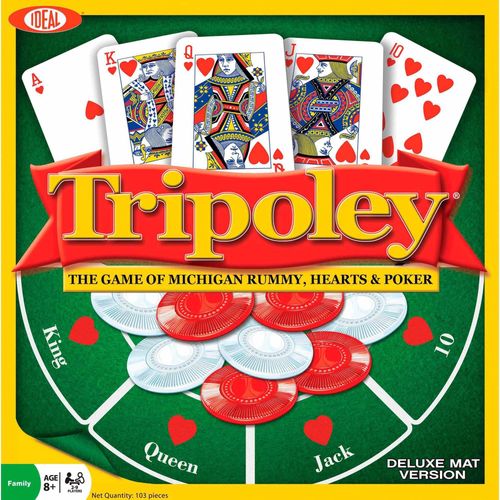
Tripoley
Tripoley Rulebook
Table of Contents
Table of Contents
Equipment
It is not necessary to own any of the commercially-produced versions of Michigan Rummy in order to play the games in this rulebook. All of the components are either readily available or can be purchased individually.
In order to play the games in this rulebook, you will need the following equipment:
- 18" x 18" game mats (one each for Michigan Rummy, Wanagan, Great Lakes, Rummoli, Tripoley)
- Poker-sized playing cards (52 cards per deck): use 1 deck for 2-5 players, 2 decks for 6-10 players, 3 decks for 11-15 players, 4 decks for 16-20 players
- Some sort of dealer marker (some poker chip sets come with one)
- Ceramic poker chips: a basic 300-piece set will support up to 6 players; a standard 500-piece set will support up to 10 players; a large 1000-piece set will support up to 20 players.
This rulebook assumes that you own an 11.5g dice poker chip set. The value of each poker chip is as follows:
- White: $1
- Red: $5
- Blue: $10
- Green: $25
- Black: $100
You can certainly use fancier poker chip sets, though you may need to adapt slightly.
Set-Up
-
Decide which game you would like to play and place the game mat on a table:
- Michigan Rummy: the classic game which combines Michigan with 5-Card Draw Poker.
- Great Lakes: a slight variation on Michigan Rummy with different payouts.
- Wanagan: a slight variation on 5-Card Draw Poker with multiple payout options.
- Rummoli: the Canadian version of Michigan Rummy with different payouts.
- Tripoley: an American version of Michigan Rummy with different payouts.
Rummy Royal has the same payouts as Tripoley, but adds an optional phase of betting on corner Aces. This phase has been included in this rulebook.
Experienced players may choose to swap the game mat between rounds to make things more interesting.
-
Decide what type of game you would like to play:
- Round limit (5 rounds for a standard game or 10 rounds for a long game)
- Time limit (30 minutes, 60 minutes, or whatever you like)
- Elimination (for when you have the whole weekend?)
-
Give each player the following poker chips: 20 x White ($1 value), 15 x Red ($5 value), 10 x Blue ($10 value), 5 x Green ($25 value).
-
Shuffle one deck of cards and have each player select a card from the deck by cutting the deck and choosing the top card after the cut. The player with the highest card becomes the dealer. If there is a tie for highest card, have those players cut the deck again. Ace is considered the highest card.
-
If there are more than five players, the Dealer will shuffle a second deck of cards and then shuffle the two decks together.
Ante
-
At the beginning of Round 6, color-up each player's chips to introduce the black $100 chips into the game and remove the white $1 chips:
- 5 White chips = 1 Red chip
- 2 Red chips = 1 Blue chip
- 2 Blue chips + 1 Red chip = 1 Green chip
- 4 Green chips = 1 Black chip
If any player has less than five White chips remaining, remove these chips from the game and place a Red chip in the center space for every five White chips removed in this manner.
-
Each player places an ante on each of the nine spaces on the game mat as follows:
- Round 1: $1 (or $2 if Dealer)
- Round 2: $2 (or $4 if Dealer)
- Round 3: $3 (or $6 if Dealer)
- Round 4: $4 (or $8 if Dealer)
- Round 5: $5 (or $10 if Dealer)
- Round 6: $10 (or $20 if Dealer)
- Round 7: $15 (or $30 if Dealer)
- Round 8: $20 (or $40 if Dealer)
- Round 9: $25 (or $50 if Dealer)
- Round 10: $30 (or $60 if Dealer)
In the game of Wanagan, each player places a double ante on the Full House, Any Flush, Any Straight, 4-of-a-Kind, and Wanagan spaces.
-
The dealer may choose to also place a bet on one of the corner Aces. Other players may also choose to cover this bet by placing an equal bet on the same corner Ace.
Deal
- Beginning with the player on their left, the Dealer deals out all the cards, one to each player plus a Dummy hand. Some players will receive more cards than others.
- After reviewing their cards, the Dealer now has three options:
- a. Play their hand as dealt.
- b. Exchange their hand for the Dummy hand, without looking at the Dummy Hand, provided that their original hand does not contain any of the Money Cards featured on the game mat.
- c. Auction the Dummy hand to the highest bidder whose original hand also does not contain any of the Money Cards featured on the game mat.
- Whichever hand is spare at this point is excluded from the round.
- If a bet was placed on one of the corner Aces, the player who now holds that Ace may collect the chips from that corner of the game mat, provided that the player who holds the Ace placed a bet on that corner during the Ante phase of the round.
Michigan
This phase does not apply when playing Wanagan. See the Wanagan section below.
- The player to the left of the dealer chooses one of the suits of the cards in their hand and places the lowest card that they hold of that suit on the table in front of them.
- Whichever player holds the next highest card of the same suit must now place that card on the table in front of them. Play continues in this fashion either until the Ace of that suit is played, or the next card in sequence is located in the discarded spare hand.
- a. Players may place more than one card at a time, provided they are in sequence.
- b. As cards or card combinations that correspond to the Money Card spaces on the game mat are placed, the player who placed the card or final card in the sequence may take the chips on those spaces. See the Money Card Spaces section of this rulebook for more details.
- When a sequence has ended for either reason, the last player who placed a card begins a new sequence by placing their lowest card in a suit of the opposite color. If they do not have any cards in the suit of an opposite color, play passes to the player on their left until someone has a card in the suit of an opposite color.
- The Michigan phase ends when one player has placed all of the cards in their hand. This player collects the chips from the center of the game mat. In rare cases where a round ends with all players having cards remaining in their hand, the player with the lowest total face value in their hand wins the chips in the center of the game mat. (Face cards count as 10 points, and the Ace counts as 11 points.)
Wanagan
- Each player selects five cards from their hand in order to win one of the Money Card spaces on the game mat and places them face-down on the table in front of them.
- Players simultaneously reveal their hands. If a player is the only person to reveal a particular sequence, they win all the chips on the corresponding Money Card space. If more than one player reveals a particular sequence, the higher hand wins. Suits are not ranked, so hands that differ by suit alone are equal, in which case the players split the chips.
- If there are still Money Card spaces with chips on them, each player selects three cards from their hand and passes them to the player on their LEFT. Each player will then assemble a new set of five cards in order to win one of the remaining Money Card spaces on the game mat, place them face down, reveal simultaneously, and resolve.
- If there are still Money Card spaces with chips on them, each player selects three cards from their hand and passes them to the player on their RIGHT. Each player will then assemble a new set of five cards in order to win one of the remaining Money Card spaces on the game mat, place them face down, reveal simultaneously, and resolve.
- If there are still Money Card spaces with chips on them, no cards are passed, but each player will then assemble a new set of five cards in order to win one of the remaining Money Card spaces on the game mat, place them face down, reveal simultaneously, and resolve. In this round, the following cards are wild: K of hearts, 10 of diamonds, 7 of spades, 4 of clubs.
Money Card Spaces
The chips on the Money Card spaces are collected during the Michigan / Wanagan phase of the game, unless otherwise noted.
Michigan Rummy
- 10 of hearts - the player who places the 10 of hearts collects the chips on this Money Card space.
- J of diamonds - the player who places the J of diamonds collects the chips on this Money Card space.
- Q of clubs - the player who places the Q of clubs collects the chips on this Money Card space.
- K of hearts - the player who places the K of hearts collects the chips on this Money Card space.
- A of spades - the player who places the A of spades collects the chips on this Money Card space.
- K-Q of diamonds - the player who places the K of diamonds immediately after the Q of diamonds has been placed, regardless of who placed the Q of diamonds, collects the chips on this Money Card space.
- 8-9-10 One Suit - the player who places a 10 in an 8-9-10 sequence, regardless of who placed the 8 or 9, collects the chips on this Money Card space.
- Poker Pot - the player who wins the 5-Card Draw Poker phase collects the chips on this Money Card space.
- Michigan Rummy - the player who wins the Michigan phase collects the chips from this center space.
Great Lakes
- Full House - if a player can create a Full House by playing four of their cards to join the last card played by the previous player, they collect the chips on this Money Card space.
- J of hearts "Tomahawk" Jack - the player who places the J of hearts collects the chips on this Money Card space.
- Q of spades "Black Mariah" Queen - the player who places the Q of spades collects the chips on this Money Card space.
- K of diamonds "Suicide" King - the player who places the K of diamonds collects the chips on this Money Card space.
- 6 Lead - the first player to begin a new sequence with a 6, because that is the lowest card they hold in that suit, collects the chips on this Money Card space.
- A-2 - the first player to place an Ace, ending the previous sequence, and then immediately placing a 2 of an opposite color to begin a new sequence, collects the chips on this Money Card space.
- 5-Card Straight - if a player can create a Straight by playing four of their cards to join the last card played by the previous player, they collect the chips on this Money Card space. The first of the four cards must match the current suit, but the three following cards may be of any suit. The next player must follow the suit of the last card in the Straight.
- "Losers" Kitty - the player who "wins" the 5-Card Draw Poker phase, by having the worst Poker hand, collects the chips on this Money Card space.
- Great Lakes - the player who wins the Michigan phase collects the chips from this center space.
Wanagan
- Full House - the first player to place a Full House collects the chips on this Money Card space.
- One Pair - the first player to place One Pair, regardless of color, collects the chips on this Money Card space.
- 4 of a Kind - the first player to place 4 of a Kind collects the chips on this Money Card space.
- Evens or Odds - the first player to place a non-duplicated sequence of even or odd cards, regardless of suit, collects the chips on this Money Card space. Ace is considered low for this purpose. (e.g. 2-4-6-8-10 or A-3-5-7-9)
- Two Pair - the first player to place Two Pair, regardless of color, collects the chips on this Money Card space.
- Any Straight - the first player to place a Straight, regardless of suit, collects the chips on this Money Card space.
- 3 of a Kind - the first player to place 3 of a Kind collects the chips on this Money Card space.
- Any Flush - the first player to place a Flush collects the chips on this Money Card space.
- Wanagan - the player who wins the final poker hand collects the chips on this center space.
Rummoli
- 10 of spades - the player who places the 10 of spades collects the chips on this Money Card space.
- J of diamonds - the player who places the J of diamonds collects the chips on this Money Card space.
- Q of clubs - the player who places the Q of clubs collects the chips on this Money Card space.
- K of hearts - the player who places the K of hearts collects the chips on this Money Card space.
- A of spades - the player who places the A of spades collects the chips on this Money Card space.
- A-K of diamonds - the player who places the A of diamonds immediately after the K of diamonds has been placed, regardless of who placed the K of diamonds, collects the chips on this Money Card space.
- 7-8-9 One Suit - the player who places a 9 in a 7-8-9 sequence, regardless of who placed the 7 or 8, collects the chips on this Money Card space.
- Poker Pot - the player who wins the 5-Card Draw Poker phase collects the chips on this Money Card space.
- Rummoli - the player who wins the Michigan phase collects the chips from this center space.
Tripoley
- 10 of hearts - the player who places the 10 of hearts collects the chips on this Money Card space.
- J of hearts - the player who places the J of hearts collects the chips on this Money Card space.
- Q of hearts - the player who places the Q of hearts collects the chips on this Money Card space.
- K of hearts - the player who places the K of hearts collects the chips on this Money Card space.
- A of hearts - the player who places the A of hearts collects the chips on this Money Card space.
- K-Q of hearts - the player who places the K of hearts immediately after the Q of hearts has been placed, regardless of who placed the Q of hearts, collects the chips on this Money Card space.
- 8-9-10 One Suit - the player who places a 10 in an 8-9-10 sequence, regardless of who placed the 8 or 9, collects the chips on this Money Card space.
- Kitty - the player who wins the 5-Card Draw Poker phase collects the chips on this Money Card space.
- Tripoley - the player who wins the Michigan phase collects the chips from this center space.
5-Card Draw Poker
- If there are chips remaining on Money Card spaces other than the Poker Pot / Kitty / Wanagan space, move all the remaining chips to the Poker Pot / Kitty / Wanagan space.
- Each player selects five cards from their hand and places them face-down on the table in front of them.
- Beginning with the player to the left of the Dealer, each player will check or raise the bet until all players have either called or folded. If all players fold except one, that player wins the pot without having to reveal their hand.
- If more than one player has not folded, the players who have not folded simultaneously reveal their hands. The best poker hand wins. If more than one player plays the same hand, the best ranked hand according to face value wins. Suits are not ranked, so hands that differ by suit alone are equal, in which case the players split the pot. If the value of the pot does not divide equally, the difference remains in the pot for the next round.
- a. Royal Flush (10-J-Q-K-A same suit)
- b. Straight Flush (5-card sequence same suit)
- c. 4 of a Kind (4 cards of equal rank)
- d. Full House (3 of a Kind and One Pair)
- e. Flush (5 cards of the same suit)
- f. Straight (5-card sequence any suit)
- g. 3 of a Kind (3 cards of equal rank)
- h. Two Pair (2 pairs of cards of equal rank)
- i. One Pair (1 pair of cards of equal rank)
- If there is at least one more round remaining in the game, the player to the left of the Dealer becomes the Dealer for the next round, shuffles the cards, and the next round begins with the Ante phase.