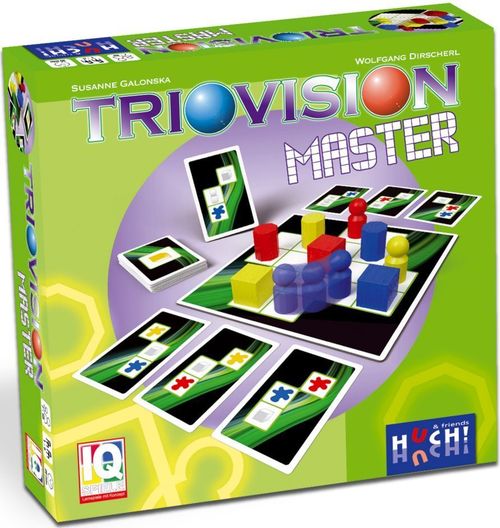
Triovision Master
Triovision Master Rulebook
Table of Contents
Table of Contents
Contents
- 1 game board
- 9 wooden game pieces (3 player figures, 3 dice, and 3 octagons, in three different colours: red, yellow and blue)
- 60 cards
Aim of the game
By moving a predetermined game piece on the game board, players try to re-create the same sequence of shapes on the game board as illustrated on the cards surrounding the game board. All players play simultaneously! The first player to come up with a correct solution is awarded the card with the corresponding pattern. The first player to collect twelve cards wins!
Game setup
Lay down the game board in the middle of the table. Place the nine game pieces randomly on the game board. Shuffle the cards thoroughly. Lay down ten cards along the outside of the game board face up. With the remaining cards, form a draw pile and place it face down next to the game board, so that the uppermost card shows a player figure (see illustration).
How to play
At the same time, all players examine the cards that are lying face up around the game board. Each player attempts to form the same pattern on the game board as illustrated on any one of the cards surrounding the game board. Exactly one game piece may be moved to an unoccupied space on the game board.
Note: Only the game piece shown on the back of the uppermost card of the draw pile may be moved on the game board!
The cards
- The shapes illustrated on the cards (player figure, die, octagon) always represent a specific game piece. The colour of the game piece is irrelevant.
- The colours shown on the cards (red, yellow, blue) always represent a specific colour. The shape of the game piece is irrelevant.
Example
The uppermost card of the draw pile shows the yellow die. Accordingly, the players may only move the "yellow die" game piece in this round. Consequently, there are two possible solutions for the card illustrated below:
- For solution 1, the yellow die is moved, which represents the "die" shape.
- For solution 2, the yellow die is moved, which represents the "yellow" colour.
Important Triovision Master rules
-
As soon as a player thinks he's found a solution, he yells "stop!". He then picks up the card, for which he has found a pattern on the game board, and moves the game piece into the right position on the board. The other players check to see if the three game pieces match the pattern on the card.
-
If the game pieces on the board match the illustration, the player gets to keep the card. A new card is drawn from the pile and laid down next to the game board, face up. The new game piece to be moved is shown on the uppermost card of the draw pile. The game then continues as described above.
-
If the game pieces on the board do not match the illustration, the game piece is returned to its original square. The player now has to wait for the other players to find a solution to any of the cards lying around the game board. He can only resume play once one of the other players has correctly formed a pattern on the game board that matches one of the cards.
-
In the rare event that no one can find a matching pattern on the game board, the uppermost card of the draw pile is discarded.
-
Note: An inverted pattern is not valid!
End of game
The game is over as soon as a player has collected twelve cards. The first player to collect twelve cards wins the game.
Game variation XXL
The game is played as usual, but is over once there are no cards left in the draw pile. The player with the most cards at the end wins the game. In the event of a tie, all players with the most cards win the game.
Game variation with two or three draw piles
To speed up the game and to add more variables, play with two or three draw piles. The game proceeds as described above with the following changes:
Before beginning, all remaining cards that have not been laid down around the game board are put into two or three draw piles. Now there are multiple game pieces, one on each draw pile, that can be moved on the game board. Players now have the choice of which game piece they want to move in order to form a matching pattern on the game board.
Game variation without restrictions
The game proceeds as described above with the following changes: In this variation, the game piece shown on the draw pile is irrelevant. Players can move any game piece they like on the board to form a pattern. Finding matching patterns on the game board is much easier and the game is much faster!
Triovision Master for one player
In the one-player game, turn over as many cards as you like. Try to form as many patterns on the board as fast as you can! You can also play against time.