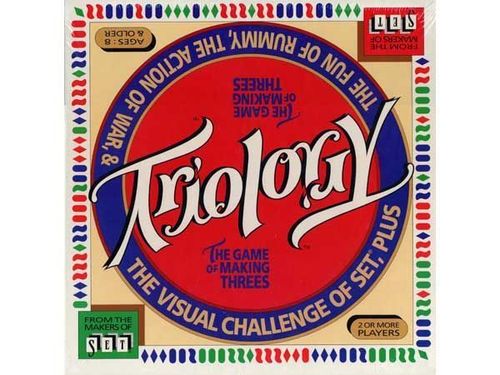
Triology
Triology Rulebook
Table of Contents
Table of Contents
Object
To form the hand into SETS of three cards (as explained below) which are placed on the table to obtain points. The first player to achieve a score of 100 points wins.
Players
Two or more players.
The Cards
1. ORDINARY CARDS have four features: symbols, colors, shading, and the number of symbols. Each card can vary in the following ways: SYMBOLS - can be ovals, squiggles or diamonds; COLORS - can be red, green, or purple; NUMBER OF SYMBOLS - can be one, two or three; and, SHADING - can be either solid, outlined or striped.
There are 81 ORDINARY cards in the deck.
2. TRIOLOGY CARDS - There are 27 special cards with the word TRIOLOGY on their face. TRIOLOGY cards are a special type of 'wild' card. These cards have three ORDINARY cards on them. Each ORDINARY 'card' is represented on a TRIOLOGY card as a group of (1, 2, or 3) symbols in a column. (There is only one type of symbol on an ORDINARY card.) Any one of the three groups on a TRIOLOGY card can be used with two other cards to make a SET, but only one of the three groups can be used.
3. HANDS-OFF cards are special cards which are used in MASTER TRIOLOGY (see below). There are 3 HANDS-OFF cards.
What Is a Set?
A SET consists of three cards in which each of the features of the cards must be either the same on each card, or, different on each card. That is to say, any feature in a SET of three must be common to all three cards, or, different on each card. For any two cards there is one, and only one, third card that can be used to make a SET.
The Magic Rule: If any one feature is the same on two of the cards but not on the third, then the three cards do not form a SET.
The Three Levels of Triology
I. Beginner Level Triology
Use just the red cards, not including the red HANDS-OFF card. This eliminates one of the four features, color, making SETS easier to find. There are no time limits on the players.
The Deal: Cards are dealt one at a time, to the left of the dealer. A hand contains 7 cards. The rest of the deck is placed face down on the table to form the stock. The top card is turned over and placed beside the stock to start the discard pile. The deal rotates in turn to the left.
The Play: The person to the left of the dealer goes first. Each player in turn must draw the top card or pick up from the discard pile (see rule for picking up discards). A player can make SETS using any combination of the cards from his/her hand, and/or the discard pile. To complete a turn, the player must discard one card, face up on the discard pile. The first player to get rid of all of his cards ends the play. A player may go out with or without discarding. If no player has gone out by the time the stock is exhausted, the discard pile is shuffled and placed face down to form a new stock, and the play continues until a player goes out.
Rule For Picking Up Discards: Any card in the discard pile may be picked up by the player whose turn it is. That player must, however, take into his/her hand all cards that have been discarded on top of that card (i.e. discarded later), and he/she must use that card to form a SET that is played that turn.
Scoring: Each ORDINARY card counts 1 point. Each TRIOLOGY card counts 3 points. The player going out gets 1 additional point and scores first. When a player goes out, all players count the points in their hands and then subtract these points from the points they have on the table. The first player to reach 100 points wins the game.
II. Triology
Use all of the cards except the 3 HANDS-OFF cards. Now you have all four features to consider when making a SET. Play as indicated above in BEGINNER LEVEL, with the difference that each player is dealt six cards. Decide whether you want to use the timers to limit turns to a maximum of three minutes.
III. Master Triology
Shuffle all the cards together including the 3 HANDS-OFF cards. Play as indicated above with the following differences.
- Each player is dealt nine cards.
- Each turn is limited to three minutes - marked by a timer (two timers are included so one is always ready to time the next player).
- A player may take an unprotected SET (one that does not have a HANDS-OFF card on it) from another player if he can use all the cards in that SET to make at least 2 different SETS with additional cards from his hand, cards he has already laid on the table, and/or cards taken from the discard pile. This is called STEALING. When a SET is stolen the three cards must be used as part of two or three different SETS. When TRIOLOGY cards are stolen, the player can chose any of the three groups depicted on it to make the new SET. The player need not use the same group as used in the original SET.
A steal can involve taking more than one SET from another player, or taking SETS from several players. If a player can go out, it is permissible to discard one of the stolen cards. This is the only time that a stolen card does not have to be used in a SET. When a SET is stolen, the 3 cards are placed on individual caddies so that the owner can identify them in case they need to be returned. After 2 or more new SETS are made using the stolen cards, the caddies are removed (as the player now owns the stolen cards).
The person from whom the SET was stolen receives one chip when the SET is stolen -- even if the SET must be returned. The chip counts as one point when totaling points at the end of the hand.
The only way to keep a SET from being stolen is to place a HANDS-OFF card on it during your turn. Once played it cannot be removed from the SET it is placed on. A HANDS-OFF card has no point value either in a hand or on the table.
If time runs out, the player must discard immediately, and may not lay down any more SETS. Furthermore, cards the player has stolen but not successfully rearranged into new SETS must be returned. If the player has not drawn or picked up a discard when the time runs out, he/she must draw from the stock and immediately discard that card.
Strategies
Since a TRIOLOGY card counts 3 points, holding it in your hand can be a serious penalty if another player goes out, so getting it onto the table is to your advantage. However, putting down a SET using TRIOLOGY cards too early in the game may make it more difficult to go out later on.
When playing MASTER TRIOLOGY stealing can turn the tables upside down, causing a losing player to win.
Playing TRIOLOGY cards in MASTER TRIOLOGY is much trickier. Since they are three-cards-in-one, they are more "stealable" than other cards. SETS made with one or more TRIOLOGY cards should be held close to the time a player is ready to go out. They are prime candidates for protection by a HANDS-OFF card if you are lucky enough to get one.