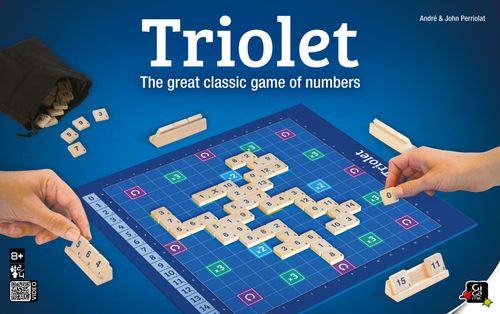
Triolet
Triolet Rulebook
Table of Contents
Table of Contents
Components
- 81 tiles numbered 0 to 15. The small number in the lower-right corner of each tile indicates the number of tiles with this face value in the game.
- A board of 225 spaces.
- A cloth bag.
- 4 racks.
- 2 wild tiles.
Concept and Goal of the Game
Each turn, each player attempts to score as many points as possible by placing one, two, or three tiles in a horizontal or vertical line, contiguous with one or more tiles already on the board. The player with the highest score at the end of the game wins!
Setup
Each player takes a rack and places it so that the tiles sitting on it will not be visible to the other players.
Mix the 83 tiles in the bag, then remove 3 unseen from the bag and place them face down on the table, without anyone seeing their values. These 3 tiles will not be used during the game.
Grab a sheet of paper and a pencil to tally players' points.
Randomly determine a first player. Each player takes 3 tiles and puts them on their rack.
Playing the Game
On your turn, you add one, two, or three tiles to the grid, then announce the points you scored (see Counting Points), which someone tallies on the sheet of paper. Then you draw new tiles from the bag so that you again have 3 tiles on your rack.
The first player's first placement must cover at least the central space, which counts as a double space (see Special Spaces). Play then continues clockwise.
Each tile must always be placed beside (orthogonally adjacent; diagonals do not count) at least one other tile already on the board.
Two tiles can be placed in one of the following ways:
- Parallel to tiles already on the board.
- On either side of a tile already on the board.
- In a line perpendicular to tiles already on the board.
Important:
- The total value of two tiles placed side by side on the board must be less than or equal to 15. Example: 7 + 6 = 13, and 13 is less than 15.
- The total value of three tiles placed side by side on the board must be equal to 15. A group of 3 tiles totaling 15 is called a Trio. Example: 11 + 4 + 0 = 15.
- It is not possible to place more than 3 tiles side by side in the same direction: at least one empty space must separate the groups of tiles.
- During your first turn, you are not allowed to form a 2×2 or 3×3 square of tiles on the board. Thereafter, you are not allowed to form a 3×3 square that would block the game.
On your turn, you may choose not to place any tiles, in order to exchange one, two, or three tiles from your rack with new ones from the bag. This action is allowed as long as there are at least five tiles in the bag.
If you cannot play tiles legally, and the bag has fewer than five tiles in it, you must pass your turn.
The printed examples for these rules are board diagrams showing tile positions; the diagrams are not reproduced here.
Counting Points
At the end of your turn, you score the total points of all new groups of two or three tiles you created with your placements. Tally your score on the sheet of paper.
Example: You placed the 6 and the 7. 9 + 6 = 15; 7 + 6 = 13. Total: 28 points.
Whenever you form a Trio (group of 3 tiles with a total value of 15), you earn a 15-point bonus, which is added to the Trio. Thus, a Trio is always worth 30 points.
Example: You placed the 3. 7 + 5 + 3 = 15, plus the Trio bonus of 15 points. Total: 30 points.
If the three tiles on your rack have a total of 15, you can place them in a line as a Triolet on the board (respecting placement rules). This play is called a Triolet, and it earns you an additional 50-point bonus.
Example: You placed these three tiles at once: 10 + 5 + 0 = 15, plus the Trio bonus of 15 points, plus the Triolet bonus of 50 points. Total: 80 points.
Special Spaces
Double Spaces
A double space doubles the point value of the tile covering it. However, if this tile is one of the tiles of a Trio, the entire Trio's point value (including the Trio bonus) is doubled: 2 × 30 points = 60 points. A Triolet bonus is never doubled.
Remember: the double space can only be used once per game, so if the tile covering it is part of two overlapping groups, the double space only counts in one of the groups.
Example: You placed the 4, 9, and 2 at the same time, and the 4 is on a double space. Trio 4, 9 and 2 doubled: 2 × 30 = 60 points, plus the Triolet bonus of 50 points. 10 + 4 = 14. Total: 124 points.
Because each double space can only double one group's point value (your choice), you wisely doubled the Trio's point value, rather than doubling only the 4 of the other group. 124 is much better than 98.
Remember: the central space is considered a double space.
Triple Spaces
A triple space triples the point value of the tile covering it. However, if this tile is one of the tiles of a Trio, the entire Trio's point value (including the Trio bonus) is tripled: 3 × 30 points = 90 points. A Triolet bonus is never tripled.
Remember: the triple space can only be used once per game, so if the tile covering it is part of two overlapping groups, the triple space only counts in one of the groups.
Example: You placed the 7, 1, and 7 at the same time, and the 1 is on a triple space. Trio 7, 1, 7 tripled: 3 × 30 = 90 points, plus the Triolet bonus of 50 points. Trio 1, 6 and 8 = 30 points. Total: 170 points.
Because each triple space can only be used once, you could triple only one Trio's points.
The principle of counting points for triple spaces is exactly the same as for double spaces, except that the point values are tripled instead of doubled, and each triple space can only be used once.
Replay Spaces
When you place a tile on a replay space, count and score your points, refill your rack, then immediately take another turn.
Each special space can be used only once per game, at the time it becomes covered; it loses its effect after it has been used once.
End of the Game
The game ends when there are no more tiles in the bag, and someone places their last tile on the grid (after tallying their score, of course).
If you are the player who now has no tiles, add the total value of your opponents' remaining tiles to your score.
Example: You are Player 4, and you just placed your last tile. Add the total of your opponents' remaining tiles to your score: 8 + 5 + 9 + 1 + 4 = 27.
Special case: everyone still has tiles, but no one can place any on the board (every player passes consecutively). In this case, the game ends, and each player subtracts the value of their own remaining tiles from their score.
In any case, the player with the most points wins!
Wild Tiles
- A wild can stand in for any tile. When you place a wild, you must declare which face value (0 to 15) it represents. This is the tile's face value for the rest of the game.
- A wild's point value is 0.
- You can use a wild in a Trio, and you still get the 15-point Trio bonus; thus the Trio is still worth 30 points.
- You can use a wild in a Triolet, but you will not get the 50-point Triolet bonus.
- You are not allowed to play both wilds in the same turn. However, you may play a wild during a replay turn even if you played the other wild in the turn that triggered the replay.
Example of the Beginning of a 2-Player Game
The newly played tiles for each turn are outlined in red in the printed rules.
- Player A is the first player, and thus must cover the central space on the first turn. The central space counts as a double space. Player A scores 25 points (11 × 2 + 3 = 25).
- Player B creates two groups of two tiles each, and scores 27 points. 11 + 4 = 15; 8 + 4 = 12. Total: 27 points.
- Player A creates a Trio and a group of two tiles, and scores 37 points. Trio 3, 8 and 4 = 30; 4 + 3 = 7. Total: 37 points.
- Player B creates a Trio and two groups of two tiles each, and scores 52 points. Trio 11, 4 and 0 = 30; 8 + 7 = 15; 7 + 0 = 7. Total: 52 points.
- Player A creates two Trios and scores 60 points. Trio 4, 3 and 8 = 30; Trio 8, 7 and 0 = 30. Total: 60 points.
Wild Tile Notes
Notes printed with the wild examples:
- Note: When played, the face value of this wild had to be declared. It will keep this face value for the rest of the game.
- Note: This wild has a face value of 3 for the rest of the game (15 − (8 + 4) = 3).
- Note: No Triolet bonus when placing a wild. It will have a value of 10 for this game.
- Note: No Triolet bonus when placing a wild. It will have a value of 3 for this game.
- Note: No Triolet bonus when placing a wild. It will have a value of 0 for this game.
The printed wild examples are board diagrams; only the captions and notes above are reproduced.
Examples of Counting Points
The printed rules give worked scoring examples for each placement type. Their tile positions are shown in board diagrams that are not reproduced here; the point captions are:
Placing a Single Tile on a Normal Space
- Tile placed creates 10 + 3 = 13. Total: 13 points.
- Tile placed creates Trio 2, 4 and 9 = 30. Total: 30 points.
- Tile placed creates Trio 9, 6 and 0 = 30 and Trio 8, 7 and 0 = 30. Total: 60 points.
- Tile placed creates 3 + 9 = 12 and 4 + 9 = 13. Total: 25 points.
- Tile placed creates Trio 3, 3 and 9 = 30 and 1 + 3 = 4. Total: 34 points.
Placing Two Tiles on Two Normal Spaces
- 9 + 6 = 15 and 7 + 6 = 13. Total: 28 points.
- Tiles placed create a Trio 2, 7 and 6 = 30 and 5 + 2 = 7. Total: 37 points.
- Tiles placed create 11 + wild = 11 and wild + 14 = 14. Total: 25 points.
Placing Three Tiles (a Triolet) on Three Normal Spaces
- Trio 5, 10 and 0 = 30, plus Triolet bonus of 50, plus Trio 11, 4 and 0 = 30. Total: 110 points.
Placing a Single Tile on a Double Space
- Trio 2, 8 and 5 doubled = 30 × 2 = 60. Total: 60 points.
- 10 × 2 + 5 = 25 and 10 + 4 = 14. Total: 39 points.