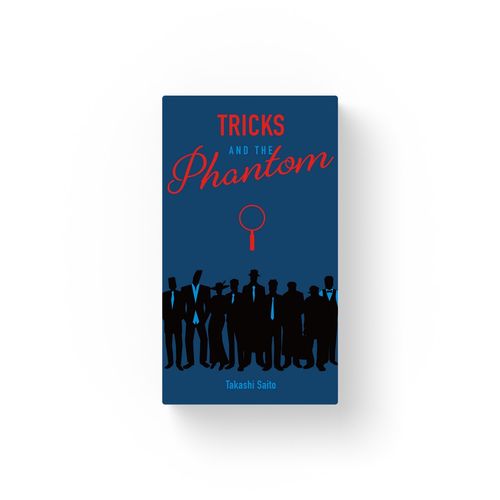
Tricks and the Phantom
Tricks and the Phantom Rulebook
Table of Contents
Table of Contents
Components
- Suspect cards #2-10: 1 of each (9 cards)
- Phantom cards: 2 cards
- Clue tokens: 3 types, 4 of each
- Summary cards: 4 cards
- Magnifying glasses: 4 pieces
- Point counters (25 in total): 1-point counter (20 pieces), 5-point counter (5 pieces)
- Game manual (this booklet)
1. Object
A criminal is loose! As police investigators, you'll investigate two crimes each round - those who can correctly deduce and report the criminals will earn points. Rounds continue until a player reaches 10 points, at which time the player with the most points is declared the winner.
4-Player Rules
These are the standard rules for 4 players. Please read these first for any amount of players, then refer to the additional 2 and 3-player rules for smaller groups.
2. Set-up
- Give each player 3 clue tokens (1 each of yellow, red, and blue), a summary card, and a magnifying glass with the same mark on the handle as the one in the top right of their summary card.
- Take the 9 Suspect cards and 2 Phantom cards and shuffle them together. Deal 2 facedown cards to each player. Each player should then look at their cards, while being careful not to show anyone else. The leftover cards will not be used this round and should be placed facedown in the middle. (Note: If this is your first time playing, it may be easier to deduce which card is the criminal if 1 Phantom card is removed before dealing.)
- The player who most recently spoke with the police becomes the first investigator, and the first round of play begins.
3. Reporting a Suspect
Starting with the first investigator and taking turns clockwise, each player reports a Suspect as follows.
- Choose 1 of the 2 cards you were dealt and place it facedown in front of you.
- If you chose a Suspect card, place a clue token on top of it that matches its color. (Lying is prohibited.) If you chose a Phantom card, you may place ANY clue token on the card.
Whodunit!?
The criminal is the card that has the highest number out of those placed by the investigators. However, depending on what effects are written on the cards, a different card may be the actual criminal instead.
To see the effects of each card, please refer to the summary cards.
Example
The Madame (8), a Detective (6), a Shopkeeper (3), and a Phantom (1) are the four cards placed. The Madame (8) did it! The Madame (8) is the highest-numbered card and thus becomes the criminal.
In another example, a Politician (10), a Detective (6), a Forensicist (5), and a Barkeeper (2) are the four cards placed. The Detective (6) did it! Because of the Forensicist's (5) effect, the Politician is removed and the Barkeeper's (2) effect is negated. The next highest-numbered card is the Detective (6) and thus becomes the criminal.
4. Solving the Crime
Starting with the last investigator to place a card down, take turns counterclockwise placing your magnifying glass on the card you suspect to be the criminal.
Be careful! If you place your magnifying glass on a Phantom card, the investigator that played the phantom card will gain 1 point from you when the points are calculated.
5. Determining the Criminal and Assigning Points
All players now reveal the cards they played and determine who the criminal is. Players will gain or lose points based on the below criteria.
| Situation | Points |
|---|---|
| Player that played the criminal card | Gain 1 point. |
| Player(s) that placed their magnifying glass on the correct criminal card | Subtract the amount of players that correctly guessed the criminal from the amount of players in the game and gain that many points. |
| Player(s) that played a Phantom card | Gain 1 point for each magnifying glass placed on your Phantom card. |
| Players that placed their magnifying glass on a Phantom card | Lose 1 point. A player cannot have less than 0 points. Note that if a player places their magnifying glass on their own Phantom card, they neither gain nor lose any points for doing so. |
| If the Detective is the criminal: the player that played the Detective card AND any players that placed their magnifying glass on the Detective | Gain double points. If the Detective is the criminal, the player that played the Detective card gains 2 points instead of 1, and any players that placed their magnifying glass on the Detective also gain double points. |
Example
Player A's card is a Barkeeper (9). Player B's card is the Detective (6), which is the criminal. Player C's card is a Forensicist (5). Player D's card is a Phantom (1).
- Player A placed their magnifying glass on the correct criminal (the Detective). Because it was the Detective: double points. Gains +4 points.
- Player B played the criminal card, and also placed their magnifying glass on their own card. Because it was the Detective: double points. Gains +6 points.
- Player C placed their magnifying glass on a Phantom card. Loses -1 point.
- Player D played the Phantom card, and 1 other player placed their magnifying glass on the Phantom. Gains +1 point.
6. The Second Crime and Finishing a Round
A second crime has been committed! For this second crime, each player will play the card that they did not choose for the first crime, following the same procedure. The player that played the previous criminal card becomes the new first investigator. Taking turns clockwise, place the correct clue token on your card. Now that you have already seen 4 cards in the first investigation, you should be able to more easily deduce which card is the criminal.
Follow steps 4 and 5 again. After points have been assigned for the second crime, the round ends.
Collect all of the cards - including the unused cards in the middle - and shuffle well. Once again deal 2 facedown cards to each player. The next round starts and the player that played the previous criminal card is the new first investigator.
7. Ending the Game
When a round finishes (after both crimes), if any players have 10 or more points the game ends, and the player with the most points is the winner. If any players are tied, continue playing rounds until a winner is decided.
2-Player Rules
Please read the standard 4-player rules first.
- Each player will act as two investigators. As in the standard 4-player rules, deal the cards and take turns playing suspect cards facedown on the table.
- Each player may only place 1 magnifying glass on a suspected criminal card.
- If a player correctly places their magnifying glass on another player's card, they gain 2 points. If a player correctly places their magnifying glass on their own card, they gain 1 point.
3-Player Rules
Please read the standard 4-player rules first.
- Shuffle all 11 cards and deal 3 cards to each investigator. After placing the remaining 2 cards facedown, turn over the top card. This card will influence the criminal investigation as a 4th party.
- Before selecting their first Suspect, each investigator chooses 1 of their cards and discards it facedown in the middle. These cards will not be used this round. (Though it is helpful to remember which card you discard.)
- From this point, the standard 4-player rules are used. However, the exposed 4th party card is included as a potential criminal in the investigation.
- If the 4th party card is the criminal, any player that played the Shopkeeper (4) or Forensicist (5) gains 1 point and becomes the new first investigator. If both cards were played, both players gain 1 point and the player that played the Shopkeeper becomes the new first investigator. If no one played either card, the first investigator remains the same.
- Turn over the second 4th party card and begin the second investigation.