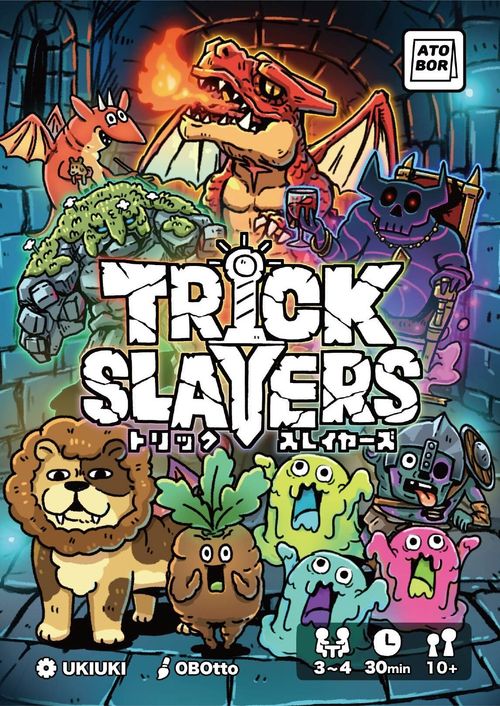
Trick Slayers
Trick Slayers Rulebook
Table of Contents
Table of Contents
- Components
- Game Objective
- Game Overview
- Setup (4 Players)
- Game Flow (Monster Appears)
- Lead Attack (First Player's Action)
- Critical Attack
- Example: Playing Lead and Critical Attacks
- Example of Attack Power Calculation
- Monster Defeat Check (After All Players Have Played Their Cards)
- Claiming Rewards
- After the Battle with the Monster Ends
- What Happens When You Run Out of Cards
- Determining the Winning Player
- Setup for 3 Players
- Q&A
- Card Reference
Components
- Attack Cards: 37 (Weapon Suits: Sword, Bow, Magic, Holy Grail)
- Monster Cards: 27 (Weapon Suits: Sword, Bow, Magic)
- Leftover Coin Chips: 26 (1 Gold: 15 / 5 Gold: 6 / 10 Gold: 5)
- Critical Chips: 4
- Instructions: 2 sheets
Attack Cards
- Card Numbers 1–12: 12 cards per suit (Sword, Bow, Magic, Holy Grail)
- Holy Grail 13: 1 card
Card layout as printed: Weapon Suits (Damage) 1~12, with the weapon attribute suit shown as Sword, Bow, or Magic (Weapons: Sword, Bow, Magic). The Attack Card 13 is labelled "Attack Card: Holy Grail 13 (All weapon attributes)."
Monster Cards
- Monsters: HP 10, 13, 16, 20, 23, 26, 30, 35, 40 (Weapon Attribute Suits: Sword, Bow, Magic)
- Monster card callouts as printed: Weapon attribute suit, Monster HP, Monster defeat reward Coins, Leftover Coins.
Points and Critical Tips
- Leftover Coins: 1 Gold, 5 Gold, 10 Gold
- Critical Tokens: +1 Damage
Game Objective
Once upon a time, there was a kingdom attacked by monsters. The king, in despair, gathered all heroes and ordered them to defeat monsters!
"Defeat the monsters! Defeat as many as you can!" "Those who succeed will claim the treasure they hoard!"
You form a party and begin an adventure to defeat monsters together! Can you follow the king's orders and earn rewards?
The player who defeats the most monsters and collects the most rewards wins!
Game Overview
"Trick Slayers" is a trick-taking game. However, unlike traditional trick-taking games, all players combine the numbers on their played cards to defeat monsters together.
The total value of all played cards becomes the party's attack power (damage)! If the total exceeds the monster's HP, the hunt is successful and the players earn rewards (coins)!
The player who played the highest number contributed the most and receives the largest reward. Players with the second and third highest numbers also receive "bonus coins," so work together to defeat the monsters!
Setup (4 Players)
- Separate the Attack Cards (Holy Grail Cards) and the Monster Cards.
- Gather all Attack Cards and Holy Grail Cards together, shuffle them well, and deal 9 cards to each player. The 1 remaining card will not be used during this battle.
- Next, gather all Monster Cards together to create the Monster Deck. Remove the 3 "DRAGON" cards from the Monster Deck.
- Shuffle the remaining Monster Cards and divide them face down into 2 separate piles. Add the DRAGON cards to the larger pile, then shuffle that pile thoroughly.
- Place the deck with Dragons at the bottom and put another Monster deck on top. Do not shuffle the decks!
- Reveal the top Monster card of the deck and place it face up next to the deck.
- Flip the top card of the deck face up so the next monster to fight is visible.
- Give each player one Critical Chip.
- Place the leftover coins near the Monster deck.
Now you are ready to begin playing "Trick Slayers"!
Game Flow (Monster Appears)
Fight against the Monster Card revealed from the Monster Deck!
Each player plays 1 Attack Card, and the total of all card values becomes the damage dealt to the monster. If the total is equal to or greater than the monster's HP, the monster is defeated.
The player who most recently defeated a monster becomes the first lead player! If no player has defeated a monster yet, choose one at random.
Lead Attack (First Player's Action)
First Player's Action
The first player chooses 1 Attack Card from their hand and plays it face up. The first card played becomes the Lead Attack. The first player may play any card they choose.
The weapon attribute of the first card played becomes the Lead Attack's weapon attribute.
Next Player's Action
The next player must choose 1 card of the same suit (weapon attribute) as the Lead Attack and play it to join the attack.
If the player does not have a card of the same weapon attribute suit, they may freely play any 1 Attack Card from their hand.
Note: If a player has a card with the same suit (weapon attribute) as the Lead Attack in their hand, they must play a card of that same suit. However, this rule changes in the case of a "Critical" attack, which will be explained later.
Continue until all players have played 1 card.
Critical Attack
A Critical Attack is a more powerful attack than the Lead Attack!
If a player has a card with the same weapon attribute suit as the monster card, they may play it as a Critical Attack.
Effect of Critical Attack
- +1 damage is applied!
- Has priority over Lead Attack!
Bonus Damage from Critical Attacks
Place 1 Critical Chip for each card with the same weapon attribute as the monster. Each chip provides +1 bonus damage.
If the Attack Card matches the monster's weapon attribute, extra damage is applied:
- +1 card: +1 damage
- +2 cards: +2 damage
- +3 cards: +3 damage
- +4 cards: +4 damage
Place additional Critical Chips. Each chip adds +1 damage!
Example: "Sword Attribute" Attack Card 11 + 6 + 5 + 4 = 26 + 4 Bonus Damage.
Takes Priority over the Lead Attack
If the attack power (total card value) is tied with the Lead Attack, the Critical Attack takes priority.
Example: Playing Lead and Critical Attacks
- Player A (Lead Player) played "Magic 9." The attribute is Magic. It is the Lead Attack.
- Player B did not follow the lead Magic, but played "Sword 4" matching the monster type. It is critical, so +1 is added, making 5 attack power.
- Player C also played "Sword 7" (+1) and joined Player B. Total attack is 13. It exceeds the monster HP!
- Player D had no Magic or Sword critical, so played "Bow 6" but could not join the battle.
Players C and D also play one card each in the same way.
Example of Attack Power Calculation
Once all Attack Cards have been played, determine the party's attack power.
Separate the played cards into "Lead Attack" cards and "Critical Attack" cards, then total the values of each group to determine their attack power.
- Add together the values of the Lead Attack cards. This is the Lead Attack Power!
- Add together the values of the Critical Attack cards, then add the bonus damage. This is the Critical Attack Power!
Compare the attack power of the "Lead Attack" and the "Critical Attack." The higher attack power takes priority. If the Lead Attack and Critical Attack have the same attack power, the Critical Attack takes priority.
- Cards with weapon attribute suits other than the Lead Attack or Critical Attack do not participate in this attack.
Monster Defeat Check (After All Players Have Played Their Cards)
Between the total values of the "Lead Attack" and the "Critical Attack," the higher attack power becomes the attack (damage) dealt to the monster.
If the attack power is equal to or greater than the monster's HP, the monster is defeated.
The cards from the attack with the lower total attack power are not used.
In the Case of a Lead Attack
- 11 + 6 + 5 + 4 = 26. Total Attack Power is 26. The monster's HP is 30, so the monster cannot be defeated.
- Additional damage does not occur unless weapon attributes match.
In the Case of a Critical Attack (Weapon Attributes Match)
- With the same cards, 11 + 6 + 5 + 4 = 26, but a Critical Attack is triggered, and an additional 4 damage is gained, making a total of 30 damage.
Claiming Rewards
If the monster is defeated, the player who played the highest number among those who participated in the attack claims the Monster Card as a reward (Monster Reward)! That player takes all of the monster's main reward.
However, the players who played the 2nd, 3rd, and 4th highest numbers also receive "Bonus Coins" as rewards for their cooperation!
- Monster Rewards: Reward for the Player Who Played the Highest Number.
- Leftover Coins: Rewards for Players with the 2nd Highest and Lower Card Values.
- 2nd Place: Gain coins equal to the leftmost number.
- 3rd Place: Gain coins equal to the second number from the left.
- 4th Place: Gain coins equal to the third number from the left.
After the Battle with the Monster Ends
- Gather the Attack Cards used during the battle and place them in the discard pile.
- Move the revealed Monster Card from the top of the Monster Deck beside the deck, and a new monster appears! This becomes the next monster to battle.
- The player who defeated the monster becomes the "first player" for the next battle and plays the first card from their hand.
- If the monster was not defeated, remove the Monster Card from play instead. The "first player" then passes clockwise to the next player.
What Happens When You Run Out of Cards
When all players run out of cards, gather all discarded Attack Cards and the 1 unused card from the beginning of the game, shuffle them well, and deal the cards evenly to all players again.
Determining the Winning Player
The player with the highest total of Monster Card victory points (coins) and Bonus Coins is the winner, the one who contributed the most during this adventure!
Calculating Total Rewards (Top Player Example)
Add together the "Monster Rewards" from the 3 defeated monsters for a total of 13 coins, then add the 8 Bonus Coins.
The player earns a final total of 21 rewards (coins).
If players have the same number of coins, the player who defeated the greater number of monsters wins. If there is still a tie, both players are considered winners.
- If you are behind in rewards (coins), it can be an effective strategy to avoid targeting powerful monsters and instead aim for 3rd or 4th place in the attack order to collect "Bonus Coins." Pay close attention to your hand and choose your actions wisely.
- Even cards with low numbers are not useless. With clever play, you can collect "Bonus Coins" and steadily build up your rewards.
Setup for 3 Players
- Gather all Attack Cards and Holy Grail Cards together, shuffle them well, and deal 12 cards to each player. The 1 remaining card will not be used during this battle.
- Gather all Monster Cards together to create the deck for the Demon Hunt. Remove the "DRAGON" cards from the Monster Deck.
- DRAGON cards are not used in a 3-player game.
- Next, remove the 3 "DEMON" cards from the Monster Deck. Shuffle the remaining Monster Cards well and divide them into 2 piles. Add the DEMON cards to the larger pile, then shuffle that pile thoroughly.
- Place the pile containing the DEMON cards on the bottom, then place the other pile on top to complete the Monster Deck.
All other rules are the same as in the 4-player game!
Note on step 3: the printed sheet says "remove" the 3 DEMON cards, and then says to add the DEMON cards to the larger pile. The sheet does not say where they are set aside in between; the text is transcribed as printed.
Q&A
Q: How is damage dealt to the monster determined? A: Compare the total values of the Lead Attack and the Critical Attack. ⇒ The higher value becomes the party's attack power.
Q: What weapon attribute does the Holy Grail (13) have? A: It has all attributes: Sword, Bow, and Magic. ⇒ It acts as a wild card for any attribute.
Q: When can the Holy Grail (13) be played? A: It can be played at any time during your turn.
Q: If the Lead Attack has the same attribute as the monster, can I play a different attribute? A: No. You must follow the Lead Attack attribute.
Q: If I have a card matching the Lead Attack attribute, can I still play a Critical Attack instead? A: Yes, you can.
Q: Who performs the next Lead Attack? A: The player who defeated the previous monster.
Q: I am the Lead Player. I do not know which Attack Card to play! A: If you have a weapon attribute matching the monster, it is usually better to play it! You can gain bonus damage!
Q: Who receives the Monster Reward? A: The player who played the highest number among those who used a Lead Attack or Critical Attack receives it.
Q: What happens if the Lead and Critical Attack totals are the same? A: The Critical Attack takes priority.
Q: What if I cannot participate in either the Lead or Critical Attack attribute? A: Play a card from any remaining weapon attribute (suit) in your hand.
Card Reference
Attack Cards (Sword / Bow / Magic / Holy Grail)
- Sword, Bow, and Magic: 12 cards each, numbered 1 to 12 (36 cards).
- Holy Grail: 13 (Holy Grail), 1 card. The Holy Grail can be used as a wild card for any weapon attribute (sword, bow, magic).
Monster Cards (Sword / Bow / Magic)
Each monster appears three times, once in each weapon attribute suit (27 cards):
| HP | Monster |
|---|---|
| 10 | Mandrago |
| 13 | Slime |
| 16 | Slimes |
| 20 | Imp |
| 23 | Ghoul |
| 26 | Manticore |
| 30 | Golem |
| 35 | Demon |
| 40 | Dragon |