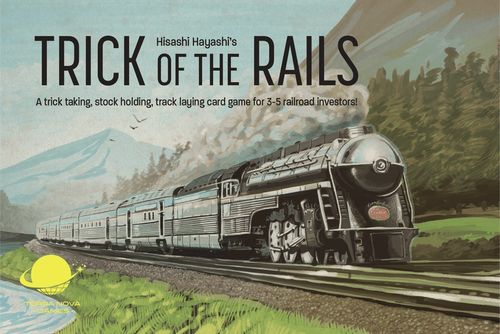
Trick of the Rails
Trick of the Rails Rulebook
Table of Contents
Table of Contents
Contents
50 Railway Cards
These cards represent either a portion of a company's railway (if added to the center) or a share in that company (if added to a player's area). On these cards you will find the following information:
- Number – Indicates the strength of the card (from 1 to 10) when played in a trick.
- Company – B&O, C&O, ERIE, NYC, or PRR.
- Station Value – Represents the value of the railway station: 10, 20, 30, or 40.
5 Station Cards
There is a Station card for each company, and they are indicated by a station icon.
Station cards begin the game in play to denote the beginning of each company's railway.
5 Exchange Cards
These cards are used for exchanging shares in the Trick Lane. There is 1 Exchange card for each company, and they are indicated by an exchange icon.
- Trick Lane Action – A reminder of what action the winning player will take when this card is leftmost in the Trick Lane.
3 City Cards
These cards are special railway stations (not used in 5-player games). On these cards, you will find the following information:
- Trick Lane Action – A reminder of what action the winning player will take when this card is leftmost in the Trick Lane.
- City Name – The name of the city that the station is in.
- Station Value – Represents the value of the railway station: 20, 30, or 40.
3 Reservation Cards
These cards are placeholders in the Trick Lane that will be swapped out during the game for Exchange cards or Railway cards.
They are added to the Trick Lane during setup, but will be removed from the game once they are swapped out.
Reservation cards are not used in 5-player games.
5 Locomotive Cards
These cards represent locomotives that companies can own. On these cards you will find the following information:
- Travel Distance – The number of consecutive cards in a railway that will count as profit at game end. This can be 3, 4, 5, 6, or the infinity symbol (to indicate unlimited distance).
- Trick Lane Action – A reminder of what action the winning player will take when this card is leftmost in the Trick Lane.
- Cost – The amount deducted from a company's profits at game end.
Setup
-
Line up the 5 Station cards in a vertical column on the table.
-
Shuffle all 50 Railway cards in a face-down deck and deal a number of cards to each player:
- 3 players: 15 cards
- 4 players: 11 cards
- 5 players: 9 cards
-
Draw each of the remaining Railway cards, 1 at a time, and add each to the right of the corresponding company's Station card. The horizontal rows thus formed represent each company's "railway."
-
Create the "Trick Lane" with a face-up row of randomized Exchange cards [E], randomized City cards [C], Locomotive cards [#], and Reservation cards [R], as shown below.
(With 4 players, only use 1 City card and 1 Reservation card. With 5 players, the City cards and Reservation cards are not used at all. Return unused cards to the box.)
- For 3 players: [E] [C] [E] [C] [E] [C] [E] [3] [E] [4] [R] [5] [R] [6/∞] [R]
- For 4 players: [E] [C] [E] [3] [E] [4] [E] [5] [E] [6/∞] [R]
- For 5 players: [E] [3] [E] [4] [E] [5] [E] [6/∞] [E]
-
The player who most recently rode on a steam engine becomes the first lead player.
Gameplay
Trick of the Rails is played over a series of rounds or "tricks" until players have played all cards from their hands. Follow these steps for each trick:
-
The lead player plays any card from their hand to the middle of the table. This card is called the "lead."
-
In clockwise order, each other player must play a card from their hand. If they have a card of the same company as the lead, they must follow suit. If a player has no cards of the same company as the lead, they may play any other card.
-
Whoever played the highest numbered card of the same company as the lead wins the trick.
-
Then players will either gain company shares or lay track to railways. Which action the players will take is decided by the leftmost card in the Trick Lane.
- If it's an Exchange card or a Railway card... The winner takes that card from the Trick Lane and adds it face up in front of them as a company share (i.e., oriented so the share icon is at the top right). Then, if there are any Reservation cards left in the Trick Lane, the card the winner played is exchanged with the leftmost Reservation card, which is removed from the game. If there are no Reservation cards left in the Trick Lane, the card the winner played is removed from the game instead. The cards the other players played to this trick are added face up in front of the respective players as company shares.
- If it's a City card... The winner adds the City card to either end of any company's railway. Then, each player (starting from the winner of the trick and going clockwise) adds their played card to either end of the railway corresponding to their card's company.
- If it's a Locomotive card... The winner places the Locomotive card to the left of the railway of any company that does not already have a locomotive. Then, each player (starting from the winner of the trick and going clockwise) adds their played card to either end of the railway corresponding to their card's company.
-
The winner becomes the new lead player for the next trick.
As a reminder of the Trick Lane action, there is an icon at the top right of each card:
- The gain-shares icon = players will gain company shares.
- The lay-track icon = players will lay track to company railways.
End of the Game
The game ends after the final trick has been played. Then, before a winner is declared, the value of each company's shares must be determined.
Calculate the profit for each company:
- If the number of cards in that company's railway is equal to or less than the locomotive's travel distance, then the company's profit is the sum of the station values of all cards in the railway.
- If the number of cards in that company's railway is greater than the locomotive's travel distance, then the company's profit is the sum of the station values of a number of consecutive cards in the railway equal to the locomotive's travel distance. Use the most valuable consecutive section of the railway.
Each company's share value is the company's profit minus the cost of the company's locomotive. (Note: The company with the infinity locomotive must still pay its cost.) If the result is negative, the share value is zero.
Each share that a player has is worth as much as that company's share value.
The player with the highest total value in share holdings is declared the winner. In the case of a tie, the tied players share the victory.
Example Scoring for a Company
A. B&O has 5 cards in its railway, which is greater than its locomotive's travel distance of 4.
B. Therefore, B&O's profit is the sum of station values in the most valuable consecutive section of 4 cards in its railway. (10 + 40 + 30 + 40 = 120)
C. B&O's share value equals its profit minus locomotive cost. (120 profit - 50 locomotive cost = 70)
D. Each B&O share that a player has is worth the company's share value. (70 share value x 2 shares = 140 for Player 1's B&O shares)
Expert Variant
When you create the Trick Lane during setup, shuffle the City cards and Locomotive cards together and distribute them randomly. Recommended for experienced players.
Team Variant
In a 4-player game, players can play as partners in teams of 2. No information may be conveyed between partners by words, gestures, expressions, or any means other than the play of the game. At the end of the game, partners add their share holdings together to determine which team wins.
Acknowledgements
Simon Lundström, Nobuaki Takerube, Hisashi Hayashi, Todd Sanders, Ian O'Toole, Reunion Game Group, Jon Meitling, Alex Alban, Dustin Schwartz, Eric Brosius, and all our fans and supporters who made this game possible.
© 2016 Terra Nova Games. All rights reserved. © 2011 OKAZU Brand. All rights reserved.