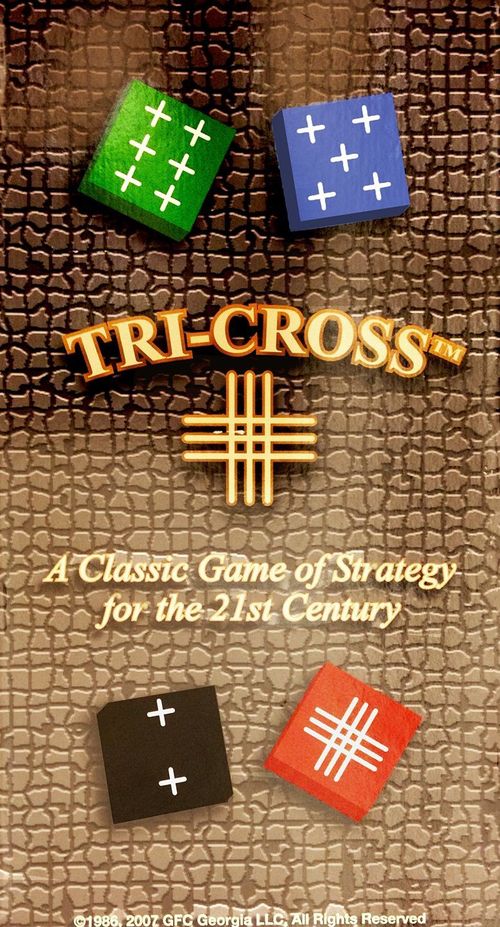
Tri-Cross
Tri-Cross Rulebook
Table of Contents
Table of Contents
Object of the Game
To win by occupying the Tri-Cross® square (center of board) with any one of your pieces for four turns in a row or to jump and remove all of your opponent's pieces.
Power of Pieces
The more crosses on a piece, the higher the power, except in the case of the Six vs. Tri-Cross.
NOTE: The Six can jump all pieces except the Tri-Cross. The Tri-Cross can only jump the Six.
- Six jumps and removes: Five, Four, Three, Two.
- Five jumps and removes: Four, Three, Two, Tri-Cross.
- Four jumps and removes: Three, Two, Tri-Cross.
- Three jumps and removes: Two, Tri-Cross.
- Two jumps and removes: Tri-Cross.
- Tri-Cross jumps and removes: Six.
Pieces of equal power (same number of crosses) only neutralize each other. No jumps are made.
Face-Up Version of Tri-Cross (2 Players)
Set Up for Play
- This version is for TWO PLAYERS only. Use only the black and red pieces.
- After choosing colors, each player will place one piece in the Tri-Cross bag while one of the players, without looking, chooses a piece. The color chosen determines who moves first.
- Place the pieces face-up in the predetermined pattern (See diagram below).
The setup diagram shows the board with a Start Zone at each end of the two extended arms, labelled Start Zone, Playing Area and Tri-Cross Square. Red pieces occupy the top and bottom Start Zones, black pieces the left and right Start Zones.
The Movement
- You may move any one of your pieces one square only, in any unoccupied square, in any horizontal or vertical direction. No diagonal movement is allowed.
- After you move a piece and your hand is removed, your move is finished.
- Any piece may leave, reenter, or move within the Start Zone.
The Jump (Removing Opponent's Piece From the Board)
- When one piece moves next to another (side-by-side), a piece MUST jump another, if possible, with the result being the removal of the jumped piece from the board. If at the end of a jump a new piece can be jumped by either player, then the jumping continues. A player's turn does not end until all jumps have been made.
- A jump can only be made in a horizontal or vertical direction over a weaker piece in an adjacent square (No diagonal jumping is allowed). A piece cannot jump into an occupied square.
- If the two pieces are of equal power, then no jump is made and both pieces remain in place.
- All jumps must begin, if possible, with the player who started the turn (See Jumping Example 2).
Jumping Example 1
The black Three moves next to the red Two and continues his turn by jumping and removing the Two from the board.
Jumping Example 2
The player who starts the turn ALWAYS gets the first chance to jump (Jumping Priority) until all jumps during the turn are completed.
The red Three moves next to the opposing Two and Four. Because the red Three started the turn by moving, that player gets to take the first jump even though the black Four has a higher power.
Jumping Example 3
Because the red Three started the turn, that player gets to take the first jump(s). The space is open for the black Four to jump the red Three and the red Five to jump the black Tri-Cross.
Example of Continuation of Jumping During Turn
The red Four moves next to the black Two. The red Four jumps the black Two and is now next to the black Five and black Three. Red moved first so it still has jumping priority. After the jump the red Four is next to the black Six. The black Six jumps and removes the red Four. This ends the red player's turn. The black player's turn now begins.
Additional Notes
- Even if not noticed initially, any time a possible jump is pointed out by either player, it must be taken immediately before any other moves are made. This rule always takes precedent.
- If you can jump more than one piece at the same time, it is left up to you to choose which piece to jump. If you can jump a piece with more than one of your pieces, you may choose either piece to make the jump.
How to Win
You win by occupying the Tri-Cross® square (center of board) with any one of your pieces for four turns in a row or to jump and remove all of your opponent's pieces.
When you move a piece into the Tri-Cross square you will immediately say, "In, in one," which puts your opponent on notice of entering the Tri-Cross square and the count of four full turns starts.
At this point, your opponent takes a turn. If you did not have to move your piece out of the Tri-Cross square or lose it by being jumped, then you can make another move with one of your other pieces. At this point you will say, "In, in two."
This process continues through the fourth full turn. After stating "In, in four," your opponent has one last move to try to force your piece out of the Tri-Cross square. If your opponent is unable to force you out of the square by either jumping your piece or forcing you to jump out, you win the game.
Additional Notes
- You must always move a piece on your turn. The only exception to this rule is if you occupy the Tri-Cross square and have no other pieces remaining on the board. In this case, you may pass on your turn and continue the count by saying, "In, in two, pass," etc. It is up to your opponent to get you out within four full turns.
- If you choose to move your piece out of the Tri-Cross square or you are forced to jump out of the Tri-Cross square, the count stops. When a piece re-enters the Tri-Cross square the count begins again at "In, in one," even if entering the Tri-Cross square by jumping. The count will continue on that player's next turn.
- If you cannot move a piece on your turn (trapped) then you lose.
Standard Version of Tri-Cross (2-4 Players)
The Standard Version of Tri-Cross uses the same gameplay as the Face-up Version. The only difference is in the initial setup for play (pieces face-down) and how the pieces are revealed. The game objective is still to win by occupying the Tri-Cross® square (center of board) with any one of your pieces for four turns in a row or to jump and remove all of your opponent's pieces.
Set Up for Play
- For TWO PLAYERS only the black and red pieces are used. For THREE PLAYERS choose between black, red, green, or blue. Only the Six, Five, Four, and Tri-Cross are used. For FOUR PLAYERS only the Six, Five, and Tri-Cross of each color are used.
- After choosing colors, all players will place one piece each in the Tri-Cross bag while another player, without looking, chooses a piece. The color chosen determines who places first.
- You and your opponents will take your own pieces and place them on their sides, facing toward you and hidden from your opponents.
- The player whose color was chosen places a piece of their choice face-down in any square in the Start Zones (three squares at the end of the four extended sides surrounded by double lines).
- After the first piece is placed, the player to the left will then place a piece face-down in any empty square within the four Start Zones. This process continues in a clockwise direction until all pieces have been placed.
- The player who placed the first piece moves first. The playing order continues in a clockwise direction.
Additional Notes
- Once a piece is placed and your hand is removed, you may not look at the face-down piece again until the piece is challenged by your opponent during game play.
The Challenge
- A challenge is made when two or more opposing pieces are moved side-by-side (not diagonally) within the playing area, and when done, the pieces still face-down must be turned face-up.
- Your piece remains face-down until it is challenged. Once your piece is challenged it must remain face-up for the remainder of the game.
- Pieces side-by-side and face-down in the Start Zone (for example in the start of play) do not fall within the challenge rule. Thus, the pieces are not turned face-up.
Example of Challenging
The black piece moves next to the red piece and the challenge is made. Both pieces are turned face-up. The black Tri-Cross can jump the red Six so it jumps and removes it from the board. The Tri-Cross stays face up for the rest of the game.
A challenge may be made ON or BY a piece located within the Start Zone if at least one piece is located in the Playing Area (See example on following page). Once a piece in the Start Zone is placed face-up it can be jumped by another face-up piece within the Start Zone.
Example of Challenging in the Start Zone
The red piece moves next to the two black pieces. Since one of the black pieces is in the Playing Area, it is challenged and that piece must be turned face-up along with the challenging red piece. The other black piece is safe and stays face-down since it is still in the Start Zone.
Example of Challenging More Than One Piece
The red piece moves next to the two opposing black pieces and the challenge is made. All three pieces are turned face up. The black Six jumps the red Five. Both black pieces stay face up for the remainder of the game.
Example of Challenging More Than One Piece (Second Example)
The only piece revealed is the black Three. The red piece moves to challenge both opposing pieces. The two face-down pieces are revealed and all three pieces stay face up for the rest of the game. No jumps can be made.
Additional Notes
- You may not turn over your piece without being challenged. If you turn over your piece or your opponent's piece when it should not have been, you automatically lose the game.
- All pieces removed from the board must remain face-up.
The Jumping Priority
In a game of three or more players, there may be instances where more than one player can jump. The player who started the turn has the jumping priority, followed by the next person in the playing order (player to left), and so on.
Example of Jumping Order with Three or More Players
The black Four moves next to the green Six and the red Five. The red Five happens to be the next player in the playing order, thus it MUST jump the black Four. After the red Five jumps the black Four, it is then next to the black Six and black Tri-Cross. Because the black Four started the turn, that player still has jumping priority, thus the black Six jumps the red Five.
Optional Variations of Set-Up Prior to Play
GUTS (For 2-3-4 Players or Team Play): Played with your pieces mixed-up and placed face-down in front of you. You then place the pieces face down as in the Standard Version but without looking and knowing what power your pieces are.
REVERSE GUTS (For 2-3-4 Players or Team Play): Played with all your pieces being placed by your opponent. You will look at your opponent's pieces before you place them face-down as in the Standard Version while your opponent observes and places your pieces in turn. You will move your pieces without knowing what your pieces are, but you will know where your opponent's pieces are and vice versa. If more than 2 players are playing, the player to your left will place your pieces.
TEAM PLAY: FOUR PLAYERS may choose to play in teams. This is done by choosing a partner. The partners sit across from each other. Each player chooses a color as if 4 separate players were to play. Pieces should then be selected and placed face down as if 4 players are playing. The difference of the game is that the partners may not reveal to each other what their pieces are while face-down or communicate plans of play. When the partner pieces come into contact they are considered as one team (not opponents), thus no challenging or jumping of partners exists. Certainly as pieces are turned face-up, good teamwork (without discussing plans) will be key to winning. When a team player's turn begins, and the team player's partner is already in the Tri-Cross square, the team player's turn will count toward the four-count total.