Tri-Ba-Lance
Tri-Ba-Lance Rulebook
Table of Contents
Table of Contents
Setup
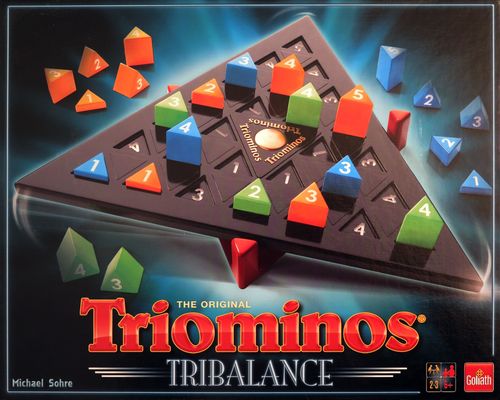
The triangular playing field is placed on the balance ball and aligned horizontally by hand. The sides of the frame serve as markers for this. When the playing field is balanced and coincides with the three sides of the frame, the scale is ready for play.
The playing pieces come in 5 sizes. They differ in size and weight.
- The smallest playing piece is the basic unit: weight 1.
- The next larger playing piece has double the weight: weight 2.
- The next larger has triple the weight: weight 3, and so on.
The ring markings on the playing pieces clearly identify each piece's weight.
Each player receives a set of playing pieces in one colour. The number of pieces depends on the number of players.
2 players:
- 3 playing pieces of weight 1
- 3 playing pieces of weight 2
- 3 playing pieces of weight 3
- 3 playing pieces of weight 4
- 1 playing piece of weight 5
3 players:
- 2 playing pieces of weight 1
- 2 playing pieces of weight 2
- 2 playing pieces of weight 3
- 2 playing pieces of weight 4
- 1 playing piece of weight 5
The players place their playing pieces in front of themselves. The game can begin. The players agree on who starts.
Goal
Each player tries to place their playing pieces optimally on the playing field, that is, to achieve the maximum possible number of points in each turn. The player with the best total result at the end of the game wins.
The points for a placement are the weight of the placed playing piece multiplied by the number of the placement field on which the piece was placed.
Examples:
- Playing piece of weight 3 on placement field 2: 3 x 2 = 6 points
- Playing piece of weight 1 on placement field 5: 1 x 5 = 5 points
The points of all playing pieces are added together at the end of the game.
Gameplay
Players take turns clockwise. On a turn, each player places one playing piece of their choice on any position of the playing field.
The deflection of the balance shows whether the turn is valid or invalid.
A turn is valid if the deflection of the balance lies within the permitted range, that is, if none of the corners and none of the sides of the playing field rests permanently on the frame. The playing field may touch the frame briefly while the piece is being placed. If the turn is valid, the placed playing piece remains in its position. The next player then takes their turn.
A turn is invalid if one of the corners or one of the sides of the playing field rests permanently on the frame. The player must take the placed playing piece back. The player may place it again later in the game. The next player then takes their turn.
End of Game and Scoring
The game ends when no player is able to place any of their playing pieces on the playing field.
If one of the players has placed all of their playing pieces on the playing field, the other players may continue placing, but only until a turn is invalid. With sufficient skill, they may even manage to place all of their playing pieces on the playing field.
For scoring, the players take their pieces from the playing field one after another and add up the points of all their pieces.
The playing pieces that a player was not able to place on the playing field are subtracted, at their value, from the total determined.
The winner is the player with the highest total score.