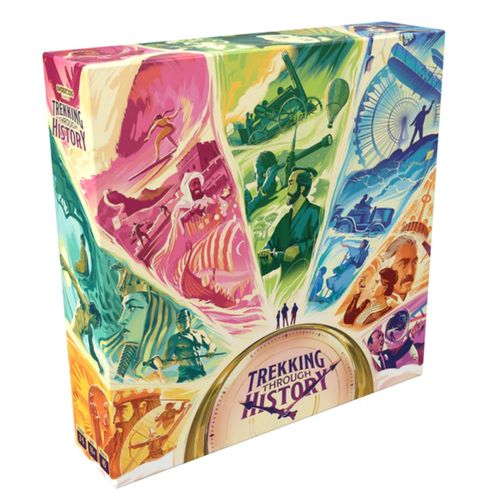
Trekking Through History
Trekking Through History Rulebook
Table of Contents
Table of Contents
Components
- 108 History cards
- 12 Ancestor cards
- 1 Clock
- 1 Neoprene playmat
- 4 Pocket Watches
- 4 Player Point markers
- 84 Experience tokens (20 Person, 18 Event, 16 Innovation, 16 Progress, 14 Wild)
- 20 Time Crystals
- 4 Crystal Tanks
- 24 Itineraries
- 4 Reference cards
- 1 Rulebook
- 1 Date index
- 24 Time Warp cards
- 4 Time Warp markers
- 1 Time Warp rulebook
Game Setup
-
Place the Supply tray (with all Experience tokens and Time Crystals inside it) on the table.
-
Place the playmat on the table.
-
Place the stack of Ancestor cards.
- 2-players: Place 6 copies.
- 3-players: Place 9 copies.
- 4-players: Place 12 copies.
-
The Day I deck of History cards has the roman numeral "I" in the upper right of each card. Shuffle and place that deck face up here. Then draw 5 cards from it and place them in the 5 empty spaces to the right of the deck. This row of 5 cards, plus the top card of the deck, form the 6-card Departures Row.
-
Shuffle the Day II and Day III decks separately, then set them aside for later.
-
Shuffle the Itineraries. Deal four to each player. In your first game, each player chooses one at random, places it face up in front of them, and keeps the others facedown nearby for later (once you've learned the game, you can pick which Itinerary you want to use).
-
Each player takes a wood Point marker matching their color and places it at 0 on the score track.
-
Place the Clock beside the playmat. Players pick a Pocket Watch matching their color and stack them in random order at 12 o'clock.
-
Give each player a Crystal Tank matching their color and one Time Crystal. Players place Time Crystals they collect into their Crystal Tank.
-
Give each player a Reference card.
TIP: The Victory Point symbol stands for points you can score. You'll find these on your Itinerary and the Treks section of the playmat.
Playing the Game
Understanding Turn Order
The Pocket Watches on the Clock determine turn order. The player whose Pocket Watch is on top goes first. As play progresses, the player whose Pocket Watch is furthest behind on the Clock goes next. If multiple Pocket Watches are tied for furthest behind, the player who is on top of the stack goes next. It's possible for a player to take multiple turns in a row if they complete a turn and their Pocket Watch is still furthest behind on the Clock.
Example: It is the blue player's turn because they are furthest behind, and on top.
On your turn, perform the following steps in order:
- Choose a Card
- Move Your Pocket Watch
- Collect Benefits
- Place Card in Trek
- Slide and Refill History Cards
1. Choose a Card
On each turn, first decide which one of the six historical events in the Departures Row you'll visit (you may choose the top card of the deck). Alternatively, you may decide to visit one of your ancestors. All the points you'll score will flow from this choice each turn.
About History Cards
Most of the time, you'll decide to visit a historical event from the Departures Row. Each History card in the row has several pieces of information:
- Title: The event you can experience
- Year: The year the event took place
- Hour Cost: The number of hours (spaces on the Clock) you must move to take this card
- History: Learn about the historical event
- Day: The Day deck to which this card belongs
- Benefits: The rewards for choosing and taking the card
The Benefits can include:
- Person Experience
- Event Experience
- Innovation Experience
- Progress Experience
- Wild Experience
- Time Crystal
About Ancestor Cards
On rare occasions, you'll decide to visit an ancestor by selecting an Ancestor card, if available. Ancestor cards work like History cards, except their dates are flexible, which makes it easier to visit events in chronological order, earning points (see "Place Card in Trek").
TIP: Remember BCE stands for "Before Common Era." The larger a BCE date number is, the older it is.
2. Move Your Pocket Watch
Look at the number on the lower left of the History card you chose. That's the number of hours you'll spend visiting the historical event. Move your Pocket Watch that many hours on the Clock, stacking it on top of any opponent Pocket Watches on the space where it lands.
Example: This red player chooses the 49BCE card and moves their Pocket Watch 2 hours.
Saving Time with Time Crystals
When you move your Pocket Watch on the Clock, you may use Time Crystals to reduce the number of hours you move. Each Time Crystal subtracts 1 hour from the total hours spent visiting an event, allowing you to move one less space on the Clock. You can spend multiple crystals in a turn, but may not make anything cost less than 1 hour.
Important: You may not use the crystals earned from a card to reduce the hours on that same card. To use Time Crystals for a card, you must already have them in your Crystal Tank before selecting it.
Example: Nick wants to get the Year 1324 card, which has an hour cost of 3. He pays 2 crystals (returning them to the Supply tray), reducing the cost of travel to only 1 hour.
TIP: Using Time Crystals can help you take multiple turns in a row. There's no limit to the number of crystals you can hold.
3. Collect Benefits
Collect the benefits shown on the card you chose. In addition, collect the benefit shown on the playmat below the card.
Example: Emma chooses the 1963 History card. This card provides an Event Experience and an Innovation Experience. The playmat below the card shows a Time Crystal, so she collects that too.
Place each gained Experience token on your Itinerary, on the uppermost empty space of the column matching the token color. Wild Experiences are wild: you can place them in any column. If you can't place a token, return it to the Supply tray. Tokens are unlimited. If you run out of a given color, use Wild tokens in their place. If you gained Time Crystals, put these into your Crystal Tank.
If you place an Experience token on a space with an icon, or completely fill a horizontal row with an icon at the end of it, immediately gain what the icon shows—either Victory Points or a Time Crystal. Move your wood Point marker on the score track to mark points gained, or place Time Crystals in your Crystal Tank.
Example: Emma places the Experience tokens she gained on her Itinerary, and immediately scores 4 points for covering the 4 in the column.
Example: Carl scores 6 points for filling the row.
4. Place Card in Trek
If this is your first card, place it in front of you. This starts your first column of cards, called a Trek.
A Trek is a series of events visited in chronological order. The more events in a Trek, the more points you'll score at the end of the game.
On a later turn when you choose a new card, do one of the following based on the date of the card you choose:
A. If your new card's year is later than the previous card in your Trek, stack the new card on top so you can see all dates. On subsequent turns, you'll continue adding cards to this column as long as each new card you take is chronologically later than the previous card you added to the Trek.
B. If your new card's year is earlier than your previous card, don't add it to your Trek. Instead, collapse your Trek into a single stack of cards. Flip it over to show it is completed and set it aside. (You will count these points at the end of the game.) Then, start a new Trek with the card you just took.
Example: Tim gained the Year 1271 card, which is earlier than his most recent History card of Year 1519, so he must start a new Trek. He collapses his previous Trek and sets it to the side next to his other completed Trek.
C. If you took an Ancestor card, add it to your current Trek. You may not start a new Trek with an Ancestor card. Your Ancestor card's date becomes the same as that of the previous card in your Trek. This allows you to keep a Trek going when it might otherwise be impossible. Note you may place Ancestor cards after other Ancestor cards.
Example: Kira gained an Ancestor card and placed it in her current Trek. It is considered to be the year 1933 when deciding what to do with the next card she chooses.
5. Slide and Refill History Cards
Slide the History cards in the Departures Row to the right to fill in any empty spaces, keeping them in the same order. Slide the top card of the Day deck to fill the leftmost empty space in the row.
TIP: Anticipate how the cards might move in the row as you wait your turn.
Clock Details
Hours in a Day
There are 3 rounds, one for each day of your trip. You have 12 hours to spend each day, as shown on the Clock.
Punctuality Bonus
If a History card (possibly in combination with Time Crystals) brings your Pocket Watch to exactly 12 o'clock, gain the Punctuality Bonus of 3 points.
Example: The red player chooses a card costing 2 hours, so they land precisely on 12 o'clock, gaining 3 points.
Movement Always Ends at 12
If a History card would send your Pocket Watch past 12 o'clock, stop at 12 o'clock anyway. You get no Punctuality Bonus in this case.
Example: The blue player chooses a card that costs 5 hours, but they still stop at 12 o'clock, receiving no bonus.
End of Day
Players must always stop at 12 o'clock upon reaching it (see "Clock Details"). When all players are at 12 o'clock, the day ends. If this is the end of the third day, proceed to Final Scoring. Otherwise:
- Discard the current Day deck and all the History cards in the Departures Row.
- Place the next Day deck face up in it's spot on the playmat. Draw 5 cards from the top of this deck and place each card face up in the Departures Row.
- Discard all the current Itineraries and the Experience tokens on them.
- Each player chooses one of their remaining Itinerary cards to use for their upcoming day.
- Begin the next day with the Pocket Watches in their current positions at 12 o'clock.
Important: When entering a new day, players continue their current Trek and keep the Time Crystals they've earned.
Final Scoring
At the end of the third day, players calculate their final scores.
Your final score consists of the following:
- Points gained from History cards and Itineraries (counted during the game on the score track).
- 1 point per unspent Time Crystal.
- Trek Scoring: Each Trek earns Victory Points based on the number of cards it contains, as shown on the Treks scoring reference on the playmat. Note: for Treks with more than 10 cards, each additional card earns 3 points.
The Treks scoring reference shows: 1 card = 0 points, 2 cards = 0 points, 3 cards = 2 points, 5 cards = 7 points, 7 cards = 15 points.
Example: Gabe is totaling up his final score. He's earned: 32 Victory Points on the score track, 1 Victory Point from unspent Time Crystals, and 24 Victory Points from his Treks. Gabe's final score is 57 Victory Points.
The player with the most Victory Points wins!
If any players are tied for the most points, the player with the longest Trek breaks the tie. If there is also a tie for longest Treks, then the tied players compare their second longest Treks to determine the winner. If their second longest is also a tie, they look to their third… and so on until there's a winner. If there's still a tie, then players share the victory.
We hope you enjoyed your time with us and visit us again at Wayback Tours! Please return your Pocket Watch to the kiosk before exiting the terminal.
Time Warps
Once you've played Trekking through History at least once and feel comfortable with it, try opening the Time Warp package you'll find in the box (24 Time Warp cards, 4 Time Warp markers, and a Time Warp rulebook).