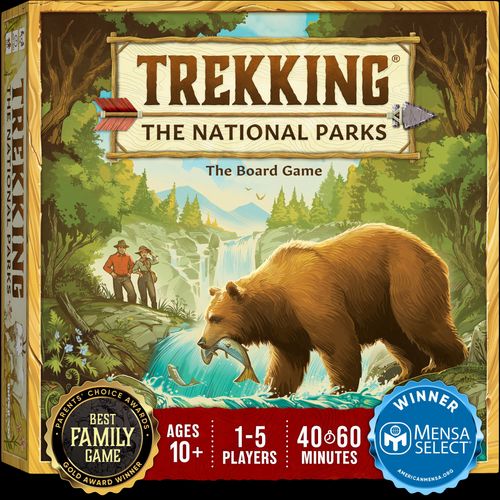
Trekking the National Parks
Trekking the National Parks Rulebook
Table of Contents
Table of Contents
Components
- 1 Map board
- 45 Stones (13 yellow, 11 red, 9 black, 7 green, 5 blue)
- 15 Tents
- 5 Trekkers
- 96 Trek cards (6 icon suits, numbered 1-4)
- 6 Major Park tiles
- 39 Park cards
- 5 Reference cards
- 1 Leatherette bag
- 1 Rule Book
- 1 Scorepad
- 1 Bear
- 47 Solo Mode cards
- 1 Solo Mode Rule Book
Object of the Game
Welcome to Trekking the National Parks, a friendly competition where you and your friends will race to visit national parks and experience their unique qualities. To win, prove yourself to be the most experienced traveler by moving around the map and scoring the most Victory Points (VP).
The golden arrowhead indicates Victory Points. Collect these wherever you can! There are four ways to earn Victory Points:
- Explore Parks: Be the first traveler to explore a park and take its card for Victory Points.
- Camp at Major Parks: Camp at Major Parks to earn Victory Points. Major Parks also give you unique abilities.
- Collect Stones: Each stone you collect is worth 1 Victory Point.
- Largest Stone Collection: If you collect the most stones of a color, you'll earn bonus Victory Points.
Setup
-
Place the Map board in the center of the table.
-
Put all 45 stones into the bag and mix them. For each park location on the map, randomly draw one stone out of the bag and place it on that location. Do not place a stone on START. Then return the bag to the game box; it will not be used during play.
-
Shuffle the Trek card deck and place it face down near the board. Flip 5 cards off of the top of this deck and place them in a face up row nearby. Save room for a discard pile.
-
Shuffle the Park cards (white border) and place them face down in a deck near the board. Flip the top 3 Park cards from this deck and display them face up (photo side).
-
Shuffle the 6 Major Park tiles (red border) and randomly pick 3 of them. Display these face up near the board. The remaining Major Parks won't be used during play; return them to the game box.
-
Give the Bear (aka, the first player token) to the person who most recently visited a national park. They will go first.
-
Give each player the following:
- 1 Trekker, which is placed on the START location on the map
- 3 Tents that match their Trekker's color
- 2 Trek cards dealt from the deck (kept secret from other players)
- 1 Reference card
Playing the Game
Players take turns in clockwise order. Each turn you must choose TWO actions from these four options:
- Draw a Trek Card
- Move
- Explore a Park
- Camp at a Major Park
You may choose two different actions, in any order, or the same action twice.
Examples: You may choose to move and then draw a Trek card. Or, move and then move again. Or, draw 2 Trek cards. Or, move and then Explore a Park... etc.
About Trek Cards
You use Trek cards to move across the map and experience the sights at national parks. Each Trek card has an icon and a number.
- Icon: The icon is used to Explore Parks and Camp at Major Parks. Each Trek card has only one type of icon.
- Number: The number is used to move your Trekker around the map. Important: The number is NOT the quantity of icons on a card.
A Trek card is always worth a single icon. Players must decide how they will use their Trek cards: either for its number value to move, OR for its icon to explore and camp.
Example: You may use a Trek card either as one tree icon OR to move 4. It's NOT worth 4 tree icons.
Option 1: Draw a Trek Card
Draw one card from the five face-up Trek cards on display, or from the top of the deck. Add it to your hand. When drawing a face-up card, immediately replace it with a new card from the top of the deck. If the deck runs out, reshuffle the discards to refresh it.
The hand size limit is 12. If you have more than 12 Trek cards at the end of your turn, discard the extras.
Example 1: Terry draws a Trek card from the face-up display. Then she flips a new card from the top of the deck face up to replace the card she took.
Example 2: Terry wants to draw a Trek card, but doesn't like any of the face-up options. So instead she draws a card from the top of the deck.
Refreshing the face-up Trek cards
If four of the face-up Trek cards are the same color, immediately discard all Trek cards and flip five new ones to replace them.
Example: Since four mountain cards are showing, discard all five face-up Trek cards. Then flip five new cards face up to replace them.
Option 2: Move
Move your Trekker across one or more trails to land on a new location. Follow these steps to move:
- Announce which location you are moving to.
- Play one or more Trek cards from your hand with a combined number value that exactly equals the number of trails separating you from your destination. Discard these cards.
- Move your Trekker to the new location. If there is a stone at that location, collect it. Do not collect stones on locations you pass through.
Example:
- John wants to move to Lassen Volcanic. He indicates which trails he will use to get there.
- John is a distance of two trails away from Lassen Volcanic. To make this trip he can use one '2' Trek card or combine two '1' Trek cards. He could not use a '3' Trek card because it is more than the distance of two.
- John collects the blue stone at Lassen Volcanic, but not the yellow stone on Redwood because he didn't end his move action there.
DO's and DON'Ts of moving
- You may use as many Trek cards as you'd like when performing a single move action. Example: You may spend '1', '2', '2', and '3' Trek cards all together to move a distance of eight trails. This counts as one move action.
- You MAY NOT spend a value higher than the distance you are traveling.
- You MAY NOT use a single trail more than once in a move action.
- You MAY NOT move through a location occupied by another player; they block the route. The START location is the exception.
- You may end your move on a location occupied by another player. This bumps the other player off that location and returns them to START.
- The START location acts as an intersection between trails just like park locations. Multiple players may occupy it.
Option 3: Explore a Park
The face-up Park cards (white border) may be explored. To do so, your Trekker must be at that location on the map. Reveal Trek cards from your hand with icons that match the icons shown on the Park card. Discard them, then take the Park card and place it face down in front of you.
After taking a Park card from the display, replace it with a new one from the top of the Park deck. There should always be three face-up Park cards available.
Note: The top card of the Park deck will preview what the upcoming Park card will be, however it's not available to explore until it's flipped face-up.
Example: John has moved to Lassen Volcanic because its Park card is available. He announces he'll use the Explore a Park action. The Lassen Volcanic Park card requires certain icons to explore. He reveals Trek cards from his hand with these icons and discards them. He takes the Lassen Volcanic Park card.
Option 4: Camp at a Major Park
Each game, three Major Parks are available (red border). These work differently than the other Park cards.
Players don't take Major Parks. Instead, players can camp at them by using their tent pieces. Doing so awards 5 Victory Points and also provides a special ability. Multiple players may camp at the same Major Park to earn its benefits. You may only camp at each Major Park once.
To camp at a Major Park, your Trekker must be at that location on the map. Reveal Trek cards from your hand with icons that match the icons shown on the Major Park. Discard them, and then place one of your Tents on the Major Park tile. It will remain there for the rest of the game. Then, activate that Major Park's ability (abilities explained below).
Example: John has moved to the Major Park Yellowstone. He announces he will use the action: Camp at a Major Park. Yellowstone requires certain icons. He reveals Trek cards from his hand with these icons and discards them. Then he places one of his Tents on the Yellowstone tile and gains its ability.
Major Parks abilities
Abilities marked as one-time effects trigger one time when you camp there. Abilities marked as ongoing effects last the remainder of the game.
- Acadia: For the remainder of the game, you may use any two Trek cards as if they were one wild card. You may make multiple wild cards on your turn. A wild card may be used as any color icon to Explore a Park or Camp at a Major Park. Tip: Use this to get better use from extra Trek cards in your hand.
- Denali: Immediately draw two Trek cards from the top of the deck. This is a one-time ability that triggers when you camp at Denali. Tip: It may be best to camp at this park later in the game so you can quickly refill your hand with new cards.
- Everglades: You may swap one stone you have with any one stone another player has. This is a one-time ability that immediately triggers when you camp at Everglades. If no other player has collected a stone, no swap is made. Tip: This is helpful later in the game for gaining a majority of a stone color.
- Hawai'i Volcanoes: For the remainder of the game, when you Explore a Park (white border), you may immediately move your Trekker to a connected location that is a distance of 1 away from your current location. This effect doesn't trigger when you Camp at a Major Park. Tip: This is helpful for gaining more stones or for positioning your Trekker closer to the next destination you want to visit.
- Grand Canyon: For the remainder of the game, when you take a move action, you may modify the total value of the cards you play by +1. Example: You may use a '2' Trek card to move a distance of 3.
- Yellowstone: For the remainder of the game, when you Explore a Park (white border) immediately draw one Trek card from the top of the deck. This effect doesn't trigger when you Camp at a Major Park. Tip: Camp here early in the game to earn several additional card draws.
End of the Game
The end of the game can be triggered in two different ways:
- All stones on the map are collected
- A player takes their 5th Park card (white border)
When either of these things happen, keep playing until every player has had an equal number of turns. Then the game ends.
Final Scoring
Use the scorepad to tally all Victory Points from:
- Park cards explored
- Major Parks camped at
- Stones collected (1 Victory Point per stone)
- Stone Bonus points (see below)
Awarding Stone Bonus points
The player who has collected the most stones of a color is awarded the Most bonus points for that color. The player who has collected the second most stones of that color is awarded the 2nd-Most bonus points for that color.
If there is a tie for Most, all tied players receive the Most bonus points, but the 2nd-Most bonus is not awarded in this case.
If there is a tie for 2nd-Most, all tied players receive the 2nd-Most bonus points.
Circle the bonus points each player would receive on the scorepad and then calculate the subtotals in the space provided directly below.
For 2-player games: Don't score 2nd-Most bonus for any stones.
Finally, add up all of each player's points. The player with the most Victory Points is the winner!
If there is a tie, the player who has scored the most points from Park cards and Major Parks is the winner. If this also creates a tie, the player who has collected the most stones wins. In the rare event players are tied in both ways, they share the victory!
Scoring Example: John ended the game with five Park cards (totaling 32 VP), two Major Parks camped (10 VP) and 11 stones (11 VP). He tied for having the most red stones with Terry, so they both get the Most Red Stones Bonus (6 VP); this tie also means 2nd-Most for red is not awarded (sorry Charlie!). He also won the 2nd-Most Black Stones Bonus (3 VP). His final score is 62 VP.