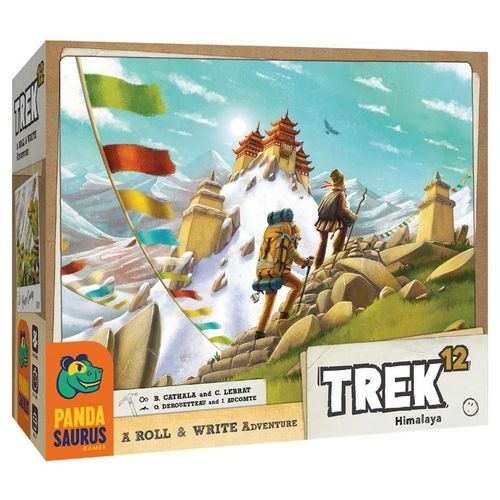
Trek 12: Himalaya
Trek 12: Himalaya Rulebook
Table of Contents
Table of Contents
Game Modes
Trek 12 includes three game modes:
- Trek Mode — A quick, easy competitive game for any number of players. Ideal for beginners or when you have limited time. These are the basic rules.
- Expedition Mode — Compete across 3 Ascents of increasing difficulty and earn helpful rewards to improve your climbing. Play in one sitting or save your progress across several sessions.
- Free Solo Mode — Face off on your own against a seasoned alpinist named Max, either for a single Express Ascent or across a full Expedition.
Learn Trek Mode first. After a few games you'll be ready for Expedition and Free Solo Mode.
Components
- 1 red die (faces numbered 1 to 6)
- 1 yellow die (faces numbered 0 to 5)
- 1 Lead Climber card
- 16 Assist cards (gear and companions that help with your Ascent — used only in Expedition Mode)
- 3 Ascent sheets: Dunai, Kagkot, Dhaulagiri
- 6 Challenge envelopes (do not open these — they are used in Expedition Mode)
Layout of an Ascent Sheet
- Climbing area — Made up of 19 circles connected to one another.
- Normal terrain — Ordinary circles.
- Dangerous terrain — Circles marked by a thick outline.
- Dice options table — Where you tick off the dice combinations you use.
- Scoring table — Rows for Fixed Lines and Mapped Zones, boxes for bonuses and penalties, and a Final Score box.
- Ascent name and Expedition-only elements (Reputation stars, Summit value).
Trek Mode
"Whoever wants to climb a mountain must start at its base." — Chinese proverb
Trek Mode teaches the basic rules of Trek 12. We strongly recommend playing a few games in this mode before taking on Expedition Mode.
Goal
Cleverly use the numbers on the dice to fill up your Ascent sheet. Create Fixed Lines and Mapped Zones to score points, but be careful to avoid Penalties that cost points.
Setup
- Pick an Ascent sheet and give each player a copy of it. For your very first game, we recommend climbing Dunai.
- Make sure each player has something to write with.
- Place the 2 dice in the middle of the table.
Leave everything else in the box (the Assist cards, the Challenge envelopes, and the Lead Climber card). These are not needed for this mode.
How to Play
The game is played in rounds. Each round has 2 steps:
- Roll both dice. Anyone can roll, since everyone uses the same result.
- At the same time, each player chooses how to combine the dice, then writes the result on their sheet.
To resolve step 2:
a. Choose one of the following options to combine the two dice:
- Use the lower die only.
- Use the higher die only.
- Subtract the lower die from the higher die (the difference). The result can be 0, but never negative.
- Add the two dice together.
- Multiply the two dice together.
Example: with a roll of 1 and 4, the options give 1 (lower), 4 (higher), 3 (subtract), 5 (add), or 4 (multiply).
b. Tick off the option you chose on your Dice Options table. Each option has 4 boxes. Once you have ticked all 4 boxes next to an option, you can no longer choose that option.
c. Write the resulting number in a circle of your choice. For the very first dice roll of the game, you may choose any circle. Afterwards, you must choose a circle that touches a circle you have already filled.
d. Mark any Fixed Lines or Mapped Zones that you created or expanded (see below).
Laying Fixed Lines
A Fixed Line is a path of connected circles with unique consecutive numbers (for example, 4-5-6-7).
When you write a number in a circle, check whether there are any consecutive numbers touching it that can create or expand a Fixed Line. If there are, draw lines connecting them together.
- Whenever you can draw a Fixed Line, you must do so.
- Each number in a Fixed Line must be unique. Do not connect a number to a Fixed Line if that number is already somewhere on the Line. For example, on a Fixed Line 5-6-7, if you write another 6 next to the 7, you may not connect them.
- No number may ever be part of more than one Fixed Line. If a number could expand several Fixed Lines, you must choose one of them to connect it to.
Terrain Types
- Normal terrain: max 12. You may only write numbers from 0 to 12 in normal terrain circles. If you choose (or are forced) to put a 13 or above in a normal circle, draw a skull there instead.
- Dangerous terrain: max 6. Marked by a thick outline. You may only write numbers from 0 to 6 in these circles. If you choose (or are forced) to put a 7 or above in a dangerous circle, draw a skull there instead.
Skulls are Penalties at the end of the game. They are not numbers, and can never be part of Fixed Lines or Mapped Zones.
Mapping Zones
A Mapped Zone is a group of connected circles that all contain the same number.
When you write a number in a circle, it creates or expands a Mapped Zone with every circle around it that contains the same number.
- When you create a new Zone, draw a unique background pattern in each circle that is part of it.
- When you expand a Zone, draw its existing pattern in each circle you add to it.
Important: A single circle can be part of both a Mapped Zone and a Fixed Line at the same time.
End of the Game
The game ends when players have filled every circle on their sheets (19 rounds). Each player then scores their Ascent as follows:
- Fixed Lines: Each Fixed Line is worth the highest number it contains, plus 1 point for each other circle on that Line. Write your score for each Fixed Line in the row.
- Mapped Zones: Each Mapped Zone is worth the number in any of its circles, plus 1 point for each other circle in that Zone. Write your score for each Mapped Zone in the row.
- Bonuses: Your longest Fixed Line and your largest Mapped Zone each score bonus points based on their size. The bonus table on your sheet tells you how many points to score; write these in the bonus boxes. Areas larger than 9 circles are worth an extra +5 bonus points per additional circle (for example, 30 points for a 10-circle area).
- Penalties: Every circle on your sheet that is not part of a Fixed Line or a Mapped Zone is an Orphan Circle. Cross out the numbers in all Orphan Circles and draw a skull next to them. Then count the total number of skulls on your sheet (from both Orphan Circles and terrain Penalties). For each skull, you lose 3 points.
Add everything up to find your Final Score. The player with the highest total wins.
If you run out of Ascent sheets, you can print more from the publisher's website.
Expedition Mode
For an Expedition, you undertake three Ascents, one after another, from the "easiest" to the "hardest" (according to the value of the Summit). The harder the climb, the more it influences your reputation. Expedition Mode uses all the basic Trek Mode rules, plus the elements below.
Earn a Reputation
In addition to the basic Ascent information, each Ascent card shows the goals needed to earn Reputation stars:
- The Summit is the minimum number of points needed to complete the Ascent. For example, a Summit of "70+" means you need at least 70 points at the end of that Ascent to reach the Summit and earn 3 Reputation stars.
- Race to the Summit stars are won only by the player(s) with the highest score among all participants in the Ascent. The highest-scoring player always wins those stars, even if they did not reach the Summit.
- The Hall of Fame (on the back cover of the booklet) archives records. During the very first Ascent in Expedition Mode, the highest-scoring player writes the date, their name, and their score in that Ascent's column. Each time the record is broken during later Expeditions, the new record holder does the same and strikes out the old one. Beating a record is worth a bonus Reputation star. If several players beat the record during the same Expedition, all of them get a bonus star, but only the highest-scoring one writes their name in the Hall of Fame.
Setup for an Expedition
- Take all the Assist cards, shuffle them, and place them face down as a deck.
- Put the not-yet-opened Challenge envelopes at the side of the table where everyone can see them.
- The oldest player takes the Lead Climber card.
Assist Cards
Assist cards help you reach the Summit more easily. At the start of each Ascent, a number of Assist cards are put into play and added to the ones left from the previous Ascent:
- 1st Ascent: reveal the first "3 + number of players" cards from the deck (for example, 8 cards for 5 players). Cards come in several copies; make a separate pile for each type.
- 2nd Ascent: add the first "2 + number of players" cards from the deck to those already in play.
- 3rd Ascent: add the first "1 + number of players" cards from the deck to those already in play.
If there are not enough cards left at the start of an Ascent, shuffle the cards already played back into the deck.
How to get an Assist card
Each time you create a new Zone made of 0s, 1s, or 2s, you may take one of the revealed Assist cards and place it in front of you.
Important:
- You can never have more than 3 Assist cards. If you take one while you already have 3, you must put one of yours back into play.
- When several players need to pick a card at the same time, start with the Lead Climber and go clockwise. The last player involved becomes the new Lead Climber and takes the Lead Climber card.
- If there are no Assist cards left when it is your turn to pick, you don't get one, but you still take the Lead Climber card if you're the last player involved that round.
How to use Assist cards
Assist cards can be used in two ways:
- During the Ascent: discard one of your Assist cards (put it back in the box) to immediately benefit from its effect. You may use several Assist cards during the same round.
- At the end of the Ascent: when scoring, beginning with the Lead Climber and going clockwise, each player may discard some or all of their remaining Assist cards. Each discarded card is worth a 3-point bonus. You start the next Ascent with the Assist cards you did not use.
The Assist cards
- The Compass — Write the dice result in a circle that is not adjacent to any previously filled circle.
- The Schnapps — Reroll the dice after all the other players have filled one of their circles. The player using it must accept the new result.
- The Rope — Set up a Fixed Line between two circles separated by one other circle (whether that circle is filled or not).
- The Tent — Perform a sum (+) even if you have already ticked all your boxes for that option on the Dice Options table. Draw a cross outside the table, on the same line.
The Challenge Envelopes
Each Challenge envelope contains a new test to enrich the game. The six challenges are:
- Your Zone must be exactly 5 circles.
- Your Zone must be exactly 3 circles of 7s.
- Your Fixed Line must be exactly 9 circles long.
- Your Zone must be exactly 7 circles.
- Your Zone must be exactly 2 circles of 11s.
- Your Fixed Line must be exactly 13 circles long.
Rules for opening them:
- When to open: After each Ascent, once totals are in, check whether any player met one of the remaining challenges.
- Only one envelope per Ascent: If different challenges were met during the same Ascent, open only the leftmost still-available envelope from the list above.
- Only one player per envelope: The player who met the challenge opens the envelope. If several players met the same challenge, the highest-scoring one for that Ascent opens it.
- What next: Follow the instructions inside. Once opened, an envelope is used up.
Building Up the Ascents
After each Ascent, fill in the Reputation stars you earned and start a new Ascent. At the end of the game, after 3 Ascents, the player with the highest number of Reputation stars wins the Expedition. In case of a tie, the player with the highest cumulative score across the 3 Ascents wins.
Free Solo Mode
Once you know the basic rules and have played a few Expeditions, you can play Trek 12 solo. Choose either a single Express Ascent or a full Expedition, and face off against a seasoned alpinist named Max. Whichever you choose, your goal is always to arrive first — Max will always be there to challenge you.
Setup
- Take the material you need for an Express Ascent or an Expedition, according to the mode you chose.
- Get two score cards: one for you and one for Max (you fill in Max's card for him).
How to Play
- Nothing changes for you. Fill in your score card exactly as in Trek Mode.
- Max imitates you. Max always fills the same circle you fill, but using the maximum possible value from the dice combination options for that roll. Represent Max's Zones, Fixed Lines, and Orphan Circles as you play. If the circle Max just filled could belong to several Fixed Lines, you decide which one to continue. Immediately apply the outcomes of Max's choices (Fixed Lines or Zones).
- Final count. Find the total for both you and Max as normal, including the bonuses from Zones and Fixed Lines.
Max's Special Bonus: Max is a seasoned climber, so minor incidents don't slow him down. After each Ascent, Max gets a 3-point bonus for each Orphan Circle (instead of the usual 3-point penalty).
Solo Expeditions
In a solo Expedition, you still undertake three Ascents from easiest to hardest, trying to earn the most Reputation stars. Additional rules:
- Assist cards: Use the Assist cards with the 2-player setup. If Max earns an Assist card thanks to a Zone made of 1s or 2s, you choose it for him among those available. Max never uses his Assist cards during the Ascents — he keeps them. Max can only ever hold a maximum of 3 Assist cards; don't take a 4th for him.
- After each Ascent: Find totals according to the Express Ascent or Expedition rules, applying Max's special rules. You and Max earn Reputation stars as usual. During the last Ascent, Max discards all the Assist cards he collected over the three Ascents, gaining a 3-point bonus per card. If Max breaks a record, write his name in the Hall of Fame.
After three Ascents, the player with the highest number of Reputation stars wins. In case of a tie, the player with the highest total wins.