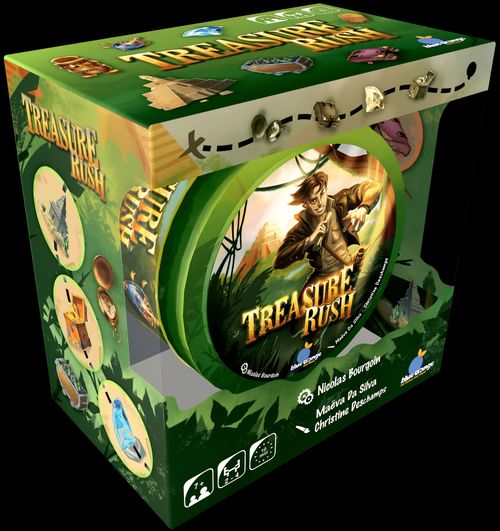
Treasure Rush
Treasure Rush Rulebook
Table of Contents
Table of Contents
Contents
- 1 wooden Treasure Chest
- 1 Destination Card
- 24 double sided Adventurer Cards (6 per player)
- 50 Treasure Map Cards
Preparation
Place the Destination Card at the center of the table with access to all players and set the wooden Treasure Chest on top of the card. This card will remain the destination for all challenges during the whole game.
Shuffle the Treasure Map Cards and place them facedown in a draw pile close to the Treasure Chest.
Each player takes 6 Adventurer Cards of their chosen color. Players place the cards in front of themselves with either side facing up, at about five cards distance from the Treasure Chest.
4 Players Game Set Up
[Setup diagram: the 4-player layout is shown as a picture in the printed rules, with the Treasure Chest on the Destination Card and each player's Adventurer Cards laid out in front of them.]
Playing the Game
The game is played in several rounds. The eldest player starts the first round by turning the first Treasure Map Card face up.
Players play simultaneously and try to recreate the path leading to the Treasure Chest by placing their Adventurer Cards in the right order, with the correct face up. They must start from their Start Point card and work towards the wooden Treasure Chest. The path on the Treasure Map Cards starts from the black dot and follows the dotted line over 2, 3, 4 or 5 icons to reach the Treasure (red cross).
Example
The Treasure Map shows the Diamond, Book, Compass, Wagon, Tablet icons, in that order. Players should place their cards as shown below.
[Example diagram: the printed rules show the placed Adventurer Cards in order, from the Treasure Chest down to the black dot.]
Fewer Icons
When the Treasure Map includes only 2, 3 or 4 icons, players must hide the unused card(s) by sliding it under another card.
Example: The Treasure Map shows the Compass, Wagon and Diamond icons, in that order. Players should place cards as shown, in that same order, with the 2 unused cards slid under one or two active cards.
[Example diagram: the printed rules show the active cards in order with the unused cards slid under them.]
Faded Icons
Note: Some icons on the Treasure Map Cards are slightly faded by time, which makes them less readable, but nevertheless part of the path to recreate.
Checking the Answer
When a player thinks they have reproduced the path perfectly, they grab the Treasure Chest. All players check the answer:
- The player is wrong: when either the cards are not in the right order OR at least one of them shows the wrong icon OR there are too many or not enough cards on the path. The player then loses one of the cards they had won and slides it under the draw pile. They are out for the remainder of the round while the rest of the players continue until one of them finds the path, or everyone fails.
- The player is correct: when they have managed to recreate the path to the Treasure Chest. They win the Treasure Map and place it in a pile in front of them. They then turn the next Treasure Map Card over face up, and a new round starts.
End of the Game
The first player to win 5 cards wins the game.
Variations
Variation in Teams (8 Players)
The game can be played with 2 player teams. Each team shares 5 Adventurer Cards, therefore one player takes 2 cards and the other one 3.
The game is played in the same way, except that the 2 teammates must plan how to place their cards. The one who places the last card on the path grabs the Treasure Chest.
Simpler Variation
Players can all agree that the lines on their cards do not need to be aligned for the path to be valid.