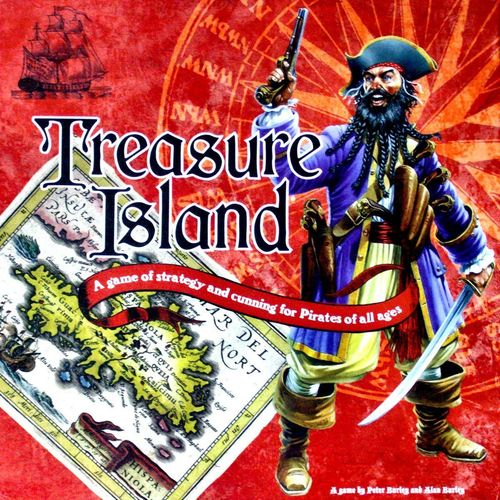
Treasure Island (2003)
Treasure Island (2003) Rulebook
Table of Contents
Table of Contents
1. Components
Game Board
A double-sided game board, with a desert island on each side. The side with a 12 x 12 grid of squares is the Small Board. The other side, with a 14 x 14 grid, is the Large Board. Both islands have lakes and rivers. Along the coast are special anchorage squares, marked with a bright orange anchor. Further inland are black treasure squares marked with a Jolly Roger (the pirate or skull-and-crossbones flag). These show where famous pirates, some fictional and some who really lived, buried their treasure on the island. The rules below apply to both the Small and the Large Board.
The Treasure Board
This board serves as the store for the treasures (cards) that the pirates buried. It has an area for each pirate, called that pirate's Treasure Trove (treasure chest). Each area corresponds to one of the treasure squares on the game board. There is also one further treasure chest, called "Davy Jones' Legacy". The treasure in this chest is a reward for the player who places the most counters on the board during the game. The reverse side of the Treasure Board is the "Final Reckoning" board, used when adding up the points at the end of the game.
Historical note: seven of the pirate names come from R. L. Stevenson's "Treasure Island". The other names come from real pirates and buccaneers who plagued the seas in the 17th and 18th centuries. One of them, Israel Hands, was a real pirate whose name had also been used for a character in Stevenson's book!
"Davy Jones' Locker"
This is a small square board used to store "surplus" treasures and cannons. It is also used to record "hits" during skirmishes (more on this later).
Footnote from the German rules: "In a 'Schapp' sailors keep their belongings."
Counters
720 pirate counters in six sets, one set in each of six different colours.
Pirate Captain pieces
Six pieces, one from each of the six coloured sets.
Treasure cards
A set of 130 cards. Each card shows a different treasure, a cannon, or a Jolly Roger flag. The number of cards for each type of treasure is as follows:
| Treasure (English name) | Cards | Treasure (English name) | Cards | Treasure (English name) | Cards |
|---|---|---|---|---|---|
| Diamonds | 6 | Pearls | 7 | Gunpowder | 8 |
| Rubies | 6 | Topazes | 7 | Spices | 8 |
| Gold | 6 | Silver | 7 | Silk | 8 |
| Sapphires | 7 | Amethysts | 7 | Rum | 8 |
In addition to these treasure cards there are twenty-one cards showing ship's cannons. Fourteen of them have a purple background and seven have a golden-yellow background. There are also two cards showing the pirate flag (Jolly Roger).
Dice
Four standard dice (two white and two black).
2. Object of the Game
It is the early 18th century. You are a bold pirate exploring the islands of the Caribbean in search of wealth and glory. After months at sea with your flotilla of sloops and brigantines, the cry "Land ahoy!" from the lookout in the crow's nest means you are in sight of the "Treasure Island"! It is time to drop anchor and venture ashore in search of buried treasure. The only problem is that you are not alone. Other pirates are eager to press their claims on the hidden loot. Your challenge is to outwit your opponents and become the most successful and notorious buccaneer on the north-east coast of South America!
To achieve this, you must compete against your rivals to collect treasure cards and score "treasure points" for the various treasures hidden on the island. Note that for each type of treasure, only the player who has the most of those treasures at the end of the game also scores points for them. So if at the "Final Reckoning" (German: "Letzte Abrechnung"), you have two Sapphire cards but another player has three, you do not score any points for your Sapphire cards. Only the player with the most Sapphire cards scores points for Sapphires. The same applies to all other types of treasure. The player with the most treasure points at the end of the game is the winner.
3. Setup
Decide which board you want to play on. The Small Board is good for beginners. For more than four players the Large Board is better suited. However, the Large Board works well with any number of players from two to six. Place the board with the chosen side face up. Make sure each player has some room in front of them to keep the treasures they collect.
Place the Treasure Board and "Davy Jones' Locker" beside the game board. It is best to place the Treasure Board directly above the "northern" edge of the game board, and "Davy Jones' Locker" directly next to the "western" or "eastern" edge of the board, depending on where the players wish to sit. Each player takes a set of counters in one colour, together with the matching Pirate Captain piece.
Shuffle the treasure cards (together with the cannons and Jolly Rogers) thoroughly and place them face down on the Treasure Board, in the area for each pirate. Follow the instructions printed on each area for how many cards to deal to that pirate. If you are using the Large Board, deal the corresponding number of cards to each area on the Treasure Board (including "Davy Jones' Legacy"). If you are using the Small Board, place cards only on the areas with yellow lettering and on "Davy Jones' Legacy", but not on the areas marked with orange lettering.
To keep the cards well mixed, it is best first to place one card on each area, then a second card on all areas that receive two or more cards, then a third card on all areas that receive three cards or more, and so on, until every area has the required number of cards.
The players must not look at the cards while they are being dealt. The remaining cards are set aside and are not used during the game. Players must not look at these surplus cards. And now the "Treasure Island" game can begin.
It is a good idea to use a shallow container (the lid of a shoebox is perfect) in which the dice can be thrown, so that they do not disturb the counters on the board.
You can either read the full rules before starting your first game, OR you can use the Quick Start rules at the end of this booklet and start playing straight away, referring to the full rules where necessary.
4. How to Play
All players throw two dice in turn, and the player with the highest total goes first.
Players then take turns throwing two dice (there are four dice, but two make the game quicker and simpler) and placing a counter on the game board.
The counter must be placed on an empty square so that:
- the number on the square matches the number on one of the dice the player has thrown,
- and the move is either a landing or an advance (see below).
With one of the moves mentioned above (landing or advance), a player places a new counter on the board rather than moving one of the counters already on the board. Once a counter has been placed on the board it stays on the same square until the end of the game. Counters are never moved on the board or removed from it.
Landings
With a landing, the player places a counter on an empty anchorage square. Please note that a player's FIRST move must ALWAYS be onto an anchorage square. All players must make one or more landings at the start of the game, because this is the only way onto the island. As soon as a player occupies one or more anchorages, they may advance inland from there.
Landings may be made at any time during the game, as long as there are still empty anchorage squares on the game board.
Advances
An advance is a move in which the player places a counter on an empty square that lies directly next to a square already occupied by the same player. The new square must lie directly side by side with the occupied one, and must NOT touch it only diagonally, corner to corner. Rivers may not be crossed: a move to a square that is separated from the other by a river is not valid. If the river covers only part of the boundary between the two squares, the advance may be made.
After a player has placed a counter, the next player clockwise takes their turn, unless the player has thrown doubles (see below).
If a player cannot use either of the two numbers they have thrown for a landing or an advance, they may not place a counter and must pass, unless they have thrown doubles. Otherwise the next player clockwise takes their turn.
Doubles (Pasch)
If a player throws doubles (i.e. both dice show the same number), the player may make a move using the number thrown and then throw again and make another move. A player may make an unlimited number of moves as long as they keep throwing doubles. As soon as a throw shows two different numbers, the player makes their last move (if that is possible) and the next player takes their turn.
Enclosed areas
In the course of the game, players will manage to place whole lines of counters on the board. A player who succeeds in completely cutting off an area of the board, so that it is impossible for other players to advance into that area, may occupy all the squares inside the area with their pirate counters. Areas occupied in this way are called enclosed areas. These areas must be surrounded on all sides either by the player's counters or by rivers (or the sea), and must not contain any opposing counters or any unoccupied anchorages. Examples of enclosed areas are shown in the figure below. The figure shows a partly played game, in which landings ("L"), advances ("A") and enclosed areas ("e") are marked. An area cannot be enclosed if it contains free anchorage squares, because it would still be possible for another player to land at that anchorage and advance from there.
[Figure: a partly played game marking landings, advances and enclosed areas. It is not reproduced in this transcription.]
Treasure squares
Treasure squares are occupied in the same way as ordinary numbered squares, either by advancing onto them and occupying them, OR by enclosing them. When a player occupies a treasure square, they take the treasure card(s) of the corresponding pirate from the Treasure Board (i.e. from the cards in the area on the Treasure Board marked with the same pirate name as the treasure square the player has occupied). When cards are taken in this way, it is called opening a treasure chest. The number shown on each treasure square is not only the number needed when throwing dice to place a counter on it, but also how many cards can be found in that pirate's treasure chest.
Cards taken from the chest must be placed face up in front of the player, so that all other players can see them. The player now owns these treasures. Treasures of the same kind must be kept in the same pile (e.g. all gold together, all spices together, and so on). The quantity of each type of treasure must be clearly visible. This can be achieved by laying the treasure cards so that the bottom card of each pile sticks out slightly further than the card on top of it. When further treasure chests are opened, these cards should be placed on top of the treasures already collected, again on the piles for the same type of treasure.
When several treasure chests are won by an enclosure
If a player wins several treasure chests in one turn, whether through an enclosed area or through doubles (i.e. the player is up twice in one round), each treasure chest must be opened separately. If several chests are won at the same time through an enclosure, the player must decide in which order to open the chests. When a chest is opened, its treasures must be taken out and kept in piles of treasures of the same kind, or added to existing piles of the same kind. If cannons are found, they must be used (see below) before the next treasure chest is opened. If they cannot be used immediately, they must be placed in "Davy Jones' Locker".
5. Cannon Cards
If a player finds cannon cards in the treasure chest, they may be used either to steal treasures from the other players or to protect the player's own treasures. After they have been used to steal treasure (or if they were unsuccessful in defending the player's own treasure in a skirmish, see below), they must be placed face up next to the Treasure Board, directly below the words "Treasure Trove". The resulting pile is called the "fired cannon" pile (German: "Gefeuerte Kanonen").
The two different kinds of cannon may be used in different ways as follows:
"Purple Cannons"
A Purple Cannon can be used to steal a pile of unprotected treasures. That means a player may steal ALL the treasure cards of a particular kind from another player (e.g. ALL of a player's Diamonds, or ALL Gold, or ALL Rum, and so on). However, the player using the cannon must already own at least one of these treasures themselves. For example, if a player wants to steal all of an opponent's Emeralds, the player must already own at least one Emerald card at the moment they find the cannon card in the treasure chest. (This also applies to treasures taken from the same treasure chest at the same time as the cannon, so that an Emerald from the same chest as the cannon gives the player the RIGHT to steal all the Emeralds of their chosen opponent.)
A Purple Cannon cannot be used to steal treasure from an opponent if that treasure is already protected by a Purple Cannon (see below).
A Purple Cannon may NOT be used to steal a Jolly Roger card, or to protect a Jolly Roger card.
Selected treasure piles may be protected with Purple Cannons. When a Purple Cannon is used for protection, the player must name the type of treasure to be protected with the cannon. The player must already own at least one treasure of that type.
When a treasure is protected with a Purple Cannon, the cards of the chosen treasure type are kept together in a pile as usual, and the Purple Cannon is placed under that pile so that the upper part of the cannon card remains visible. Each pile may contain only one type of treasure, and the cannon protects only that one type of treasure. The cannon cannot be moved to protect more valuable treasures that may be won later. All treasures of the chosen type won later may be added to the pile on the cannon and are protected by it.
Once a cannon has been used to protect a treasure, it can no longer be fired (i.e. used to steal treasures from other players).
A defending Purple Cannon remains in the chosen pile until the end of the game, or until it is removed by an opponent's attack with a Gold Cannon (see below). A treasure pile cannot be protected by more than one Purple Cannon.
Treasures that have just been stolen with the help of a (Purple or Gold) cannon may be immediately protected by their new owner with another Purple Cannon, if both cannons came from the same treasure chest.
"Gold Cannons"
A Gold Cannon can be used to steal a pile of unprotected treasures, with the same rules as described above for stealing unprotected treasures with a Purple Cannon.
A Gold Cannon can be used to steal a Jolly Roger card.
A Gold Cannon can be used to try to steal a treasure from an opponent even if the opponent has protected their treasure with a Purple Cannon. In this situation the two players must fight a skirmish (see below) to determine whether the attacking player is successful in their attempt. If the attacker wins the skirmish, they take the treasure from the defending player. Both cannons (the attacking Gold Cannon and the defending Purple Cannon) are placed on the "fired cannon" pile. If the defender wins the skirmish, the attacking player does not get the treasure. The attacking player must place the Gold Cannon on the "fired cannon" pile, but the defending player keeps the Purple Cannon, which continues to protect that treasure.
A Gold Cannon can NEVER be used to protect treasures.
Purple Cannons & Gold Cannons
If several cannons are won from the same treasure chest, they may each be used individually either to steal or to protect treasures, following the rules above.
If a player is, for certain reasons, unable to use a cannon to steal a treasure or to protect a treasure, the cannon must be placed in "Davy Jones' Locker".
6. Davy Jones' Locker
How to place treasures in Davy Jones' Locker
"Davy Jones' Locker" (German: "Davy Jones' Schapp") is a designated area where players sometimes have to get rid of "surplus" treasures. The number of different types of treasure a player may hoard is limited. The number of treasure types a player may have at the end of their turn is printed on "Davy Jones' Locker". This number depends on how many players are taking part (for example, in a two-player game each player may hoard nine different treasure types, but for four players the number is only seven). A player may have as many treasure cards as they like, as long as they do not exceed the number of different types. If, at the end of their turn, a player has exceeded the number of treasure types, they must choose which treasure types to get rid of, and ALL the treasures of those types must be placed in "Davy Jones' Locker" (i.e. the treasure cards are placed on the Locker card). A player may open several treasure chests in one turn, either because they were able to enclose an area or because they threw doubles several times. Treasure types are not discarded after opening a chest, but only once the player has finished their turn and before the next player takes their turn.
How to take treasures out of Davy Jones' Locker
When it is their turn, other players may take some or all of these treasures back out of "Davy Jones' Locker", provided they already own at least one example of that particular treasure type. For example, if a player is forced to place all their Pearls in Davy Jones' Locker and another player already owns at least one Pearl, that second player may, on their turn, take ALL the Pearls out of Davy Jones' Locker and keep them with those they already own. There is no limit to how many treasure types a player may take out of Davy Jones' Locker during their turn, as long as they own at least one example of each type they take. Treasures may be taken out of Davy Jones' Locker at the start of a turn if the player has already won corresponding treasure types in earlier turns. If a player wins a treasure during their turn that is of the same type as one of the treasures in Davy Jones' Locker, they may also take that treasure type out of Davy Jones' Locker and add it to their existing treasures. If a player misses the opportunity to take treasures out of Davy Jones' Locker during their turn, they lose the chance, and the next player who owns at least one treasure of that type may use the chance.
How to place cannons in Davy Jones' Locker
Cannons that are not used immediately when they are taken from the treasure chest must be kept in Davy Jones' Locker. Please note that this is not the same as placing cannons on the "fired cannon" pile (see below).
How to take cannons out of Davy Jones' Locker
A cannon may be taken out of Davy Jones' Locker by any player on their turn, if the player can use it immediately to steal or protect treasures, or to steal a Jolly Roger, following the rules listed under "Cannon Cards" above. If there are several cannons in Davy Jones' Locker, the player may take out as many as they can use during the course of their turn. A player who was forced to place a cannon at the start of their turn may be able to regain it later in the same turn, if treasures they receive from further "treasure chests" enable them to use the cannon.
Discarded cannons
If a player decides to place in Davy Jones' Locker a particular treasure type that was protected by a Purple Cannon, that cannon is placed on the "fired cannon" pile and NOT in Davy Jones' Locker!
7. Jolly Roger Cards
A player who takes a Jolly Roger card from the chest places it beside their other treasures, but separately from the existing piles. This entitles the player to collect one additional treasure type, in addition to the number shown on "Davy Jones' Locker" (the Jolly Roger itself does not count as a treasure type). So, for example, in a two-player game, if one of the two players has a Jolly Roger, they may collect ten different treasure types instead of the usual nine. A player who has both Jolly Roger cards may collect two additional treasure types. The benefits of a Jolly Roger apply to the player for the whole game, unless another player steals the card with a Gold Cannon (see above). If a player has a Jolly Roger stolen from them and as a result has too many different types of treasure, they must discard the types above the permitted number at the end of their next turn.
8. Skirmishes
Skirmishes are a method of determining the winner in the following four situations:
- when a player uses a Gold Cannon to steal a "protected" treasure pile from another player;
- when the game is tied between two or more players because they have the same number of counters on the board. The winner of such a skirmish may open "Davy Jones' Legacy";
- when, during the scoring phase described below, the game is tied between two or more players because they all have the same number of cards of a particular treasure type. The winner of the skirmish receives the points for that treasure type;
- when two or more players have an equal score at the end of the scoring. The winner of this skirmish wins the game!
A skirmish between two players
One player takes the two white dice and the other takes the two black dice. Both players throw their dice at the same time, and the player with the higher total scores a hit. To mark the hit, the winner places one of their counters on one of the "Jolly Roger" corners of "Davy Jones' Locker". The two players throw again, and the winner places a counter on another corner of "Davy Jones' Locker" (only one counter may be placed on each corner). When a player has scored three hits, they win the skirmish. If both players score two hits, all four corners of "Davy Jones' Locker" hold counters (two of each colour), and the next player to score a hit wins the skirmish. If both players throw the same total, neither scores a hit and a new round is thrown. At the end of the skirmish both players take back the counters they used to mark their hits and return them to their supply of unused counters.
Skirmishes with three or more players
This works in a similar way to a skirmish for two players. All players taking part throw two dice. The player with the highest total scores a hit and places a counter on a corner of "Davy Jones' Locker". If two or more players share the highest total, nobody scores a hit and all the players throw again. As soon as two players have each scored at least one hit on the corners of "Davy Jones' Locker", the other players drop out of the skirmish, and the two remaining players fight as described above over who first scores three hits.
9. The Endgame
Using both dice
Towards the end of the game, the players reach a point where they can no longer reach any of the unopened treasure chests because they have been cut off by the counters of the other players. When a player is in this situation, so that it is completely impossible for them to reach a treasure square, they may from then on until the end of the game take the numbers on both dice they throw for two moves each, instead of choosing only one of the numbers. Once all the treasure chests have been won, all players are in this situation and may use the numbers on both dice until the end of the game. This allows a faster and tidier ending, to "clear up" the last few squares. A player who throws doubles may add the points of both dice together and then throw again as in the "normal" game.
"Davy Jones' Legacy"
When every square on the board holds a counter, each player counts their counters on the board. The player with the most counters may now take the chest with "Davy Jones' Legacy". If the highest counter count is tied between two players, they must fight a skirmish to decide who may take "Davy Jones' Legacy".
The winner takes four treasure cards from the Legacy and places them in the usual way on their own pile of treasure cards. They may use all cannons contained in the chest to steal items from their opponents' treasures, following the usual rules. Then they must discard any surplus treasure or cannon cards in the usual way. Then the other players have an opportunity to take discarded treasures from "Davy Jones' Locker", beginning with the player to the left of the previous player and proceeding clockwise. The usual rules also apply here (i.e. they must already own at least one treasure of the type they wish to take from "Davy Jones' Locker"). Cannons may also be taken out and used, if this is possible. Once all players have had their chance, the game proceeds to the point described below, where the score is determined.
10. The Winner
Once "Davy Jones' Legacy" has been opened and the last exchange of treasures has taken place, there are no cards left on the Treasure Board. It can now be turned over to show the "Final Reckoning" board. Place each player's Pirate Captain piece at the start of the score track.
Determining the score
First, see who has the most Diamond cards. If two or more players are tied for the most cards, they must fight a skirmish (see above) to decide who is the winner for the Diamond points. The player with the most Diamonds (or the player who won the skirmish) may now move their Pirate Captain piece forward 16 spaces along the score track on the "Final Reckoning" board. If the player has more than four Diamond cards, this also entitles them to additional bonus points, and they may move their Pirate Captain further forward. If they have five Diamond cards, they receive one bonus point and may move 17 spaces forward. If they have all six Diamond cards, they receive three bonus points and may therefore move 19 spaces forward.
This process is repeated for Rubies, then for Gold. It is repeated for all treasures in descending order of value, down to Tobacco. Use the scoring table on the "Final Reckoning" board to go from the most valuable treasure down to the treasure of least value. This table also shows the total score for the different numbers of treasures of each type.
The score is determined in exactly the same way for each type of treasure. If a particular type of treasure does not appear at all during the game, or if all treasures of a particular type are in "Davy Jones' Locker" at the end of the game, nobody scores points for that type of treasure.
When the appropriate points have been determined for all the different types of treasure, the player whose Pirate Captain is furthest along the score track has won. If two players have the same highest score, they must fight a final skirmish to decide who has won the game!
Scoring table (from the official French rules, cross-check)
The German rules refer to the table printed on the "Final Reckoning" board but do not reproduce it. The table below is the one printed in the official French rules by Burley Games. Columns show the points for 1, 2, 3 or 4 treasures, and then for 5, 6, 7 and 8 treasures, with the bonus points stated in the column header.
| Treasure | 1, 2, 3 or 4 treasures | 5 treasures (bonus 1) | 6 treasures (bonus 3) | 7 cards (bonus 7) | 8 cards (bonus 15) |
|---|---|---|---|---|---|
| Diamonds | 16 | 17 | 19 | ||
| Rubies | 14 | 15 | 17 | ||
| Gold | 12 | 13 | 15 | ||
| Sapphires | 10 | 11 | 13 | 17 | |
Quick Start Rules
Please read the sections Components, Object of the Game and Setup carefully before trying to play with the Quick Start rules.
- The players throw two dice in turn.
- Each player chooses one of the two numbers thrown and places a counter on a square with that number on the game board. (p. 3)
- The chosen square must be an anchorage square, or a square next to another square the player already occupies. (p. 3)
- Rivers may not be crossed. (p. 3)
- A player who throws doubles may throw again. (p. 3)
- When a player encloses an area, they place a counter on every square in that enclosed area. (p. 4)
- When a player occupies a treasure square, they may take the treasure cards from the corresponding treasure chest on the Treasure Board. (p. 4)
- A player who takes treasures from a chest owns them and must keep them in front of them, in piles of the same type, visible to all players. (p. 4)
- Purple Cannons allow players to protect their various treasure types. (pp. 4–5)
- Purple Cannons or Gold Cannons may be used to steal unprotected treasure types from other players. (pp. 4–5)
- Gold Cannons may be used when attempting to steal protected treasure types, by fighting a skirmish. (p. 5)
- Gold Cannons may be used to steal Jolly Rogers from other players. (p. 5)
- Cannons used to steal treasures, or in an unsuccessful attempt to protect a treasure in a skirmish, are placed on the "fired cannon" pile (NOT in "Davy Jones' Locker"). (p. 5)
- A player may only collect a certain number of treasure types, as indicated on the Davy Jones' Locker card. All surplus treasure types must be placed in "Davy Jones' Locker". (p. 5)
- Cannons that are not used must be placed in "Davy Jones' Locker". (p. 5)
- During their turn, a player may take treasure types out of "Davy Jones' Locker", provided they already own at least one of that type. (p. 5)
- During their turn, a player may take cannons out of "Davy Jones' Locker", provided they can use them immediately in one of the prescribed ways. (p. 6)