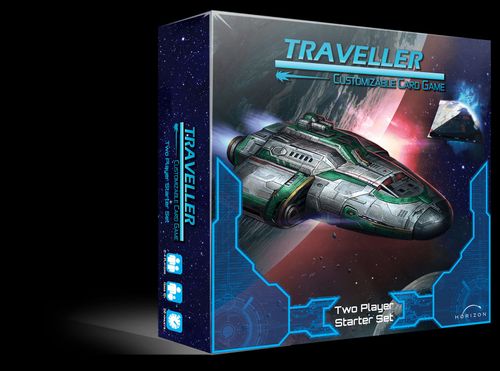
Traveller Customizable Card Game: Two Player Starter Set
Traveller Customizable Card Game: Two Player Starter Set Rulebook
Table of Contents
Table of Contents
Overview
Icons
In designing Traveller, we were inspired by the way board games have increasingly relied on visually driven icons in place of rules text. We know that at the beginning the large number of new symbols may be daunting, but don't worry too much about learning the names to all the icons. After a playthrough or two, you'll become familiar with the underlying concepts, and until you're there, you can just rely on picture matching! Once you've acquired a complete understanding of the game, we expect you'll find the icons more clear than the text it replaces.
Control v Ownership
Control and ownership are two different concepts in Traveller.
Captains own all cards that are included in their decks at the start of the game, as well as their Ship. Note that ownership as a game concept is not tied to ownership in a legal sense.
By default, a captain controls all cards they bring into play. Control entitles a Captain to generate effects, trigger abilities, collect resource tokens, select variables and pay costs.
During the course of a game, control of a card may change, but ownership may not.
Background
The Traveller Customizable Card Game is set in the Third Imperium, an interstellar empire of more than 10,000 member worlds thriving in the distant future. Each player assumes the role of a starship captain at the head of a modest vessel and a small, adventurous crew, in search of riches and adventure.
Game Overview
Traveller has been designed to accommodate between one to four players ("Captains"). Each captain requires a 20 card Adventure Deck, a 60 card Captain's Deck, and a single Ship card.
Victory
The objective of the game is to be the first captain to reach 20 Victory Points (VP). Captains must also avoid Bankruptcy, which occurs if a captain incurs an expense and is unable to pay for it. Bankruptcy results in defeat, even if the captain is ahead in VP when insolvent. If all opposing captains have been eliminated, the remaining captain is the winner.
The Golden & The Platinum Rules
Golden Rule: Card text can override any game rule except the Platinum Rule. If any card's text conflicts with the basic game rules, the card's language prevails, but only to the minimum extent necessary to resolve the effect. When determining a conflict between a card that says it does something and another card that says something "cannot" occur, "cannot" prevails.
Platinum Rule: Cards may never change ownership. Within the course of a game, control of a card may change, but the owner will always be the captain who brought the card to the game. When a captain is eliminated, all cards owned by the vanquished captain are removed from the game, even if they are controlled by, or attached to cards controlled by, another captain.
Important Terms
In the back of this rulebook is a glossary of game terms. Some terms are so important that familiarizing yourself with their meaning will help with understanding the rules.
Attach
In Traveller, some cards will "attach" or become "attached" to another card. Attached cards remain in play unless removed by some effect or until the foundation card is removed from play. Attach is further explained in the glossary.
Bankruptcy
A captain unable to meet an expense becomes Bankrupt. Because captains must meet expenses if able, as a practical matter, bankruptcy will only occur when there is a pending expense and no further cards in hand or in the Captain's Deck are available to be expended.
A bankrupted captain is removed from the game, and any cards owned by that captain are also removed, even if under the control of another captain. In a two-player game, bankruptcy results in a victory for the remaining captain, even if the solvent captain is behind in VP. If a captain becomes insolvent during a multi-player game, they are removed from play immediately, and the game resumes.
Card Slots
Card slots constrain the number of certain card types that a captain may have in play.
- Crew and Upgrades are limited by the slots provided by the captain's Ship.
- Crew may not have more than one attached Gear of the same subtype.
- Captains may not have more than one Connection of the same subtype.
- A Contract may not have more attached Complications than its Complication slots.
Contract Slots
There are always four Contract slots. Control of Contract slots depends on the number of players in the game.
| Number of Captains* | Contract Slots Controlled |
|---|---|
| 2 | 2 |
| 3 | 1 |
| 4 | 1 |
Whenever a Contract leaves play, the slot's controller draws from their Adventure Deck and plays the card face up as a Contract. They then draw another card and, without looking at it, attaches it to the Contract face down as a Complication.
If the number of captains in the game changes, for instance due to bankruptcy, the remaining captains follow the rules applicable to the new number of current participants.
*In a three-player game, each captain always controls one slot. The fourth slot is controlled by the captain with the lowest VP total. If multiple captains have earned the same VP, control passes to the captain with the highest Initiative. If these are tied, determine controller randomly.
Cost
Cost is an important concept in the Traveller Customizable Card Game. Playing a Captain's Card requires paying the cost in Credits, which is printed in the upper left hand corner, by expending cards for their Expense Value (see Expenses, Expend and Expense Value (EV), page 5). A cost of 0 Credits does not require the expenditure of Expense Value.
If a captain cannot pay all of the costs of playing a card, the captain cannot attempt to play it. Some effects in the game may modify the Credits cost to play a card or add a cost requirement other than Credits; in order for these effects to alter a cost, they must have already resolved before a captain attempts to play a card (or generate an effect, see below). Once costs are paid, they cannot be altered. All modifiers to costs are applied before determining final cost. Final Credit costs below 0 become 0. Costs are not Queued.
Additionally, many cards have abilities that require a cost before they may be generated. Besides Credits, generating an ability may require other costs, such as Exerting a card. A captain can only attempt to generate an effect the captain can pay all of the costs for. Costs for abilities on cards in play are indicated by text and icons immediately preceding a colon.
Only the card's controller may pay costs, and all costs must be met from cards under that captain's control. When unspecified, a card refers to itself, so a cost to Exert means Exert the card generating the effect or a cost to jettison means jettison the card generating the effect.
Unless subject to a specific restriction, an effect may be generated multiple times, provided the cost can be met for each specific instance.
Example: Tactical Display provides two different abilities, each with their own cost. If a captain were to discard a Starship Operations token from their Resource Pool, they could generate the first ability. However, if they discarded a Tech token, they could generate the second ability.
Example: A captain with Tactical Display and two Starship Operations tokens in their Resource Pool may discard both to generate the ability twice.
Deck/Discard Pile
In Traveller, each player has their own Adventure Deck and Captain's Deck. Adventure Cards will only ever be present in an Adventure Deck and Captain's Cards will only ever be present in a Captain's Deck. Each deck has its own, separate discard pile. A card will never go into a deck or discard pile of a player other than that of the owner of the card.
Expenses, Expend, and Expense Value (EV)
Captains will incur Expenses. An expense must be met by expending captain's cards for Expense Value (EV). Once an expense has been incurred, a captain must attempt to meet it by expending cards from hand or off the top of their captain's deck, in any combination the player may desire. Expended cards are moved to the discard pile. Captains may not fail to meet an expense, and if they incur an expense that cannot be met, they become Bankrupt.
Captain Aubrey would like to procure the Upgrade LSP Multi-Phased Array. Because it has a cost of 2 Credits, Aubrey must expend cards from his hand or from the top of his deck until the EV of the expended cards equals or exceeds 2. If he cannot meet the expense, he is bankrupt.
EV may not be split between multiple expenses. If a card provides 3 EV, it cannot be used as 1 EV for one expense and 2 EV for a second expense. However, multiple cards can (and, if necessary, must) be expended to combine their values to meet a single expense.
Ready, Exert, and Exerted
Ready and Exerted are two game states indicating a card's availability for further use. Only cards currently in play may be Readied or Exerted, and only a ready card may Exert, while only an exerted card may Ready.
Cards
Target
Targeting is the act of identifying the specific subject or recipient of an effect. Some cards may require a captain to select one or more targets. That captain must select an eligible target. If there are no eligible targets, the effect fails. Targeting is explicit. If a card does not use the word "target," it does not target.
Cards
Cards in Traveller are divided into several different types, each with their own attributes and uses. Each player will require one Ship, a Captain's Deck of sixty captain's cards, and an Adventure Deck of twenty adventure cards.
The Ship represents both the captain and their vessel. Unlike other cards, a captain's Ship may never be removed from play until bankruptcy or upon the game's ultimate conclusion.
A Captain's Deck is comprised of captain's cards. The six types of captain's cards are: Connections, Crew, Gear, Heroic Actions, Events, and Upgrades. Card types are explained in further detail in the Play Guide. Unqualified references to cards, whether in these rules or in card text are always to be assumed to refer to captain's cards. Similarly, unqualified references to "decks" or "discard pile" are assumed to refer to the Captain's Deck and the captain's discard pile, respectively.
An Adventure Deck is comprised only of adventure cards. Adventure cards are dual purpose, consisting of both a Contract and a Complication. Contracts are opportunities to gain VP. Complications attach to Contracts and impede a Captain's ability to complete the attached Contract. When an adventure card enters play, it does so only as either a Contract or a Complication, and it will retain that type so long as it persists, and cannot change between Contract and Complication.
The Adventure Deck and the Captain's Deck have separate discard piles. Discard piles are public knowledge. Any captain may look at the contents of any discard pile.
When an Adventure Deck has no cards remaining and an adventure card draw is required, shuffle the Adventure Deck's discard pile to reform the Adventure Deck. However, when a Captain's Deck has no cards remaining, do not shuffle its discard pile to reform the Captain's Deck.
Each player has a hand of cards. By default, all captains have a maximum hand size of seven. Only captain's cards are ever in your hand. Cards in hand must be concealed from other players. You may always look at your own cards in hand. You may not look through your Adventure Deck or your Captain's Deck after play has begun unless a card so directs.
Tokens and Counters
A token is a game play element with specified effects that do not depend on any other card, ability or effect. Common examples include Resource, Infamy and Victory Point tokens.
Counters are generated by or used to track specific effects, but have no independent agency, effect or ability outside that granted by a specific card.
Individual cards may assign names to counters. Whenever another card would add counters to a card that specifies a particular named counter, those additional counters have that name.
Example: Named Counters. The card Finch & Cho, CPAs has an ability to add Bookkeeping counters to it. Any other card that directs a captain to add or remove a counter from Finch & Cho, CPAs, would add or remove a Bookkeeping counter, unless the card explicitly mandated a counter with a specific name is to be added or removed.
Deck Construction
Traveller is a customizable card game, which means players create their decks using the entire universe of available cards. It is this element of deck construction that gives card games like Traveller a continuing appeal. Players are able to exercise creativity when making decks, basing them around particular mechanics, themes or aesthetics.
In order to play Traveller, each player must have exactly 1 ship card, an adventure deck of 20 adventure cards, and a captain's deck of 60 captain's cards. No adventure card may appear more than twice in any captain's adventure deck, and no captain's card may appear more than three times in any captain's deck.
New players will likely stick to the packaged ship decks for their first few games, and that's fine. But once you've got a handle on the rules, you can start to tailor your decks to meet your individual preferences and playstyle.
Initial Set Up
To begin a game of Traveller, each captain must:
- Place their Ship into play.
- Shuffle their Captain's Deck, then draw a hand of seven cards.
- Shuffle their Adventure Deck, then draw a card from the deck and play it face up as a Contract. Then draw another card and play it face down, without looking at it, attached to the Contract as a Complication. Repeat this step for each Contract slot the captain controls. In a two-player game, each captain controls two Contract slots.
Sample Layout (Game in Progress): the page shows a diagram of the play area, labelled: Ship; Crew; Contracts with Attached Complications; Adventure Deck and Adventure Discard Pile; Captain's Deck and Captain's Discard Pile; Attached Gear; Connections; Upgrades; and the Opponent's area.
The Round
Round Sequence
A game of Traveller proceeds through rounds. Within each round, play progresses through six phases.
- Ready Phase
- Adventure Phase
- Procurement Phase
- Action Phase
- Resource Phase
- Resolution Phase
In Initiative Order v. Alternate in Initiative Order
In Initiative Order: Beginning with the first captain, and proceeding clockwise, captains fully resolve any activities in the stage.
Alternate in Initiative Order: Beginning with the first captain, then proceeding clockwise, a captain takes a single mandatory or elective action. Play then passes to the next captain and continues to rotate until the stage is complete. The captain with right to act is termed the "active captain."
Ready Phase
The Ready Phase provides captains with an opportunity to reset their positions and plan their strategy for the upcoming round. Play proceeds through the following stages:
Stage 1: All captains simultaneously Ready all exerted cards.
Stage 2: All captains simultaneously resolve to hand size by discarding any cards in hand in excess of their hand size, which by default is seven, then discarding any number of unwanted cards in their hands, then drawing cards from the Captain's deck until they reach their hand size limit, or until no more cards remain in the captain's deck, whichever happens first.
Stage 3: Determine play order by comparing each captain's Initiative. The captain with the highest rating sets play order by choosing a first captain for the remainder of the round. If the Initiative ratings are tied, determine the first captain randomly. When play occurs in "Initiative Order" it begins with the first captain, then proceeding clockwise. The "acting captain" is the player currently progressing through a stage.
Stage 4: In initiative order, captains may restore Wounds from Crew and/or repair Structure from Upgrades, at a cost of 1 Credit per point. Captains may elect to recover some or all of the Wounds or Structure, at their discretion.
Stage 5: In initiative order, captains may move Gear between Crew they control. No Gear may be moved more than once per Ready Phase. Gear with Integral (remember, all Hindrances have Integral) may not be moved.
Stage 6: Check for victory. If a captain has met their VP threshold, which is 20 by default, they win the game. If multiple captains have exceeded their VP threshold, the captain with the highest VP wins. If there is a tie, then the captain with the highest Initiative wins.
Adventure Phase
During the Adventure Phase, captains play Complications on Contracts and commit to an activity for the remainder of the round. Play proceeds through the following stages:
Stage 1: In initiative order, captains draw an adventure card, look at it without revealing it to opponents, then attach it face down on any Contract in play as a Complication. Contracts may not have more attached Complications than permitted by its Complication slots. If a new Complication would exceed that limit, the acting captain must choose and discard an already attached Complication to make room for the new one.
Stage 2: In initiative order, captains choose an activity to pursue from one of three options:
- Uncommitted: An uncommitted captain does not pursue any activity. If the captain was committed to a Contract at the start of the phase, they may choose this activity, but must abandon the Contract by paying the Abandonment cost.
- Pursue a Contract: This activity allows the captain to commit to a Contract. Any captain may pursue any Contract, regardless of Contract slot control. A captain committed to a Contract may elect to pursue a different Contract, which will require abandoning the previous Contract, by paying the Abandonment cost. Captains may also continue pursuing a Contract they had previously committed to but had not yet resolved.
- Any time a captain elects to pursue a new Contract, they must cover the distance (Distance). For a cost of 1 Credit, a Ship covers Distance equal to its Jump. Multiple jumps may be required to cover the distance.
- Pursue Piracy: Captains may declare as a pirate for a cost of 1 Credit. Any captain declaring as a pirate gains an Infamy token. Captains may engage in piracy even if currently committed to a Contract, but they must abandon the Contract by paying the Abandonment cost.
Open Bidding: Multiple captains may pursue the same contract.
Stage 3: Check for victory. If a captain has met their VP threshold, which is 20 by default, they win the game. If multiple captains have exceeded their VP threshold, the captain with the highest VP wins. If there is a tie, then the captain with the highest Initiative wins.
Procurement Phase
In the Procurement Phase, captains have the opportunity to hire Crew, equip Gear, forge Connections and install Upgrades.
Stage 1: In initiative order, captains put Connections, Crew, Gear and Upgrades into play ("procure") from their hand by paying the card's cost. When procuring cards during this phase, Captains must pay an additional 1 Credit for each Infamy token they possess.
Connections and Crew are placed directly into play. Upgrades are attached to the procuring captain's Ship. Gear are attached to a Crew controlled by the procuring captain. Gear or Upgrades with the Hindrance keyword may instead be played on a card controlled by an opposing captain.
Some card types have certain limits that constrain the number that a captain may have in play.
Card Limits
| Card type | Limit |
|---|---|
| Connection | No more than one of each subtype. |
| Crew | No more than the Crew slots provided by the captain's Ship. Crew are unique. No captain may have more than one Crew with the same name, but multiple captains may each have a copy of the same Crew. |
| Gear | No Crew may have attached more than one Gear of each subtype. |
| Upgrade | No more than the subtype slots provided by the captain's Ship. |
Anytime a captain would control cards in excess of any limit, that captain must choose and jettison cards until within permissible amounts. Cards with the keyword Trifling do not count against slot limits. See the Trifling entry in the keyword glossary for more details.
Example: Captain Adama currently controls two Crew, Rika Honami and Flint. His Ship, the Type S Scout, provides three Crew slots, so Adama may safely procure one more Crew. If he were to procure two, this would bring him up to four Crew, so he would have to choose one to jettison.
Stage 2: Check for victory. If a captain has met their VP threshold, which is 20 by default, they win the game. If multiple captains have exceeded their VP threshold, the captain with the highest VP wins. If there is a tie, then the captain with the highest Initiative wins.
Action Phase
During the Action Phase, captains have the opportunity to improve their position and hinder their opponents.
Stage 1: Captains alternate in initiative order performing actions. Actions are denoted by the Action icon. Some Gear may provide Use actions, indicated by the Use icon. Use is always an Action, and it requires the acting Crew to Exert.
Heroic Actions are a special kind of Action available to Crew with the requisite skill. When declaring a Crew is performing a Heroic Action, the controlling captain must choose whether the acting Crew is taking the trained or the expert Action. A trained Crew may only select the trained Action. An expert Crew may perform either, but not both.
The expert level of some Heroic Actions may say "as above," with or without additional text. As above indicates that the trained level text is applied, subject to any other modifying language in the expert ability.
Captains may play cards, use non-action abilities or generate effects even if they are not the current active captain. However, no card or ability may be played during an Action unless that card or ability has reaction (Reaction).
The active captain may pass, if so desired. If all captains pass in order, the phase ends. If one captain passes and another acts, any previously passing captain may act.
Example: On her turn, Captain Harrington elects to pass. Her opponent, Captain Needa, becomes the active captain and may elect either to take an Action or to pass. If Needa passes, the Action Phase ends. As it happens, he has one of his Crew perform a Heroic Action, Aggravated Assault. Then Harrington becomes the active captain and may choose to act or to pass.
Stage 2: Check for victory. If a captain has met their VP threshold, which is 20 by default, they win the game. If multiple captains have exceeded their VP threshold, the captain with the highest VP wins. If there is a tie, then the captain with the highest Initiative wins.
Resource Phase
In the Resource Phase, captains generate tokens for use in resolving Contracts and Complications.
Stage 1: In initiative order, captains collect all resource tokens to which they are entitled. In Traveller, there are two kinds of resource tokens: Capabilities and skills.
- A captain's Ship generates one capability token for each capability icon it possesses.
- Each Crew controlled by the captain generates one skill token for each skill it possesses. Skills come in two levels, trained and expert. A Crew generates the skill token that corresponds to the level it possesses.
Resource tokens from a captain's Ship and Crew are generated automatically, and are collected into the captain's Resource Pool without any further act by the captain. A captain need not remember to physically gather the tokens. A captain may voluntarily reject any token from entering their Resource Pool, but must do so explicitly. If any effect requires a captain to pay a cost or resolve an effect to collect a token, that captain must explicitly elect to pay the cost or resolve the effect.
Stage 2: Check for victory. If a captain has met their VP threshold, which is 20 by default, they win the game. If multiple captains have exceeded their VP threshold, the captain with the highest VP wins. If there is a tie, then the captain with the highest Initiative wins.
Jack-of-all-Trades
Jack-of-all-Trades is slightly different from the other skills. It does not have a token of its own. Instead, a Crew with Jack-of-all-Trades at the trained level may collect any other trained skill token except Psionic. Additionally, a Crew with Jack-of-all-Trades may not select a token corresponding to another trained skill that Crew possesses.
A Crew with Jack-of-all-Trades at the expert level may collect any two trained skill tokens (subject to the above limitations), but the tokens must come from two different skills.
Jack-of-all-Trades is a partial exception to the rule that tokens are generated automatically.
During Stage 1 of the Resource Phase, the controlling captain must announce which tokens they wish to collect from any Crew with Jack-of-all-Trades. A captain who neglects this requirement is forbidden from collecting tokens for the undeclared Jack-of-all-Trades skill that phase.
Resource Phase Example
Example: Captain Nemo is collecting tokens for his Resource Pool. His Ship, the Beowulf Free Trader, generates Cargo and Passenger tokens. He also has one Crew in play, Ta'Nal of Adari. Ta'Nal of Adari has the Medical skill at the trained level, so she provides a Medical token. Furthermore, because her attached Gear Engineering Kit provides her with Tech at the trained level, she also generates a Tech token.
Resolution Phase
The Resolution Phase is, in many ways, the culmination of a captain's efforts. During this part of the round, players attempt to resolve Contracts and piracy, in the hopes of advancing towards victory.
Stage 1: All captains simultaneously reveal all face down Complications on a Contract they are pursuing.
Stage 2: Captains alternate in initiative order performing one of the following Resolution Phase actions:
- A captain pursuing a Contract with attached Complications may attempt to resolve a Complication.
- A captain declared as a pirate may resolve a piracy attempt.
- A captain may pass. Captains who pass may make no further selections during this stage. Note, this is different from the procedure during the Action Phase, where captains are allowed to act after passing if another captain has subsequently acted.
Actions in the Resolution Phase: Some cards may be played as an Action during the Resolution Phase. A captain may play such an Action instead of conducting piracy or resolving a Complication. Note, however, that a captain who plays an Action may resolve a Complication or conduct piracy when they next become the acting captain. Because uncommitted captains may not resolve Complications or conduct piracy, as a practical matter their only available selections as the active captain are either a Resolution Phase action, or passing.
Once all captains have passed, the stage ends. If a captain is pursuing a Contract, and that Contract has no attached Complications at the time the captain passes, that captain is an "eligible" captain. If a captain is pursuing a Contract, and that Contract does have attached Complications at the time the captain passes, that captain is "ineligible."
Complication Resolution: Captains committed to Contracts may attempt to resolve any attached Complication by the following procedure:
- Select an attached Complication. All Complications on pursued Contracts should already have been revealed, but if, for some reason, the Complication has not been revealed, reveal it.
- Complications are resolved by meeting its requirements. Requirements displaying a Resource Token icon are resolved if the captain can discard the corresponding token from their Resource pool. Alternatively, some requirements obligate the captain to jettison cards or incur expenses. Finally, requirements that simply state a card type or attribute (such as a trait) but do not specify any other obligation (such as jettison, Exert, etc) can be met if the captain controls the corresponding card or a card with the specified attribute.
- If a Complication has multiple requirements, resolve each one individually. Complications are resolved only if all requirements are met.
- If the Complication is resolved, the acting captain may then attempt to resolve any subplots (Subplot) on the Complication by meeting its requirements. If a Subplot has multiple requirements, resolve each one individually. Subplots are only resolved if all requirements are met. Some Subplots may have elective requirements, in which case the acting captain must choose one to fulfill. If there are multiple Subplots, the acting captain may attempt to resolve some, all, or none at their election. If a Subplot is resolved, the acting captain claims the Subplot award.
- If the Complication is resolved, move it to its owner's adventure discard pile. Unresolved Complications remain attached.
- If the acting captain resolved the Complication, they may make further selections later during the Resolution Phase. If the acting captain failed to resolve the Complication, they are treated as though they had passed, and may make no further selections during the rest of the phase, and are counted ineligible.
Complication Resolution Example
- Captain Kirk is pursuing the Contract Group Package. Attached to Group Package is the Complication Customs Inspection. During the Resolution Phase, when he becomes the acting player, he elects to attempt to resolve the attached Complication.
- Customs Inspection has a requirement of either an Admin token or a Social token. To resolve the Complication, Captain Kirk must discard an Admin token or a Social token from his Resource Pool.
- Captain Kirk discards a Social token from his Resource Pool. Because all the Complication requirements are met, it is moved to its owner's adventure discard pile.
Piracy: Captains who committed to piracy during the Adventure Phase may resolve a piracy action by the following procedure:
- The acting captain targets a Ship controlled by an opposing captain. The pirate is the "attacker," the target the "defender."
- The attacker inflicts damage equal to their Attack Value, minus the defender's Defense Value. For each point of damage, the attacker assigns it either as Structure damage inflicted on an Upgrade attached to the defender, or as an expense the defender must meet.
- If the attacker inflicted damage (if their Attack Value exceeded the defender's Defense Value), the piracy action is successful. If the attacker did not inflict damage, the piracy action was unsuccessful.
- The defender now inflicts damage equal to their Attack Value, minus the attacker's Defense Value. For each point of damage, the defender assigns it in an identical manner as step 2. The defender's damage, or lack thereof, has no impact on whether or not the piracy action succeeds (step 3).
- The pirate becomes uncommitted.
Piracy Example
- Captain Sakai declared as a pirate during the Adventure Phase. Now, in the Resolution Phase, she is the acting captain. Her Ship is the Type S Scout. She selects as her target Captain Tylor's Empress Marava Far Trader.
- Captain Sakai's Type S Scout has a native Attack Value of 1. She also has an attached Narda Systems 150-MJ Laser, which adds Attack Value +1, for a total of 2. Finally, she has an RVD Overtuned Thruster Plate, which adds Attack Value +1 against Ships with lower Initiative. Since her Type S Scout has a higher Initiative than Tylor's Empress Marava Far Trader, she qualifies for the Attack Value bonus. This brings her to a total of 3 Attack Value.
- Captain Tylor's Empress Marava Far Trader has a native Defense Value of 0, and he has no attached Upgrades. However, he plays the Event Glancing Shot, which gives him Defense Value +2. If he controlled a Crew with Starship Operations, he would have gained Defense Value +3, but alas he does not.
- Sakai's 3 Attack Value exceeds Tylor's 2 Defense Value by 1. She must now allocate that 1 damage either as Structure applied to an Upgrade, or as an expense Tylor must pay. Since Tylor lacks Upgrades, it must be an expense, so Tylor is obligated to pay 1 Expense Value.
- Sakai inflicted damage, so her piracy action was successful. This allows her to Exert her Upgrade Hacker's Chainsaw, for 1 Victory Point.
- Now Tylor inflicts damage equal to his Attack Value, but unfortunately his Attack Value is 0, so no damage is done.
- The piracy action ends, and Sakai becomes uncommitted.
Passing: A committed captain may elect to pass, rather than attempt to resolve a Complication or piracy. Captains who pass in the Resolution Phase may make no further selections for the remainder of the phase. If a captain passes while pursuing a Contract, and that Contract has no attached Complications, they are "eligible." If the captain passes while pursuing a Contract, and that Contract has one or more attached Complications, the captain is "ineligible."
Once all captains have passed, the stage ends.
Stage 3: In initiative order, eligible captains may attempt to resolve the Contract they are pursuing.
- Contracts are resolved by meeting its requirements. Requirements displaying a Resource Token icon are resolved if the captain can discard the corresponding token from their Resource pool. Alternatively, some requirements obligate the captain to jettison cards or incur expenses. Finally, requirements that simply state a card type or attribute (such as a trait) but do not specify any other obligation (such as jettison, Exert, etc) can be met if the captain controls the corresponding card or a card with the specified attribute.
- If a Contract has multiple requirements, resolve each one individually. Contracts are resolved only if all requirements are met. If the Contract has been resolved, the acting captain claims the Contract Victory Points.
- If the Contract is resolved, the acting captain may then attempt to resolve any Subplots on the Contract by meeting its requirements. If a Subplot has multiple requirements, resolve each one individually. Subplots are only resolved if all requirements are met. Some Subplots may have elective requirements, in which case the acting captain must choose one to fulfill. If there are multiple Subplots, the acting captain may attempt to resolve some, all, or none at their election. If a Subplot is resolved, the acting captain claims the Subplot award.
- If the Contract is resolved, move it to its owner's adventure discard pile. Then, the owner of the Contract slot draws an adventure card and plays it, face up, as a Contract. They then draw another adventure card and, without looking at it, attaches it face down on the new Contract as a Complication. If the Contract was not resolved, it remains in play.
- If the Contract was resolved, the acting captain becomes uncommitted. If the Contract was not resolved, the acting captain remains committed to it.
Competition: If multiple captains are pursuing the same Contract, and they each complete it, each captain gains 1 less Victory Point.
Stage 4: Any captain who did not conduct a piracy action during the round loses 1 Infamy token. Even if a captain declared as a pirate during the Adventure Phase, they will still lose an Infamy token if they did not actually conduct a piracy action at any point during the round.
Stage 5: All captains discard any remaining tokens in their Resource Pool.
Stage 6: Check for victory. If a captain has met their VP threshold, which is 20 by default, they win the game. If multiple captains have exceeded their VP threshold, the captain with the highest VP wins. If there is a tie, then the captain with the highest Initiative wins.
After Stage 6 of the Resolution Phase, the round ends. If nobody has won, begin a new round by repeating the phases, and continue the sequence until a victor has been determined.
Contract Resolution Example
Captain Janeway is committed to the Contract Witness Relocation. It has two requirements, Cargo and Passenger tokens. She must be able to meet both requirements by spending a Cargo and Passenger resource tokens from her Resource Pool. Fortunately her Ship, the Subsidized Merchant, provided three Cargo/Passenger tokens during the Resource Phase. She now discards two of the Cargo/Passenger tokens to meet the Contract requirements.
Having resolved the Contract, Janeway may now attempt the Subplot, which requires a single Starship Operations token. Although she does not have a Starship Operations token, she plays the Event Consultant Call to add one to her Resource Pool. She may then expend it to meet the Subplot requirement, and collect the reward of 1 Victory Point.
Janeway now becomes uncommitted. The resolved Contract is moved to its owner's adventure discard pile. In this case, Janeway was the controller of the Contract slot, so she moves the resolved card to her adventure discard pile, then draws an adventure card and plays it as a Contract. Then, she draws another adventure card and, without looking at it, attaches it face down to the new Contract as a Complication.
Glossary
The following is a list of terms, concepts and rules used in the Traveller Customizable Card Game.
Ability: Any effect generated by card text on a permanent.
Attach: Attach creates a special relationship between two cards, binding them together. Attaching cards enter play by joining with another card currently in play (the "foundation card"), and remain in play unless removed by some effect or upon the removal from play of the foundation card.
While the removal of the foundation card from play will always cause any attached cards to leave play, the inverse is not true, and the attached cards can be removed from play without impacting the foundation. Attaching cards maintain distinct game states, and can be targeted, affected, Readied or Exerted and removed from play independently of the foundation card.
Attribute: An attribute is a value on a card with a specific in-game effect. Each card type has its own set of attributes, further described in the card anatomy section of the Play Guide.
Cancel: An effect that cancels another effect prevents the second effect from occurring. Cancelling a card played still means the card is played, it just will not produce an effect. Cancelling an effect or a card played does not prevent costs from being paid.
Discard (card): The act of moving cards from hand to the discard pile. It does not include moving cards from the top of one's deck to the discard pile to meet an expense (see Expend). It also does not include moving cards in play to the discard pile (see Jettison). Only captain's cards can be discarded, as adventure cards are never part of a hand.
Discard (token): Removing tokens from the Resource Pool.
Disperse: When an effect directs a player to disperse a card, the card is set aside and is no longer part of the game. Except for Ships, any card type can be dispersed, including both adventure cards and captain's cards. Cards that are removed from the game because the owning captain has been eliminated are not dispersed, and do not trigger any text that references disperse.
Dispersed Region: The dispersed region is an out-of-game location used to store dispersed cards. Any card in the dispersed region is no longer in the game, and isn't subject to any effect unless that effect specifically indicates it affects dispersed cards.
Effect: An effect is any card text with in game consequences. Effects enter the queue (see Appendix I: Timing).
Jettison: Move the jettisoned card from play to the discard pile.
Limited: A limited effect may only be generated once each round. Limited is depicted with the Limited icon.
Look: Allows a captain to view a specified card (or cards) without revealing it (or them) to any other captain.
Modifier: Any effect that increases or decreases any value of any card in play. Values in Traveller may be subject to either positive or negative modification. Fractional values are rounded up. Modifiers apply their full effect, even if that would reduce a value to less than zero. However, any value less than zero after all modifications have been applied counts as zero.
Modifier Example: Captain Reynold's Ship, the Beowulf, allows him to procure Connections for 1 Credit less. If procuring a 0 cost Connection, that card's cost would be reduced to -1. If an opposing captain wished to increase the cost through some effect, they would be increasing the value starting from -1. However, if there are no further modifications, the Connection cost of -1 would be treated as 0 when resolving.
Move: Alter the location of a card, between the play area, discard pile, deck, hand, or dispersed region.
Native: Native refers to values, icons, text and attributes physically printed on the card.
Non-Human: A Crew counts as non-Human if their Species is any other than Human.
Permanents: A permanent card has a persistent presence in the game play area, unless removed by an effect. Connections, Crew, Gear, Upgrades and Ships are all permanents.
Restore: Remove Wounds from a Crew or Structure from an Upgrade.
Search: When directed to search, a captain may select a card from the designated search location (typically either the captain's or adventure decks or discard piles), reveal the selected card to all players, and then perform any further effects as may be pending.
Trait: A trait is a special characteristic of a card that lacks an independent effect, but may be implicated by other effects that reference the trait. Traits are always represented with bolded italic text.
Target: Specifying the subject of an effect. Targeting is an explicit concept. If an effect does not state the word "target," that effect does not target. When targeting is required, captains must choose a legal target, if able. If an effect cannot find a legal target, the effect fails.
Transient: Transient cards have a temporary presence in the game play area, existing only long enough to resolve any effects they may generate, after which they are moved out of play (typically to the discard pile). Events and Heroic Actions are transient card types.
Timing
In customizable card games, timing is the framework that determines the order in which effects occur. Traveller uses a LIFO system, Last In, First Out. Effects are resolved in reverse order in which they are played. LIFO can sound counter-intuitive, but as a mechanic it allows players the opportunity to respond to changing circumstances.
The Queue
Whenever a card is played or an effect generated, it enters the queue. The queue is cleared by resolving effects in reverse order in which they were played. Once a queue has been formed, only cards and effects with Reaction may be added to the queue.
Most queues will only have a single item, and resolve without any further issues. However, the queue becomes relevant when captains wish to respond to an effect or card play.
Example: Captain Solo plays the Event Time is Money, targeting himself, and increasing his Initiative by 3. There are no responses from any captain (including potentially Solo himself), so Time is Money is on a queue of 1 card, which resolves.
Example 2: Captain Solo plays the Event Time is Money, as before. However, this time his opponent, Captain Gloval, responds by using Liach, T'zen and Giiar's crew ability (Reaction - Jettison: Change the target of an Event or cancel an Event), jettisoning the Crew to cancel Time is Money. No further effects are generated or cards played, so there are two cards in the queue: Time is Money and Liach, T'zen and Giiar. Because the crew ability was played last, it resolves first, canceling Time is Money. Because Time is Money has been canceled, it does not generate Initiative for Captain Solo.
Activated Effects
An activated effect is any effect that requires a cost to be payed or a card play to generate. All transient cards are activated effects. Permanents also have activated effects, in the form of abilities that require a cost. Activated effects always go on the queue.
Persistent Effects
An effect is persistent if it is generated by permanent cards from abilities that do not have a cost. Such effects are always active, unless subject to an unmet condition. Persistent effects do not enter the queue.
Example: RVD Thruster Plate has two persistent effects. One grants Initiative +1. This effect is persistent because it has no associated cost, so it is always active while the card is in play. The Upgrade's second ability, Attack Value +1 against Ships with lower Initiative, is also a persistent effect, but it is conditional. The effect is only generated while the condition is met.
Priority
Priority identifies the captain with the initial opportunity to take an Action, generate an effect, or play a card. Generally, priority rests with the acting captain. During phase stages in which there is no acting captain (for instance, Stage 1 Ready Phase), if two or more captains wish to play a card or generate an effect, priority is assigned to the captain with the highest Initiative.
Use: The Use icon is an icon found only on Gear. Technically a cost indicator, Use combines Action and Exert, so it also operates as a timing indicator. Crew with attached Gear may perform the Use it provides. Use is always an Action and it always requires the attached Crew to Exert.
Phase Restrictions
Some effects may have certain limitations regarding the phase or phases in which they may be generated. These phase restrictions are displayed on the cards in blue outlined text. Any text below the phase restriction is subject to it.
Example: Rhonuit Pruir's ability is located beneath the Resource Phase restriction, and therefore may only be generated during the Resource Phase. Note, however, that his effect requiring he be jettisoned if his controller also controls a Solomani Crew is above the phase restriction, and so is not subject to it. (The card reads: "Jettison if you control a Solomani Crew. Resource Phase: Tech token: Gain a Combat or Underworld token of the same Skill level as the spent Tech token.")
Timing Indicator
Text or icons preceding a dash (-) in a card's text box determines an effect's timing. There are two principle timing indicators in Traveller:
- Action: This icon indicates that the effect is an action. Action may only be generated by the acting captain.
- Reaction: This icon indicates that the effect is a reaction. Unlike other effects, Reaction may be generated at any time, including while another effect is being resolved. Unless otherwise specified, all Event cards are playable as Reaction.
Example: Aminah Darzi, M.D. has two abilities. Each ability is subject to a phase restriction limiting it to the Action Phase. Additionally, both abilities have timing indicators showing they are Action.
If an effect is not subject to either a phase restriction or the Action timing indicator, then it may be generated at any time, provided no other effect is pending. Only effects with Reaction timing may be played while another effect is on the queue.
Example: Dreaded Visage has an ability that permits its controller to jettison it to remove a Corsair Complication. This ability is not subject to any phase restriction or timing indicator, so it may be used at any time, provided that another effect is not currently pending.
Keywords
Keywords are abilities represented by a single term. Using keywords saves space and ensures that the same ability works the same way across multiple cards. Keywords are represented by bolded and underlined text.
Armor (X): For each point of Armor, reduce Wounds inflicted from each source by one.
Armor Penetration (X): For each point of Armor Penetration possessed by a wounding source, reduce the effectiveness of Armor by one.
Cash: When playing cards with this keyword, Captains may only expend cards from their hand to pay the card's cost.
Concealed (X): For each point of Concealed, increase the cost opposing captains must pay to target the concealed card by one.
Countermeasure (trait): A Hardened source with this keyword ignores any Critical from a damaging source with the corresponding specified trait.
Critical (X): For each point of Critical possessed by a damaging source, reduce the effectiveness of Hardened by one.
Equity: When playing cards with this keyword, Captains may only expend cards from the top of their deck to pay the card's cost.
Expendable (X Expense Value): A card with this keyword may be jettisoned to provide its Expendable value towards a pending Credits cost.
Hardened (X): For each point of Hardened, reduce Structure inflicted from each source by one.
Hindrance: Hindrance appears almost exclusively on cards meant to be played attached to a card controlled by an opponent, for a deleterious effect. Hindrances have both the Integral and Trifling keywords. Additionally, Gear with Hindrance may be played attached to a Crew controlled by an opposing captain, and Upgrades with Hindrance may be played attached to an opposing captain's Ship.
Humaniti: A Crew with this keyword counts as Human. This keyword will only be found on Crew with a Species other than Human, and such Crew also remain non-Human. Humaniti Crew therefore qualify as both Human and non-Human.
Infamous: While a card with this keyword is in play, its controlling captain is considered to have an additional Infamy token.
Integral: A card with Integral may not be moved, except to an out of play area, such as the hand, deck, dispersed region, or discard pile.
Invulnerable (to x): Cards with Invulnerable cannot be affected by effects or cards of a specified type. Invulnerable will always be paired with a specific identifier describing the nature of the immunity. A card's Invulnerability will never extend to abilities it itself generates.
If a card is Invulnerable to an effect, that effect may not:
- Target Invulnerable cards.
- Cancel or modify an effect generated by Invulnerable cards.
- Attach to an Invulnerable card.
- Change the Invulnerable card's game state, Ready or Exert the card, or move the card.
- Inflict Wounds or Structure, Jettison or Disperse the Invulnerable card.
- Change any value or attribute on the Invulnerable card.
- Include the Invulnerable card in any count. The Invulnerable card is invisible to the specified effect.
Invulnerable Example: Baronet Cronin used his ability to give himself Invulnerable to crew abilities. This prevents any other Crew from using their abilities to affect him in any way. Note that this applies equally to friendly crew abilities. However, it does not apply to any abilities he may have himself.
Mechanical: Mechanical Crew may not have Wounds restored by crew abilities, Gear or Heroic Actions unless the effect specifically indicates it will restore Wounds to Mechanical Crew.
Reflec: An Armor source with this keyword ignores any Armor Penetration from a wounding source with Laser.
Replenish (X): For each point of Replenish, the effect's controller moves a random card from their discard pile to the bottom of their deck. If instead the text states to "Replenish this card," then rather than drawing a random card from the discard pile, the card with Replenish is moved to the bottom of the controller's deck.
Resilient: A Resilient card restores missing Wounds or Structure during Stage 4 of the Ready Phase at no cost.
Restricted/Unrestricted: Normally, a card with a given card title can only be included up to twice in an Adventure Deck or up to three times in a Captain's Deck. When a card has Restricted (X), it can only be included X number of times or fewer in the relevant deck. So, Restricted(2) for a Captain's Deck card means at most two copies of that card in the Captain's Deck. An Unrestricted card may have any number of copies in a deck.
Trifling: Trifling cards do not count against any limit restricting the number of cards a captain may have in play, and do not take up any slots. However, it still won't permit a captain to control multiple Crew with the same name.
Across the Stars: For mechanical purposes, we have abstracted the exact location of the captains, ships and crew in the game. We've assumed that everyone is operating in the same region of space, roughly the size of a subsector, and that the various opportunities and obstacles serve to push people into close contact. When using an effect or playing a card, captains don't have to worry about "where" a target may be.
Card Types
There are nine card types in Traveller, each with their own properties. A card will always be a single card type. Even adventure cards, which individually contain both Contract and Complication, will only count as one type while in play.
Ship Cards
Each captain will have one Ship. A Ship remains in play as long as the captain remains in the game, and cannot be removed from play for any reason other than the departure of the captain from the game.
Ships represent both the captain's vessel and the captain themselves. Each Ship type has a unique combination of attributes and abilities, meant to appeal to different play styles.
Captains may not attach Upgrades with a higher tonnage requirement than the Ship tonnage rating.
Ship attributes: Attack Value, Defense Value, Initiative, Jump.
Ship card anatomy (numbered callouts on the sample Beowulf Free Trader): 1 Card Type; 2 Name; 3 Tonnage; 4 Traits; 5 Capabilities; 6 Initiative; 7 Jump; 8 Attack Value; 9 Defense Value; 10 Card Slots Bar; 11 Text Box.
Slots Bar: The slot bar constrains the number of Crew and Upgrades (by subtype) the captain may have in play.
Capabilities: Capability icons allow a Ship to fulfill Contracts. There are two kinds of capabilities: Basic and Advanced.
Basic capabilities supply the ability to meet a single requirement. Advanced capabilities are a combination of two basic capabilities. They count as both of their component basic capabilities, and may be discarded to fulfill either requirement. They are also affected by any effect that would include either basic requirement. However, it is important to understand that while the Advanced may be used to fulfill either Basic, it may only fulfill a single requirement.
| Basic | Advanced |
|---|---|
| Cargo | Cargo/Passenger |
| Military | Military/Passenger |
| Passenger | Military/Survey |
| Survey | Passenger/Survey |
Advanced capabilities may be spent in place of either of their component capabilities. So, for instance, Cargo/Passenger may be used as either Cargo or Passenger.
Unless otherwise specified, advanced capabilities count, for all purposes, as both of the basic capabilities that make up its components. Thus, a Military/Passenger counts as both a Military and a Passenger and would be affected by any card or effect that encompassed either capability.
Adventure Cards (Contract or Complication)
A captain's Adventure Deck consists of twenty dual use adventure cards, each capable of being played as either a Contract or a Complication. While adventure cards are "played", they do not have costs and cannot be given costs. Unless a card specifically says it affects the play of an adventure card, if it affects the play of a card, it only affects the play of a Captain's card.
During the game, a captain may find it necessary to abandon a Contract, at which point that player is required to pay the Contract Abandonment cost, modified by any Abandonment modifiers from attached Complications.
After the Contract has been abandoned, if there are no remaining captains pursuing it, that Contract is removed from play, and the slot controller immediately replaces it with a new Contract. If the abandoned Contract still has one or more remaining committed captains, it remains in play.
Adventure card anatomy (Contract): 1 Card Type; 2 Contract Name; 3 Contract Traits; 4 Distance; 5 Requirements; 6 Complication Slots; 7 Abandonment Penalty; 8 Victory Points; 9 Subplot(s); 10 Flavor Text. (Complication): 11 Complication Name; 12 Complication Traits; 13 Complication Requirements; 14 Abandonment Penalty Modifier; 15 Flavor Text.
Adventure attributes: Abandonment, Distance, Subplot.
Requirements: To resolve a Complication or Contract, all requirements must be met.
Subplots: To resolve a Subplot, all requirements must be met. If a captain can resolve the Subplot, they collect the reward.
Dual Use: Adventure cards are dual use, but once played, they only count as a single type, either a Contract or a Complication. The portion of the card corresponding to the unplayed type is ignored.
Enemy Ship
Some Complications may require the captain to defeat an enemy ship (Ship). To resolve the Complication, use the Piracy rules on page 18, with the acting captain entitled to select whether they will assume the role of attacker or defender. The player must inflict sufficient damage to destroy the enemy's Structure to resolve the Complication, however enemy ships do not repair Structure, so it is possible to accumulate damage over several rounds. If any enemy Ship attribute value is omitted, that value defaults to 0. Enemy Ships do not target Upgrades. Any damage they inflict are resolved as expenses.
Connection Cards
Connections represent friends, contacts and resources, potential partners forged on the mains. These cards tend to be more support-oriented, augmenting the captain's position rather than providing direct effects. A captain may not control more than one Connection of the same subtype.
Connection subtypes: Ally, Locale, Organization.
Connection card anatomy: 1 Card Type; 2 Name; 3 Cost; 4 Traits; 5 Subtype; 6 Expense Value; 7 Text Box; 8 Flavor Text.
Six Degrees in Space: Connections can provide powerful, though usually indirect, effects. But because captains are limited to no more than one of each subtype, choosing the right cards to include in a deck can be tricky. When considering a connection, try to find effects that fill gaps in what your Ship or Crew may provide.
Crew Cards
Crew provide skills and abilities critical to completing Contracts and hindering opponents.
Crew card anatomy: 1 Card Type; 2 Name; 3 Cost; 4 Traits; 5 Species; 6 Skills; 7 Expense Value; 8 Wound Capacity; 9 Text Box; 10 Flavor Text.
Crew attributes: Species, Wounds.
Crew Manifest: The Ship limits the number of Crew a captain may have in play. Whether building a deck or deciding who to procure during the game, captains must carefully balance a particular Crew value in terms of their cost, skills provided and abilities. Ships with fewer Crew slots, like the Type S Scout, may tend towards generalists, while the Subsidized Merchant captain can afford a few niche picks.
Wound Capacity: Crew are jettisoned when they have taken a number of Wounds equal to their wound capacity.
Skills: Admin, Combat, Jack of all Trades, Medical, Psionics, Science, Social, Starship Operations, Tech, Underworld. Skill levels: Trained, Expert.
Skill Levels
Skills come in two levels: Trained and Expert. Crew may only have a given skill at a single level. No Crew may have a skill at both the trained and expert levels. Crew with trained who gains expert just has the expert. The expert level of a skill may always be used in place of the trained. An expert skill token may be spent to meet a trained skill requirement or cost.
| Current level: | Unskilled | Trained | Expert |
|---|---|---|---|
| Gain a level | Trained | Expert | Expert |
| Lose a level | Unskilled | Unskilled | Trained |
| Suppressed | Unskilled | Unskilled | Unskilled |
Some effects may grant a Crew a specific skill level, rather than increase or decrease by levels.
Event Cards
Whether a fortuitous twist of fate or a meticulously planned ace in the hole, Events are powerful, single use effects that can potentially change the course of an entire game.
Events always play as Reaction, unless otherwise specified.
Event card anatomy: 1 Card Type; 2 Name; 3 Cost; 4 Traits; 5 Expense Value; 6 Text Box; 7 Flavor Text.
Sudden but Inevitable Betrayals: Events derive much of their effectiveness from their surprise value, and the fact that they may be played as responses. This allows captains to disrupt an opponent's plans. But remember, Events are single use, which makes them comparatively more expensive than permanents like Crew or Gear.
Events are Transient: After the Event resolves, move it to the discard pile.
Gear Cards
Gear allows captains to increase the effectiveness of their Crew. These cards can provide new abilities, increased durability and improved lethality.
Gear card anatomy: 1 Card Type; 2 Name; 3 Cost; 4 Traits; 5 Subtype; 6 Expense Value; 7 Text Box; 8 Flavor Text.
Gear subtypes: Alteration, Armor, Gadget, Vehicle, Weapon.
A Can of Mace, a Forty-Five, All I Need to Stay Alive: Stacking multiple Gear onto a single Crew is an easy way to increase that card's effectiveness, though it's a strategy not without risk. If the Crew leaves play, so does all the attached Gear.
Use: Crew with attached Gear may perform the Use provided by the Gear. Use is an Action that requires the attached Crew to Exert.
Subtypes: A Crew may not have more than one attached Gear of each subtype.
Heroic Action Cards
Heroic Actions are special, single use actions available to Crew with the requisite skill. Because they require a captain to have a Crew in play, and that Crew must have the specified skill, Heroic Actions can require some set up to use effectively. However, their effects can be powerful, and typically Heroic Actions have 2 Expense Value, so even if they can't be played, they can be expended efficiently.
Heroic Action card anatomy: 1 Card Type; 2 Name; 3 Cost; 4 Traits; 5 Required Skill; 6 Expense Value; 7 Text Box; 8 Flavor Text.
Heroics and Crew: Heroic Actions are performed by Crew with the appropriate skill. The acting Crew must Exert. After the Heroic Action resolves, move it to the discard pile.
Heroic Actions show two effects. An acting Crew with Expert may select either the Trained or Expert.
Heroism on a Sliding Scale: Heroic Actions come with two abilities, one for the trained skill level, and one for the expert. Crew with expert may select either of the two abilities, but Crew possessing only the trained level must use the trained ability. Many of the expert abilities will state "As above." This indicates that the expert ability copies the trained ability, subject to whatever additional text may be present in the expert line, if any.
Ship Upgrade Cards
Upgrades allow captains to customize their Ship, increasing capabilities, improving defenses, or augmenting firepower.
Upgrade card anatomy: 1 Card Type; 2 Name; 3 Cost; 4 Traits; 5 Tonnage Requirement; 6 Subtype; 7 Structure Capacity; 8 Expense Value; 9 Text Box; 10 Flavor Text.
Upgrade attributes: Structure.
Structure Capacity: Upgrades are jettisoned when they have taken a number of Structure equal to their structure capacity.
Upgrade subtypes: Computer, Hardpoint, Hull, Internal.
Subtypes: The Ship slots bar limits the number of attached Upgrades by subtype. Additionally, Ships may not attach Upgrades that require higher tonnage than the Ship tonnage rating.
Souped Up: When deciding on Upgrades, keep in mind that each Ship has its own limits on the number and subtype that may be attached. Avoid slot competition by identifying the Upgrades in each subtype that best accomplish your goals. Some Upgrades generate capabilities, and are effective in resolving Contracts and Complications. Others increase your Ship attributes, and can be particularly powerful in a piracy deck.
Game Concepts
Action, Credits, Expense Value, Exert, Ready, Victory Point, Infamy, Limited, Linked, Reaction, Use.
Linked Icons Explained
In Traveller, linked is a concept used when an effect is reliant on a card having multiple specific icons. An effect that references a Linked pair of icons requires both icons within the link for the effect to apply.
The first icon in a link will define the object, whether a card type or a card attribute, such as a Subplot. The second icon will be an attribute. Often this attribute will be a requirement, skill, type or subtype.
For instance, the Event 3PL states: "Remove from play target [Complication, Cargo]". This reads as: "Remove from play target Complication with a Cargo attribute." Links may not link to icons within a link.
Example of Play
Setup
- Ahab reveals his Type S Scout Ship. He shuffles his 20 card adventure deck and his 60 card captain's deck. Nymeria reveals her Beowulf Free Trader Ship, then shuffles her adventure and captain's decks.
- Ahab and Nymeria each draw seven cards from their captain's deck to form their starting hands.
- Ahab draws a card from his adventure deck and places it face up as a Contract. Then, he draws another card from his adventure deck and, without looking at it, attaches it face down as a Complication onto the Contract. Both captains repeat this process until they have each played two Contracts, each with an attached, face down, Complication.
Ready Phase
- Ahab and Nymeria compare Initiative values. Since Ahab's Type S Scout has a higher Initiative than Nymeria's Beowulf Free Trader, Ahab determines which captain will act first in the round. He selects Nymeria.
Adventure Phase
- Nymeria, as the first captain, draws a card from her adventure deck. She looks at it, then places it face down as a Complication on any Contract of her choice. If the new Complication would exceed the Complication slots limit on the Contract, Nymeria would choose an already attached Complication and move it to its owner's discard pile. Then, Ahab repeats the same process.
- Next, Nymeria must choose an activity to pursue for the round. Her choices are to remain uncommitted, to commit to a Contract, or to declare as a pirate. She decides to declare as a pirate. This has a cost of 1 Credit, and she immediately gains an Infamy token.
- Now, Ahab must choose an activity to pursue. He elects to pursue a Contract, Mid Passage Mark. It has a Distance of 1 and his Ship has a Jump of 1, so he can cover it in a single jump for a cost of 1 Credit.
Procurement Phase
- Nymeria, as the first captain, must procure first. She procures the Upgrade Missile Barbette. It would normally cost 0 Credits, but because Nymeria has an Infamy token, she must pay an additional 1 Credit on all cards she procures during the Procurement Phase, which increases the cost to 1 Credit. She meets the cost by expending cards from her hand or the top of her captain's deck until she reaches a total of 1 Expense Value. After attaching the Missile Barbette, Nymeria doesn't have anything else to procure.
- It is now Ahab's turn to procure. He hires a Crew, George Zamepiimaakha for a cost of 2 Credits. He then attaches a Body Pistol to George for a cost of 2 Credits. With that, he has finished procurement.
Action Phase
- As the first captain, Nymeria must either take the first action or pass. Since she has no actions she wants to take, she passes.
- Now Ahab may take an action or pass. However, if Ahab also passes, the phase will end. Ahab elects to have George Zamepiimaakha take one of his actions in his text box to gain an Admin token for the round, for 1 Credit. He does this because even though the Contract he is pursuing does not require admin, he doesn't know what the face down Complication is, so better to have Admin and generate a token than potentially get stumped by a Complication he can't resolve.
- Now it is Nymeria's turn again, who passes.
- Ahab will have George take his other action, to gain a Tech token until the end of the round, at a cost of 1 Credit.
- Nymeria passes again.
- Ahab passes and the phase ends.
Resource Phase
- Ahab and Nymeria collect tokens based on the capabilities provided by their Ships and skills provided by their Crew.
- Nymeria adds a Cargo/Passenger and a Cargo from her Ship. She has no Crew in play, and no other source of tokens.
- Ahab adds a Passenger/Survey from his Ship. He also has George, who natively has Science. However, George also has Combat from his Body Pistol, and until the end of the round, he has Admin and Tech from the actions he took, so in total George contributes four trained skill tokens to Ahab's Resource Pool.
Resolution Phase
- All facedown Complications on any pursued Contract are revealed, so Ahab reveals the one Complication on his Contract. It is Customs Inspection.
- Nymeria is the first captain, so she must choose either to pass or to resolve her piracy attempt. Note, unlike the Action Phase, where a captain may pass and still act if another captain acts, in the Resolution Phase, once a captain passes, they make no further selections. Since she does not want to lose her piracy attempt by passing, she elects to resolve her piracy attempt.
- a. She uses the ability on her Missile Barbette to add Attack Value +3. She also plays the Event Predatory Tactics, which gives her Attack Value +1 and Defense Value +1. This gives her a total of 4 Attack Value, which she may either assign as expenses Ahab must pay, or as Structure to an Upgrade. But Ahab has none in play, so she assigns it as an expense and Ahab pays 4 Expense Value.
- b. Since she successfully inflicted damage, Predatory Tactics is Replenished back into her deck.
- c. Ahab now returns fire with his 1 Attack Value, but Nymeria has 1 Defense Value from Predatory Tactics, which absorbs the damage.
- d. The piracy attempt is now resolved. Nymeria becomes uncommitted.
- Play passes to Ahab. He elects to attempt to resolve Customs Inspection, the Complication attached to his Contract. It requires either an Admin or a Social token. Ahab has an Admin token in his Resource Pool, so he spends it to resolve the Complication, which is moved to its owner's discard pile.
- Nymeria is uncommitted. Uncommitted captains may only pass, so she passes.
- Ahab doesn't need to do anything else, so he passes. Since, at the time he passed, the Contract he is pursuing has no attached Complication, he is an eligible captain.
- Ahab is now able to resolve the Contract he is pursuing. Mid Passage Mark requires a Passenger token, which he can fulfill because he has a Passenger/Survey token in his Resource Pool. So he spends it, resolving the Contract.
- Because he has resolved the Contract, he may now attempt to resolve any Subplot on the Contract. In this case, there is a Subplot requiring a Combat token. Ahab spends the Combat token in his Resource Pool and collects the Subplot reward of 1 Victory Point.
Solo Play
Although Traveller is intended for multi-player games, and it has been designed and balanced with that environment in mind, the basic mechanics permit solo play. Unless otherwise specified, all the standard rules of the Traveller Customizable Card Game apply.
Set Up
Follow the set up as per standard rules. However, in solo play, the captain controls all four Contract slots, so they will place four Contracts, each with an attached, face down, Complication.
Adventure Phase
Because Complications are the primary obstacle in solo play, the Adventure Phase has a number of important changes.
Complications
- The captain draws an adventure card and, without looking at it, plays it face down as a Complication, using the following steps to determine the Contract to which it should attach.
- A. Attach it to the Contract with the highest Victory Points unless that Contract already has a number of attached Complications equal to its Complication slots, in which case, attach it to the Contract with the next highest Victory Points.
- B. If all Contracts already have a number of attached Complications equal to their Complication slots, then attach it to the Contract with the lowest Victory Point total, after choosing an already attached Complication to move to the discard pile.
- The captain draws an adventure card and places it face up as a Complication on a Contract of their choosing.
Choosing an Activity to Pursue: Because Piracy is not an option, captains must choose between pursuing a Contract or being uncommitted.
Opposition
In solo play, the Opposition represents any number of hostile forces against which the captain must contend. Some scenarios may add an Opposition, whereas other Opposition effects may be included as challenges.
Unless otherwise stated, Opposition mechanics follow all standard Traveller rules.
Solo Challenges
After a few games, solo captains may want to consider increasing the difficulty by adding one or more Challenges (see side bars). Each challenge awards a number of challenge points. Test your mettle and see how many challenges you can overcome!
Adventure Deck Challenges
- 25 card adventure deck: +5 challenge points
- 30 card adventure deck: +10 challenge points
- No more than 1 copy of each adventure card: +10 challenge points
- 5 adventure cards whose Contracts have requirement capabilities not native to your Ship: +15 challenge points (Only +10 challenge points if the 25 card adventure deck challenge is taken, and only +5 challenge points if the 30 card adventure deck challenge is taken)
Captain's Deck Challenges
- 50 card captain's deck: +5 challenge points
- 40 card captain's deck: +15 challenge points
- No more than 2 copies of each captain's card: +5 challenge points
- No more than 1 copy of each captain's card: +20 challenge points
Reduced Contract Slots Challenges
- 3 Contract slots: +10 challenge points
- 2 Contract slots: +25 challenge points
Reduced Hand Size Challenges
- 6 cards: +5 challenge points
- 5 cards: +10 challenge points
Complication Challenges
- 2 Complications attach to each Contract as it enters play, rather than 1: +15 challenge points
- Contracts have infinite Complication slots: +10 challenge points
Opposition Challenges
- As an additional cost to play any card, inflict 1 Wound on a Crew you control or 1 Structure on an Upgrade you control, if able: +10 challenge points
- At the end of each Procurement Phase, inflict 1 Wound on each of your Crew. You may not Restore Wounds from Crew during the Ready Phase: +5 challenge points
- After you generate any Crew, Gear or Upgrade ability, as an additional cost, jettison the card: +20 challenge points.
Solo Play Scenario 1: Alone in the Black
This is the standard solo play scenario.
- Set Up: Four Contract slots, each filled with a Contract and a face down, unrevealed Complication.
- Objective: Reach 20 Victory Points before bankruptcy.
- Opposition: None.
- Challenges: All the challenges from the Solo Play list are available.
Solo Play Scenario 2: The Cost of Doing Business
The Captain must spend money to make money.
- Set Up: Four Contract slots, each filled with a Contract and a face down, unrevealed Complication.
- Objective: Reach 20 Victory Points before bankruptcy.
- Opposition: At the end of the Ready Phase, the player must pay Credits equal to their current Victory Point total.
- Challenges: All the challenges from the Solo Play list are available.
Solo Play Scenario 3: The Dirty Half-Dozen
The captain must contend with a dangerous group of embittered mercenaries.
- Set Up: Four Contract slots, each filled with a Contract and a face down, unrevealed Complication.
- Objective: Reach 20 Victory Points before bankruptcy.
- Opposition: Create an Opposition Deck of the following 6 captain's cards: Doctor Wishik; Flint; Rika Honami; Vorn Drusus; Wabapawap, Speaker of the Tree; Walter Glen, IMC.
At the end of each Procurement Phase, draw a card from the Opposition Deck and put it into play. The Opposition Deck cannot run out of cards. Simply reshuffle as necessary.
During the Action Phase, the Opposition is always the First Captain, and will use any crew ability that generates Wounds or exerts the player's Crew, if able, according to the following priority list:
The Opposition will always:
- Choose a wounding effect over any other effect.
- Choose the ability that inflicts the most Wounds.
- Choose an ability that targets a specific Crew over an ability that allows the player to select the target (e.g., Walter Glen, IMC).
When determining the target of an effect, the Opposition will always use the following priority list:
- Choose a target the effect can remove from play, if able.
- Choose a target against whom the Opposition crew ability is most effective (e.g., Flint would prioritize targets without Underworld).
- Choose a target with the lowest Wound capacity.
- Choose a target without Armor.
- Choose a target with the most Gear.
- Determine target randomly.
The Opposition begins the Action Phase as the First Captain and will always act, if able. If there is no legal target for any Opposition ability, the Opposition will pass. If the player performs an action that subsequently provides a target, the Opposition will act as normal.
When using crew abilities, the Opposition ignores any credit cost, but must fulfill other costs (such as exerting).
Opposition Crew may be removed from play as normal. They then enter the Opposition Discard Pile, and await the chance to be reshuffled and potentially brought back into play. At the end of the Resolution Phase, the captain must pay 1 Credit for each Opposition Crew in play.
- Challenges: All the challenges from the Solo Play list are available. Additionally: 1 Opposition Crew starts the game in play: +3 challenge points. 2 Opposition Crew start the game in play: +10 challenge points.
Icon Reference
Round Sequence: Ready Phase (page 10): Ready all exerted cards; resolve to hand size; determine first captain; in initiative order restore Wounds / repair Structure, move Gear, victory check. Adventure Phase (page 11): in initiative order play Complication, choose activity, victory check. Procurement Phase (page 12): in initiative order procure, victory check. Action Phase (page 13): alternate in initiative order take Action, victory check. Resource Phase (page 14): collect Resource Tokens, victory check. Resolution Phase (page 16): reveal all face down Complications on pursued Contracts; alternate in initiative order take resolution Action; eligible captains resolve Contracts; victory check. End of round.
Ship attributes: Attack Value, Defense Value, Initiative, Jump. Capabilities, Basic: Cargo, Military, Passenger, Survey. Advanced: Cargo/Passenger, Military/Passenger, Military/Survey, Passenger/Survey. Adventure attributes (Contract or Complication): Abandonment, Distance, Subplot. Crew attributes: Species, Wounds. Connection subtypes: Ally, Locale, Organization. Gear subtypes: Alteration, Armor, Gadget, Vehicle, Weapon. Upgrade subtypes: Computer, Hardpoint, Hull, Internal. Upgrade attributes: Structure. Game Concepts: Action, Credits, Expense Value, Exert, Infamy, Limited, Linked, Reaction, Ready, Use, Victory Point. Skills: Admin, Combat, Jack of all Trades, Medical, Psionics, Science, Social, Starship Operations, Tech, Underworld, Trained, Expert.