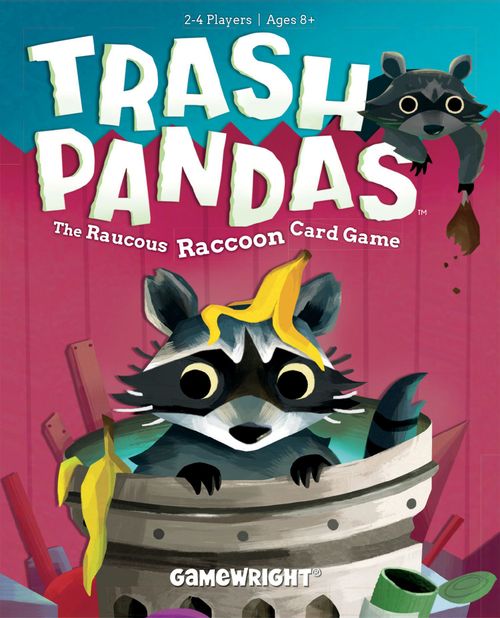
Trash Pandas
Trash Pandas Rulebook
Table of Contents
Table of Contents
Contents
- 54 cards
- 6 tokens
- 1 custom die
Cards
Most cards provide points at the end of the game when they are stashed. The icons in the upper left corner show how many points are scored for 1st place, 2nd place, and 3rd place, based on who has the majority of that type of card. Each card also has an action at the bottom that you may use instead of stashing. (See the Card Guide for specific information about each card's ability.)
Each card is laid out the same way:
- Name — the card's name, in the banner across the card.
- Stash Points (1st, 2nd, 3rd) — the three numbers in the upper left corner, showing how many points that card is worth to whoever has the most, second-most, and third-most of that card type stashed.
- Quantity in deck — the number in parentheses next to the card's name, showing how many copies of that card are in the 54-card deck.
- Special Action — the text at the bottom of the card, describing the action you may perform instead of stashing the card.
To activate an action, discard the card face up next to the trash can (the discard pile is open information), and then perform the action listed on the card. You may play any number of actions on your turn. The "protect" and "steal" actions on the Doggo and Kitteh cards are used on another player's turn, and only if you are the target of a Steal action. There is no limit to the number of cards you may have in your hand or your stash.
Setup
-
Remove the "Token Actions" card and place it within easy view.
-
Whoever took out the trash is the first player.
Shuffle the deck and deal cards, face down, based on turn order: Player 1 = 3 cards, Player 2 = 4 cards, Player 3 = 5 cards, and Player 4 = 6 cards. (Look at your cards but keep them secret from opponents.) Stack the rest of the deck face down nearby to form the "trash can."
-
Arrange the 6 tokens in a row, in the middle of the playing area.
-
Place the die near the tokens.
How to Play
The player with the fewest cards in hand starts the game and play passes to the left. On your turn, follow this sequence in order:
A. Roll the Die
Roll the die and take the token that matches the die result from the middle. Then decide to either STOP or CONTINUE rolling. If you decide to stop, move to Resolve Tokens.
If you continue, roll the die again and take the token that matches that roll result. However, if the die result ever matches a token you have already taken, you BUST and do not resolve ANY tokens. Place any collected tokens back in the middle and play passes to the left. Note: You may save yourself from busting by discarding a Blammo! card to re-roll, and/or possibly change the result by discarding a Nanners card to ignore the last roll (if you have one).
Consolation Prize: If you bust, draw one card from the trash can into your hand.
BONUS: If you manage to collect all six tokens, go immediately to Resolve Tokens, and then take a bonus turn. With this bonus turn, however, you are limited to collecting a maximum of three tokens. For the sake of the game end, this is still considered to be the same turn. Even with no cards available, you will be able to roll the die to try for stash or steal functions.
B. Resolve Tokens
Once you choose to stop rolling, you may then resolve each of the tokens you have collected in any order. Place each token back in the middle as you resolve it. Once you have resolved your tokens, your turn ends. Pass the die to the next player.
Note: The number in parentheses () on each card indicates how many times that card shows up in the deck.
Die Faces / Tokens
| Icon | Action |
|---|---|
| Trash can | Draw up to two cards from the trash can into your hand. (You may not draw from the discard pile.) |
| Tree | Stash up to two cards from your hand. Stashed cards are set aside, face down, until the end of the game. You may always look at stashed cards. |
| Trash can / Tree | Either draw one card from the trash can OR stash one card from your hand. |
| Bandit mask | Steal one random card from another player's hand (not stashed cards). That player may immediately play a Doggo or Kitteh card to block this (if they have one). |
| Masquerade mask | Draw the top card from the trash can and REVEAL it to other players. Then add it to your hand. Each other player now has the opportunity to stash one card from their hand that matches that card. However, these cards must be stashed FACE UP. For each card stashed by other players, draw one card from the trash can and add it to your hand. |
| Recycle | Exchange this token for a token that was not previously taken. Recycle is somewhat of a "wild" ability, but is limited to remaining tokens. Note: If you manage to collect all six tokens, the Recycle token has no effect since there are no remaining tokens. |
Notes
- You may not resolve any tokens until you decide to stop rolling (without busting).
- Once you start resolving tokens, you may not use any cards gained during that turn. For example, if you resolve a Trash Can token and draw a Feesh card, you must wait to use it on a later turn. However, you may stash cards that have been gained during the same turn.
- You may not stash cards unless a Tree or Bandit Mask action is used. Any cards that have not yet been stashed must remain in your hand.
- Stashed cards are stored face down unless the Bandit Mask token action is used.
- If you ever go to draw a card and there are none left, the end of the game is triggered.
Game End & Scoring
Once the last trash can card is drawn, the current player finishes their turn and the game ends. All players then discard any cards remaining in their hands, reveal stashed cards, and sort them by type.
Add up the total number of cards per type and compare with opponents. Score points based on who stashed the most, according to the icons in the upper left corner of each card. (Note: You must have at least one card of a type in order to score any points for it.) For example, if you have the most Feesh cards, score five points. If there is a tie, the players involved in the tie receive one fewer point. For example, if two players tie for the majority of Feesh cards, both score four points instead of five. The player with the next most Feesh cards would move to second place and score three points because of the tie for first.
Score one point for each Blammo! card stashed.
Count up and compare points - whoever has the most wins. In case of a tie, whoever has the most variety of cards wins. If there's still a tie, whoever has the most cards wins.
A Word from Gamewright
It's amazing how a simple change of words can alter our perceptions. The word "Raccoon" is often associated with annoying nocturnal pests, best known for raiding our trash and causing a mess. But "Trash Pandas" seem like cuddly creatures that you might want to own as pets! Inventors Lisa and Michael Eskue picked up on this hilarious nickname and created a card game that is as deviously smart as a real trash panda. Punctuated by Kwanchai Moriya's vibrant illustrations, you'll get a little taste of what it's like to be a scrappy backyard scavenger. Just be sure to wash your hands after playing!
Game by: Lisa J. Eskue and Michael E. Eskue Illustrations by: Kwanchai Moriya
Card Guide
The number in parentheses () on each card indicates how many times that card shows up in the deck.
Doggo (3)
This hulking dog is not happy about all these garbage shenanigans. If another player tries to steal from you, discard Doggo to prevent them from doing so. As a bonus, you may immediately draw two cards from the trash can. Note: If there are fewer than two cards, draw what's available.
Action: Block a steal attempt, then draw 2 cards.
Nanners (11)
Trash Pandas go bananas for Nanners. Nanners are used when you are about to bust. Discard the Nanners card to cancel your last die roll. It is treated as if it was not rolled and you had decided to stop. Once a Nanners is played, you may not continue rolling unless another player uses a Yum Yum card on you.
Action: Ignore your last roll and choose to stop.
Feesh (7)
Stinky, but tasty. Use a Feesh card to look through the discard pile and fish (take) any one card. If possible, you may use that new card on this same turn. i.e. - you may take a Blammo! or Nanners to prevent a bust.
Action: Take a card from the discard pile.
Shiny (3)
Trash Pandas LOVE shiny objects. Use a Shiny card to distract another player while you steal one of their stashed cards. Add that card to your hand. You may steal a face up or face down card. If you steal a face down card, you do not look at it until you have taken it. The target player may use a Doggo or Kitteh from their hand to block this action. If they do, discard the Shiny card.
Action: Steal a stashed card from a player. (Put in your hand.)
Kitteh (2)
This cat is neither soft, nor warm – it is a cold and evil ball of fur. If another player targets you with a Steal action, you may discard a Kitteh card to turn the tables on them. Instead of them taking a random card from your hand, you take a random card from their hand. (That player may use a Doggo card or another Kitteh card to defend against this.) If you use a Kitteh to defend against a Shiny steal attempt, you would then steal from that opponent's stashed cards as if you were using a Shiny card.
Action: If a player tries to steal from you, steal from them instead.
Blammo! (13)
Also known as carbonated energy. Use a Blammo! to re-roll, ignoring the previous result. This is often done to prevent a bust, but you may decide to re-roll a die before busting if you want to try for a different result. When stashed, Blammo! cards are treated differently from other point cards as they are each worth one point, regardless of majority.
Action: Re-roll your last die. 1 point per BLAMMO! stashed.
MMM Pie! (9)
Everyone loves leftover pizza. Use MMM Pie! when resolving your token results to resolve a token a second time. For example, if you use it to resolve the Trash Can token, you would draw four cards instead of two. Note: You may NOT use multiple MMM Pie! cards on a single token.
Action: Resolve a token twice.
Yum Yum (5)
Also known as chocolate. Yum Yum is played on another player's turn to force them to take an additional roll once they have decided to stop. If the player busts, they may use Blammo! or Nanners cards as normal. If the player does not bust, they may decide to continue their turn instead of stopping as they had originally planned.
Action: Force a player to continue rolling.