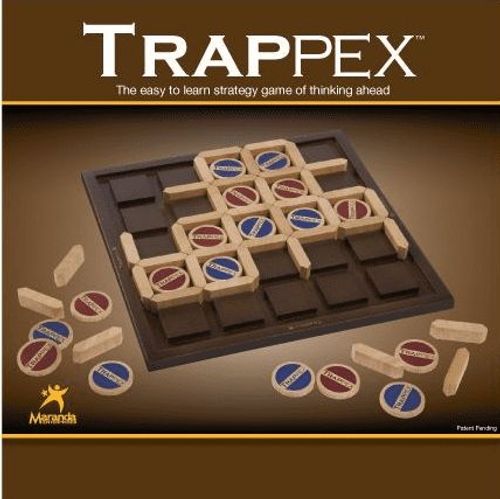
Trappex
Trappex Rulebook
Table of Contents
Contents
- 1 - Trappex Game Board
- 60 - Trappex Walls
- 25 - Two Sided Game Disks
Objective
To be the player who "traps" the most squares by the end of the game. (See Figure 1)
Set Up
Remove the game from the packaging. Players place the "walls" and two-sided game disks into piles from which both players will draw. Players select the color each will play. One player red and one player blue.
To Play
Players decide who will play first. Beginning with an empty game board, the first player places a "wall" piece in any of the channels which surround the 25 squares on the game board. Players then alternate turns. When a player places the fourth and final wall piece around a square, that square has been "trapped." (See Figure 2)
The player that traps the square then:
- Places one of the two-sided game disks with their color facing up in the "trapped" square.
- Must place another wall piece somewhere on the game board to complete their turn. If this wall piece "traps" another square, the pattern continues until no more squares are "trapped" by the placement of their wall piece.
The game continues, with players alternating turns in this pattern until all of the squares are "trapped."
Figure 1
Blue wins with 13 disks on board.
Figure 2
Example of "trapping" a square. With placement of 4th wall the square is trapped. Player places their colored disk inside the square. Player can now trap the square just above to continue their play.
Winning
The player who has the most disks on the board when all squares are trapped, is the winner.
Strategy Tips
- A player does not have to complete every square available to them during a turn. However, their opponent is free to complete any available square during their next turn.
- TRAPPEX is essentially a game of control. Due to the nature of the game, chains of squares will occur. Each player is trying to control the manner in which chains of squares will be trapped by each player near the end of the game.
- It may be strategically advantageous for a player to sacrifice a square to their opponent early in the game if it prevents long chains of squares from forming.