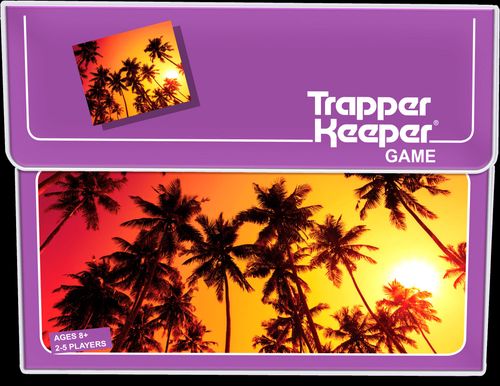
Trapper Keeper Game
Trapper Keeper Game Rulebook
Table of Contents
Table of Contents
Contents
81 School Paper cards, 11 Bell cards, 5 Folders, 1 Teacher's Pet Marker, 1 Score Pad, 1 Pencil, Instructions
Unit 1: Setup
- Give each player a Folder.
- Shuffle the School Paper cards and deal them into nine face-down stacks, forming a 3x3 grid. There should be nine cards in each stack.
- Flip the top card of each stack face up.
- Shuffle the Bell cards and deal six to form a face-down (clock-side up) deck, and place the rest back in the box. These will track the number of game rounds. A round is complete when each player has taken a turn. Note: For a 5-player game, deal out five Bell cards.
- Choose a player to be Teacher's Pet for the game and give them the Teacher's Pet Marker (apple). They will be in charge of the Bell Stack.
Unit 2: Card Overview
There are seven types of School Paper cards. Each type has a different way of scoring at the end of the game; some pair with other cards to score, and some score on their own.
Quizzes (12 cards)
Score the points shown on the Quiz card (1, 2, or 3 points).
Homework (21 cards)
The player with the most Homework cards scores 6 points. The player with the second most scores 3 points. Tied players will each receive points for that place. Example: Noelle and Jon each have three Homework cards, and Laurie has two. Noelle and Jon score 6 points each, and Laurie scores 3 points. Homework cards can also be used to score Report cards that are paired with a Signature card (see Report Cards).
Notes from Classmates (16 cards)
There are notes from four different classmates: Archer, Lilly, Pharah, and Zuzu. Score points based on how many sets of notes you collect from different classmates. You may score multiple sets of unique notes (see School Paper Phase).
Detention (14 cards)
Score 2 points for each Detention card you have, unless you have more than any other player. The sole player with the most Detention cards scores 0 points for Detention cards. It's cool to be edgy, but don't be a burnout! Note: Players tied for most Detention cards will still score 2 points per card.
Signatures (8 cards)
Signature cards are not worth points on their own, but each one can be paired with either one Field Trip Slip card or one Report card to score. At the end of the game, you will decide which cards to pair with your Signatures cards (see School Paper Phase).
Field Trips (5 cards)
Field Trip Slip cards are scored only when paired with a Signature card. Score 4 points for each Field Trip Slip card that is paired with a Signature card.
Report Cards (5 cards)
Report cards are scored only when paired with a Signature card and score based on how many Homework cards you have. Score 1 point for each Homework. Score points in this way for each Report card paired with a Signature card.
Unit 3: Game Play
Summary
Players take turns choosing a row, column, or Bell card pattern from the grid and collecting a card from the top of each stack to place into their Folders.
On Your Turn
- If you are the Teacher's Pet, you will start each round by revealing the top card of the Bell stack and placing it face up (locker-side up) next to the grid, making sure the orientation of the Bell card matches the orientation of the grid of School Paper cards.
- Choose any row or column in the grid and collect the top card from each stack, whether it is face up or face down. The currently revealed Bell card will show a third option of stacks you may choose from, by following the pattern of the red lockers. The Bell card orientation is important: you cannot rotate the pattern. Example: For the face-up Bell card shown, either of the two sets indicated by the green lines may be selected by the player. The indicated pattern may not be flipped horizontally or vertically. Note: If a row, column, or Bell card pattern includes any now-empty stacks, no card can be collected from those stacks.
- Choose one pocket of your Folder (left or right side) and tuck ALL cards you collected on this turn together into the same pocket. At the end of the game, you score for the blue doodles on cards in the left pocket combined with the red doodles on cards in the right pocket. Note: Once you've tucked your cards into a pocket, you may not rearrange them, but you may always look at them. Place the cards in the left pocket to score blue doodles. Place the cards in the right pocket to score red doodles (see Doodle Phase).
- After you place your cards into your Folder, the turn passes to the player on your left and play continues clockwise.
- If three or fewer School Paper cards are face up at the end of your turn, flip the top card of each face-down stack, so that all top cards in the grid are face up. Note: Any stacks that are depleted during play remain empty and are not refilled. Example: After Noelle's turn, four cards are face up on the School Paper card grid, so no cards are flipped over before Jon's turn. After Jon selects the three cards on the right side of the grid, only two cards are left face up; so the seven face down cards will be flipped over, before the next player goes.
End of the Game
When the Teacher's Pet reveals the last Bell card from the stack, the final round begins. Each player takes one last turn, then proceeds to Scoring.
Unit 4: Scoring
Scoring has two phases: the Doodle Phase and the School Papers Phase.
Doodle Phase
- Remove all cards from the left side of your Folder and display them so all the blue doodles are visible. Do the same for the right side of your Folder, so all the red doodles are visible.
- Score each of the five doodle types one at a time. Starting with the Heart doodle, each player adds the number of blue Heart doodles from their left folder pocket with the number of red Heart doodles from their right folder pocket. The player with the most total Heart doodles scores 5 points. The player with the second most scores 2 points. Tied players will each receive points for that place. Example: After each player adds up their total blue and red Heart doodles, they determine that Player "TH" has the most. Player "TH" scores 5 points. Player "DS" has the second most, so they score 2 points.
- Continue scoring this way for each of the five doodle types: Heart, Smiley Face, Cool S, Cube, Tic-Tac-Toe.
School Paper Phase
- Each player sorts all their cards by type.
- For each Signature card you have, choose to pair it with either a Report card or Field Trip Slip card to allow it to score. Example: This player must decide if they want to pair their Signature card with a Field Trip Slip card or a Report card. Pairing it with the Field Trip scores 4 points. But, pairing it with the Report card scores 1 point per Homework card they have, which is 5 points!
- Starting with Quizzes, score each type of card. (See Card Overview)
A Note on Scoring Notes: There are four different classmates who you can collect notes from. These notes are scored in sets. Each set can only contain one note from each classmate, and the score of that set is determined by the number of different classmates. Players can have more than one set, and a set does not need to contain notes from all four classmates.
| # of Unique Notes | 1 | 2 | 3 | 4 |
|---|---|---|---|---|
| Points for Set | 1 | 3 | 6 | 12 |
Example: A set containing 4 unique notes and a set containing 3 unique notes, worth a combined 18 points!
- Total up each player's points on the Score Pad. The player with the most points wins and is the coolest in school! If players are tied for the most points, all tied players share the victory.