Tramways Conductor's Manual
Tramways Conductor's Manual Rulebook
Table of Contents
Table of Contents
Overview
All the Tramways rules and Tramways Engineer's Workbook rules are the same except those listed below. You can use the 3D Locomotive as a first player marker in the Tramways Engineer's Workbook or / and use the new rules.
Components
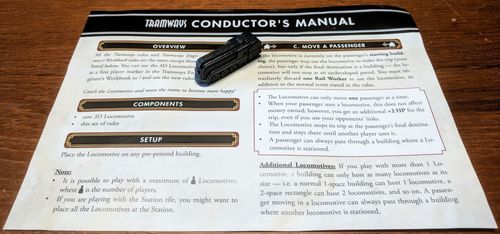
- one 3D Locomotive
- this set of rules.
Setup
Place the Locomotive on any pre-printed building.
Note:
- It is possible to play with a maximum of Locomotives equal to the number of players. (The printed sheet shows player-figure icons for both the Locomotive count and the player count; rendered here as words.)
- If you are playing with the Station tile, you might want to place all the Locomotives at the Station.
C. Move a Passenger
If the locomotive is currently on the passenger's starting building, the passenger may use the locomotive to make the trip (your choice), but only if the final destination is a building — the locomotive will not stop at an undeveloped parcel. You must immediately discard one Rail Worker to use the locomotive, in addition to the normal icons stated in the rules.
- The Locomotive can only move one passenger at a time.
- When your passenger uses a locomotive, this does not affect money earned; however, you get an additional +2 HP for the trip, even if you use your opponents' links.
- The Locomotive stops its trip at the passenger's final destination and stays there until another player uses it.
- A passenger can always pass through a building where a Locomotive is stationed.
Additional Locomotives: If you play with more than 1 Locomotive, a building can only host as many locomotives as its size — i.e. a normal 1-space building can host 1 locomotive, a 2-space rectangle can host 2 locomotives, and so on. A passenger moving in a locomotive can always pass through a building where another locomotive is stationed.