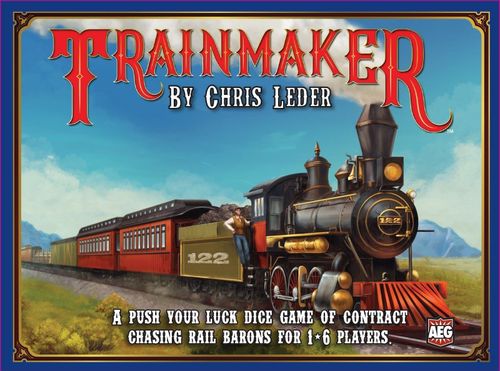
Trainmaker
Trainmaker Rulebook
Table of Contents
Table of Contents
Contents
- 7 six-sided Train dice – all with the same faces (2 black Locomotives, 1 blue Passenger Car, 1 yellow Boxcar, 1 green Flatcar, 1 red Caboose)
- 40 City cards representing seven goods types – 6 each of cattle (red), mail (blue), coal (purple), passenger (grey), lumber (green), corn (yellow) and 4 wild (Dollar Sign).
- 6 Whistlestops (1 rolling stock goal)
- 18 Depots (2 rolling stock goal)
- 12 Stations (3 rolling stock goal)
- 4 Terminals (4 rolling stock goal)
- 12 Contract cards
- 6 Switch Track tokens
- 1 Rulebook
Object of the Game
Players take on the role of railroad pioneers in the Old West, pushing their luck to build trains and deliver goods to cities across the wild nation. The goal of the game is to expand your rail network to either include all goods types or to fulfill the terms of your secret contract.
Set Up
Give each player one Switch Track token. Shuffle the Contract cards and deal two to each player. At the beginning of each player's first turn, they choose one Contract card to keep and discard the other from the game. A Contract card remains secret until the player can meet its criteria and win the game.
Shuffle the City cards and place them in the center of the table. Draw the top three City cards and lay them out in the middle of the table where all players have access to them.
The player who rode a train most recently takes the first turn, then play passes clockwise around the table.
Playing the Game
Each turn, you will perform the following steps:
- Replenish City cards (if necessary),
- Roll Dice and Begin a Train,
- Re-roll Unplaced Dice and Add to Train,
- Score a City card if Able.
Once you score a City card, your turn is over unless you have a Double Locomotive Bonus.
1) Replenish City Cards (if necessary)
There should always be three face-up City cards available at the beginning of each player's turn.
2) Roll Dice and Begin a Train
You are attempting to build a single train, always beginning with a Locomotive, continuing with rolling stock (Boxcars, Flatcars, and/or Passenger Cars), and ending with a Caboose. The rolling stock on your train should match the needs of a city, as displayed on the bottom of its City card, so that you may score it.
Players always build trains from left to right, starting with the Locomotive. On your first roll, you must roll at least one Locomotive and one rolling stock. Place these on the table together to begin your train. Dice you place as part of the train can never change position or be moved.
If you fail to roll a Locomotive on your first roll, your turn is over. As a consolation, if you have already spent your Switch Track token, you may take it back to use again. (See "Switch Track Ability")
3) Re-Roll Unplaced Dice and Add to Train
Once you place a Locomotive and at least one rolling stock, you may re-roll your remaining unplaced dice to try to add onto your train. Whenever you re-roll, you must add at least one of your results onto the train. If you are unable to add a die onto a train after a re-roll, you DERAIL and your turn ends!
All new rolling stock must be placed to the right of the existing train, and Locomotives may never be added after the first roll of a turn. A Caboose may only be added at the very end of a train to complete it.
As long as you can legally place at least one die per roll onto the train, you may re-roll as many times as you like until:
a) you choose to stop, b) you have placed all of your dice, or c) you DERAIL. Remember that every time you re-roll, you must add at least one die onto the train!
About Cabooses
In order for a train to be complete and eligible to score a City card, it must end with a Caboose. A Caboose can only be added at the very end of a train to complete it. If you have rolled, re-rolled, and placed all of your dice, and your train has no Caboose, you DERAIL and your turn ends!
NOTE: A train may only have one Caboose.
4) Score a City Card
Each City card represents a bustling location with certain cargo needs that you strive to fulfill. When you complete a train with rolling stock (in any order) matching the needs shown on a City card, score the card by placing it in front of you so all players can see it.
Each City card has a main export good, indicated by the icon in the upper-left corner and represented by a color scheme. Collecting sets of goods from City cards is crucial to winning.
To score a City card, your train must include each type and quantity of rolling stock depicted on the card, but it is acceptable (and often strategically important) for the train to include more than the required rolling stock. This can help maximize the train if you have the Double Locomotive Bonus. The train's rolling stock does not have to be in the same order as the icons on the City card. Only one City card can be scored per train.
The export goods are: Passengers, Coal, Cattle, Corn, Mail, Timber, and Wild.
Double Locomotive Bonus
Scoring a City card typically ends your turn. However, if you began your train with two Locomotives, you get the Double Locomotive Bonus and you may continue your turn after scoring a City Card!
You may start rolling a brand new train using ONLY the dice that were included in the previous train (Locomotives, rolling stock, and Caboose) to go after the remaining City card(s). Do not reveal new City cards. Any dice that were not placed in the original train are passed to the next player.
You may also create a Double Locomotive Bonus with your second train if you successfully score another City card and have two Locomotives placed on your train. In this way, you could potentially score all three available City cards in one turn.
(Reminder: You do NOT replenish City Cards as soon as one is scored, only at the end of your turn.)
Switch Track Ability
You begin with one Switch Track token, which you can play once during the course of the game. To use the Switch Track token, discard it after rolling the dice to change any one unplaced die to the result of your choice.
Discard the Switch Track token after using it. You may get it back if you do not roll any Locomotives on the initial roll of a subsequent turn.
Winning the Game
The winner of the game is the first to complete one of these sets:
a) A set of City cards featuring each of the six goods types. b) The specific requirements on your Contract card.
Once either of these sets is complete, the game ends immediately and the player is victorious!
NOTE: Terminal City cards (ones requiring four rolling stock to score) are WILD and can be used as any type to complete a set to win the game.
The Steam Engine
To play Trainmaker solitaire, or to add challenge to any games, you may compete against the Steam Engine, a dummy AI player.
During Setup, after players are dealt their Contract cards, the Steam Engine is dealt one Contract card face up. Players may freely look at the Steam Engine's Contract card before deciding which Contract cards they will choose.
During Gameplay, after every player has taken their turn, the Steam Engine activates. On its turn, the Steam Engine draws and claims City cards from the top of the deck until it has gained at least 3 rolling stock worth of cards.
For example, if the first card claimed is a Whistlestop (requiring 1 rolling stock) and the second was a Station (requiring 3 rolling stock), it would stop collecting cards. If the first card was a Terminal (requiring 4 rolling stock), it would only collect that card.
The Steam Engine wins if it completes its Contract Card before the other players. Even though the Steam Engine gains cards each turn, it does not always collect cards that get it closer to winning.