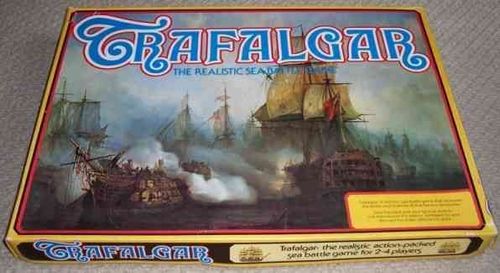
Trafalgar
Trafalgar Rulebook
Table of Contents
Table of Contents
How to Win
You can defeat the enemy in two ways:
- Sink all the enemy ships, or gain a superiority of 3 or 4 to 1.
- Or open a path to the enemy port, capture the enemy flag and bring it back to your own port.
N.B.: You cannot win if the enemy holds your flag.
Contents of the Game Box
- 4 ships of the line, with masts
- 4 frigates, with masts
- Markings and flags on self-adhesive strips
- 44 guns
- 3 artillery dice
- 4 flag masts (2 spares)
- 1 wind direction indicator
- 8 battle result cards, corresponding to the 8 ships
- 1 game board
- The rules of the game
Setup
- Assemble the two half-boards of the game board.
- Once you have assembled and decorated all the ships, anchor each English ship, facing the sea, in the port of Gibraltar (see the black dots). Do the same for the French and Spanish ships in the port of Cadiz.
- Install the guns in the two circular positions provided at the ends of each port.
- Mount two flag masts, decorate them and place them near the names, one in each corner of the ports.
- Place the arrow showing the wind direction on the compass rose. You may fix it in place with a pin under the game board.
- Deal the battle result cards to the players: 4 to the English camp, and 2 for the French and 2 for the Spanish to the Franco-Spanish camp. Then install the guns on the artillery batteries: 3 on each side of each ship of the line, and 2 on each side of each frigate.
The Ships
Each squadron comprises 4 ships: 2 large ships (ships of the line), each with 3 batteries, and 2 small ships (frigates), each with 2 batteries. The masts of the ships are removable: they are taken off during combat when a ship is hit.
A ship's power depends on two important factors: its speed of navigation and its firepower.
Speed
Speed is determined by the number of masts in good condition. An unhit ship of the line may make 4 "moves" * each turn:
- 1 for the foremast (mât de misaine, the front mast)
- 2 for the mainmast (mât central, the large mast)
- 1 for the mizzenmast (mât d'artimon, the rear mast)
If the mainmast has been shot down, the ship can make only 2 moves.
An unhit frigate is faster than a ship of the line: it can make 2 moves per mast in good condition, so it can make 6 moves each turn.
- N.B.: a "move" is the movement of a ship from one intersection point to another.
Firepower
Firepower is determined by the number of operational batteries on each ship. It decreases as the batteries are damaged. The results are recorded on each ship's battle result card (see "Hitting Targets" below).
Figure on the first page of the sheet, captioned "The Field of Fire": a diagram of the triangles of fire on either side of a ship. The rule is given in the section "The Field of Fire" below.
Ship Movement
Ships are always placed on intersection points. A ship may:
- move forward from one intersection point to another;
- or change direction by turning 60°;
- or combine the two movements.
Each movement, whether forward or turning, counts as one move. A ship of the line that has not been hit, which must make 3 moves to turn around (3 × 60°), therefore still has one move left to advance in its new chosen direction.
A ship may also choose to use only part of its moves, or to remain at anchor.
A ship cannot stop on an intersection point that is already occupied, nor pass over such a point.
Dark brown patches indicate reefs; no ship can cross them. Light brown patches are sandbanks: frigates may pass over them, but ships of the line may not.
Start of Combat
Toss a coin (heads or tails). The winner decides the wind direction and places the wind arrow as desired. A ship cannot sail into the wind.
The player who was unable to decide the wind direction plays first. Once he has moved all his ships, it is the enemy fleet's turn to anchor. (Translator's note: the French here reads literally "c'est à la flotte ennemie de mouiller", i.e. the other fleet is then to anchor; the sheet does not elaborate on this step.)
How to Play
On your turn you move all your ships and fire if an enemy is within range. A ship may:
- simply advance the distance allowed, without firing;
- or fire, then advance;
- or fire while advancing;
- or fire at the end of its move.
A ship may also turn around and fire with the guns that [are] on the other side. If your ship is positioned between two enemy ships, you may use both the starboard and the port guns. But if your broadsides miss, you will be a famous target for the enemy when it is their turn to play.
A turn is only over when all the ships of a squadron have moved and fired, or have only moved. Then it is the other player's turn.
When both opponents have played, roll the die to see whether the wind direction has changed:
- 1 star: move the wind arrow one point in the direction of the hands of a clock (clockwise);
- 2 stars: move the wind arrow two points;
- 3 stars: move the wind arrow three points (180°);
- no stars: the wind direction stays unchanged.
(The sheet gives the clockwise direction only for the 1-star move; it does not state a direction for the 2-star or 3-star moves.)
Artillery Fire
A target is within range if it is at a distance of no more than 3 intersection points.
Each battery is represented on the battle result cards by 2 guns: one to port (bâbord) and one to starboard (tribord). Once per turn you may fire with all of your guns, by rolling the die once for each gun aimed at a target.
Undamaged ships of the line can therefore fire 3 times per broadside (6 dice), whereas undamaged frigates can fire only 2 times (4 dice).
The Artillery Die
The die has stars on 3 faces; the other 3 faces are blank. When the die is thrown:
- a blank face: the target is not hit;
- one star: a ship can be hit if it is at a distance of one intersection point (direct fire);
- two stars: the same, at a distance of two intersection points;
- three stars: the same, at a distance of three intersection points.
The stars therefore indicate that a shot is fired, and the number of stars indicates the maximum range of the shot.
The Field of Fire
The game board is designed so that a ship is always at the tip of two larger triangles: one of the triangles on the port side and one of the triangles on the starboard side. Any target located within these triangles, and at a distance of no more than 3 intersection points from the ship, is within range of fire (see diagram).
Hitting Targets
In the naval wars of that period, a different type of ammunition was used depending on whether one aimed at masts or at artillery batteries. Therefore, before opening fire on an enemy ship, you must specify whether the target is a battery or a mast.
IF THIS IS NOT SPECIFIED BEFORE THROWING THE ARTILLERY DIE, THE HIT DOES NOT COUNT.
Each time a battery is hit, one gun is destroyed. Remove one gun from the battle result card of the damaged ship, on the side where the shot struck (port or starboard). Firepower is then reduced on that side.
For example, a ship of the line that has been hit twice on its port side can no longer fire more than once to port (1 die) on the following turn.
When a mast is hit, it is removed. The ship's speed is then reduced in proportion.
The mainmast of a ship can only be hit from the front or the rear once it has already lost either its foremast or its mizzenmast.
If a ship presents its bow or its stern to the adversary, only its masts can be hit.
When all the masts and all the batteries of a ship have been destroyed, the ship is considered sunk and is removed from the game.
Repairs
When all the masts of a ship have been removed, it can obviously no longer sail. However, its mizzenmast (mât d'artimon, at the rear) can be repaired. To do this, the player passes his turn twice. Afterwards, the ship may move again.
A dismasted ship may still fire on an enemy ship that is within its range.
Fort Guns
Guns in a port may fire on an enemy ship (1 die) as soon as it is within their range (at most 3 intersection points).
N.B.: If an enemy ship passes into the field of fire of a fort, and the fort's defender notices that at the end of its turn this ship will move beyond the field of fire of the guns, the defender may shout "FIRE!", and the fort's gun may fire even though it is not its camp's turn. However, a port gun may fire only ONCE PER TURN, and a ship has firing priority over a fort gun.
When a port gun has been destroyed by the enemy, it can only be replaced after 2 turns. The new gun can therefore only fire on the third turn.
Capturing the Enemy Flag
Enter the enemy port boldly and occupy the anchorage point in the corner. On the following turn, seize the enemy flag, place it on your ship in the small hole situated at the stern, and face the open sea.
Only on the third turn can you begin your return voyage. The enemy may then try to recover its flag.
N.B.: Remember that you cannot win if your flag is in the hands of the enemy, even if you hold theirs.
You may transfer the enemy flag from one of your ships to another. For this, your two ships must be side by side, and both must pass a turn. It is only in this case that two ships may occupy the same intersection.
To recover your own flag, you must sink the enemy ship carrying it. The flag is then transferred to your own ship. If you have sunk the enemy ship while it was leaving port, the flag returns to its place in your port.