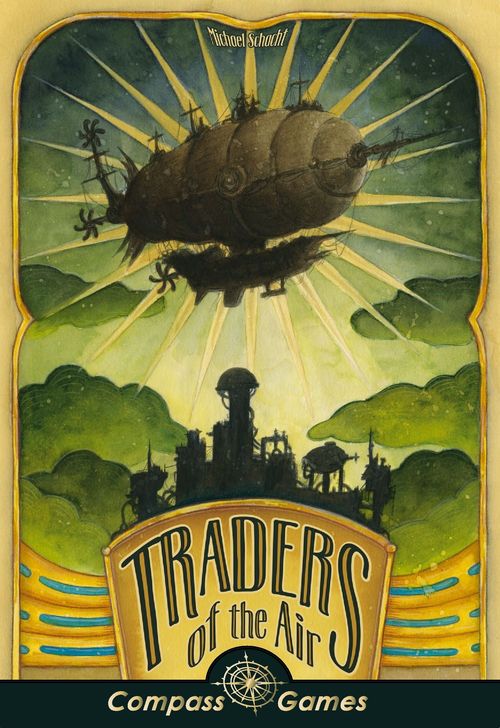
Traders of the Air
Traders of the Air Rulebook
Table of Contents
Table of Contents
2. Components
2.1 The Game Boards
Traders of the Air has two game boards backprinted on one sheet. One side is slightly easier to play; we recommend using it for the first games.
Each board depicts a central part of the planet and contains the nine most important cities. The cities are connected via arrows.
Each city has between one and three numbered spaces for goods markers. These spaces are termed warehouse spaces. The guild contracts of the players are also placed in cities.
In addition, in the bottom of the boards there are five supply spaces for goods markers.
2.2 The Guild Mats
The game contains eight backprinted guild mats. Four are generic ones, the others have special guild abilities.
The players put their money, their guild contracts and their goods on them.
Players should play their first few games with the generic guild mats.
The text on the mats describes the special guild ability.
2.3 The Steamship and the Start Player Marker
The players are jointly travelling from city to city in this steamship. The start player places this marker in front of him.
2.4 The Guild Contracts
The wooden discs in the four player colors represent the contracts of the guilds. The players put them on cities to show their influence at that location.
2.5 The Goods Markers
Traders of the Air contains 78 goods markers in six different colors. In each color, the front side shows one good 4 times, two goods 5 times, and three goods 4 times.
2.6 The Sky Dollars
As guild traders the players try to make as much profit as possible and earn a lot of sky dollars.
2.7 The Bag
The goods markers are placed into the bag and later drawn out of it.
3. Set Up
-
One player places the game board on the table with the selected side face-up. Note: For the first few games we recommend this side.
-
Now, with 2 players one of them takes out all goods markers in two colors and returns them to the game box. With 3 players one player takes out all goods markers in one color and returns them to the game box. With 4 players all goods markers are used. The goods markers in use are now put into the bag. A single marker each is then drawn and placed onto each numbered (warehouse) space on the game board. Once all markers have been placed, they are turned over to their front side. Example: The players start with Thespian and the warehouse spaces marked "1". Afterwards, one marker is placed on each remaining warehouse space, in numerical order. The remaining goods markers are now placed, face down, in five approximately equal stacks onto the five supply spaces. Note: The numbers and the arrows are important during the game.
-
One player places the steamship at New Copenhagen.
-
The sky dollars are put to a side of the game board. They form the "bank".
-
Now each player takes:
- 15 guild contracts in one color, one guild mat. Note: For the first few games we recommend guild mats without any special abilities. Later the players may select guild mats with special abilities or draw them randomly.
Each player puts the guild contracts and the sky dollars (see below) on their guild mat.
-
The players determine a random start player. The start player receives the start player marker.
-
The start player receives 1 sky dollar, the next player in clockwise order receives 2 sky dollars, a third player 3 sky dollars and a fourth player 4 sky dollars.
Example: This shows a part of the setup in a 3-player game.
The game is now ready to begin!
4. Sequence of Play
Traders of the Air is played in individual player turns.
Beginning with the start player and continuing in clockwise order each player carries out four phases that make up their player turn. The four phases are:
- Income
- Replenish Goods Markers
- Actions
- Taxes and Tolls
4.1 The Income Phase
At the start of their player turn a player takes his income of 3 sky dollars from the bank and places it on their guild mat.
4.2 The Replenish Goods Markers Phase
If there are empty warehouse spaces on the board, the player may now replenish those spaces. Filling empty warehouse spaces later is not possible!
To replenish empty spaces the player has to pay 1 sky dollar from their guild mat to the bank.
Note: If a player decides to replenish warehouse spaces they have to replenish all empty ones – the total costs are 1 sky dollar.
A player is only forced to replenish empty warehouse spaces if all warehouse spaces are empty – then they have to spend 1 sky dollar and replenish all.
When a player replenishes, they pay 1 sky dollar to the bank and take one goods marker from the first (leftmost) supply space on which any markers remain and place it face up on the empty warehouse space.
Warehouse spaces are filled in numerical order from lowest to highest.
If, during replenishing, a supply space is emptied, the player continues replenishing from the next supply space.
4.3 The Actions Phase
This phase is the heart of Traders of the Air.
There are three possible actions:
- Purchasing Goods
- Setting Up Guild Contracts
- Selling Goods
Note: The active player may move the steamship before, after or in between actions.
- A player may conduct as many actions as they want in a turn, provided they can pay for all of them.
- A player may choose the order of their actions and may also conduct the same action multiple times.
- A player may opt to not carry out any actions.
Example: It is Marianne's turn. The steamship is located at Nemesis. She conducts an action at that city. Afterwards, she moves the steamship to Aleborg and conducts an action there. Then she moves to New Copenhagen and chooses not to carry out any action there. Finally, she moves the steamship to Downington and conducts an action at that city.
4.3.1 General Rules
- A player may only conduct an action in the city where the steamship is currently located.
- A player may conduct one action in that city. If they intend to conduct additional action in their player turn they first have to move the steamship to a different city.
4.3.2 Moving the Steamship
The standard rule is that the steamship is moved along the set routes and in the direction of the arrows. Moving from one city to the next costs the player 1 sky dollar, payable to the bank.
However, the players may also move in opposite arrow direction – "against the wind." Moving from one city to the next against the wind costs the player 2 sky dollars instead of 1, payable to the bank.
A player may move the steamship as many times as they want in this phase, or they have the money to do so. The steamship movement may happen before, after or in between actions.
Note: It is possible that the steamship visits the same city more than once during a player's turn. In that case, the player may also conduct another action in the city. Moving the steamship does not count as an action in a city.
4.3.3 The Individual Actions
A player may choose to conduct these actions:
Purchasing Goods
The player takes one goods marker from one of the warehouse spaces of the city where the steamship is located. It is placed face up on the player's guild mat.
The player has to pay 1 sky dollar for the marker. The sky dollar is paid to whoever has the majority of guild contracts in that city.
- If no player has any guild contracts in the city or
- if multiple players are tied for majority of guild contracts, the sky dollar is paid to the bank.
- If the active player has the majority, they receive the goods marker for free.
A player may not purchase more than one goods marker at a city at one time as this would count as more than one action in the same city.
Setting Up Guild Contracts
The player may choose to set up one, two, or three guild contracts in the city where the steamship is currently located.
- Guild contracts do not cost sky dollars. Instead they cost one of the goods markers that a player has purchased before and which is on their guild mat. The spent goods marker is then returned to the game box.
- The player places as many guild contracts into the city as the number on the goods marker says.
- If the player does not have enough guild contracts left, they can only set up as many contracts as they have remaining.
Each player may have as many guild contracts in a city as they wish.
Note: A player's guild contracts should be stacked to permit an easy overview during the game.
Example: It is Marianne's turn. She has two goods markers on her guild mat: one with number 1, one with number 2. The steamship is located at Downington, where Michael has 4 guild contracts and Marianne only two. She pays the goods marker with number 2 and places two additional guild contracts at Downington. She now has the same number of guild contracts as Michael does. Marianne would have liked to set up another guild contract using the other goods marker but this is not possible as it would be two actions in the same city.
Selling Goods
A player may only sell goods in a city in which they have at least one guild contract.
To sell, a player needs to have at least two goods markers of the same color.
A player may sell more than one color of goods at the same time provided that they have at least two goods markers of each color.
If a player sells goods in a city they have to remove one of their guild contracts from that city. It is placed back onto their guild mat.
A player only removes one guild contract, regardless of the number of goods they sold.
Sold goods markers are flipped over. Players should move them in front of their guild mat. Here they remain till the end of the game. They cannot be used anymore for any purpose.
Selling goods does not cost any sky dollars but it does not earn the player any income as well. Instead, each goods marker counts towards victory points at the end of the game.
Example: It is Michael's turn. He sells his 3 orange goods markers and 2 brown goods markers at Downington. He flips the markers and moves them in front of his guild mat. One of his guild contracts is removed from the city.
Losses: The other players suffer losses as a result of a player selling goods if they own any goods markers of the just-sold color(s). Each player has to lose one goods marker of the just-sold color(s).
If a player has multiple goods markers of an affected color, they may choose which marker is lost. Any lost markers are returned to the game box.
Example: Marianne has 2 orange and 1 brown goods markers. As a result of Michael's sale above, she loses 1 orange and 1 brown goods marker each.
4.4 The Taxes and Tolls Phase
After a player has carried out all desired actions, they may be subject to Taxes and Tolls.
A player may own at most 3 sky dollars and 3 goods markers at this time.
Any additional sky dollars are placed into the bank, any additional goods markers are put back into the game box.
In case of too many goods markers the players may decide which surplus markers are removed.
Note: Players are only subject to Taxes and Tolls now – they may have more than 3 sky dollars and more than 3 goods markers at any other time of the game.
A player's turn is now over and play passes to the next player on the left.
Example: Michael takes his income. He then chooses to replenish the empty warehouse spaces, paying 1 sky dollar. The steamship is located at New Copenhagen where he pays 1 sky dollar to Ann and purchases a goods marker. He pays another sky dollar to move the steamship to Thespian where he buys another goods marker. Since he has the majority of guild contracts in the city, he does not pay anything. He pays another sky dollar to move the steamship to Stockgard where he chooses not to conduct an action. With his final sky dollar he moves the steamship to Rev'all where he trades his foods marker with number 3 in for three guild contracts. He does not have to pay any taxes or tolls so his turn is over.
5. The End of the Game
The end of the game is triggered when a player chooses to replenish empty warehouse spaces and has to start using at least one of the goods markers stacked on the last supply space (with number "5"). In this case, the current game round is played to the end to ensure that each player had an equal number of player turns (that is the reason why the start player marker is in the game).
6. Scoring
At the end of the game, each player adds up their victory points.
- Each unsold goods marker a player owns is worth 1 victory point.
- Each sold (i.e., flipped over) goods marker a player owns is worth 1 victory point plus a number of victory points equal to the number shown on the marker. Example: A goods marker with number "1" is worth 2 points; a marker with the number "3" is worth 4 points.
- Each city where a player has at least 1 guild contract is worth 2 victory points. If only one player has any guild contracts in a city, this monopoly is worth 4 victory points instead.
- The player who has started to take goods markers from the last (fifth) supply space first receives 2 victory points.
- The player who has the most guild contracts in a city on the game board, receives 3 victory points.
- The player who has at least 1 guild contract in the most cities on the board receives 4 victory points.
- The player with the most sold goods markers with number 1 receives 5 victory points.
Note: If more than one player is tied for majority in the last three entries above, all of them receive the full amount of points.
The player with the most victory points in the game is the winner and the best Trader of the Air!
In case of a tie, among the tied players the one with the most guild contracts on the game board is the winner. If players are still tied, they share the win.
7. The Compass: A Variant
If you have played Traders of the Air a few times you may want to add this variant.
Before starting the game one player places the compass marker on edge on a smooth surface and spins it. When the compass has stopped spinning, place it, without changing its orientation, onto the island in the south of Stockgard.
- If the compass marker landed on this side, the steamship movement is unchanged and follows the movement arrows normally.
- If the compass marker landed on this side [sic – the printed rulebook repeats "this side" for both outcomes; the second is the other side of the compass, as shown in the illustration], all movement arrows are reversed; i.e., the standard steamship movement is in the opposite direction.
This counts for all steamship movement during the entire game.