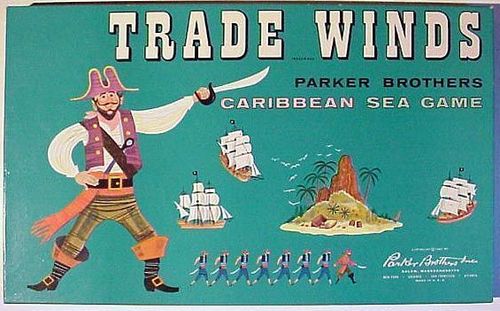
Trade Winds
Trade Winds Rulebook
Table of Contents
Table of Contents
Object
The object of this game is to be the first player to bring to his home port, treasure equal to twenty points or more.
Equipment
The equipment consists of a playing board; a plastic island which contains treasure in the form of barrels, gems, pearls, and gold bars; six ships to be used as playing pieces; one deck of Chance Cards; and one deck of Crew Cards.
Preparation
(A) The Board: Open the playing board and insert pirate island with all its treasure up through the bottom of the board. Then remove the plastic cover. There are eight ports around the edges of the board. When there are less than five players, each player should sit on a different side of the board. Each player selects one ship and a home port of the same color. All ports, including the two ports with grey squares, are trading ports. Pirate Island is in the center of the board and the colored squares which surround it are the coastal waters of that island. Any ship may move over or stop on any of these squares, but no ship may "land" at the island except on the side which has the same color as that ship. Thus, the red ship may "land" on the red squares and the purple ship may land on the purple squares. However, the blue and yellow ships may "land" on either the blue or yellow spaces and the green and orange ships may land on either the green or orange spaces. There are two other islands, Norman and Hispaniola, as well as two danger areas, Navassa and Sail Rock. No player may cross over any islands, danger areas or the four rock areas around Pirate Island. However, on a diagonal move a player may move his ship between Pirate Island and its rocks.
One player is selected as dealer.
(B) Chance Cards: The dealer shuffles the Chance Cards (red deck) and places them face down on the space marked "Place Chance Cards Here." A Chance Card may be drawn whenever a player "lands" his ship on the coastal squares on the side of Pirate Island which contains his own color. When a player draws a Chance Card he reads it aloud and at once follows the directions printed on it unless otherwise directed. Once a Chance Card is used it must be returned to the bottom of the pile.
(C) Crew Cards: The dealer now shuffles the Crew Cards (blue deck) and deals two cards face down on the spaces marked "Crew and Treasure for Sale" at the islands of Tortuga and Tortola. When less than six play, he also deals 2 cards face down on any island whose harbor is not being used as a home port. He then deals six Crew Cards to each player:
All Crew Cards have a one, two or three appearing on them, both on the back and on the face. This indicates the number of sailors the card represents. The sailors are either red or black in color. Each player should examine the six cards dealt him to determine the following:
(1) Sailing Strength — This is the total number of sailors shown on the Crew Cards in a player's hand without regard to color.
(2) Fighting Strength — This is the difference between the total number of red sailors and the total number of black sailors in a player's hand. Some examples of fighting and sailing strength are:
4 Red Sailors and 3 Black Sailors have a Sailing Strength of 7 and a Fighting Strength of 1
2 Red Sailors and 9 Black Sailors have a Sailing Strength of 11 and a Fighting Strength of 7
6 Red Sailors and 6 Black Sailors have a Sailing Strength of 12 and a Fighting Strength of 0
0 Red Sailors and 10 Black Sailors have a Sailing Strength of 10 and a Fighting Strength of 10
Crew Cards may be lost to another ship in an attack, traded from a player's home port, or reduced by instructions on the Chance Cards. A player may increase his Crew Cards by attacking another ship, by trading cards found in an opponent's home port, or by instructions on the Chance Cards.
(D) Treasure: The dealer checks each port where two Crew Cards have been dealt. He adds the numbers on the backs of the Crew Cards on each of the unoccupied islands and adds treasure of such value so that the sum of the cards plus the value of the treasure equals eight at each island. Treasure of the highest possible value is used. Treasure is valued as follows:
Gem = 5 points — Pearl = 3 points Gold = 4 points — Barrels = 2 points
For example if the two Crew Cards have a combined value of 3 one gem worth 5 points would be added at that island to make a total point value of 8. Whenever a player gets treasure by any means he must put it in his ship until such time as he returns to his home port.
Sailing
In this game a player moves his ship according to the sailing strength indicated by the Crew Cards in his hand. If a player has a sailing strength of 9 in his hand he may move any number of spaces up to and including 9 on his turn. A ship may be moved in any direction, vertically, horizontally, or diagonally. A player may change the direction of his ship only at the start of his turn. Changing the direction of a ship counts the same as moving one space. If a player has a sailing strength of 9 and changes direction of his ship he can then move no more than 8 spaces in the new direction. A player may start out of any harbor in any direction indicated by the arrows without deducting one from his sailing strength. Two ships may not occupy the same space except when one ship is attacking another. Any ship is subject to attack on any space on the board including harbors. A ship may pass over a space occupied by another player without attacking but must stop and fight if the other ship declares that it wishes to attack.
Home Port
The port from which a player starts is his own throughout the game, but other ships may trade at his port. Anything of value which is left by another ship at a player's home port may be freely taken up by him whenever his ship is in his home port. If an opponent leaves Crew Cards in exchange for treasure, the Crew Cards may be picked up by the owner of that home port when he next returns to it.
A player, before sailing from his home port, may leave behind any Crew Cards or Chance Cards that he has. In this way he may increase his fighting strength by leaving the Crew Cards of one color behind even though his sailing strength will be reduced. An additional advantage may result from the fact that the instructions on Chance Cards apply only to cards held in a player's hand, and penalties may thus be reduced. The disadvantage is that another player may enter the port and trade for the cards.
Play
The dealer moves first. He may start his ship in any one of the directions indicated by the arrows at the entrance to his home port, and move as many spaces as he wishes provided that he does not exceed his sailing strength. When he has made his move, play passes to the player on the dealer's left and continues in order around the board. On following turns players continue to move in accordance with their sailing strength.
As the game progresses players may do any of the following:
(1) Pirate Island — Whenever a player lands on one of the squares on the side of Pirate Island which has the same color as his ship he draws a Chance Card, reads it aloud and immediately follows the directions printed on it unless otherwise instructed. There are some cards which may be held for play later. With the exception of the cards which are played to the board, all Chance Cards are returned to the bottom of the Chance Card pile as soon as they are used. Players can get treasure from Pirate Island only when so instructed by the Chance Cards. It is therefore often to a player's advantage to remain at Pirate Island for more than one turn. A player may remain at Pirate Island for as many turns as he wishes provided that he moves his ship at least one space on each turn.
(2) Trading — Whenever a ship enters any harbor its owner may trade any Crew Cards or special Chance Cards which he holds or any treasure which he is carrying in his ship for Crew Cards, Chance Cards or treasure which is at that harbor. All trades must be made on the basis of equal points. For example a player may exchange a Crew Card worth 3 points and a barrel worth 2 points for a gem which is worth 5 points.
(3) Attacking — Whenever a player's ship lands on a space already occupied by another ship an attack takes place. Such action may take place anywhere on the board including spaces in all harbors and the colored squares around Pirate Island. When the attack takes place the 2 players involved show each other their cards being careful not to disclose them to any other players. The player with the greater fighting strength wins the battle and receives from the loser either of the following:
(A) All treasure aboard the losing ship that the winner can carry on his ship provided that the total does not exceed 19 points in value. Any excess treasure must be returned to Pirate Island. When there is excess, the winner has the privilege of deciding what treasure he will put on his ship and what treasure will be returned to Pirate Island, or
(B) Two Crew Cards from the loser's hand. In this case the loser has the choice of what cards he will pass over.
After the attack the loser may immediately take a free turn. On this turn he may do anything that he can do in a regular turn. The winner cannot attack the same ship again until he has completed his next turn. In the event of a draw fight between players, the ship attacked still has a free turn.
One player's ship may pass directly over the ship of an opponent, if he has sufficient sailing strength, and not attack that ship. If, however, the opponent says "attack" he must stop and fight in accordance with the regular attack rules.
(4) Unloading Treasure — A player may return to his home port with the treasure which he has accumulated at Pirate Island or has captured from other players, by moving in the usual manner on his turn. No player may carry more than nineteen points worth of treasure at any time. If a player overloads his boat so that some of his treasure falls off he must return whatever falls off to Pirate Island.
Upon reaching his home port a player unloads his treasure. If he has 3 or more treasures of the same kind he may place them in the safety zone. Once a player has 3 treasures of the same kind in his safety zone he may add any number of that same kind of treasure to his safety zone as soon as he gets it into his home port. No treasure in safety zones can be taken by other players by trading.
Derelicts
A derelict is a ship without crew and such a ship may travel one space in any direction on its player's turn.
Hispaniola and Norman Islands
Any Crew Cards or treasure on Hispaniola or Norman Island are free and may be taken up by any ship on any of the adjacent spaces around either island, or by the first ship to sail to any adjacent space around either island.
Checking an Opponent's Sailing Move
If a player feels an opponent has moved too many spaces he may ask to see the backs of his opponent's cards. If a mistake is made the opponent must move his ship back the number of spaces needed to correct the mistake.
Winning the Game
The first player to accumulate 20 points or more in his home port (it is not necessary to have any or all the treasure in a safety zone) wins the game.