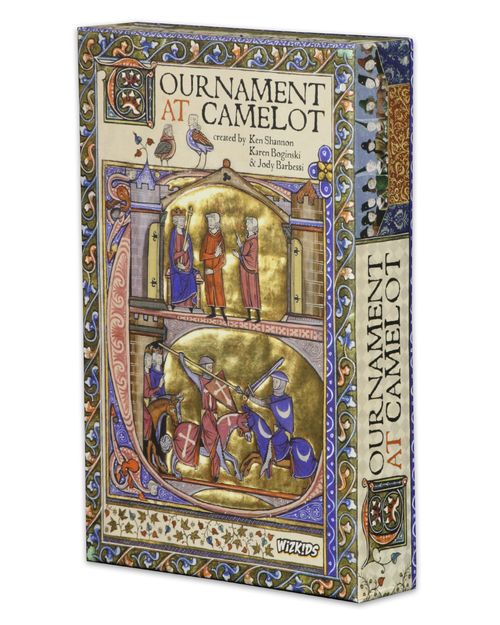
Tournament at Camelot
Tournament at Camelot Rulebook
Table of Contents
Table of Contents
Object of the Game
To be the player with the most HEALTH at the the end of the game. This is achieved by injuring your opponents (with weapon cards) more than they injure you.
Components
1. Character Cards (16) — 8 Protagonist and 8 Companion Cards
Every player receives a PROTAGONIST card and paired COMPANION card that they will play with for the duration of the game.
Matching graphics visually indicate the card pairing. The Protagonist card indicates the COMPANION this card is paired with; the Companion card indicates the PROTAGONIST this card is paired with.
- The PROTAGONIST'S powers are always available for use.
- The COMPANION'S powers may be used after the card's Threshold for Use is met.
See Companion Cards: Threshold for Use for the specifics.
2. Health Cards & Tokens (6 sets)
Keeps track of each player's Health (shows the level of injury sustained). There are 2 cards and one token per set, as shown below.
- CARD #1 — Side A: ROBUST (400 down to 305). Side B: FEEBLE (200 down to 105).
- CARD #2 — Side A: STABLE (300 down to 205). Side B: CRIPPLED (100 down to 5, then ZERO).
- Health Marker (heart token).
3. Weapons Deck (80 cards)
Each player's hand consists of cards from this deck that are dealt out every round. There are 3 types of Weapon cards: Basic Weapons, Alchemy and Sorcerers (MERLIN and SORCERER'S APPRENTICE).
A. Basic Weapon cards (60)
4 SUITS: SWORDS, ARROWS, SORCERY AND DECEPTION — 15 cards each.
Each Basic Weapon suit has 11 STANDARD cards and 4 POISONED cards.
- STANDARD CARDS: They are worth 5 injury points.
- POISONED CARDS have a skull as well as a "Poison" symbol on the side. Worth 10 injury points.
POISONED cards injure opponents more than STANDARD cards.
B. Alchemy cards (15)
ALCHEMY cards stand in for any Basic Weapon suit. However, special rules apply when playing them. (See Playing Alchemy Cards.)
There are no "poisoned" ALCHEMY cards. ALCHEMY cards are worth 5 injury points.
C. Sorcerer Cards (5)
- MERLIN (3) and SORCERER'S APPRENTICE (2) cards
- These cards are wild. When played, each is assigned a specific suit and number value.
- MERLIN cards inflict 25 injury points
- SORCERER'S APPRENTICE cards inflict 5 injury points
6. Godsend Cards (24)
- GODSEND cards give special help to players with the least Health.
- They are used for one round only, and then discarded.
Each card carries flavor text and the special powers for that particular card.
7. Other Tokens (4)
- When playing as KING ARTHUR the "+3" token is used as a card value reminder
- The (3) WILL OF GOD tokens keep track of the special WILL OF GOD card powers.
Game Set Up
-
Distribute to each player:
- a) PROTAGONIST card and paired COMPANION card. (Randomly selected or specifically chosen by players.)
- b) Set of HEALTH cards and a HEALTH MARKER
-
Each player places their PROTAGONIST card over their COMPANION card, covering everything except the threshold for use area at the bottom of the COMPANION card.
For example, the GUINEVERE card is placed on top of LANCELOT, showing only the threshold for use on the LANCELOT card.
Note: SIR GAWAIN'S COMPANION, the GREEN SASH, is the only card with no Threshold for Use. These two cards are placed side by side at the start of the game.
-
Each player puts their HEALTH cards on the table, with the blue "Robust" card on top. They then place their HEALTH marker on the space marked 400. (400 indicates the player is at full health.)
-
Shuffle the GODSEND deck and put it face down on the table, leaving space for two cards to be revealed at the start of the "Godsend Phase".
-
DEALING the CARDS
- a) Randomly determine the dealer.
- b) Each player receives 12 cards.
- c) The remaining WEAPON cards are placed on table to form the WEAPONS Draw Deck. Some PROTAGONIST and GODSEND cards may require the drawing of additional weapons.
Game Setup for a 4-Player Game
The GODSEND deck is placed face down with an area designated for GODSEND CARDS (two card spaces) beside it. The WEAPONS Draw Deck is placed with an area designated for the DISCARD PILE beside it. Each player has their character cards (PROTAGONIST over COMPANION) and their HEALTH card with marker in front of them.
KING ARTHUR always begins with the +3 token.
How to Play
Tournament at Camelot is a trick-taking game played in a series of hands ("Tourney Rounds") during which Weapon cards are played from each player's hand into the center of the table ("Melee"). Cards are played in a clock-wise direction.
Tourney Round
- The player to the left of the Dealer always plays the first Weapon card of the Tourney Round.
-
a) All opponents must follow suit if they are able — or play a MERLIN or SORCERER'S APPRENTICE card.
As noted previously, both MERLIN and SORCERER'S APPRENTICE cards are assigned a specific suit and number value by the person playing the card. The suit the player assigns must be the same as the lead suit.
-
b) If a player is unable to follow suit, they must play an ALCHEMY card. ALCHEMY cards take on the character of the LEAD SUIT
-
c) If a player is unable to follow suit, and does not have an ALCHEMY card, they choose any card from their hand and place it face up directly into the DISCARD PILE. That player immediately sustains 5 injury points for the SHAME of not being able to participate in the Melee.
-
d) Players may only lead with an ALCHEMY card if it is the only suit left in their hand. If ALCHEMY is lead, you may play any card.
-
- FEINT: Before determining who wins the Melee, flip all cards of equal value face down (this includes MERLIN and SORCERER'S APPRENTICE cards that share a value with other cards in the Melee). These cards cannot win the Melee but count towards injury.
- From the remaining face up cards, the player who played the LOWEST VALUED Weapon card LOSES the Melee.
- a) The losing player gathers the played Weapon cards, and places them in a pile ("Weapon Hits pile") on the table in their immediate play area. (Weapons added to the Discard Pile are NOT taken by the losing player as Weapon Hits.)
- b) If ALL the cards in the Melee are face down they are not taken: set them aside as injury for the next Melee. If this was the last Melee of the game, discard them.
- c) The losing player must play the FIRST Weapon card of the NEXT melee.
- Steps 1 and 2 continue until all dealt cards have been played, at which time the current Tourney Round ends.
Sample Melee
- Player 1 leads with the 13-SORCERY card. Each opponent must play a SORCERY card if they have one.
- Player 2 has no SORCERY or ALCHEMY cards, so they can play any card from their hand. However, since it doesn't follow suit, it's immediately placed into the Discard Pile and the Player suffers 5 injury for the SHAME.
- Player 3 plays the 11-ALCHEMY card. This card, in effect, becomes an 11-SORCERY card.
- Player 4 plays the 7-SORCERY card.
- Player 5 plays the MERLIN card and immediately declares that it is an "11 of Sorcery."
Before we determine who has won the Melee, the 11 of Alchemy and the MERLIN card acting as an 11 of Sorcery are flipped face down due to a FEINT.
Of the remaining face up cards, Player 4 loses the Melee for playing the lowest valued card. That player takes all the cards in the Melee and places them into their Weapon Hits pile.
EXAMPLE: These are the cards in Player 4's Weapon Hits pile at the end of the first Tourney Round.
- 13-Sorcery — 5 points
- 7-Sorcery — 5 points
- 11-Alchemy — 5 points
- 9-Swords (poisoned) — 10 points
- 11-Sorcery (poisoned) — 10 points
- 1-Arrows — 5 points
- Merlin — 25 points
Player 4's TOTAL INJURY for this round is 65.
MAXIMUM INJURY EFFECTS: Some cards may double a suit's injury points. Doubling injury points is the maximum any card may inflict or any player may receive.
EXAMPLE: Total Weapon Hits = 65. 400 minus 65 = 335. The higher the Weapon Hits, the greater the Injury and the lower the Health score!
- Once the Tourney Round is over, each player counts up the Weapon Hits taken during the Tourney Round to determine their total INJURY.
- STANDARD Weapon cards are worth 5 INJURY points
- POISONED cards are worth 10 INJURY points
- MERLIN cards are each worth 25 INJURY points
- SORCERER'S APPRENTICE cards are each worth 5 INJURY points.
- Once TOTAL INJURY is determined, each player moves their Health Token to the appropriate space on their HEALTH card.
- Any player who has passed the Threshold for Use on their Companion card may use the Companion card's special powers in the upcoming Tourney Round. See "Companion Cards: Threshold for Use".
- The most injured player gathers and shuffles all the Weapon cards. They will become dealer for the next Tourney Round. If there is a tie for most injured, the tied player closest to the previous dealer will be the dealer in the next Tourney Round.
- GODSEND cards are distributed, as outlined below ("WHO GETS A GODSEND CARD"), before the cards for the next Tourney Round are dealt.
Godsend Phase
In Tournament at Camelot, Divine Help is always available to the most injured players. GODSEND cards provide players with additional special powers that may be used during a Tourney Round.
Who Gets a Godsend Card?
As the game progresses, the number of players who automatically receive a GODSEND card grows:
GODSEND CARD ELIGIBILITY CHART (3-4 PLAYERS)
- Tourney Round 1 - only most injured player receives a card
- Tourney Round 2 - two most injured players receive a card
- Tourney Round 3 - three most injured players receive a card
- Tourney Round 4 - four most injured players receive a card
- Tourney Round 5+ - five most injured players receive a card
GODSEND CARD ELIGIBILITY CHART (5-6 PLAYERS)
- Tourney Round 1 - two most injured player receives a card
- Tourney Round 2 - three most injured players receive a card
- Tourney Round 3 - four most injured players receive a card
- Tourney Round 4+ - five most injured players receive a card
THE HEALTHIEST PLAYER NEVER GETS A GODSEND CARD
WHAT IF THERE IS A TIE FOR MOST INJURED? If there is a tie for eligibility to draw a GODSEND card, the tied player closest to the previous dealer will draw a GODSEND card first.
How Do Players Choose Their Godsend Cards?
After INJURY points have been tallied and scored on HEALTH cards:
- The first two cards of the GODSEND deck are turned over (see GAME SET-UP diagram).
- The most injured player (with the lowest score) selects a GODSEND card:
- a) They may take one of the face-up cards OR draw one from the top of the GODSEND deck.
- b) They place the selected GODSEND card face up on the table next to their Companion card.
- c) If one of the face-up cards was selected, it is immediately replaced with another from the the top of the GODSEND deck. (Note: This step may be ignored during the first round in a 3-4 player game.)
- Step 2 is repeated for all eligible players according to the number of rounds that have been played. The Player(s) with the most Health NEVER receives a GODSEND card!
- Any player who is 100 or more points behind the healthiest player receives an additional GODSEND card, beginning with the most injured player.
- Any player who is 200 or more points behind the healthiest player receives an additional GODSEND card, beginning with the most injured player.
- Any remaining face-up GODSEND cards are placed in the GODSEND discard pile.
Companion Cards: Threshold for Use
The power on a COMPANION card is available for use once a player has reached its Threshold for Use, which is shown at the bottom of each COMPANION card. Meeting the Threshold is determined by the player's Health score.
Example: LANCELOT'S Threshold for Use is 150 health. Once Player 1 reaches 150 HEALTH, they can remove LANCELOT from beneath GUINEVERE and use the powers on the card in the upcoming Tourney Round.
All players, including the player with the most Health (highest numerical points on Health card) may use their COMPANION card abilities, as long as the Threshold for Use has been met.
Once a COMPANION has joined the Protagonist in play, it is always available for use — even if a player's Health increases to a point higher than the COMPANION card's printed Threshold for Use.
End of Game and Victory
- The game ends when a player reaches ZERO on their health card.
- The player with the most remaining health wins!
2-Player Game Variation
For a 2-player game, remove the ARROWS suit from the deck, and play as described above.