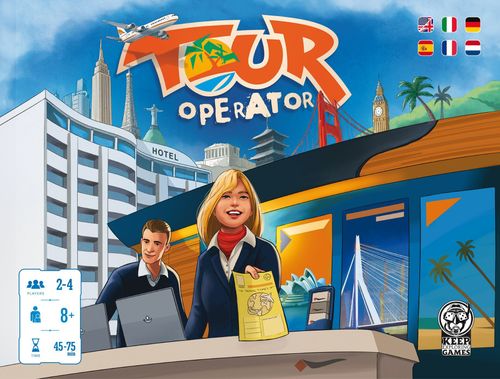
Tour Operator
Tour Operator Rulebook
Table of Contents
Table of Contents
- Components
- Symbol Glossary (English column)
- Set up
- Game Overview
- Phase 1 - Previous tourists check-out
- Phase 2 - New tourists appear
- Phase 3 - Gain and use resources
- Phase 4 - New tourists fly and score points
- Phase 5 - Tourists check in in hotel
- Phase 6 - Activities and waiting tourists get impatient
- End of the Game
Components
- 4 Plane / office boards
- 4 Hotel boards
- Scoring / activities board
- 36 Tourist cards
- 30 Employee cards
- 25 City cards
- 8 Turn overview cards
- 4 Airplanes
- 25 Fuel tokens
- 25 Coupon tokens
- 25 Clean seat tokens
- 25 Clean room tokens
- 80 Player tokens in 4 colors
- 5 Dice
- Start player marker
Symbol Glossary (English column)
Patient; Impatient; Angry; Fuel token; Clean seat token; Clean room token; Coupon token; VIP Room; Dorm; Single room; Economy seat; Business seat; Once per round use; Single use; Victory point(s); One tourist; All tourists; Reduce stay by one week; Change a die to any side; Resources; Per, In; Or; Nature; Party; Culture; Shopping; Beach; Fine dining; Winter sports; Scuba diving; Hiking; Hotel; Office; Plane; Employee.
Set up
Give each player a plane/office board and a hotel board. Place the plane/office board in front of you, and place the hotel board to the right side of this board.
Shuffle the city cards and randomly place the number of cards face up in a grid as explained below. You can vary with how many cards you place on the table, in which shape and for how many rounds the game lasts, but here is what we recommend:
- 2 players: 16 cards in a 4 * 4 grid - game lasts 7 rounds
- 3 players: 20 cards in a 5 * 4 grid - game lasts 6 rounds
- 4 players: 25 cards in a 5 * 5 grid - game lasts 5 rounds
For a longer 4 player game, you can also play 6 rounds, but it will make the fuel planning for the last round pretty hard.
Return any unused city cards to the box.
Every player places a clean seat token on their 3 airplane seats and a clean room token on their 4 hotel rooms. They also place 2 fuel tokens and 2 coupon tokens in their resources space.
These clean seat, clean room, fuel and coupon tokens are called resources. Place all remaining resources in an easy to reach place.
Shuffle the tourist deck and place it face down next to the city cards. Do the same thing with the employee cards.
Discarded tourists and employees will form two discard piles. If the draw pile of one of these decks runs out, shuffle the discard deck and make a new draw pile.
All players choose a color and place the airplane in their color below one of the four sides of the grid. They will start their journey from this baseline. This will be further explained in the fourth phase.
All players also take all markers in their color. Place one marker on the '0' of the scoring board. You will use the other markers over the course of the game to mark the patience of tourists, the number of weeks tourists will stay in the hotel, and to mark activities on the activities track.
Your travel agency is now ready to open its doors!
(Sample set-up for two players: the small colored dots on the game board are where these planes can fly to with their first fuel token.)
Game Overview
Tour Operator is played in a number of rounds, depending on the number of players. Each round is divided in a number of phases. Once every player has completed a phase in turn order, the next phase will be played. At the end of each round, the starting player for the next round will be determined. For the first round, the start player will be the player that traveled most recently. After the first round, the start player will be the player with the fewest victory points. When tied, the player with the fewest resources will start the next round. When still tied, the player closest to the current start player in clockwise order will start the next round. Hand the start player marker to the start player.
Player order only matters in phases 4 and 6. In phase 1, 2 and 5, players may decide to act simultaneously if they wish to speed up the game. In phase 3, when one player gathered his / her resources, the next player can roll the dice while he/she decides how to spend them.
Summary of phases
- Previous tourists check-out
- New tourists appear
- Gain and use resources
- New tourists fly and score points
- Tourists check in at hotel
- Activities and waiting tourists get impatient
Phase 1 - Previous tourists check-out
Before you fly in new tourists, it is time for the previous tourists to check out and end their vacations.
You can skip this step in the first round. In other rounds, you will lower all numbers of weeks the tourists will still stay in their room by 1. Tourists that were on 1 week will be discarded and their rooms will be available again, once cleaned.
When this is done, proceed to phase 2.
Phase 2 - New tourists appear
You start the game with an empty office. At the end of phase 2, every player always needs to have 4 tourists in their office. In this phase, tourist cards will be drafted until every player has 4 tourists in the office.
First, everyone draws a number of cards equal to the number of tourists they need to add to their office, plus 1. If you already have 4 tourists in your office, you draw 2 cards. So in the first round, everyone draws 5 cards.
Then, everyone chooses the number of tourists they still need, minus 1. So if you need only 1 tourist card, you do not choose any at this point. In the first round, everyone chooses 3 tourists from those 5 cards. Place these tourists in your office and mark their patience level with a player marker. Then, pass along the 2 remaining cards clockwise. From these 2 cards, you choose your final tourist for this round. Discard the other card.
When everyone has 4 tourists, this phase ends and play continues to phase 3.
Tourists
Each tourist has their own wishes and demands. These are the symbols you can encounter on a tourist card:
Top left: One or two interests out of culture, party, shopping and nature. Some tourists show a +1 bonus VP for one of these interests. You can only score one interest per tourist.
Top right: Patience level. A tourist coming into your office is either happy or already impatient. At the end of phase 6, any tourists still waiting in your office will lower their patience level by 1. If a tourist becomes angry, he/she will leave your office and this will cost you 3 VP.
Bottom left: Airplane needs. Some tourists would like to fly business class. If you put someone that wants to fly business class into an economy seat, deduct 1 VP. If you upgrade someone without the business class symbol to business class, you will not get rewarded or punished for this.
Bottom right: Hotel needs. First of all, it shows the number of weeks (1-3) a tourist will stay. You will get VP for this tourist only once, but he/she will keep a room occupied for their entire stay. One round represents one week.
Some tourists demand a VIP room. Similar to the business class in the plane, if you put someone with the VIP symbol into a single room, you will lose 1 VP. There is no reward for upgrading someone else to the VIP room.
There is also a dorm room, in which you can put 2 people that both have the dorm symbol. Refer to phase 5 for more information on this.
Examples:
- Top: Yavanna will score either the nature or the culture attribute of a city, is patient, wants to fly business class and stay in a VIP room, and will stay for 1 week.
- Bottom: Sandy will score the party attribute of a city, is impatient, is fine with staying in a dorm and will stay for 2 weeks.
Phase 3 - Gain and use resources
Now you know who wants to travel with you, it is time to prepare your business!
In turn order, each player rolls all five dice. They all have the same six sides:
- Fuel - Gain 1 fuel token
- Coupon - Gain 1 coupon token
- Clean seat - Gain 1 clean seat token
- Clean room - Gain 1 clean bed token
- Employee - Draw 3 employees and hire up to one
- Wild card - Choose any one of the other five rewards
If you are happy with the outcome, gather all resources in your resource space. Or, you could discard one die and change another die to a side of your choice. For instance: you roll 4 fuel and 1 clean room. You don't need so much fuel but you do need a clean seat. You discard one fuel, and change another fuel to a clean seat. So you end up with 2 fuel, a clean room and a clean seat. You can discard and change multiple dice this way.
Employees
When you gain an employee, draw the top 3 cards of the employee deck, and choose one. Each employee works in either the office, plane or hotel. You can have only one employee in each place. Some employees are single use (garbage can symbol), other employees are once-per-round use (recycle symbol). When hiring an employee, you place him or her in the matching space on your player boards. You can use an employee at any relevant time. For instance, you can choose to have an employee clean a room at any phase you like, but you can only have an employee change a die during the third phase when rolling the dice. After using a single use employee, the card is discarded to the discard pile. You can replace a once-per-round or unused single use employee by a new one if you draw another employee of that location. You can use the employee you already had after you draw the three employees, discard it and replace him/her with the new employee if you want to.
Top: The employee works in your office, and gives a once-per-round bonus.
Down: The employee works in your plane. He has a more powerful bonus, but needs to be discarded when used.
Resources
While the next player starts rolling for their resources, you can put your resources to use. You can calm impatient clients with a coupon. Discard a coupon token to increase the patience of one tourist by 1 level. You can also do this in phase 6. If a tourist would become angry at the end of phase 6, he/she leaves your office and this would cost you 3 VP.
In order for the plane to fly during phase 4, it needs fuel. It needs one fuel for each card on the game board you would like it to fly over or to.
You run a well-known travel agency, and so you do not use budget airlines. Therefore, you need to make sure you clean the plane well before each flight.
You start the game with all plane seats cleaned. But when a tourist flies, you will remove the clean seat token. And so you need to put a clean seat token on the seat before the next flight phase (phase 4). If you let a tourist fly on a seat that does not have a clean seat token, you lose 1 VP.
Similarly, you also need to clean the hotel rooms after each stay. When a tourist enters a room, you will remove the clean room token. If a tourist stays for multiple weeks, you do not have to clean his/her room during his/her stay. But before a new tourist enters the room, you need to have put a clean room token on their room. Tourists cannot be put in a room without a clean room token.
You can clean seats and rooms at any phase you like.
When everyone has collected resources and had the opportunity to use them, proceed to phase 4.
Phase 4 - New tourists fly and score points
Now you should be ready to fly your tourists to their destination! Starting with the start player, each player starts by selecting which tourists to take with them. There are always 4 tourists in the office and 3 seats in the plane, so you can never take more than 3 tourists with you per round. Remember you will get a 1 VP penalty when seating a tourist with the business class symbol into an economy seat. You will also get a 1 VP penalty when seating a tourist on a seat without a clean seat token.
Keep in mind that you can only move tourists to a clean room in phase 5! If you do not have enough clean rooms, you cannot put these tourists into the plane. If you bring someone in your plane and you will find out in the next phase you do not have a clean room to put them into, you will not score any points for this tourist but he/she will be angry and leave, costing you 3 VP.
When you have the tourists seated, move your plane to a city of your choice. Pay 1 fuel for every city you pass through. You cannot move diagonally. In the first turn, you start from a baseline on any one side of the board. This means that to fly to any of the cities on the first row (from your perspective), you need to pay 1 fuel. If you fly to a city in the second row, this would cost another fuel. From the second round on, you start your journey from the city where you ended your previous turn.
Then the plane arrives in the city of your choice, and before the tourists will crash in their beds, you get your reward! Every city shows the four interests that tourists may have; nature, party, shopping and culture. Next to it, it shows a number for each interest. This is the number of VP you will get for bringing a tourist here with that interest. If a tourist has two interests, you will choose which one of these interests to score, you cannot score both. If a tourist has a +1 bonus for an interest, you will now get a +1 VP bonus when you score that interest.
Track your score on the common scoring/activities track.
There can only be one airplane stationed on any one city. It is allowed to pass another plane when flying. In phase 6, all cities traveled to this round will be closed and flipped over. Each city can only be scored once for the entire course of the game. You can still pay a fuel to fly over a closed city. If needed, you can land or stay on a city that is closed, but this would yield 0 VP for any travelling passengers. In that case, you can put the tourists in your hotel as usual (without scoring VP), have them leave angry (-3 VP each) or let them stay in your plane for the turn. This costs -1 VP per tourist and it means you will have 4 waiting tourists that can't fly in your office next round. Or you could plan ahead and don't fly any passengers this round if you can't reach any cities with the fuel you have, deal with the patience level for all 4 tourists in your office this round, and refrain from drafting any tourists next round.
When all players brought their passengers to a city and scored for doing so, proceed to phase 5.
Example: When you fly Yavanna to Cairo, you can choose to get 3 VP for nature or 5 VP for culture, so you will score 5 VP for Yavanna.
Phase 5 - Tourists check in in hotel
The tourists have arrived at their destination, and now you will put each of them in their room.
Some tourists demand a VIP room. Similar to the business class in the plane, if you put someone with the VIP symbol into a single room, you will lose 1 VP. There is no reward for upgrading someone else to the VIP room.
There is also a dorm room. You can put two tourists into the dorm room when they both show the dorm symbol. You can also put one tourist without the dorm symbol alone into the dorm room without penalty. (You will still get a 1 VP penalty when putting a VIP alone into a dorm room). You cannot put two people into the dorm room unless both have the dorm room symbol. Two people with the dorm room symbol and a different number of weeks staying can stay in the dorm room, but you can only put new people into the room when it is empty and cleaned.
When placing a tourist in a room, remove the clean room token and place a marker on the number of weeks they will stay in your hotel as indicated on the tourist card. For two tourists staying in a dorm room, you place this marker on the highest number of weeks on the two tourists staying there.
If you have a tourist on the plane but can not place them into a clean room, discard this tourist and take a 3 VP penalty.
When all tourists are settled, proceed to the last phase.
Phase 6 - Activities and waiting tourists get impatient
First of all, the tourists you just placed will be participating in an activity. Each city shows 1 or 2 symbols at the bottom of the card. This represents an activity that can be done at that location. There are 5 activities: beach, scuba diving, hiking, winter sports and fine dining. You can place a marker on one of the activities on the scoring/activities board matching those on the city you just landed on. If you are the first player to finish a row, you will receive the bonus listed on the end of the row. When you do, other players cannot score this row anymore. Some rows are only available when playing with 3 or 4 players, as shown by the 3+ and 4 symbols. You don't need to fill a row left to right, you can fill it in any order. You can put a marker on the same square as someone else, but only the first player to complete the row gains the bonus points.
After you organized an activity, close the city you landed on this turn. Place it facedown. Each city can only be scored once for the entire course of the game. You can still pay a fuel to fly over it. If needed, you can land or stay on a city that is closed, but this would yield 0 VP for any travelling passengers.
Example: You scored Kyoto this turn. You can now place one of your markers on a snow or hiker symbol, in order to hopefully fill up a row. Some rows are only available when playing with 3 or 4 players.
Finally, any tourists still in your office get impatient. Give each one a coupon, use a relevant employee if you can, or lower the patience of each tourist by one. If a tourist becomes angry, he/she will immediately leave your office, yielding you a 3 VP penalty.
Congratulations, you just finished managing a wild week at your travel agency! Now have a look at the VP of all the players, and give the start player marker to the travel agency with the fewest VP. (When tied, the player with the fewest resources will start the next round. When still tied, the player closest to the current start player in clockwise order will start the next round.)
You will continue again from phase 1 until the end of the game. The game ends after a set number of rounds. When playing with the recommended settings:
- 2 players: 16 cards in a 4 * 4 grid - game lasts 7 rounds (2 cities are left open)
- 3 players: 20 cards in a 5 * 4 grid - game lasts 6 rounds (2 cities are left open)
- 4 players: 25 cards in a 5 * 5 grid - game lasts 5 rounds (5 cities are left open)
End of the Game
After the last phase of the final round, players will simply compare VP scores. The travel agency with the most VP wins! Ties go to the player with the fewest waiting tourists left. If still tied, the player with the most resources left wins. When still tied, play another game to determine the winner!
Scoring summary
- -1 VP for a tourist with a business class symbol seated on an economy seat.
- -1 VP for a tourist seated on a dirty airplane seat.
- -1 VP for a tourist with the VIP symbol staying in a single room or alone in a dorm.
- -3 VP for a waiting tourist becoming angry and leaving.
- -3 VP for a tourist that was put in the plane but can't stay in a clean, empty room.
Not possible:
- Tourist in a dirty room.
- Two tourists without both having the dorm symbol in a dorm room.