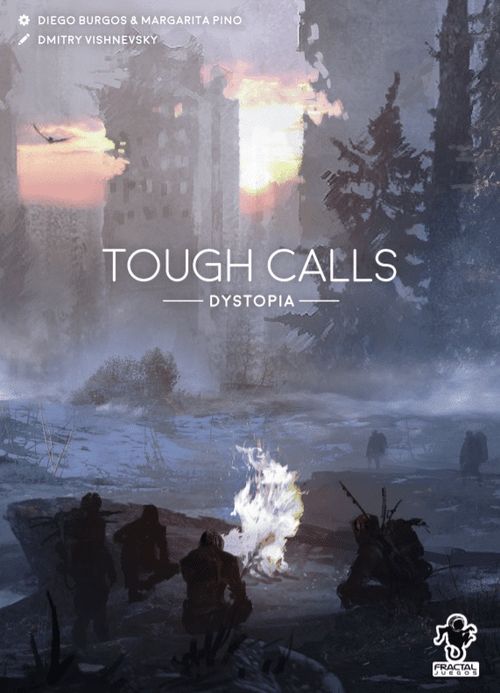
Tough Calls: Dystopia
Tough Calls: Dystopia Rulebook
Table of Contents
Table of Contents
Components
- 30 Question cards
- 30 Event cards
- 10 Scenario cards
- 10 Faction tokens
- 1 Urn lid
- 1 45-second sand timer
- 1 Bottle opener
- 34 Voting tokens
- 1 Rulebook
Game Setup
- Each participant chooses a color and takes the 2 corresponding Faction tokens.
- Shuffle the Question cards, forming a pile, and place it at the center of the table.
- Place the Voting tokens and the Sand Timer on the table within reach of the group.
- As a group, choose a Scenario card. You may choose one or take one at random. Then take the 3 Event cards that correspond to the chosen scenario (they share the same card back), place them face down next to the pile of Question cards, and return the rest of the Scenario and Event cards to the box. They will not be used in this game.
- Assemble the urn using the Urn lid and the game box. The lid must fit onto the box insert so that 5 compartments are formed, one for each faction.
- Give the Bottle Opener to whoever proposed playing Tough Calls: Dystopia. That person will be the first to play.
Playing the Game
The goal of the game is to earn the most votes by the end of the game. To do this you must try to answer the questions of each phase in the best way possible, building with your decisions and creativity a coherent and unique narrative, to convince the rest of the group that you are the best choice to lead the group of survivors.
Starting in the Second Phase, a vote will take place at the end of each round. When this happens, each participant must, following turn order, take one of the Voting tokens and secretly place it in the urn, in the compartment of the faction belonging to the person who answered in the best way.
At no point in the game may a person vote for their own faction.
Tip 1: there are no rules on how to choose the best answer. Some criteria could be the most creative, the funniest, or whoever created the most interesting character. It is left to the judgment of whoever is voting. This is a game about creating fiction — the ideas or speeches you present don't have to represent what you actually believe.
I. First Phase: scenario question
To begin the game, the person holding the Bottle Opener must read aloud the description of the chosen scenario, including the colony's location and population. Next they must read the scenario's initial question and answer it. Their answer immediately transforms the world being collectively created. Afterward, the person to their left must answer the same question, and so on until the whole group has answered.
Once this happens, the person to the left of whoever read the scenario must take the Bottle Opener and begin the Second Phase. There is no voting in the First Phase.
Tip 2: during this phase, the foundations of the collective story are built. Try to make your answer different from the others, because you can use this information to build your character and their context.
II. Second Phase: rounds of questions
This phase unfolds as a series of voting rounds, one per participant, in which everyone must answer the same question and vote for the answer they think is best.
The person whose turn it is must draw 3 Question cards from the pile, read them silently, choose one of them, read it aloud, and answer it immediately. The cards that were not chosen must be discarded face down to one side. Then the person to their left must answer the same question, and so on until the whole group has answered it.
Then, each participant must vote secretly for their favorite answer, starting with whoever holds the Bottle Opener. Remember that you can never vote for your own faction.
Once voting has finished, the round ends. Then the Bottle Opener must be passed to the person on the left, who begins the new round by taking 3 Question cards from the pile, choosing one, and answering it.
This process repeats until every participant has begun a round of the Second Phase.
Tip 3: although you may borrow concepts from answers other people have already given, for the flow of the game it is recommended not to base your speech on responding to, copying, or contradicting your opponents' answers.
Tip 4: in this phase, each participant is expected to be consistent with what they have answered previously, including in the First Phase. Most of the question cards will force you to answer creatively, since the rest of the group will likely have already used the more common answers before you. Don't be afraid to propose that your colony adapts and survives in interesting or even strange ways!
III. Third Phase: final event
Once the Second Phase has ended, the Bottle Opener must be passed one last time to the person on the left. That participant must draw one of the three Event cards at random, read it aloud, and answer it immediately. Next, the person to their left must answer, continuing in turn order until the whole group has answered.
In this phase's vote there are 2 differences to consider compared to the previous phase:
-
Each participant must vote for whoever they believe performed best, in their judgment, during the entire game (including their last contribution in the Third Phase).
-
Each participant must vote using one of their Faction tokens. This token counts as 2 Voting tokens (see page 6, "Vote Count and End of the Game").
Tip 5: the Event cards put your colony in difficult or strange situations. Your answer in this phase should try to integrate your whole narrative into a coherent response. Think of this phase as the closing line to wrap up your story.
Vote Count and End of the Game
When the last vote has been cast, the urn is opened and the vote count begins. Count the tokens in each faction's compartment. The person who accumulates the most votes wins (remember that Faction tokens count as 2 Voting tokens). In case of a tie, whoever has more Faction tokens wins. If the tie continues, the victory is shared.
Optionally, participants may explain why they voted for that particular person with their Faction token.
More Tips and Notes
Note 1: The Sand Timer is optional. It can be used at any time when a person is taking too long to think or answer. Once the Sand Timer is used, that person must begin their answer or finish their argument before time runs out.
Note 2: If you still have doubts about how to play Tough Calls: Dystopia, we recommend reading the example below before starting.
Tip 6: if you find this game difficult to get into, we recommend thinking of a particular character you could imagine in the scenario chosen by your group. There is a whole universe of science-fiction dystopias to draw on for reference. You could be a temperamental person who would do anything for their family, a grandiloquent priest who believes a god sent this catastrophe, a fierce rebel who wants to overthrow their people's oppressors, or even an evil dictator who just wants a safe pass into this dark new world.
Tip 7: Tough Calls: Dystopia is not a particularly competitive game. The game works best when the whole group enjoys creating fantastic, vivid worlds together. It is recommended not to seek victory at all costs, but rather to dare to create an interesting and absorbing story.
Example of a Three-Participant Game
First Phase
We invite you to read an example of the start of a game of Tough Calls: Dystopia for three participants. Remember that this is just a reference text, since in this game you are the ones who create the story.
After choosing the scenario and their factions, Elena, Úrsula, and Isaac are about to begin the game. Elena reads aloud to the rest of the participants the description of the alien invasion scenario, and then its initial question:
"We have been detected! At this very moment a ship is descending upon our colony. To our surprise, what emerges from it is not a squadron ready to eliminate us, but a diplomatic alien. It tells us that if we want to survive, we must hand over 1% of our population as tribute each month. How would you select the tribute?"
Elena, who was chosen as the starting player, answers first, so she receives the Bottle Opener:
"As you all know, I dedicated my whole life to working together with the late academic Dr. McPherson on a new university entrance exam, one that could measure abilities not yet developed by people. Well... even though it has never been used before, this may be its moment... I propose that we all take this test once a month, and whoever gets the worst result makes up the tribute. Dr. McPherson would be proud that his method was used for such a noble purpose..."
Once Elena has finished her answer, it is Úrsula's turn, who sits to her left and answers:
"I'm not surprised you're talking about obsolete and unjust tests. But you forget that since the extraterrestrials arrived, a lot has changed. Most of the jobs that used to be enriching now have no meaning or value, while other jobs, once poorly paid and looked down on, are now vital. Rich people are used to their past privileges, and they have become true leeches on our colony. We cannot sacrifice those who heal the sick, work the land, or educate our children for individuals whose only worth is the gold and diamonds they obtained in the past. I propose we review the contribution the wealthy make to the colony, and hand over those who have failed to adapt to the new conditions."
Last to answer is Isaac, who sits to Úrsula's left:
"We are 8,000 survivors! If we sacrifice 1% a month, our colony will disappear within a few years. Don't you see it? These cruel aliens want to eliminate us and watch us suffer a slow agony, like ants crushed one by one, trapped in their anthill. We cannot allow it! We must fight, seize their diplomatic ship, and travel to Tunguska, the secret human stronghold. The apocalypse has reached our colony, but not our end. That said, if there are people in the colony who don't want to go into battle, or who show sympathy for the aliens, I think those people should be handed over as tribute."
When Isaac finishes his answer, all three participants have answered the initial question, so the First Phase ends. Elena hands the Bottle Opener to the participant on her left, Úrsula, who will be the starting player for the first round of the Second Phase.
Second Phase
Úrsula begins the round by drawing three cards from the Question card pile, reading them silently, and choosing one of them. She discards the other two cards face down, and then reads the chosen card aloud:
"How do you plan to produce food for your colony?"
After reading the question, Úrsula answers:
"The alien attack has left our city in ruins. Animals are scarce and canned food is nearly gone. But there is a ray of hope: our farmers. They were people looked down on by the wealthy in the past, but today they are vital to our survival. I propose we form schools where they teach us agricultural techniques for apocalyptic times. Only through self-management and the empowerment of the working class will we grow stronger, and so free ourselves from any kind of oppression, whether alien or human."
When she finishes her answer, it becomes Isaac's turn, who answers:
"I mean it. This is our chance to take control and leave this city in ruins. Let's eliminate every alien we can, then freeze their bodies in their cryogenic chambers. We bring our food reserves to the ship, and if we run short of supplies along the way... well, we eat those extraterrestrials! Trust me. If you set aside your nausea at the sliminess, we can easily feed ourselves with them. They're creatures that surely taste great once roasted, and once we reach Tunguska we can once again enjoy the finest feasts."
When Isaac finishes, it is Helena's turn to answer:
"Food isn't the real conflict here. The real problem is our rigidity about what we've understood as 'food' until now. Our digestive system can perfectly well process foods with new flavors and smells... but can we say the same about our conscience? Let's stop thinking of eating as a pleasure, and start seeing it as a necessity we must fulfill in order to survive. As Dr. McPherson used to say, 'If apples are scarce, it's time to look for worms.' I propose we explore new ways of feeding ourselves, incorporating insects and other organic matter into our diet."
Once all three participants have answered the question, it is time for the first vote. Starting with the starting player, the participants each take a Voting token and approach the urn. They must place the Voting token in the compartment of the faction that, in their view, gave the best answer during this round, without anyone else seeing their choice.
Then the Bottle Opener must pass again to the player on the left — in this case, to Isaac, who becomes the new starting player. It is his turn to take three cards from the Question card pile, choose one, read it aloud, and answer it immediately. The whole process must be repeated until every person has begun a round. At that point, the Second Phase ends, and the Third Phase must begin with the final event.
Game Summary
I. First Phase: scenario question. Whoever proposed playing takes the Bottle Opener and reads the full Scenario card, then answers its question. Each participant answers in turn, passing to the left. No voting.
II. Second Phase: rounds of questions. The Bottle Opener passes to the person on the left, who must draw 3 Question cards, choose one, and answer it. In turn, each participant answers the same question and finally votes for their favorite answer. After the vote, the Bottle Opener passes to the person on the left, who draws 3 Question cards and chooses one. This process repeats until every participant has chosen a question and it has been answered by the whole group.
III. Third Phase: final event. The Bottle Opener returns to whoever began the Second Phase. That person must draw an Event card at random, read it aloud, and answer the question. Each participant answers the same question in turn, and finally votes with a Faction token for their preferred participant.
Count the votes, and whoever has the most votes wins the game. Remember that Faction tokens count as 2 Voting tokens.