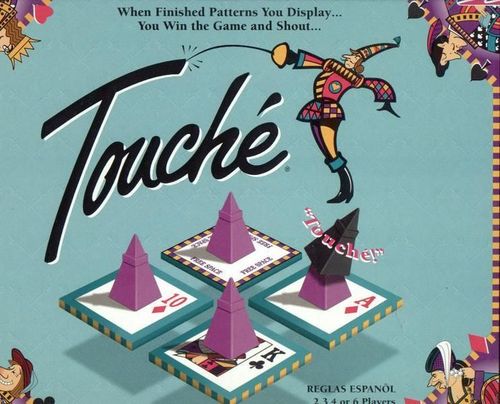
Touché
Touché Rulebook
Table of Contents
Table of Contents
Components
- 1 game board, showing card images (the number of card images corresponds to the number of cards in the two card decks).
- 2 card decks, 110 cards in total.
- 4 sets of playing pyramids: yellow (60), turquoise (60), lilac (60), and black (30).
The board also has 8 free spaces, marked "Free Space" (see below).
Choosing the Game Figures
The figures that players build are:
- Four squares, each a block of four cells in a 2×2 arrangement, where the squares touch each other.
- Three separate lines: one horizontal, one vertical, and one diagonal, each formed by five cells in a row.
- Three T-figures: the letter "T" formed using five cells, horizontally, vertically, or diagonally.
- Three crosses: a "cross" figure of five cells, lengthwise or crosswise, horizontally, vertically, or diagonally.
- Four combinations: "combination" figures, formed from any visible figure. [Diagram: four example patterns of cells, shown on the leaflet.]
If three players play, the number of required figures is reduced by one. For example: three squares, two lines, two T-figures, two crosses, and three combination figures of any kind.
Setup
- Each player draws one card from the deck. The player who draws the higher card is the dealer ("Распасовывающий"). The dealer must choose the figure pattern that all players will build.
- The dealer deals 5 cards to each player, face down. Players use these cards during their turns to build the required figures.
- Each player chooses a set of playing pyramids by color. Team members play with pyramids of the same color (see Team Play). The pyramids are placed on the board space that corresponds to the card. When a figure is completed by a player or team, black pyramids are used to "crown" the colored pyramids in the completed figure, and it indicates that those spaces can no longer be used. During the game, the black pyramids are kept separately.
Turn Order
-
The player seated to the left of the dealer starts the game. Turn order passes clockwise.
-
On your turn, do the following:
- Place one of your cards face up on the table in front of you, so that all players can see your card.
- Then take one of your pyramids and place it on the game board, on the space that corresponds to the card you just placed.
- Then draw a new card from the deck. A player must always have 5 cards in hand.
Example: If you have the "Three of Hearts" card, place it on the table, take one of your pyramids, and place it on the board space showing the "Three of Hearts" card. Then draw a new card from the deck.
-
The next player does the same, and play continues around the table.
-
Each player tries, where possible, to complete his figure. After playing a card, he places it next to the space where his teammate or he himself placed a card earlier. If the player cannot attach the card to his own figure, he starts a new figure in another place on the game board.
-
A player uses his cards to defend, to block an opponent's attempts to build, complete, or create his own figure.
-
Jokers are wild. A joker may be used in place of an opponent's pyramid, in any space on the board, by replacing it with your own pyramid, or it may be used instead of a missing card.
-
A player who has placed a joker has the right to move an opponent's pyramid that it "knocked out" to any space marked "Free Space."
-
A free space is used only when it is needed to complete a figure. Cover the free space with your colored pyramid and "crown" it with a black pyramid, to show that the free space is no longer usable.
Completing a Figure
When a player or players have finished building a figure, they confirm it by calling out "Touché!" Then they crown all of their completed figures with black pyramids. This means those spaces can no longer be reused. All other pyramids are removed from the game board, and play continues.
If, during the game, two completed figures of the same team share one common space, only one figure is counted.
Team Play
Players in a team use pyramids of the same color. Teammates may not sit next to each other, and may not give advice during the game. When playing in teams, each player has his own cards, which he uses in the game to build a shared figure.
Scoring
The player or team that wins the majority of games (for example, two out of three, or three out of five) is the winner of the game of Touché.
For correct scoring, the following system may be used:
- 10 points for each square, or each figure made of lines;
- 15 points for each T-figure, and each "cross" figure;
- 20 points for each win in a game with a combination of figures;
- 25 points for each rare formation, when the opponent is "defending."
Tournament
If you want to organize a tournament, you need to count points correctly. Points may be counted as follows: 10 points for each square or figure of lines; 15 points for each T-figure, "cross" figure, etc. The player who collects the most figures becomes the winner.
Reminder
Players decide together which figure they will build, except the first time, when the dealer does it. Players may also invent their own figures to build. In any case, before the start of the game you must decide the figure and its quantity.