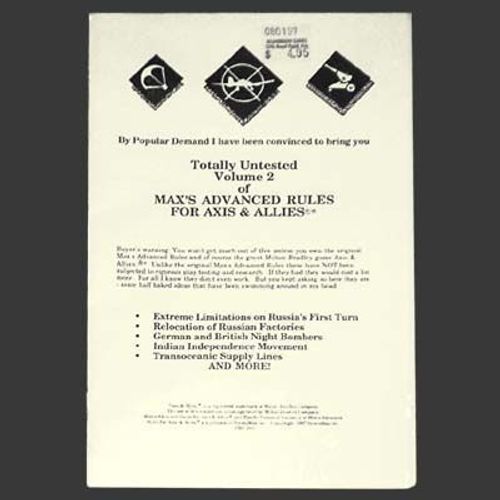
Totally Untested Volume 2 of Max's Advanced Rules for Axis & Allies
Totally Untested Volume 2 of Max's Advanced Rules for Axis & Allies Rulebook
Table of Contents
Table of Contents
- B. Extreme Limitations on Russia's First Turn
- C. German and British Night Bombers
- D. German Night Fighters
- E. Survival of Fighter Pilots Shot Down Over Friendly Territories
- F. Survival of Fighter Pilots Shot Down Over Occupied Sea Zones
- G. Indian Independence Movement
- H. Transoceanic Supply Lines and Limited Attacks
- I. Finland
- J. Artillery Bombardment Attacks
B. Extreme Limitations on Russia's First Turn
Using Max's Advanced Rules can make it tough on the Germans between evenly matched players. (Quite historically accurate but not always a fun game.)
This rule will slow down - maybe even mortally wound - the Russian juggernaut even if you are using the Russo-Japanese Non-Aggression Pact (rule #5 of Max's Advanced Rules).
The Russian player may NOT do any of the following on the first turn:
- Conduct any attacks (nothing new here - refer to the game's manufacturer's own good supplement)
- Purchase any units
- Make any weapons development attempts
- Collect any income (The Russian player still gets the income at the start of the game).
The Russian player may:
- Change the original location of any of the Russian infantry, armor, fighter, and bomber pieces. All, some, or none of them may be moved to any Russian owned territory regardless of the distance between where they start and where they end up. Think of it as a chance for the Russian player to redo the original setup of these pieces to his liking.
B. Relocation of Russian Factories
(Printed under heading B in the source, as a second sub-rule after the first B section.)
Before play begins allow (require?) the Russian player to relocate one or both of the Russian Industrial Complexes to any other Russian color coded territory that did not originally contain one.
As always, once placed the Russian Industrial complexes cannot be moved. This simulates one of the great feats of the war: the relocation of much of Russia's manufacturing machinery and her workers out of harm's way and beyond the immediate range of the German blitzkrieg.
C. German and British Night Bombers
The Germans and the British (no one else) may perform strategic bombing at night. Simply conduct a strategic bombing run in the usual way but declare that it is a night bombing raid. Antiaircraft fire is resolved by rolling two dice against each bomber instead of one. A hit is scored and a bomber shot down for every 2 or 3 rolled with the two dice.
The results of the bombing raid are resolved normally except that 2 is subtracted from rolls of 3, 4, and 5. Rolls of 1, 2, and 6 are not affected. (Hey a lucky shot is a lucky shot and you're bound to hit something even if it is just a wagon load of turnips. Also don't forget to apply the restrictions on damage if you are bombing an alternate target via Max's Advanced Rule #12.)
Night bombers cannot be intercepted by defending fighters (Max's Advanced Rule #13) unless the interceptors are night fighters. Night bombers may not be accompanied by fighter escorts (Max's Advanced Rule #13).
When purchasing bombers it is not necessary to designate any as night bombers. Night bombing is simply another type of mission regular bombers which are built at the regular price may undertake. Just like other missions, bombers that conduct night bombing raids may not be used for additional other tasks during the same turn. Night bombing raids may be conducted using heavy bombers.
D. German Night Fighters
Germany (and only Germany) may produce night fighters to intercept night bombers. Night fighters cost 14 instead of 12 I.P.C.s. The extra cost is considered to be radar equipment for the planes and extra training on its operation for the crews. Night fighters defend against strategic bombing raids exactly like regular interceptors in Max's Advanced Rule #13. Fire from defending night bombers is also resolved in the same way except two dice are rolled for each defending night bomber. A hit is scored for every 2 or 3 rolled.
E. Survival of Fighter Pilots Shot Down Over Friendly Territories
Whenever a friendly fighter is shot down over a territory you occupied at the start or the end of a player turn roll one die to see if the pilot has survived unscathed. On a roll of 1, 2, or 3 the pilot is considered to have survived in good enough health to jump into a new plane and have another go. In these cases the price of any new fighters purchased during your next turn for the lucky flyboys is 8 I.P.C.s rather than 12 I.P.C.s. The reduced price reflects the amount saved by not having to train replacement pilots.
F. Survival of Fighter Pilots Shot Down Over Occupied Sea Zones
Whenever a friendly fighter is shot down over a sea zone you occupied at the start or the end of a player turn roll one die to see if the pilot has survived unscathed. On a roll of 1 or 2 (note the difference) the pilot is considered to have survived in good enough health to jump into a new plane and have another go. In these cases the price of any new fighters purchased during your next turn for the lucky flyboys is 8 I.P.C.s rather than 12 I.P.C.s. The reduced price reflects the amount saved by not having to train replacement pilots.
This rule cannot be used by the Japanese player as Japanese search and rescue was nonexistent. All Japanese fighter pilots shot down over sea zones are presumed lost.
G. Indian Independence Movement
Presume that the Indian independence movement gets an early start and India does not willingly provide the heroic assistance to the Allied cause that actually occurred.
Instead require the British player to garrison India to receive Indian I.P.C.s. To receive the three Indian I.P.C.s the British player must have a total of at least three land combat units (any combination of infantry, artillery, or armor) in India at the end of the British turn. If only two British land combat units remain in India at the end of the British turn then only two I.P.C.s may be collected. If only one British land combat unit remains in India at the end of the British turn then only one I.P.C. may be collected. If no British infantry, artillery or armor units occupy India roll 1 die. On a result of 1, 2, or 3, zero I.P.C.s are collected by the British player. On a roll of 4, 5, or 6, one I.P.C. is collected by the British player.
Should an Axis player occupy India the Axis are faced with the exact same conditions when attempting to collect Indian I.P.C.s.
H. Transoceanic Supply Lines and Limited Attacks
Continue to conduct all amphibious assaults as usual. All non-combat movement continues normally. Also all units everywhere continue to defend as usual. But when one or more sea zones exist between a land unit (infantry, artillery or armor) and one of its country's original industrial complexes and no land route exists then it may not be able to attack. In these cases a land unit may only attack if it is in supply. To be in supply the unit must be adjacent to a sea zone or able to trace an unbroken chain of empty (or partially empty) transport ships occupying each intervening sea zone between its current location and one of its country's original industrial complexes. One chain of a single empty transport ship in each intervening sea zone can supply up to two attacking land units of any type. Additional chains of empty transport ships can supply an additional two units each. This rule continues to apply even if a new industrial complex is built in a territory that is separated by one or more sea zones from one of the owning player's original industrial complexes. Some special notes about this rule:
This rule applies only to land units. If you want to make it really tough (impossible?) on the Allies apply it to fighters and bombers as well. This rule doesn't say a thing about units in territories that can trace a path through land territories to an original industrial complex without crossing a sea zone. Even if one or more of the intervening territories are occupied by enemy units this rule does not apply. Units in this kind of fix are free to attack. (They are in enough trouble already).
This rule does not apply to Japanese units in Asia or the U.S.S.R (heaven forbid you aren't using Max's Advanced Rule #5). In these cases it is assumed the Japanese are harvesting the resources of the region for their own use. It does apply to Japanese units everywhere else.
The British have it easy. Their chain of transports to Europe is only one ship long.
The Germans will have it tough in Africa. (This may make it a bit more historic?) The Allies will have it tough in Europe and Asia. Attacks on the Pacific Islands won't be affected as they are all only one territory in size and will always be attacked using amphibious assaults; which are not affected by this rule. The British can use American transports and the Americans can use British transports as part of their respective supply chains. But be careful as each empty transport may only be used once per game turn (not once for the U.S. and once for the British). It's a lot easier to NOT do this. If you insist, turn the used transports on their sides to indicate they have already been used. Be careful that British transports are not moved by the American player and vice versa. Yes you can count a transport that is transporting a single infantry unit as having supplies for one additional unit. Yes you do get to use improved merchant marine transports (Max's Advanced Rule #15) to perform transport and supply duty simultaneously too. But be careful that you do not move these transports out of the "chain" before combat. Yes, totally empty improved merchant marine transports supply up to three land units for attack.
I. Finland
When using Max's Advanced Rule #18 "Alternate Victory Conditions - A Negotiated Peace" treat Finland differently than the other territories color coded to Germany. Max's Advanced Rule 18 A. 2 should now read as follows:
A. The German player is immediately declared the winner upon: 2. simultaneously controlling all of the territories originally color coded to Germany except Finland and five of the eight territories listed below.
Karelia, Caucasus, Anglo Egypt-Sudan, Persia, Italian East Africa, Gibraltar, Syria-Iraq, Finland
Germany is not required to have Finland to win.
J. Artillery Bombardment Attacks
When using Max's Advanced Rule #8, artillery pieces attack in a special way. Artillery units conduct a one-round artillery bombardment before other land combat is resolved. (Printed as "a on round"; read as "a one-round", the only sensible reading.) Any air to air combat is resolved first. Then an artillery bombardment is conducted by the attacking artillery. Any hits are removed by the defender before the first full round of combat is started. Then the remaining pieces (if any) join the air units and the artillery in the attack and a die is rolled for each attacking and defending piece as usual. Defending artillery defends in the normal way along with all other defending pieces. It does not "shoot back" during the attacking artillery's bombardment.