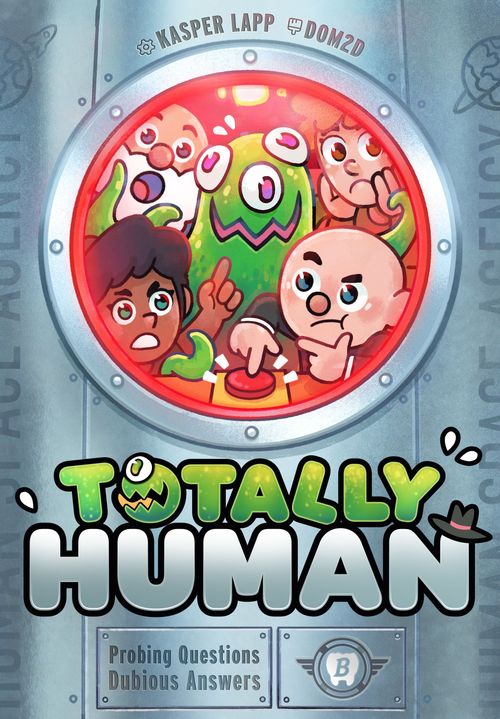
Totally Human
Totally Human Rulebook
Table of Contents
Table of Contents
Overview
Players must answer three multiple-choice questions as "human-like" as possible, but aliens don't understand human culture completely and face restrictions on how they can respond.
The humans' goal is to escape on the biggest alien-free rocket to form a new colony out in the stars.
The aliens' goal is to blend in and sneak onto any rocket with humans for a tasty, post-invasion snack.
Both aliens and humans can achieve their goals on different rockets, but it's also possible that nobody wins. Be careful who you trust!
Components
- 40 identity cards (5 alien)
- 40 answer cards (8 sets of 5 cards)
- 64 question cards
- 35 adjective cards
- 53 noun cards
- 8 character/button cards
- 6 rocket cards
- 32 character standees
Setup
- Each player selects a character and takes the matching button card, answer cards, and character standees.
- Shuffle the identity cards and deal each player three cards, kept secret from others.
- Shuffle the question cards, adjective cards, and noun cards into three separate piles. Note: The adjective cards and noun cards are double sided, so feel free to randomly flip them as you shuffle.
- Lay out the rocket cards in a line above the play area.
Identities
Each player looks at their identity cards. If there are no aliens on your cards, you are a human and can ignore the cards, but you must still keep them in your hand for the whole game.
If there is an alien on one or more of your identity cards, you are an alien. Your identity cards tell you which answers you must choose during the game (though you decide the order).
Note: You have about a 1/3 chance to be an alien and a 2/3 chance to be a human. It is possible to have no aliens in a game!
Example: Pink was dealt the identity cards 4-1-1, and the 4 is an alien card. During the game, Pink must answer either 1-1-4, 1-4-1, or 4-1-1 across the three questions.
Gameplay
Questions Phase
One player draws a question card and reads it out loud, then places it face up on the table. They then draw and flip an adjective card and a noun card, place the cards next to each other (lined up by the colored lines), and read the five answer combinations ("Noisy Goldfish," "Glassy Dog," etc.).
Important: If the symbol (square / circle / triangle) on the noun card isn't displayed on the question card, discard the noun card and draw another.
Select answers
Each player simultaneously selects an answer by playing one of their answer cards facedown. Humans can answer freely, but aliens must pick one of the numbers on their three identity cards.
Reveal and discuss
Once all players are ready, they simultaneously reveal their cards and place one of their character standees next to their answer (to the left of the adjective card). Then, they take back their answer card (so they have all the options again for the next question).
Now, discuss the answers. Humans can explain their reasoning, and aliens can try to justify their choices without giving themselves away.
Repeat
Once everyone is satisfied (or content to simmer in their suspicions), repeat this process for the next question. Leave the answered question on the table.
Note: As questions are answered, aliens will have fewer options. If you can come up with a good reason for a slightly strange answer on the first or second question, it may deflect some suspicion if you have to commit to a weirder answer for the third!
Launch Phase
After three questions have been answered, it is time to decide who to trust — and who to leave in your space dust. Each player places their last character standee on a single rocket card, then the negotiations begin.
Moving around
There are no turns or rounds during this phase. At any time, a player can move their standee to another rocket.
You can move to an empty rocket for free.
You can move to a rocket with other players only if they all agree to let you onboard. (Players can show this by pushing their buttons.)
Communicate as much or as little as you desire. If other players gave suspicious answers, ask them to explain, and try to figure out if they answered freely or were forced to by their cards.
Example: Red suspects that Blue is an alien, so she moves to her own rocket.
Example: Green suspects that Pink is an alien, so she asks to join Red, and Red agrees.
Pink suspects Blue is an alien and asks to join Red and Green. Red agrees but Green refuses, so Pink cannot join and instead goes to her own rocket.
Red decides that she trusts Pink more than Green and asks to join her, and Pink accepts.
What Should You Aim For?
As a human, avoid being on the same rocket as an alien. But also make sure to be on the single largest alien-free rocket.
As an alien, try to be on any rocket with at least one human.
Blast off!
Once all players on a rocket agree to take off, they may launch by pushing their button cards and chanting, "Launch!" Slide the rocket up (into the . . . outer space of your table). Players can no longer leave or enter the rocket, but do not reveal roles yet.
Players alone on a rocket may launch on their own (and must do so if all other players have launched on other rockets).
Resolution Phase
Once all players have launched, it's finally time for the aliens to reveal themselves! Starting with the smallest rocket and proceeding to the largest, all players on the rocket reveal their identity cards and see if they succeed or fail:
Aliens succeed if they share a rocket with at least one human (bon appétit!). Aliens fail if they're alone or only with other aliens.
Humans succeed if they are onboard the single largest alien-free rocket. If they are on a rocket with an alien, they fail (it was a short-lived journey). If they are on an alien-free rocket, but not the single largest, they also fail (there weren't enough humans to successfully start a new colony).
In case of a tie for largest alien-free rocket, none of the humans succeed (they should have cooperated)!
Important: It is possible that some humans and some aliens will succeed in the same game (just never on the same rocket). It is also possible for all players (aliens and humans) to fail. Whoops!
Resolution Examples
The aliens on the left rocket are not onboard with a human, so they fail. The remaining two rockets are alien-free, but only the humans on the largest one succeed. The lone human fails.
The aliens are onboard a rocket with a human, so they succeed. The abducted human fails. The two remaining humans also both fail because none of them are on the single largest alien-free rocket (they should have trusted each other)!