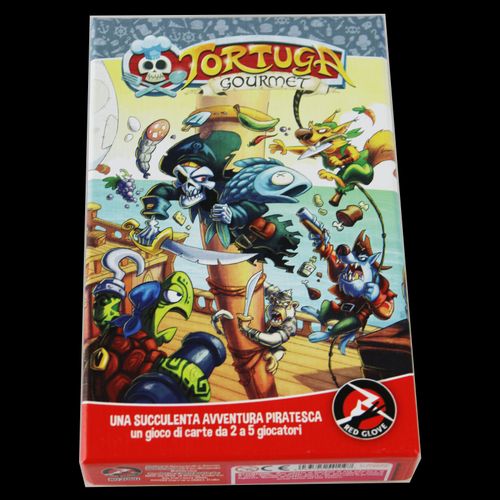
Tortuga Gourmet
Tortuga Gourmet Rulebook
Table of Contents
Table of Contents
Components
- 6 Recipe cards
- 84 Ingredient cards
- 5 Flag cards
- 5 Empty Chest decks (of 3 cards each)
- 5 Pirate tokens (first edition exclusive)
Object of the Game
Each pirate-cook has a precious recipe card, on which two recipes are shown – one made of 3 ingredients and one made of 2 ingredients, worth 6 and 3 points – plus a loophole (Henry Morgan meatballs) worth 2 points, and an inelegant way to get rid of useless ingredients (fish food) worth -1 point. Following this recipe card, you must try to obtain the ingredients needed to cook both the 3-ingredient and the 2-ingredient recipe several times (accumulating sets of three and pairs of the ingredients required by the two recipes).
To obtain the precious ingredients you must sail around the 12 islands (decks of cards) and take the cards whose chest holds the right ingredient. The same cards will help you move from one island to another, using their movement value (from 0 to 5) written on the chest's padlock.
On your voyage you will also accumulate superfluous ingredients; these can be recycled into meatballs by forming sets of three identical ingredients worth 2 points. All cards showing unpaired or useless ingredients at the end of the game become fish food and count -1 point each.
Setup
- Take the deck contained in the box and set aside the 6 recipe cards, the 5 pirate flag cards and the 15 empty chest cards (the latter are easy to recognize because they are the same on both sides).
- Shuffle the remaining cards and form 12 piles of 7 cards each, then arrange them in a circle in the center of the table, back side down, so the card's ingredient is visible (1). These represent the 12 islands.
- Each player chooses a token representing their pirate, takes the flag card of the matching color and an empty chest pile made up of one card of value 1, one of value 2 and one of value 3 (2).
- Randomly deal 1 recipe card to each player. These cards are not secret; you may show them to the other players (3).
- Randomly choose one of the 12 piles to be the starting island, and place all players' pirates next to it on the table (4). The pirate flag card stays visible in front of each player to help remember their color.
You are ready for adventure!
How to Play
The player who cooked most recently starts. The game is played in turns, clockwise.
During the first round, the active player has 3 cards without ingredients with movement values 1, 2 and 3. They choose which of the 3 cards to play and play it, moving their pirate clockwise or counterclockwise (their choice) by exactly the number of islands shown by the movement value on the card, placing it next to the island where it arrives (1).
They discard the played card in front of themselves to form their pantry deck (their own discard pile), then take the top card of that island's pile and add it to their hand.
They then have 3 cards in hand again and are ready to pass play to the player on their left. (Remember: during your turn you always start with 3 cards, play one card and discard it to your pantry deck, draw one card and always end your turn with 3 cards in hand; you may look through your pantry deck at any time.)
During the game, players can draw 5 types of card from the various islands:
- Ingredient card: This type of card (unlike the starting ones) has both a movement value and an ingredient (grog, seaweed, drumstick, fish or fruit). When played, its movement value is used to move your ship as with the starting cards; once discarded to the pantry deck, however, it counts as an ingredient for cooking your recipes.
- Secret Ingredient card: This ingredient is special and can be used in place of any other ingredient to complete recipes. It is used for movement the same way as any ingredient card. If it remains unpaired at the end of the game, it is still worth -1 point.
- Doubloon card: Money is always welcome! Each doubloon card in your pantry deck is worth 1 point at the end of the game.
- Lonely Island card: You have found a precious map showing secret passages to lonely islands! When you play this card you may move your pirate token to an island of your choice where no other pirates are present. It gives no points at the end of the game.
- Crowded Island card: You have found a precious map showing secret passages to crowded islands! When you play this card you may move your pirate to an island of your choice where at least one pirate is present. It gives no points at the end of the game.
End of the Game
In 2- to 3-player games, the game ends when the cards of one of the 12 piles run out. In 4- to 5-player games, the game ends when the cards of two of the 12 piles run out.
The round is still completed: the players who have yet to take their turn at that moment do so, up to (but not including) the first player.
Attention: when an island is completely emptied, it is no longer counted for pirate movement.
Scoring
Each player takes their pantry deck and removes the 3 starting cards (those without ingredients) and any lonely/crowded island cards (these give no points at the end of the game), and adds the 3 remaining cards from their hand.
They divide the ingredients on the cards so as to cook as many 6-point and 3-point recipes as possible (forming sets of three and pairs with the ingredients required by the recipe card). They check whether the remaining ingredients can form sets of three identical cards to cook meatballs (2 points for each set of three cards with the same ingredient), check for doubloon cards and place them next to the others (1 point each), and finally set aside all remaining unpaired cards (fish food), which are worth -1 point each.
Add up the 6-point recipes, the 3-point recipes, the 2-point recipes and any doubloons, and subtract the fish food cards. The player with the most victory points is the winner. In case of a tie, the pirate who completed the most Recipes wins (if still tied, whoever "threw" the fewest Ingredients to the fish).
Example: in this case, the total is 19 points: 12 for the two 6-point recipes (completed thanks to a Secret Ingredient card), 6 for the two 3-point recipes and 2 for the fruit meatballs, for a total of 20 points, from which 1 is subtracted for the Grog thrown to the fish.
Variants
You can add the following rules to increase the game's difficulty.
- Forgetful Pirates: you may not look at the cards in your pantry deck.
- Pressure Test: if you want to increase the length of the game, you may freely decide to increase the number of piles that must run out of cards for the game to end.