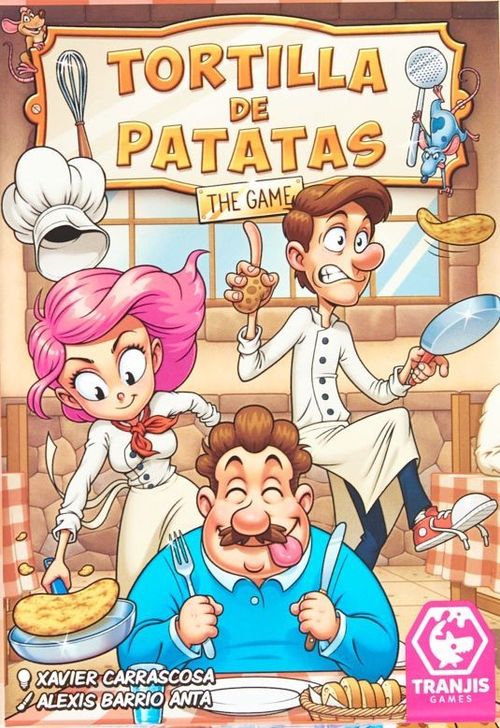
Tortilla de Patatas: The Game
Tortilla de Patatas: The Game Rulebook
Table of Contents
Table of Contents
The Perfect Omelette
As everyone knows, a medium (M) well-made omelette needs these ingredients:
- M: 3/4 potatoes, +2 eggs, +1 onion
A large omelette (XL) can also be made using:
- XL: 5/6 potatoes, +3 eggs, +2 onions
Translator's note: the recipe card prints the potato amount as a fraction ("3/4" for M, "5/6" for XL). It is transcribed exactly as printed; the rulebook does not further explain the fraction.
Some people think the perfect potato omelette should not contain onion. Of course, they don't know what they're talking about.
Components
- 4 recipe cards
- 6 diner cards
- 62 ingredient cards
- 6 chef's pans
Wildcards: These are cards with 2 or 3 ingredients. During the game it is not necessary to state how a wildcard will be used, but at the end of the game each wildcard counts for only 1 of its ingredients, chosen by you.
Basic Game (Juego Básico)
Kids' Menu (Menú Infantil)
For your first games.
Setup
- Give 1 recipe card to each person and place all the diner cards to one side of the table. If there are 2 players, both will be chefs. If there are 4 players, you play in 2 teams. Sit so that each person faces their partner: one will be the chef and the other the kitchen assistant (pinche).
- As chef, you are in charge of 3 pans placed in front of you on the table. You may use only one of them or as many as you like. If you are a kitchen assistant, you will have no pans in front of you: you work in your chef's pans.
- Shuffle the ingredient cards and deal 3 to each person.
- Place the rest of the cards face down in the center of the table, forming a draw pile. This is the fridge.
- Each chef takes 2 cards from the fridge and places them in 2 of their pans. In this way, 2 of their 3 pans start with 1 ingredient each.
Setup example for 4 players (diagram omitted).
How to Play
Naturally, the game is started by whoever has eaten potato omelette most recently. Turns pass clockwise.
On your turn you MUST do the following:
-
Choose an ingredient card from your hand and then either:
- a) Place it in one of your pans, covering the previous ingredient card. Once you have done this, you can no longer look at the ingredients beneath it, so try to memorize the cards you place!
OR
- b) Start a new pile of ingredients with it in another pan. Remember that you do not need to use all the pans.
-
Finally, take a card from the fridge so that you again have 3 ingredient cards in your hand.
IMPORTANT: If you play in a team, you are forbidden to talk to your partner about which ingredients you think are in each pan and which ones you have in your hand.
Serving a Table
At any moment during your turn you may serve a table. Whether you are a chef or a kitchen assistant, when you consider that you have a pan with the number of ingredients indicated by the recipe, you may turn over one omelette (never more than one per turn!).
At that moment, without looking at the ingredients, turn over all the cards in the pan and set them aside, forming a face-down pile. Then take an available diner card (for 1, 2 or 3 diners) and place it on top of that pile.
The number of diners shown on the diner card determines the number of points you will score. The more certain you are that your omelette is perfect, the more diners you should serve it to!
End of the Game
The game ends when the ingredients in the fridge run out, or when every diner card has been served an omelette.
Each chef reveals their finished omelettes and checks whether they are perfect or not, according to the ingredients on the recipe. A perfect omelette is one that has the ingredients listed on the recipe in the correct amounts. This means satisfied diners and therefore positive points. A badly made omelette, however, subtracts points.
- A perfect medium (M) omelette scores as many points as the diner card it was served with. If it is badly made, it subtracts that same amount of points.
- A perfect large (XL) omelette scores double (x2) the points on its diner card. A badly made large omelette also subtracts double.
Scoring
At the end of the game, each chef reveals the omelettes they have served and checks whether they are perfect. They add the points for each perfect omelette and subtract the points for each badly made omelette.
The player with the most points turns their restaurant into the most successful in the city and wins the game!
Scoring example:
- Medium (M) omelette, badly made (missing at least one potato), served to a table of 2 diners: -2 points.
- Large (XL) omelette, badly made (one egg too many and one onion missing), served to a table of 1 diner: -1 point x2 (XL) = -2 points.
- Perfect medium (M) omelette, served to a table of 2 diners: +2 points.
- Perfect large (XL) omelette, served to a table of 3 diners: +3 points x2 (XL) = +6 points.
TOTAL: -2 -2 +2 +6 = 4 points.
Variant 1: Day's Menu (Menú del Día)
Now you can steal ingredients.
Setup
The setup is the same as for the Kids' Menu, but the ingredient cards are dealt differently.
- Deal 5 cards to each chef and 3 to each kitchen assistant, if there are any.
- Place the remaining ingredient cards face down, forming the fridge draw pile.
- Turn over the first card of the draw pile and leave it face up next to the pile. This card is the fridge door.
- Each chef places 2 of their 5 ingredient cards in 2 of their pans.
Setup example (diagram omitted).
How to Play
Play as in the Kids' Menu, with one important difference: now ingredients can be stolen.
If, when you place an ingredient on a pan, it matches the top card of another pan (yours or your opponent's), you must steal the matching ingredient from that other pan and place it on top of yours.
- If your ingredient repeats on a pan belonging to your opponent, steal it and place it on top of your own ingredient.
- If it repeats on another of your own pans, take it from that pan and place it on top of your ingredient.
- If it repeats on one of your own pans and on one of your opponent's, steal your opponent's.
Wildcards do not count for this rule. They cannot steal and cannot be stolen.
Only one ingredient may be stolen per turn.
At the end of your turn, refill your hand to 3 cards. You may:
- Take the top card of the fridge draw pile; or
- Take the card at the fridge door and then replace it by turning over the first card of the draw pile.
End of the Game and Scoring
The game ends in the same way as in the Kids' Menu. The scoring is also the same, but another challenge is added: each omelette that has not been served to a table subtracts 1 point from the team it belongs to.
Variant 2: Gourmet Menu (Menú Gourmet)
For experienced chefs.
Play exactly as in the Day's Menu, but when you turn over an omelette and choose 1 diner card, you may not take just any card. You may only place on your completed omelette:
- If you have 1 pan with ingredients: diner cards with 1 diner.
- If you have 2 pans with ingredients: diner cards with 1 or 2 diners.
- If you have 3 pans with ingredients: any diner card.