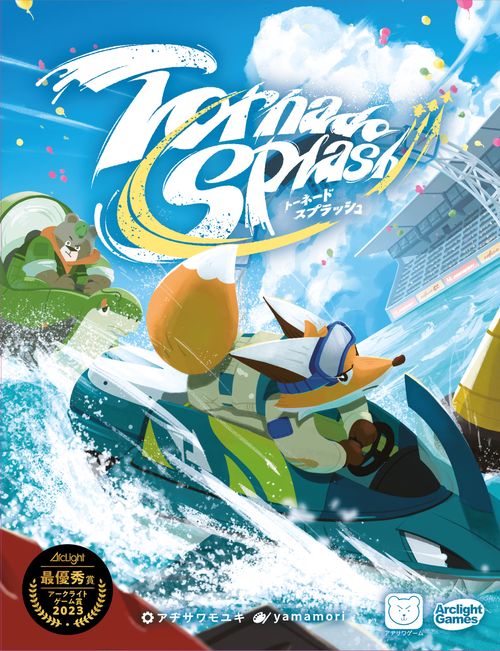
Tornado Splash
Tornado Splash Rulebook
Table of Contents
Table of Contents
Components
- 6 Character Tokens
- 6 Boat Tokens
- 6 Character Cards
- 6 Boat Cards
- 5 Summary Cards
- 4 Course Cards
- 120 Racing Cards (6 colors each with 20 cards)
- 1 Starting Gate (Left and Right)
- 1 Finish Line (Left and Right)
- 3 Curve Markers
- 6 Curve Cards (2 types each with 3 cards — Top and Bottom)
- 2 Course Tools
- 1 Winners Stand
- 1 Rulebook (Part 1)
- 1 Rulebook (Part 2)
How to Use the Start and Goal Gates
Fold along the crease lines as shown in the diagram and join the left and right sides together.
How to Use the Curve Cards and Markers
Curve Cards are placed faceup for left turns and facedown for right turns. Which side should be used is dictated by which course is being played.
- Left Turns (Faceup)
- Right Turn (Facedown)
Curve Cards are placed in a set with a top and bottom version.
Curve markers go on top of both curve cards.
The angle of the curve varies depending on the course.
Setting Up the Game
Creating the Course
When playing for the first time, we recommend using the Tornado Circuit. In this setup, we will create the course using the Tornado Circuit. Take out the Tornado Circuit course card and place it nearby where it can be easily referenced.
- Place the two course tools at the center of the table, touching end to end. If the table is too small, you may fold one or both of the course tools to shorten them.
- Place both the starting gate and finish line under the tool kits, centered with where the two ends meet. Make sure the arrows on both gates point to the right.
- Place the curve cards at either ends of the course kits, as shown on the left.
- Place curve tokens 1 and 2 on top of each curve card.
- Take the Winners Stand and place it somewhere on the table where it won't interfere with gameplay.
- Return the unused course cards, curve cards, and curve tokens to the box.
Player Setup
- Lay the 6 character cards out face up, and place their corresponding character token above each card.
- Similarly, lay out the 6 boat cards face up and place both the corresponding boat tokens and 20 card racing deck by each card.
- Decide who the first player will be via rock-paper-scissors, or any other agreed upon method. Starting with the first player and going clockwise, each player chooses 1 character and 1 boat and places all associated tokens and cards in front of themselves.
- Shuffle the 20 racing cards belonging to the boat you chose to form your racing deck and place it nearby.
- Give each player 1 summary card, and return any leftovers to the box.
Determining Start Position
- Take your selected character token, and push it in sideways to insert it into your selected boat. From this point on, anytime the rules mention your "token" it refers to this combined set of character and boat tokens.
- All players compare the weight of their selected boat, which is indicated on the bottom right of their boat card. Starting with the player with the highest number and going in descending order, each player chooses a space on the starting gate to place their token. Each space can only fit 1 token at a time.
- Once everyone has placed their tokens, the game is ready to begin.
Game Flow
Tornado Splash is played in rounds, with each round made up of a repeating cycle of phases:
Ranking Phase → Draw Phase → Action Phase
- Ranking Phase — Compare the current positioning and, if needed, weight of each player's token to determine the ranking for this round. All players perform simultaneously.
- Draw Phase — Each player refills their hand up to the limit determined by their ranking this round. All players perform simultaneously.
- Action Phase — Players place racing cards in front of their token to determine where they advance this round. Players take turns according to the ranking of the current phase.
Your objective is to play your racing cards in a way that guides your token over the finish line before any other player. The game ends once the final rankings of all players have been determined.
Ranking Phase
Determine which player is currently in 1st, 2nd, 3rd, etc., based on who has advanced the most towards the finish line.
First Round Ranking
At the start of the game, all tokens are placed on the start gate an equal distance away from the finish line. When tokens are at an equal distance from the end, ranking is then decided by who has the lower weight value on their boat card.
Course Details
Courses may contain two different kinds of zones, straight zones and curve zones.
Lines
- Boundary Line — The boundary line is considered to extend beyond the edge of the physical card.
- Finish Line
Tokens are in Different Zones
The player token in the zone closest to the finish line is 1st, with the remainders continuing to be ranked based on distance.
Tokens are in the Same Zone
Compare the distance between player tokens and the next zone boundary line. Players are ranked from the closest to the furthest.
Judging Distance in a Straight Zone: Compare the distances in a straight line from the next zone boundary line and each player token.
Judging Distance in a Curve Zone: Compare the degree of the angle between player tokens and the next zone boundary line. The curve marker serves as the vertex when measuring the degree of the angle.
Judging Line Crossings
If the white lines dictating the boundaries of the space your token is placed on even slightly come in contact with the boundary line, you are considered to have crossed the line.
When Equidistant
While playing the game there are times when there may be two or more player tokens ending the round at equal distances from the next boundary line.
This happens at the start of every race when all tokens are lined up at the starting gate, and in similar cases as well ranking is determined by the weight of the boats going in order of lowest number to highest.
Draw Phase
Each player draws new cards into their hand, up to the hand limit decided by their current ranking at the end of the current round.
The cards drawn from the deck are considered to be your hand.
Hand Size
| Rank | Hand Size |
|---|---|
| 1st | 4 Cards |
| (in between) | 5 Cards |
| Last | 6 Cards |
*Do not draw any cards if you already have a number of cards equal to or exceeding your limit at the end of the round.
Draw Phase Example: A player in 1st Place holding 2 cards draws 2 cards. A player between 1st and last place holding 5 cards draws none. A player in Last Place holding 3 cards draws 3 cards.
When Your Deck is Empty
It will often be the case that you end up playing all the cards from your deck but still need to draw more cards. When this happens, draw cards from the card that is furthest back in the route you have played thus far.
In other words, once your deck runs out you will pick up the first card you played at the start of the game and continue picking up the next card each time you need to draw one.
Action Phase
Starting from the player ranked in 1st place, each player will take a turn to place racing cards so that their token can move up to 3 spaces this round.
Placing Racing Cards
Racing cards should be placed so that the centerline of the card aligns with the centerline of the card your token is currently located. It is also important to make sure your cards are facing the correct direction, which you can confirm by referencing the waves present on the cards.
Racing Card Placement Methods
Method 1: Accelerate — Align the racing cards so that they touch edge to edge. Connect the center line on the cards.
Method 2: Curve — Place the racing cards along the diagonal line to have them at an angle. Align with the diagonal line. As when accelerating, make sure to connect the center lines.
Method 3: Coming Out the Starting Gate — The first card you play in the game should align with the line coming from your space on the starting gate. The center line is connected.
Racing Card Limitation
Racing cards are placed so that your token can move up to 3 spaces during the current round.
In the example shown, there are already 3 spaces the token can move so it's not possible to place any more cards.
Covering Spaces
Some racing cards will have diagonal lines for placement between spaces. When placing another racing card on such a line, it will cover the spaces that appear after. Any spaces that are covered are not counted and should be considered nonexistent.
Avoid Obstacles
If there's an obstacle in your path (e.g., another player's token or a curve token), and you're unable to place a racing card while connecting the center lines, you may slightly shift the placement of the racing card within reason to avoid the obstacle.
At the very least, racing cards absolutely must be touching each other in any given scenario. Placing cards near each other but not touching is not an option.
*You may shift the card left or right as long as it stays within the width of the card.
*Other racing cards, be they your own or other players', and the course tools are not considered to be obstacles.
Overlapping Player Cards
Throughout the course of gameplay, there may be times when the next movement space, diagonal line or card edge are partially covered by another players racing card.
In such cases, as long as the location in question is even partially visible you may place your player token or next racing card in such a way that it aligns with the visible portion.
Likewise, it is also possible that the movement spaces, diagonal lines and edges of your racing cards can end up being completely covered by other player' racing cards.
In these cases, you proceed with gameplay as if the completely covered location in question no longer exists.
*If the white circle on the boat symbol is completely covered, then the movement space itself is considered to be covered.
Ex: If the white circle on what would have been your next movement space is covered, but the diagonal lines or edge of your racing card are still at least partially visible, you would skip the now hidden movement space and place your next racing card according to the rules as usual.
Unavailable Card Placement
If there is ever a time that both the diagonal lines and edge of your racing card are completely covered by other players' cards, place your next racing card in such a way that the center line of that card aligns with your player token.
*Cards placed in this way can go in any direction.
*In a situation as described above, even if there is still an uncovered movement space remaining, consider it as being out of play and play your next racing card directly connecting to your player token.
Out of Bounds
Any player that cannot place their next racing card via any acceptable method and avoid that card hanging even slightly off from the table being used as a play area is considered to have gone out of bounds and is immediately eliminated from the game.
Eliminated players remove their player token from the course and no longer participate in any part of the remainder of the game.
Player Token Movement
After placing your racing cards, move your player token 3 spaces.
Player Token Placement
When taking your final movement for the current Action Phase, your player token must be placed so that every part of it is located behind the preceding white bracket.
You may not end your turn with your player token overlapping or crossing over the white bracket.
Ending the Action Phase
During the Action Phase, your turn ends when you have finished playing racing cards and moving your player token. Gameplay then proceeds to the player in the next ranking.
The Action Phase ends when the last ranked player finishes their turn. If the phase ends and there are still players who have not crossed the finish line, gameplay proceeds to the next round starting again from the Ranking Phase.
Moving Less Than 3 Spaces
On your turn any player can move UP to 3 spaces by default. However, they also have the option to move only 1, 2, or even 0 spaces if they so choose.
In such an instance, players should place as many racing cards as needed to move the desired number of spaces, and no more than that.
Boosting
All players, regardless of which character or boat they selected, can activate a boost ability once per game.
Activating your Boost
On your turn during any Action Phase, you can choose to activate your boost by flipping your character card face down.
*As mentioned, each player can only activate their boost a single time per game, so once a character card is flipped face down it stays that way until the end of the game.
Boosted Movement
On the turn that you activate your boost ability, you can move your player token up to 4 spaces instead of the regular 3.
Crossing the Finish Line
A player is considered to have crossed the finish line when a movement space with their player token on it overlaps or passes the white center line.
*If the white bracket at the front of a movement space is touching the white finish line even slightly, it is considered to have crossed over. Players must also cross within the borders of the finish line, crossing from the outside does not count.
Final Rankings
Once a player crosses the finish line they immediately remove their player token from the course and separate the character token from the boat token.
If they were the 1st, 2nd, or 3rd player to cross the finish line they place their character token on the winners stand according to their final ranking. Boat tokens are returned to the box. If a round ends with only some players making it past the finish line, gameplay continues into the next round onwards with only the remaining players participating until the final rankings of all players have been determined.
Ending the Game
Once the final ranking of all players has been determined, the game ends.
Ex: This means the game can end without the last player crossing the finish line. For example, in a 3 player game, once the 1st and 2nd ranked players have crossed the finish line, the last player automatically is ranked 3rd regardless of their current position on the course.
All players receive a final ranking in the order they cross the finish line. Any players who were eliminated from the game for going out of bounds share last place.
Grand Prix Mode
Players who want to get the most out of playing Tornado Splash should also play the variant grand prix mode.
This mode consists of a series of 3 races, where players will earn points according to their ranking at the end of each race. At the end of the 3rd race, players total up their points with the player with the most points being the winner.
| 1st | 2nd | 3rd | 4th/5th | |
|---|---|---|---|---|
| Points | 5 | 3 | 2 | 0 |
Note: In a 2-player game, 2nd place scores 0 points. In a 3-player game, 3rd place scores 0 points.
Variant Courses
Once players are familiarized with the game and its mechanics, we recommend trying out the other courses also provided.
[During game setup, before building the course]
- Place the 4 course cards faceup on the table.
- All players discuss and choose together a single card to use for this session.
- Reference the "Additional Course Setup" section below and follow the instructions for the selected course.
Additional Course Setup
Splashway
- Place a curve card with the left-turn side facing up as shown in the diagram, and place curve tokens 1 on top of it.
- Place the two course tools as shown in the top left image.
- Place the starting gate and finish line as shown.
- Move the two course tools and position then as shown in the bottom left image.
- Place a curve card with the right-turn side facing up, and place curve tokens 2 on top of it.
- Place the winners stand nearby in a way that does not interfere with gameplay.
- Return any unused curve cards and tokens to the box.
Roundabout River
- Place a curve card with the right-turn side facing up as shown in the diagram, and place curve tokens 1 on top of it.
- Place the two course tools as shown in the leftmost image.
- Place the starting gate and finish line as shown.
- Return the course tools to the box.
- Place the winners stand nearby in a way that does not interfere with gameplay.
- Return any unused curve cards and tokens to the box.
Raindrop Road
- Place a curve card with the left-turn side facing up as shown in the diagram, and place curve tokens 3 on top of it.
- Place the two course tools as shown in the leftmost image.
- Place the starting gate and finish line as shown.
- Move the two course tools and position then as shown in the rightmost image.
- Place two sets of curve cards with the right-turn side facing up as shown, and place curve tokens 1 and 2 on top accordingly.
- Place the winners stand nearby in a way that does not interfere with gameplay.
Original Courses
Want to experience even more Tornado Splash?
Using the curve cards, curve tokens, and course tools you and your friends can experiment to come up with your own unique course.
Take pictures of your personalized creations and share online to show the world!
You can also keep things simple and just add some obstacles to existing courses.
With the tools provided, the only limitation in what you can create is our own imagination!
FAQ
Q: When shifting the placement of a racing card to avoid an obstacle, am I restricted in taking the most inconvenient path?
A: No, as long as the racing card follows the placement rules you may shift it however you see fit.
Q: While placing my racing cards, I realized I'm at risk of going out of bounds. Is it ok if I choose to move less than 3 spaces this round, hoping to draw a card on the next round that will let me stay on the course?
A: Yes, moving 3 spaces is an option, not a requirement. Since this is a racing game, in the majority of cases it is ideal to move the maximum number of spaces possible, but you are free to move only 2, 1 or even 0 spaces on your turn if you so wish. Just remember that you cannot end your turn without your front-most placed racing card having your player token on it.
Q: Are course tools considered obstacles?
A: No, they are not obstacles and you may place cards over them.
Q: Are the folded edges on either side of the finish line considered obstacles?
A: Yes, they are. If the folded edges of either the finish line or start gate are in the way of where you would place a racing card, you may shift the placement according to the usual rules.
Q: What do we do if there is a disagreement on whether two or more player tokens should be ranked equally?
A: Have all players compare the placement of the player tokens in question. If the majority of players agree they are at the same rank, then determine turn order according to boat weight according to the usual rules.
Q: During my turn, can I replace a racing card I've already placed with a different one?
A: Yes, as long as you haven't moved your token yet, you can reposition or replace your movement cards.
Q: Can I place movement cards angled back on themselves (turning more than a right angle from the previous card)?
A: No. You cannot place a movement card that turns more than 90 degrees from the previous card.