Tori Shogi
Tori Shogi Rulebook
Table of Contents
Table of Contents
Components
- Board (7 x 7 squares)
- 32 pieces: swallow 16, crane 4, pheasant 4, quail (left and right) 4, hawk 2, peng 2. The back of the swallow is the goose, and the back of the hawk is the mountain hawk-eagle.
Setup
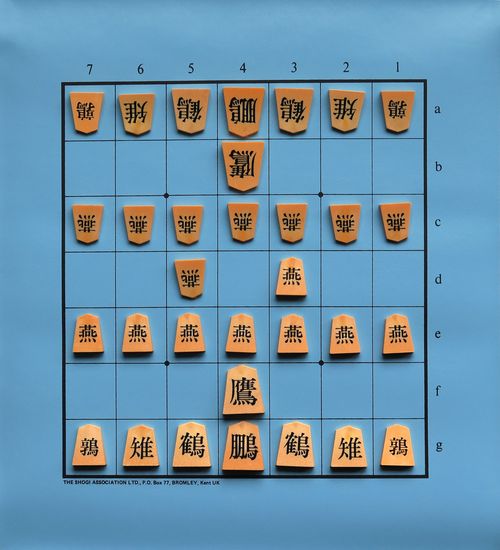
Place the pieces as shown below. The piece in the forward position is your piece, and the piece facing the opposite direction is your opponent's piece. Note the sides of quails.
The printed setup diagram is a 7 x 7 board with all 32 pieces placed and none kept. Read from your opponent's side (top row) to your side (bottom row), the diagram shows:
| Row | Col 1 | Col 2 | Col 3 | Col 4 | Col 5 | Col 6 | Col 7 |
|---|---|---|---|---|---|---|---|
| 1 (opponent's back row) | Quail | Pheasant | Crane | Peng | Crane | Pheasant | Quail |
| 2 | Hawk | ||||||
| 3 | Swallow | Swallow | Swallow | Swallow | Swallow | Swallow |
The diagram marks the promotion zone beside the top two rows, which are the two front rows on your opponent's side. For the opponent, the promotion zone is the two rows nearest you (rows 6-7 of the diagram).
Gameplay
The basic rules are the same as in orthodox Shogi. Players take turns playing either of the below. Passing is not allowed.
- Move one of your pieces according to the piece movement (see the Piece Movement section below). If there is an opponent's piece at the destination of the move, capture it and keep it as your piece.
- Place one of your kept pieces in any empty square.
If the peng is in the capture range of an enemy piece, it is called to be in check. If your peng is in check, you must make a move to avoid the check. If your peng is in a position where it cannot escape from capture, it is called mate or checkmate and you lose the game.
If the same move is repeated three times, the player who initiated the moves must change his or her move.
Piece Promotion
The swallow and the hawk can be promoted to a higher rank. This is done by turning over the piece when it advances to the promotion zone: the front two rows on the opponent's side.
Unlike in the orthodox Shogi, the promotion is compulsory in Tori Shogi and must be done as soon as those pieces enter the promotion zone. Once a piece is promoted, it cannot return to the pre-promoted piece unless it is captured.
- Swallow promotes to Goose.
- Hawk promotes to Mountain Hawk-Eagle.
Prohibited Moves
- You cannot place three of your swallows in the same column (vertical line).
- You cannot place a promoted piece from your kept pieces.
- You cannot place your swallow in the deepest row on the opponent's side from your kept pieces.
- You cannot make your opponent's peng to be in checkmate by placing your swallow from your kept pieces. If you do so, you lose the game immediately (however, check is permitted in the same situation).
Piece Movement
The gameplay rules refer to a separate piece-movement sheet, "Pieces in Tori-Shogi," which is reproduced here.
Swallow (Tsubame, En)
The equivalent of the pawns in the orthodox Shogi. It advances only one step straight forward, and is promoted to Goose when it enters the enemy's territory.
Tips: The swallow is a summer bird in Japan. They fly in from the south in spring, raises its young, and leaves in autumn (although it is a seasonal word for spring). They are familiarly seen nesting under the eaves of houses.
Goose (Kari, Gan) — promoted Swallow
The promotional piece for Swallow. It jumps diagonally forward or straight backward with one square in between. The intervening piece is jumped over.
Tips: Geese fly to Japan in autumn and leave for the north in spring. It has been often used in waka and haiku (traditional Japanese poems) as the seasonal word for autumn.
Hawk (Taka, Ou)
It moves in the direction of 7 adjacent squares except the straight backward. Promoted to Mountain Hawk-Eagle in enemy territory.
Tips: A medium-sized bird of prey representative of Japan. Most of them are resident birds, but it is a seasonal word for winter. In the old days, used for hunting as hawk-hunting (Taka-gari).
Mountain Hawk-Eagle (Kumataka, Syu) — promoted Hawk
The promotional piece for the hawk. It can move straight forward or to the left or right one step, or diagonally backward one or two steps, or diagonally forward or straight backward unrestricted. It cannot jump over other pieces.
Tips: Kumataka literally means "bear-hawk," because it is a relatively large bird among Japanese hawks. It reigns at the top of the forest ecosystem and is called the king of the forest.
Quail (Uzura, Jun)
The only type of piece that moves differently between the left piece and the right piece. The left quail takes one step left backward and moves forward and right backward unrestricted (it cannot jump over other pieces). The right quail does the opposite.
Tips: A small bird found in the autumn fields in Japan, it has been raised for food and appreciation since ancient times. Its eggs, in particular, are familiar as a food source.
Pheasant (Kiji, Chi)
It takes one step diagonally backward or jumps over one square straight forward. The intervening piece is jumped over.
Tips: A resident bird of Japan found in the mountains and fields and is a seasonal word for autumn. It is a familiar bird in Japan because of its appearance in the folk tale "Momo-taro."
Crane (Tsuru, Kaku)
Moves to any of the six adjacent squares except left and right.
Tips: The large bird flies to Japan in the autumn and spends the winter near the water. In Japan, it is well known in the folk tale "The Crane's Return" and as a traditional subject for paintings. A seasonal word for winter.
Peng (Hou, Otori)
The piece equivalent to the king in the orthodox Shogi, moves to adjacent squares in eight directions. If your Peng cannot escape capture from the opponent, it means checkmate and you loses the game.
Tips: The peng is a gigantic bird from Chinese myth. Its exact appearance is not known, so it is represented here as a silhouette with a large wing. It is best known for being used in the names of the Sumo Champions Taihou and Hakuhou.